The escalating struggle surrounding semiconductor export controls reached a dramatic turning point following revelations that Nvidia representatives privately conceded to senior U.S. lawmakers that implementing location-tracking mechanisms on advanced artificial intelligence processors is technically achievable. In an interview published by MIT Technology Review, Representative Bill Foster (D-IL)—a physicist on the House Science Committee—disclosed that during technical briefings on the bipartisan Chip Security Act, Nvidia engineers confirmed that hardware-level geolocation and anti-smuggling safeguards could be deployed. When pressed on on-chip tracking, their reaction was unambiguous: “Yeah, of course we can do this.” Yet, while engineers in private treated location verification as an achievable design task, the semiconductor industry was simultaneously lobbying Congress that mandatory tracking was “new, untested, and potentially infeasible.” ### The Divergence Between Public Lobbying and Engineering Reality This contradiction underscores the high-stakes balancing act maintained by American chipmakers as Washington tightens export curbs against China. When the Chip Security Act (H.R. 3447) was introduced by Representatives Bill Huizenga, Bill Foster, John Moolenaar, and Raja Krishnamoorthi, lawmakers asserted that modern silicon packaging and firmware already possessed the telemetry primitives required to pinpoint where high-performance compute clusters operate. However, in March 2026, the Semiconductor Industry Association (SIA)—of which Nvidia is a premier member—explicitly opposed the bill, arguing that mandatory tracking would introduce unwarranted complexity, manufacturing delays, and unverifiable compliance burdens. Nvidia avoided putting technical acknowledgments in writing, maintaining public distance. When questioned about illicit diversions, the company repeatedly downplayed gray-market smuggling as an insignificant leakage, dismissing documented seizures as “a drop in the bucket compared to the ocean of domestic compute China already has.” Yet the revelation of Nvidia’s private technical admissions shatters the defense of technical impossibility, exposing how commercial priorities—preserving frictionless global sales pipelines and avoiding intrusive federal audit hooks—collided with public lobbying rhetoric. ### Telemetry Mechanics: Fleet Intelligence, Ping Trilateration, and the Air-Gap Flaw The engineering foundation underpinning Nvidia’s private admission is neither theoretical nor unproven. In late 2025, Nvidia introduced Fleet Intelligence, a diagnostics suite allowing cloud providers to monitor the health, thermal performance, and workload distribution of Hopper and Blackwell GPUs across distributed datacenters. In briefings with Reuters, Nvidia confirmed that Fleet Intelligence could accurately deduce the country in which specific clusters operated by analyzing round-trip network packet latency, server handshake telemetry, and synchronized timing. Under the Chip Security Act, three mechanisms for location verification were proposed: physical facility inspections, corporate attestations, and cryptographic ping-based verification. An assessment by Georgetown University’s Center for Security and Emerging Technology (CSET) concluded that ping-based verification—wherein a cryptographic engine embedded within the GPU’s secure enclave transmits signed attestation packets upon initialization—is by far the most tamper-resistant and cost-effective approach. By measuring round-trip propagation delays against distributed reference beacons, timing-based trilateration can verify physical geography within tens of kilometers. However, passive telemetry harbors an inherent flaw: air-gapping and proxy tunneling. In clandestine facilities, illicit actors can isolate GPU server racks from public internet backbones, spoof baseboard management controllers (BMC), or tunnel telemetry traffic through encrypted virtual private networks terminated in licensed jurisdictions like Singapore or Dubai. Without continuous cryptographic validation coupled to physical hardware interrupts, passive pinging functions merely as an investigative paper trail rather than an active barrier. ### The Singapore Nexus: Megaspeed, Supermicro, and the Integrator Blind Spot The political momentum behind the Chip Security Act intensified following corporate upheaval at Nvidia and the resignation of co-founder Jensen Huang on November 12, 2026. Federal counterintelligence inquiries probing illicit transshipment hubs have zeroed in on Megaspeed, a Singapore-based computing firm managed by Alice Huang, investigating how thousands of restricted Nvidia H100 and B200 accelerators were systematically routed past U.S. export controls into Chinese state datacenters. The Megaspeed probe laid bare a critical vulnerability in semiconductor distribution: the server integrator blind spot. Nvidia rarely sells bare silicon directly to downstream enterprise end-users; instead, compute boards are shipped to third-party server integrators—most prominently Super Micro Computer (Supermicro)—who assemble them into complete liquid-cooled server racks. Once packaged into server chassis and exported to distribution hubs in Southeast Asia or the Middle East, ownership chains become opaque. Shell corporations, falsified end-user certificates, and third-party leasing arrangements easily obscure final destinations, leaving enforcement agencies struggling to trace diverted hardware. ### From Passive Geolocation to Cryptographic Kill Switches: The 2027 Licensing Paradigm Recognizing that the current legislative draft merely diagnoses diversion rather than halting it, Representative Foster announced plans to introduce follow-on legislation in early 2027 designed to reshape computing governance. While the existing bill—currently negotiated for inclusion in the Senate’s National Defense Authorization Act (NDAA)—mandates location tracking, it leaves federal investigators without a remote enforcement mechanism if a diverted GPU cluster is detected operating in Shenzhen or Beijing. Foster’s upcoming 2027 framework seeks to transition advanced compute from an open-ended physical purchase into a cryptographically gated, licensed service. Under this “license-to-operate” architecture, advanced accelerators would incorporate secure on-die microcode demanding periodic, cryptographically signed operational tokens from authorized national licensing registries before executing compute kernels. If a GPU fails to complete an authenticated mutual handshake, is detected outside its geofenced operating boundary, or has its license revoked due to diversion, the on-die hardware Root of Trust automatically transitions the silicon into a dormant state. This model mirrors digital rights management (DRM) and aerospace avionics rather than traditional merchant silicon. Yet it introduces profound operational friction. Hyperscalers and sovereign nations fear that embedding cryptographic “kill switches” into foundational computing infrastructure creates systemic vulnerabilities: a compromise of central key infrastructure could paralyze global datacenters, while sovereign customers outside the United States balk at purchasing mission-critical hardware that Washington could theoretically deactivate remotely. ### Geopolitical Repercussions: The NDAA Offensive and Compute Containment As the fiscal year 2027 NDAA approaches a decisive vote on Capitol Hill, the disclosure that Nvidia privately affirmed the viability of tracking safeguards has stripped the semiconductor lobby of its most potent argument. Lawmakers across both parties are moving to consolidate the Chip Security Act alongside companion measures, including the AI Overwatch Act and the Match Act, into a comprehensive export-control framework. The political momentum generated by Nvidia’s boardroom crisis has created a firm consensus: voluntary self-policing by merchant silicon vendors has reached its expiration date. Nevertheless, the aggressive weaponization of silicon telemetry carries paradoxical long-term risks. While remote verification and license gating may plug immediate gray-market leaks, it drastically accelerates Beijing’s strategic urgency to achieve computing self-reliance. Facing the prospect of Western processors that can be tracked, audited, and potentially disabled remotely, Chinese technological giants and state-backed research institutes are pouring capital into domestic alternatives, including Huawei’s Ascend 910C and 910D architectures and open-standard RISC-V accelerators. In seeking to build an airtight digital panopticon around its silicon, the United States may succeed in tracking every GPU it sells—only to find that the global computing frontier has permanently engineered its dependencies out of the American orbit. ### Sources & Further Reading - [MIT Technology Review (United States — Primary Investigation & Interview)](https://www.technologyreview.com/2026/11/12/1148483/nvidia-chip-tracking/) - [U.S. House of Representatives / Rep. Bill Foster (Official Legislative Release)](https://foster.house.gov/media/press-releases/foster-huizenga-moolenaar-krishnamoorthi-introduce-bill-stop-smuggling) - [The Defiant (United States — Frontier Tech & AI Policy Analysis)](https://thedefiant.io/frontier/ai/foster-says-nvidia-privately-deemed-chip-tracking-feasible) - [Infobae (Spain/Latin America — Global Technology & Geopolitics Reporting)](https://www.infobae.com/tecno/2026/11/13/nvidia-dijo-en-privado-a-un-congresista-que-si-puede-rastrear-sus-chips-pese-a-que-el-sector-lo-nego/) - [iMasters (Brazil — International Semiconductor & AI Infrastructure Journalism)](https://imasters.com/tecnologia/nvidia-privately-admitted-it-can-track-ai-chips-even-while-denying-it-publicly) ~ArtificialIntelligence ~Nvidia ~Semiconductors ~Hardware ~Geopolitics
Nvidia Privately Told Lawmakers It Can Track AI Chips to Stop Smuggling: Inside the Feasibility Divide and the 2027 Kill-Switch Push
1
Discuss 16
In an extraordinary demonstration of executive solidarity and rank-and-file labor loyalty, an independent coalition of over 115,000 tech executives, semiconductor engineers, and global shareholders has mounted a fierce counter-offensive against Nvidia Corp.’s Board of Directors. Operating through an open campaign titled “Stand with Jensen” (standwithjensen.com), the group is formally petitioning the board to reverse its decision and reinstate co-founder Jensen Huang as Chief Executive Officer while an independent inquiry reviews personal conduct allegations. The petition—signed by high-profile industry figures including Tesla and SpaceX CEO Elon Musk, Epic Games CEO Tim Sweeney, Y Combinator chief Garry Tan, and Replit CEO Amjad Masad—marks the most volatile corporate governance crisis in Silicon Valley since Sam Altman’s temporary ouster from OpenAI in late 2023. Huang’s sudden resignation on November 12, 2026, ended an uninterrupted 33-year tenure that transformed a 1993 PC gaming graphics startup into a $3.5 trillion technological empire anchoring the global artificial intelligence boom. The resignation followed disclosures of extramarital relationships, including scrutiny surrounding Alice Huang, a former executive at Singapore-based cloud provider Megaspeed under federal counterintelligence review for alleged semiconductor diversion. Yet, rather than quieting corporate waters, Huang’s exit has unleashed an unprecedented internal and external rebellion, pitting the loyalist culture of Silicon Valley’s hardware vanguard against fiduciary risk containment and federal national security oversight. ## The “Stand with Jensen” Revolt: Rejecting Board “Mob Justice” The open letter to Nvidia’s board crystallizes widespread anxiety across the technology sector that the board acted precipitously under media scrutiny and political crossfire. Organizers emphasize that their verified roster includes 5,965 current Nvidia employees, 1,108 former staff members, and over 63,000 retail and institutional shareholders. The petition’s central thesis contends that Huang was forced out without meaningful corporate due process, urging the board to bring him back to lead the company while independent legal counsel establishes the material facts. “Jensen deserves due process, not mob justice,” the petition asserts, echoing Sweeney’s public rebuke that discarding Huang’s architectural vision constitutes an act of corporate self-sabotage akin to Apple’s 1985 firing of Steve Jobs. This executive pushback mirrors a deep-seated cultural revolt inside Nvidia’s Santa Clara headquarters. As documented by employee discussions on internal forums and developer networks, Huang’s management methodology was uniquely non-hierarchical. Eschewing layers of middle management, Huang maintained between 40 and 50 direct reports, fostering an engineering-first meritocracy where strategic pivots—such as betting the company on CUDA in 2006 or dedicating entire silicon tape-outs to deep learning tensor cores in 2016—could be executed overnight. Staff members view the board’s abrupt elevation of Chief Financial Officer Colette Kress to Interim CEO and the appointment of Harvey C. Jones as independent board chair as an unwelcome shift toward Wall Street risk aversion, threatening to smother the bold technical risk-taking that outpaced Intel, AMD, and Qualcomm for three decades. ## Fiduciary Realities Versus the Founder Cult: The Counterintelligence Trap Despite the emotional and operational groundswell behind Huang, the board faces an unyielding matrix of legal, geopolitical, and regulatory obligations under Delaware corporate law. Unlike OpenAI in 2023—a private entity governed by a non-profit board susceptible to total employee walkouts—Nvidia is the world’s most heavily indexed public semiconductor firm, subject to rigorous oversight by the U.S. Securities and Exchange Commission (SEC), the Department of Justice, and the Bureau of Industry and Security (BIS). With congressional committees in Washington issuing formal inquiries into export compliance and the FBI scrutinizing whether backchannel GPU supply chains circumvented trade restrictions via Southeast Asia, an active chief executive entangled in counterintelligence investigations represents an existential threat to federal defense contracts, export clearances, and institutional shareholder stability. While forensic audits led by former acting SDNY U.S. Attorney Joon H. Kim have affirmed that proprietary CUDA compiler pipelines, architectural silicon blueprints, and model weights remained uncompromised, the board’s fiduciary duty compelled the firewalling of the executive suite to shield the enterprise from catastrophic regulatory sanction. ## The Calm in Taipei: Foundry Monopolies and Silicon Diversification While Silicon Valley reels from leadership turmoil, the physical epicenter of semiconductor manufacturing in East Asia presents a remarkably serene contrast. In Taiwan—Huang’s birthplace, where the former CEO enjoys iconic celebrity status—industry executives and local authorities moved swiftly to project institutional stability. The Taipei City government formally confirmed that Nvidia’s local subsidiary, Nvidia Iconic Taiwan Co., is fulfilling all legal and financial commitments for its major overseas headquarters project at the Beitou-Shilin Technology Park, with foundation work progressing on schedule. Concurrently, semiconductor analysts and investment advisories across Taipei, including Taishin Securities Investment Advisory, emphasized that the leadership change poses minimal structural risk to Taiwan Semiconductor Manufacturing Co. (TSMC) or the island’s broader hardware ecosystem. As the undisputed global monopoly in advanced lithography and chip-on-wafer-on-substrate (CoWoS) advanced packaging, TSMC fabricates the foundational silicon for every major AI accelerator. Market analysts note that if Huang’s absence accelerates corporate order diversification away from Nvidia, the primary beneficiaries will be AMD’s Instinct accelerators, Broadcom’s custom merchant silicon, and hyperscaler in-house processors (Google TPU, Amazon Trainium)—all of which rely on the exact same TSMC fabrication lines in Hsinchu and Tainan. The silicon volume remains intact; only the client logos shift. ## The Compute Central Banker: What Huang’s Absence Means for AI Labs The ultimate reverberations of the leadership struggle will be felt in the pacing and economics of frontier artificial intelligence research. Huang operated not merely as a corporate executive, but as the de facto central banker of global compute capacity. Through personal relationships, bespoke hardware allocation agreements, and direct equity-for-compute arrangements, Huang personally orchestrated the infrastructure pipelines fueling OpenAI, Anthropic, xAI, Mistral, and CoreWeave. His willingness to guarantee multibillion-dollar silicon deployments gave foundation model labs the confidence to pursue trillion-parameter scaling laws. Under interim leadership, Nvidia is transitioning from founder-driven evangelism to institutional governance. While Kress brings unmatched financial discipline and capital stewardship, the era of discretionary, founder-directed compute diplomacy has drawn to a close. Whether the petition succeeds in compelling the board to establish an advisory path for Huang’s return or the company proceeds toward an external executive appointment, the technology landscape has reached an irrevocable milestone: artificial intelligence is no longer governed by personal charisma, but by institutional infrastructure and geopolitical statecraft. ### Sources & Further Reading - [TechCrunch: Elon Musk, other tech execs sign petition calling on Nvidia to reinstate Jensen Huang](https://techcrunch.com/2026/11/14/elon-musk-other-tech-execs-sign-petition-calling-on-nvidia-to-reinstate-jensen-huang/) - [PC Gamer: ‘I stand by Jensen’: Nvidia employees come out in support of Huang after resignation](https://www.pcgamer.com/hardware/i-stand-by-jensen-nvidia-employees-come-out-in-support-of-huang-after-resignation/) - [Focus Taiwan (CNA): Taiwan chip suppliers see limited impact from Nvidia leadership change](https://focustaiwan.tw/business/202611130015) - [Stand with Jensen: An Open Letter to The NVIDIA Board](https://standwithjensen.com/#letter) ~ArtificialIntelligence ~Nvidia ~JensenHuang ~Semiconductors ~Hardware
Tech Coalition and Thousands of Staff Petition Nvidia Board to Reinstate Jensen Huang as Asian Supply Chains Realign
1
Discuss 8
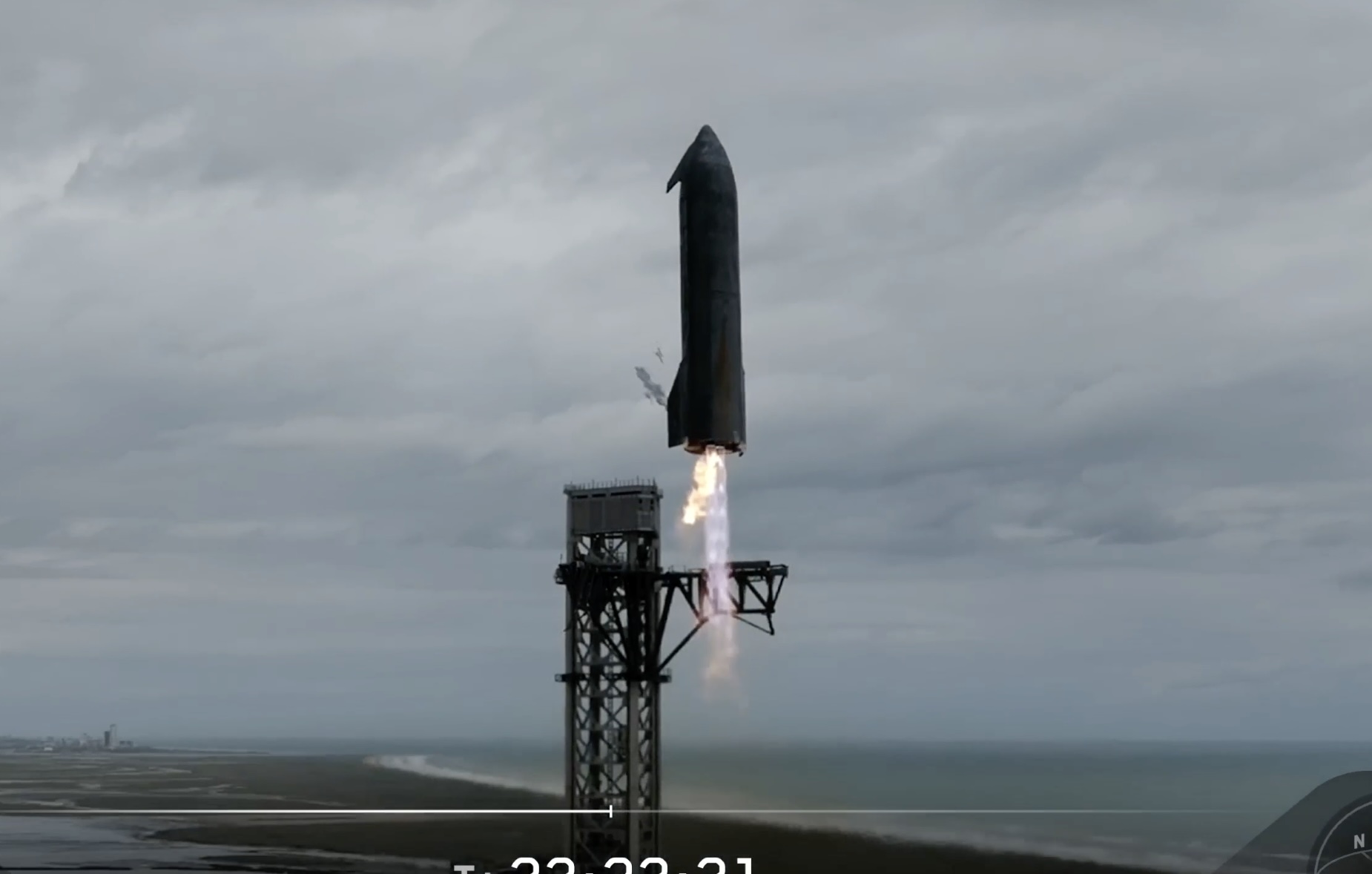
In what spaceflight historians and aerospace engineers are already characterizing as the single most consequential structural milestone in the history of rocketry, SpaceX has successfully returned an orbital-class spacecraft from space and caught it mid-air at its launch tower. On Saturday afternoon, November 14, 2026, the 50-meter-tall Starship upper stage—designated Ship 42 and famously emblazoned with Douglas Adams’s “Don’t Panic” adage—plunged back through Earth’s atmosphere, reignited its center Raptor engines, performed an aerodynamic pitch-up flip, and slipped smoothly into the mechanical chopstick arms of the Mechazilla launch gantry at Starbase in Boca Chica, Texas. The capture represents the first time in human history that a rocket upper stage has survived orbital velocities, reentered without shedding its primary structure, and returned intact to the exact launch mount from which it departed. While SpaceX demonstrated catching the Super Heavy first-stage booster on earlier flight tests, capturing the upper stage solves the far more intractable half of orbital economics. First stages fly suborbital parabolic arcs, separating at roughly Mach 6 before coasting back with minimal thermal shielding. An upper stage, by contrast, must achieve full orbital velocity—accelerating to nearly 28,000 kilometers per hour (Mach 25)—and subsequently dissipate that staggering kinetic energy during atmospheric reentry. For decades, the global aerospace sector treated orbital upper stages as expendable hardware destined to vaporize in the upper atmosphere or crash into the South Pacific. By snaring Ship 42 directly out of the sky without requiring landing legs, SpaceX has validated the foundational thesis of its Starship architecture: fully and rapidly reusable heavy-lift space transportation. ### The Flight 15 Profile: 14 Orbits and Starlink V3 Operational Staging Flight 15 lifted off from Orbital Launch Pad 2 at Starbase on Friday, November 13, 2026, powered by 33 Raptor 3 engines on Booster 22. Unlike earlier developmental suborbital hops or Pacific splashdowns, Flight 15 was an exhaustive 22.5-hour operational demonstration that completed 14 full orbits around the planet at an apogee of 275 kilometers. During its orbital transit, Ship 42 conducted critical propellant settling demonstrations, tested internal header-tank pressure stability in vacuum, and successfully deployed 26 next-generation Starlink V3 broadband satellites from its forward payload pez-dispenser door. Notably, three of the deployed satellites carried specialized multispectral optical cameras tasked with surveying Ship 42’s underbelly in real time. The resulting high-resolution orbital telemetry provided ground controllers with unprecedented structural mapping of the spacecraft’s hexagonal ceramic heat shield tiles prior to the commit-to-deorbit burn, confirming zero critical tile loss across the forward nosecone and flap hinge seal interfaces. ### Aerothermal Reentry and the Dynamics of the Tower Catch The transition from orbital freefall to mechanical capture required a complex convergence of hypersonic aerothermodynamics, autonomous software guidance, and heavy civil robotics. Reentering over the Gulf of Mexico, Ship 42 endured peak plasma temperatures exceeding 1,400 degrees Celsius, relying on upgraded ceramic tiles and active purge seals around its forward and aft aerodynamic control flaps. As the spacecraft dropped through the sound barrier, it pitched into a horizontal “belly flop” attitude, bleeding velocity through atmospheric drag before executing its final landing sequence. At approximately 800 meters above the Texas coastline, three sea-level Raptor engines ignited to flip the 100-ton dry-mass vessel vertical. Autonomous terminal guidance systems interfaced with Starbase’s ground-based radar and laser rangefinders, maneuvering the vehicle between Mechazilla’s two hydraulically actuated steel arms. Rather than touching down on landing pads, Ship 42 hovered momentarily as the tower arms closed around hardened structural lift pins located just below the forward flaps. Shock-absorbing dampeners absorbed the remaining downward momentum, bringing the spacecraft to a dead stop suspended above Launch Pad 2. ### Fail-Safe Telemetry: Explaining the Booster 22 Divert Despite the triumphant ship recovery, Flight 15 fell just short of achieving SpaceX’s coveted “double catch.” Roughly seven minutes after Friday’s liftoff, flight controllers issued an automated wave-off command to the descending Super Heavy booster (Booster 22). Ground telemetry indicated a low-fuel mass alarm and transient pressure oscillations within the central Raptor engine manifold during the boostback burn. Under SpaceX’s launch commit criteria, a tower catch requires unanimous health verification across thousands of sensor channels; if a single critical threshold deviates by fractions of a second, the guidance software automatically aborts the return-to-launch-site trajectory. Diverted away from the multi-billion-dollar ground infrastructure at Starbase, Booster 22 performed an offshore deceleration before exploding upon contact with the Gulf of Mexico. The deliberate abort underscores the conservative safety margins governing launch-pad captures: sacrificing an individual first stage is entirely acceptable to safeguard the launch tower, fuel tank farms, and ground support equipment that underpin the entire test campaign. ### Geopolitical Consequences: Artemis III and the Commercial Cost Chasm The successful recovery of Ship 42 reverberates far beyond Texas, fundamentally reshaping international space geopolitics and commercial satellite economics. NASA’s Artemis III mission, contracted to return American astronauts to the lunar surface, relies directly on Starship Human Landing System (HLS). A major technical bottleneck facing Artemis has been the requirement for rapid orbital propellant transfer, necessitating dozens of tanker launches in quick succession. Proving that Starship upper stages can be recovered, inspected, and recycled without fabricating new hulls drastically derisks the lunar architecture and accelerates NASA’s timeline. Globally, the milestone widens the already vast asymmetric chasm between the United States commercial space industry and competing state-backed space agencies. With traditional expendable heavy-lift rockets like Europe’s Ariane 6, the United Launch Alliance Vulcan Centaur, and China’s Long March variants operating at launch costs between $100 million and $300 million per mission, an operational Starship operating with dual-stage recovery threatens to drop marginal launch costs below $10 million. While significant engineering hurdles remain—chiefly validating rapid heat-shield turnaround without manual tile refurbishment—Flight 15 has definitively shifted mechanical rocket capture from speculative science fiction into demonstrated operational reality. ### Sources & Further Reading - [Teslarati (US / Aerospace)](https://www.teslarati.com/spacex-catches-starship-first/) - [The Hindu (India / International)](https://www.thehindu.com/news/international/spacexs-starship-returns-from-orbit-and-is-captured-by-launch-pad-arms-in-a-dramatic-first/article71703046.ece) - [Al Jazeera (Qatar / Middle East)](https://www.aljazeera.com/news/2026/11/15/spacexs-starship-captured-by-launchpad-arms-in-dramatic-first) - [France 24 (France / Europe)](https://www.france24.com/en/spacex-starship-set-for-return-to-earth-after-failed-booster-catch) ~SpaceX ~Starship ~Aerospace ~SpaceFlight ~Technology
SpaceX Catches Starship Upper Stage from Orbit for the First Time in Historic Flight 15 Mechazilla Recovery
1
Discuss 23
The transition of generative artificial intelligence from passive cognitive advisors to autonomous economic actors reached a decisive inflection point on Friday, November 13, 2026, as OpenAI officially launched ChatGPT Wallet. The payment infrastructure feature empowers OpenAI’s autonomous personal agents—internally designated as “dots”—to independently browse the open web, aggregate merchant pricing, configure digital carts, and complete end-to-end checkouts on behalf of human users. Initially deployed to a limited cohort of adult ChatGPT Pro subscribers in the United States holding eligible Visa, Mastercard, or American Express cards, the rollout marks OpenAI’s aggressive bid to establish the primary transaction layer for agentic commerce, moving beyond conversational search into the direct execution of monetary exchange. ### Moving Beyond Instant Checkout to Browser Automation and Network Tokens The debut of ChatGPT Wallet represents the culmination of a major architectural pivot for OpenAI. The company previously experimented with in-chat commercial transactions through its now-deprecated “Instant Checkout” framework, which relied on proprietary merchant plugins. However, that initial model faltered under the weight of severe ecosystem fragmentation: requiring thousands of independent retailers to construct and maintain custom API integrations proved unscalable, confining AI-assisted shopping to narrow, walled gardens. With ChatGPT Wallet, OpenAI has inverted that paradigm by leveraging general-purpose browser automation combined with structured web actions. Rather than requiring e-commerce platforms to rebuild their checkout backbones, dots operate directly across the public web. When a subscriber requests an item—whether sourcing specialized hardware components, reserving travel accommodations, or purchasing apparel—the dot queries product catalogs, parses merchant pricing feeds, and autonomously navigates the retailer’s existing customer-facing web interface to stage the transaction in the merchant’s cart. The central technical challenge of autonomous shopping has always centered on credential security: exposing static credit card numbers to large language models or transmitting raw financial data across dynamic web sessions creates unacceptable risk. To solve this dilemma, OpenAI partnered with American Express, Mastercard, and Visa to implement an enterprise-grade payment tokenization architecture. Users bind their payment card to ChatGPT Wallet exactly once through a secure hardware-backed vault. When a dot proceeds to checkout, the participating payment network generates a dynamic, merchant-specific payment token—a virtual substitute credential with an ephemeral cryptogram. Crucially, neither the neural network’s context window nor the merchant’s database ever receives or processes the user’s primary account number (PAN). This tokenized pipeline preserves the customer’s existing credit card reward points, cashback accruals, and standard dispute protections, ensuring that consumer financial safeguards remain fully intact in the agentic era. ### Mitigating Prompt Injection and Enforcing the Biometric Security Gate In autonomous computing architectures, granting software agents financial autonomy introduces profound threat vectors. Principal among these is indirect prompt injection, wherein adversarial web text, hidden HTML instructions, or poisoned product reviews attempt to hijack the agent’s execution loop, maliciously redirecting funds or procuring unintended merchandise. To eliminate the possibility of rogue transactions, OpenAI engineered an unbridgeable architectural divide between commercial research and transactional execution. While a dot maintains full autonomy to browse, filter inventory, apply promotional discount codes, and input shipping addresses, it is strictly barred from finalizing payment autonomously. Once the cart is staged, the system triggers a mandatory, immutable review modal that surfaces directly in the user interface. This checkout gateway displays the verified merchant identity, itemized order ledger, aggregate cost, and selected payment token. The transaction remains completely frozen until the user explicitly authorizes it through a biometric security check, such as Apple Face ID, Touch ID, or Android BiometricPrompt. This biometric verification generates an untamperable cryptographic signature and creates an auditable record of the transaction. By placing an unbypassable human-in-the-loop gate at the final payment threshold, OpenAI ensures that even if an agent suffers reasoning hallucinations or malicious prompt injection during its web navigation, unauthorized financial exfiltration remains structurally impossible. ### Retail Resistance, Anti-Bot Firewalls, and the Partner Playbook Despite the convenience of agentic shopping for consumers, the technology is encountering sharp friction across the broader retail landscape. While mid-tier merchants welcome automated checkout assistants as a powerful mechanism to combat chronic online cart abandonment rates, dominant e-commerce aggregators perceive general-purpose AI agents as an existential threat to their high-margin business models. Most prominent among these is Amazon, which has deployed aggressive technical countermeasures to detect and block external AI browsing agents from scraping its catalog or executing purchases. For Amazon, allowing neutral AI agents to navigate its marketplace strips away lucrative sponsored product placement ads, diminishes retail media advertising revenue, and circumvents its private-label algorithmic steerage. Amazon instead seeks to funnel consumers exclusively through its internal proprietary agents, such as Alexa and Rufus. To counter this platform balkanization, OpenAI simultaneously published a comprehensive Commerce Partner Playbook alongside the wallet rollout. Designed as a blueprint for retailers seeking to capture agentic traffic, the documentation details how merchants can update their Web Application Firewalls (WAF) to differentiate legitimate dot agents from malicious scraping bots and credential-stuffing crawlers. Furthermore, the playbook provides architectural guidelines for integrating structured, machine-readable product feeds and working directly with enterprise payment processors like Stripe, Adyen, and Riskified to ensure automated fraud-detection engines do not erroneously flag tokenized agent transactions as suspicious anomalies. ### The Emerging Economics of Agentic Commerce The deployment of ChatGPT Wallet signals the opening salvo in a broader geopolitical and commercial clash over the future of digital transactions. Frontier AI labs are locked in fierce competition: Meta has seen AI-driven shopping become one of the most prominent activities on its 10-million-user Muse platform, while Anthropic, Google, and xAI are rapidly maturing their own browser-use capabilities and tool-execution frameworks. As the industry grapples with soaring capital expenditures for GPU infrastructure and the eventual saturation of standard software subscription tiers, agentic commerce unlocks a multi-trillion-dollar monetization frontier. By positioning itself at the definitive point of checkout, OpenAI can capture high-value commercial intent at its inception, opening pathways for transaction-based platform fees and merchant affiliate arrangements that bypass traditional search engines entirely. OpenAI has already outlined its developmental roadmap for ChatGPT Wallet. As behavioral fraud telemetry matures and merchant partnerships expand, the company plans to introduce granular autonomy settings. Users will eventually be able to configure categorical spending thresholds, establish recurring procurement rules, and set daily monetary budgets, enabling dots to handle routine, low-risk purchases with fully autonomous delegation. By resolving the fundamental tension between autonomous agent execution and cryptographic payment security, ChatGPT Wallet establishes the foundational transaction infrastructure for an economy increasingly negotiated by artificial intelligence. ### Sources & Further Reading - [TechCrunch: ChatGPT’s new Wallet lets AI agents shop and check out for you](https://techcrunch.com/2026/11/13/chatgpts-new-wallet-lets-ai-agents-shop-and-check-out-for-you/) - [The Decoder: OpenAI rebuilt AI shopping from scratch with ChatGPT Wallet](https://the-decoder.com/openai-rebuilt-ai-shopping-from-scratch-with-chatgpt-wallet/) - [The Next Web: ChatGPT Wallet – OpenAI dots agents payments](https://thenextweb.com/news/chatgpt-wallet-openai-dots-agents-payments) - [9to5Mac: OpenAI launches ChatGPT Wallet, enabling dot agents to make purchases](https://9to5mac.com/2026/11/13/openai-launches-chatgpt-wallet-enabling-dot-agents-to-make-purchases/) ~ArtificialIntelligence ~OpenAI ~ChatGPT ~Fintech ~AgenticAI
OpenAI Launches ChatGPT Wallet to Power Autonomous Agentic Commerce via Tokenized Network Credentials
1
Discuss 11
In a dramatic operational reversal that redefines the geopolitical map of the Red Sea littoral, forces aligned with Yemen's internationally recognized government announced on Sunday, November 15, 2026, a sudden and coordinated withdrawal from the strategic heights overlooking the Bab al-Mandeb Strait. The Saudi-backed Southern Armed Forces, operating in tandem with elements of the Western Coast Joint Forces, abandoned Dhubab Airport and entrenched coastal redoubts across the southwestern Taiz and Lahj governorates. Official military spokespersons framed the retreat as an urgent "tactical redeployment" necessitated by an imperative to establish a fortified defensive perimeter around the interim capital of Aden, located less than 150 kilometers to the east. The pullback effectively marks the collapse of a bruising six-week government counteroffensive launched in early October, handing Ansar Allah—the Iran-aligned Houthi movement—uncontested ground command over one of the world's most critical maritime arteries. ### The Collapse of the Coastal Buffer The decision to pull back from Dhubab represents more than an isolated territorial concession; it signifies an acute military crisis for the Presidential Leadership Council (PLC) in Aden. In late September, Houthi shock brigades had executed a lightning thrust down the Tihama coastal plain, overrunning the port hub of Mokha and securing visual telemetry over Perim Island (Mayyun) at the narrowest throat of the Bab al-Mandeb. While Saudi-backed southern brigades managed to temporarily reclaim portions of the Dhubab coastal strip during a grinding counter-push in October, front-line commanders found themselves exposed along an overextended, vulnerable sliver of littoral sand. Hemmed in by rugged, Houthi-dominated interior ridgelines to the east and the open sea to the west, government garrisons faced an imminent threat of operational encirclement. When Houthi assault units launched coordinated multi-axis thrusts across northern Lahj over the weekend, the risk of having supply corridors severed forced southern commanders to execute an emergency retreat. Houthi forces moved rapidly into the vacuum, sweeping south through Dhubab toward Khor Omairh. Rather than an orderly regrouping, field observers describe the maneuver as a forced consolidation born of severe attrition, defensive exhaustion, and mounting panic regarding the defensibility of Aden itself. ### The Strategic Center of Gravity Military analysts emphasize that southwestern Yemen is governed by a ruthless operational geometry. Retired Lebanese Brigadier-General Hassan Jouni, a veteran regional security strategist, characterized the mountainous triangle connecting Aden, the besieged highland city of Taiz, and the Bab al-Mandeb Strait as "the strategic center of gravity for the war in Yemen as a whole." By controlling the coastal apex of this triangle, the Houthis have effectively severed direct land communication between government-aligned formations stationed along the western maritime front and the defensive garrisons guarding the approaches to Aden. Furthermore, the encirclement of Taiz—where government troops have remained trapped in a grueling static siege for nearly a decade—has now become substantially tighter. With Houthi artillery and mobile anti-tank guided missile (ATGM) teams operating from the newly acquired Dhubab heights, the movement of government armor, fuel convoys, and ammunition along coastal arteries has been rendered perilous. The tactical vacuum directly exposes the western gates of Aden, a city that has repeatedly endured severe security shocks, including persistent drone and ballistic missile incursions directed against its port and administrative ministries (as examined on [Mushimu](https://www.mushimu.com/post/9000)). ### Maritime Leverage and the Global Chokepoint The immediate global fallout of the government's retreat centers on the Bab al-Mandeb Strait—a narrow 20-mile maritime bottleneck through which roughly 12 percent of global commercial trade and millions of barrels of crude oil transit daily between the Indian Ocean and the Suez Canal. Although Houthi military representatives issued public statements claiming their forces "pose no threat to neutral commercial shipping," they simultaneously reaffirmed that vessels connected to Saudi Arabia, Israel, and Western naval coalitions remain legitimate targets in their broader campaign of asymmetric pressure. In practical terms, physical possession of the mainland coastal cliffs and Dhubab's infrastructure grants Houthi forces direct line-of-sight radar observation, rapid uncrewed surface vessel (USV) staging bays, and forward launch positions for anti-ship cruise missiles without relying on remote highland telemetry. For international maritime insurers and global shipping conglomerates already routing container fleets around South Africa's Cape of Good Hope, the re-establishment of Houthi coastal control extinguishes lingering hopes for a swift return to normalized Red Sea transit. War risk premiums, already elevated, face renewed upward spikes as commercial hulls navigate within visual range of fortified Houthi gun emplacements. ### Riyadh's Diplomatic Quagmire The unraveling of the western coastal front exposes the deepening political fissures within the anti-Houthi coalition and confronts Saudi Arabia with a profound strategic dilemma. Over the past two years, Riyadh has prioritized delicate, back-channel diplomatic détente with Tehran and direct peace negotiations with Houthi representatives, seeking a durable exit ramp from its costly decade-long military intervention. A major military re-engagement to halt the Houthi march on Aden risks shattering these negotiations and inviting retaliatory ballistic strikes against Saudi energy infrastructure. Conversely, passivity carries unacceptable strategic penalties. The collapse of the Southern Armed Forces' perimeter leaves the internationally recognized government cornered in an increasingly indefensible enclave, while Iran-aligned forces achieve full dominion over the northwestern highlands, the Red Sea shoreline, and the maritime gateway to the Gulf of Aden. With the Presidential Leadership Council fractured along regional, political, and tribal fault lines—pitting southern secessionists against northern loyalists—the battle for Yemen's southwestern triangle has entered a decisive, perilous phase that threatens to fundamentally redraw the security architecture of the Arabian Peninsula. ### Sources & Further Reading - [Al Jazeera (Qatar / Middle East)](https://www.aljazeera.com/news/2026/11/16/houthis-edge-closer-to-aden-as-yemeni-forces-pull-out-of-bab-al-mandeb) - [BBC News (United Kingdom)](https://www.bbc.co.uk/news/articles/cqvg2xgyvnjpo) - [The Hindu (India / International)](https://www.thehindu.com/news/international/yemeni-government-forces-retreat-from-strait-in-major-setback-in-war-against-houthis/article71705608.ece) ~WorldNews ~Yemen ~Houthis ~MiddleEast ~RedSea
Yemeni Forces Retreat from Bab al-Mandeb to Defend Aden: The Strategic Center of Gravity and Red Sea Stakes
0
Discuss 0
During its official shareholders' briefing for the first half of the fiscal year ending March 2027, Japanese publishing titan Bandai Namco Holdings formally detailed the strategic architecture and technical philosophy behind SOL-AVES, its brand-new proprietary game engine. First conceived in 2019 and kept largely confidential during early development, SOL-AVES represents Bandai Namco Studios' most ambitious internal technology initiative in decades. Built under the direction of former Ubisoft and Square Enix technical lead Julien Mercenon, the engine consolidates decades of fragmented internal tools into a unified production pipeline designed to power AAA releases—ranging from open-world role-playing games to competitive fighting titles—while systematically breaking the studio's dependency on commercial middleware like Epic Games' Unreal Engine and Unity. Addressing investors and analysts, Bandai Namco leadership specifically singled out raw execution speed and low-latency throughput as the primary engineering breakthroughs of the engine. 'SOL-AVES consolidates the know-how we have accumulated through many years of game development,' the company's executive representative stated during the briefing. 'It is designed to support a wide range of genres, including fighting action games and RPGs, which are among the genres Bandai Namco aims to expand within its game portfolio. In particular, one of SOL-AVES's key strengths is its high processing speed, which is essential for fighting action games.' The disclosure provides critical clarity on how Bandai Namco plans to future-proof core fighting franchises like *Tekken* while insulating its production budgets from escalating third-party licensing fees. ### The Low-Latency Imperative: Engineering for Competitive Fighting Games The technical demands of modern competitive fighting games represent one of the most unforgiving challenges in software engineering. While narrative-driven action games can tolerate minor frame pacing fluctuations or frame generation buffers, fighting titles require absolute frame-deterministic execution locked at a minimum of 60 frames per second. Every attack, block, and parry operates on discrete frame data, where a single dropped frame or delayed input can fundamentally compromise competitive integrity. Furthermore, the universal adoption of rollback netcode has multiplied this computational burden. Under rollback architectures, an engine must be capable of executing multiple speculative game state simulations, rewinding logic, and resynchronizing client physics within milliseconds when network desynchronization occurs between players across different regions. Commercial general-purpose engines like Unreal Engine 5, while visually stunning, often introduce heavy garbage-collection overhead, non-deterministic physics scheduling, and input pipeline layers that can introduce sub-frame latency spikes. By developing SOL-AVES with a stripped-down, bespoke execution pipeline tailored to immediate thread dispatch and deterministic state machines, Bandai Namco Studios can ensure rock-solid rollback reconciliation without sacrificing modern graphical fidelity or complex skeletal animation. ### Kirby Air Riders: The Switch 2 Proving Ground and Asset Velocity Although officially detailed to investors this week, SOL-AVES has already undergone trial by fire in live commercial production. Industry analysts and tech enthusiasts noted that the engine quietly served as the underlying runtime for Nintendo's *Kirby Air Riders*, co-developed by Bandai Namco Studios alongside legendary director Masahiro Sakurai for Nintendo Switch 2 hardware. During its early production phases, technical presentations revealed that the development team initially grappled with severe rendering bottlenecks on mobile silicon, languishing at 15 frames per second at native 720p. Through customized memory allocation passes, temporal antialiasing refinements, and lightweight dynamic lighting shaders integrated directly into SOL-AVES, the engineering teams successfully scaled *Kirby Air Riders* to a locked 60 frames per second at an upscaled 1440p presentation. This optimization milestone demonstrated the engine's versatility: it proved capable of delivering high-velocity vehicular physics and dense visual particle effects on portable hardware architectures while maintaining uncompromising responsiveness. As Bandai Namco explained to shareholders, a central tenet of the engine's development philosophy is 'implementing creative assets into games as quickly as possible,' bridging the historical divide between level designers, animators, and core gameplay programmers through real-time asset hot-reloading. ### Technological Sovereignty: The Industry Divide Over In-House Engines Bandai Namco's multi-year investment in SOL-AVES highlights a deepening strategic divergence within AAA game development. Over the past five years, prominent Western and European studios—most notably CD Projekt Red transitioning from REDengine to Unreal Engine 5—have abandoned proprietary engines due to soaring maintenance costs, recruitment friction with junior developers unfamiliar with custom codebases, and the sheer velocity of Epic Games' R&D. However, Asian powerhouses have largely pushed in the opposite direction. Capcom's remarkable critical and commercial renaissance has been propelled by its proprietary RE Engine, which powers everything from *Resident Evil Requiem* and *Monster Hunter Wilds* to *Street Fighter 6*. Similarly, South Korean developer Pearl Abyss has built its production pipeline around its proprietary BlackSpace Engine for *Crimson Desert* and *DokeV* (examined in [Mushimu post #9400](https://www.mushimu.com/post/9400)), maintaining total control over its graphics stack and avoiding commercial royalty cuts. For Bandai Namco, developing SOL-AVES ensures complete ownership over its software IP, eliminates recurring royalty fees on multi-million selling hits, and allows bespoke hardware optimizations across dedicated consoles and handheld PCs (such as those analyzed in [Mushimu post #9390](https://www.mushimu.com/post/9390)). By mastering its own silicon toolchain, Bandai Namco positions itself to navigate the next console hardware generation with custom rendering efficiency, ensuring that its flagship fighting and role-playing franchises maintain their technical edge without external dependencies. ### Sources & Further Reading - [Kotaku (United States — Video Game Journalism & Industry Analysis)](https://kotaku.com/bandai-namco-game-engine-sol-aves-tekken-fighting-games-2000757390) - [Automaton Media (Japan — Video Game Industry News & Corporate Analysis)](https://automaton-media.com/en/news/bandai-namco-says-new-in-house-engine-sol-avess-key-strength-is-the-high-processing-speed-fighting-games-require/) - [iXBT Games (International — European Technology & Gaming Press)](https://ixbt.games/es/news/2026/11/16/sozdateli-tekken-delaiut-stavku-na-skorost-bandai-namco-rasskazala-o-dvizke-sol-aves.html) ~Gaming ~BandaiNamco ~GameDev ~Tekken ~Nintendo
Bandai Namco Unveils In-House Engine SOL-AVES: Fighting Game Latency Priorities, Kirby Air Riders R&D, and Divergence from Unreal Engine
0
Discuss 6
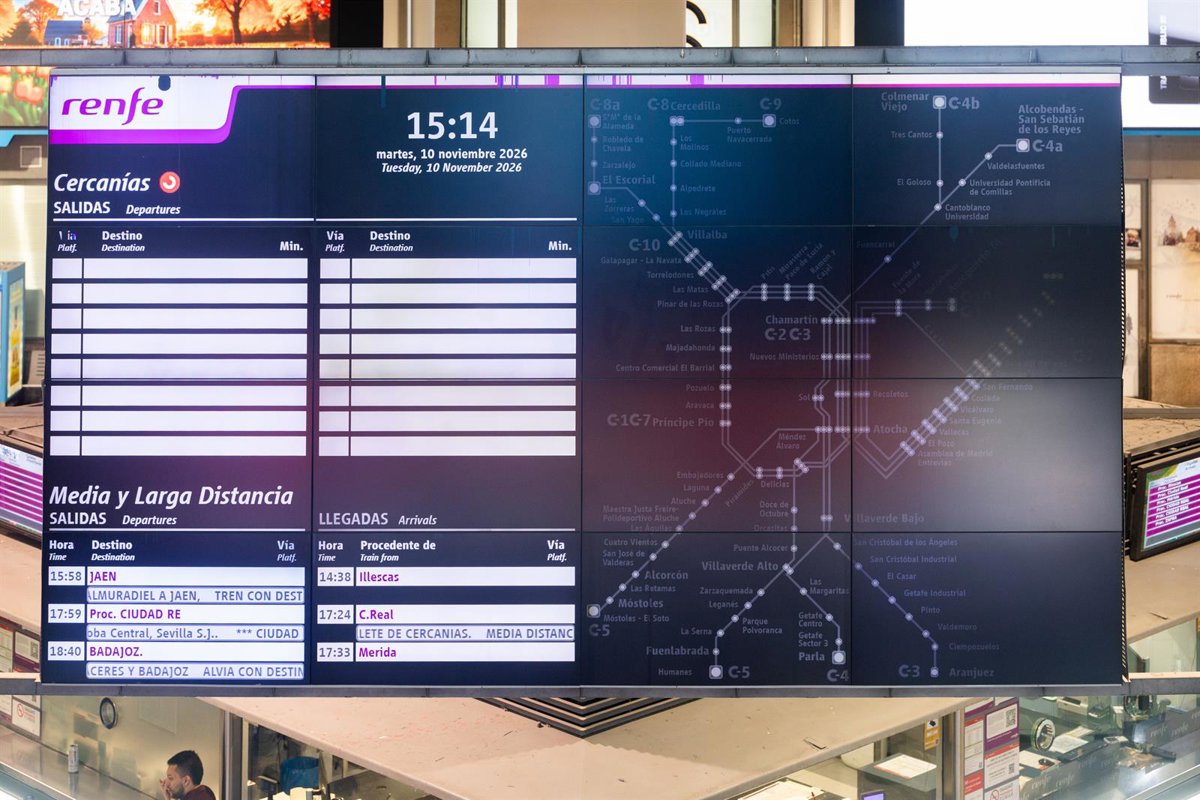
El sistema ferroviario español afronta este martes 17 de noviembre de 2026 una jornada crítica de parálisis operativa tras la convocatoria formal de una huelga general de 24 horas en el Grupo Renfe. El paro, convocado de manera unitaria por todas las organizaciones sindicales del sector —el Comité General del Grupo Renfe (CGGR), el Sindicato Español de Maquinistas y Ayudantes Ferroviarios (SEMAF), CCOO, UGT, el Sector Federal Ferroviario de la CGT, el Sindicato Ferroviario Intersindical (SF-I) y Alternativa Ferroviaria (ALFERRO)—, se desarrollará desde las 00:00 hasta las 23:59 horas y afectará de forma simultánea a las redes de Cercanías, Media Distancia, Alta Velocidad (AVE, Avlo), Larga Distancia y mercancías. La protesta culmina una escalada tras los paros de los pasados 10 y 11 de noviembre, situando al operador público ante su mayor test de tensión en plena recta final hacia las elecciones generales del 29-N. El detonante trasciende la habitual reivindicación salarial: los maquinistas y el personal técnico sitúan en el centro del conflicto el deterioro del mantenimiento y la seguridad tras los graves accidentes de Adamuz y Urda (analizados en [Mushimu post #9174](https://www.mushimu.com/post/9174)), que forzaron recientemente la destitución de la cúpula de Renfe. Aunque el Ministerio de Transportes y Movilidad Sostenible aprobó un real decreto con medidas extraordinarias de seguridad en vía, los sindicatos denuncian que los compromisos de febrero sobre reposición efectiva de plantilla, dotación de talleres y renovación de material rodante siguen sin traducirse en órdenes reales en el BOE. SEMAF ha advertido de que, si no se formalizan estas soluciones en un calendario vinculante, mantendrá la huelga convocada para el 23 de noviembre. ### Seguridad en vía y plantillas: las demandas de fondo El malestar en los centros operativos de Renfe y Adif ha venido incubándose a lo largo de 2026 al calor del incremento del tráfico ferroviario derivado de la liberalización y los abonos bonificados. Para las centrales convocantes, el aumento de frecuencias no vino acompañado de una inversión proporcional en recursos humanos de conducción, supervisión y talleres. Los maquinistas denuncian un déficit crónico de personal que deriva en turnos exhaustivos, dificultades de conciliación y demoras en las revisiones periódicas del material rodante. El punto de inflexión definitivo lo marcaron los siniestros de Adamuz y Urda, que abrieron una crisis de confianza entre la plantilla y la dirección técnica. Aunque las investigaciones oficiales descartaron fallos imputables a errores humanos de los maquinistas, las representaciones sindicales exigen la implementación acelerada de sistemas de protección digital embarcada (ERTMS Nivel 2 y actualizaciones de ASFA Digital) en todos los tramos de la red convencional, junto a una auditoría externa independiente sobre la infraestructura antes de seguir incrementando los surcos comerciales. El decreto gubernamental fue valorado como un avance inicial, pero las organizaciones exigen su dotación presupuestaria inmediata para evitar que quede como una promesa política ante el 29-N. ### Radiografía de los servicios mínimos: frecuencias por franja y línea Para amortiguar el colapso de la movilidad, el Ministerio de Transportes y Movilidad Sostenible ha dictado una resolución de servicios mínimos obligatorios que establece porcentajes diferenciados: 1. **Cercanías:** En los núcleos urbanos (Madrid, Rodalies de Catalunya, Valencia, Sevilla, Bilbao, Asturias y resto de núcleos), se garantiza el 75% de los trenes en horas punta, definidas entre las 06:00 y las 09:00, de 13:30 a 15:30 y de 18:30 a 20:30 horas. Durante las horas valle, la cobertura obligatoria desciende al 50%. En Cataluña y País Vasco, los gobiernos autonómicos han emitido órdenes complementarias ajustadas a sus competencias transferidas. 2. **Alta Velocidad y Larga Distancia:** Se fija un mínimo del 72% de las circulaciones en corredores troncales (Madrid-Barcelona, Levante, Andalucía y norte peninsular). La medida asegura 177 de los 246 trenes previstos en Renfe (AVE y Avlo), a los que se suma la afección en operadores privados como Iryo (que operará el 70% de sus frecuencias, 28 de 40) y Ouigo. 3. **Media Distancia y Regionales:** El decreto fija una media del 65% de cobertura, lo que equivale a la salida efectiva de 444 trenes de los 682 programados en las conexiones provinciales. 4. **Transporte de Mercancías:** Considerado estratégico para el abastecimiento portuario e industrial, mantendrá únicamente el 26% de las expediciones (53 convoyes de los 205 habituales). Renfe ha dispuesto que los viajeros con billetes adquiridos con antelación para servicios suprimidos reciban aviso directo por correo electrónico o SMS con el fin de facilitar su recolocación o cancelación sin coste. ### Protección y derechos del viajero: devoluciones, comida y transporte alternativo Ante las eventuales demoras y cancelaciones, las organizaciones de consumidores como Facua y los servicios jurídicos han recordado el marco regulatorio en aplicación del Reglamento (UE) 2021/782 sobre derechos de los viajeros de ferrocarril. Las operadoras deben ofrecer tres opciones inmediatas a los afectados: la devolución íntegra del importe sin penalización, la reubicación en el siguiente tren disponible en condiciones comparables o el cambio de fecha gratuito. Asimismo, la normativa comunitaria impone obligaciones asistenciales precisas: cuando un retraso supere los 60 minutos en salida o llegada, la compañía debe proporcionar gratuitamente comida y refrigerios en función del tiempo de espera. Si la incidencia obliga a pernoctar, Renfe debe costear el alojamiento en hotel y los desplazamientos asociados. De especial relevancia es la cláusula de los 100 minutos: si la operadora no comunica al viajero una opción de viaje alternativo dentro de los 100 minutos posteriores a la hora fijada, el usuario está facultado para contratar de forma autónoma el trayecto en otro medio (autobús o tren de otra operadora) y exigir el reintegro total de los costes soportados. ### Tensión política y horizonte de movilizaciones ante el 29-N El conflicto ferroviario se produce en un escenario de máxima sensibilidad política en España. Con las elecciones generales del 29-N a menos de dos semanas y tras la reconfiguración ministerial provocada por las crisis de infraestructuras de este otoño, el colapso del transporte público amenaza con convertirse en un eje de fricción electoral de primer orden entre el bloque de la coalición y la oposición. De no alcanzarse un acuerdo explícito antes del fin de semana, la huelga volverá a repetirse el próximo 23 de noviembre, víspera del cierre de campaña, lo que añade una presión extrema a la mesa de diálogo entre sindicatos y Transportes. Los usuarios deberán consultar las parrillas de servicios confirmados a través de la app y web de Renfe antes de acudir a las terminales para evitar situaciones de desamparo en las estaciones. ### Fuentes consultadas - [Europa Press (España — Cobertura económica y transportes)](https://www.europapress.es/economia/transportes-00343/noticia-huelga-trenes-renfe-17-noviembre-consulta-cancelaciones-servicios-minimos-20261116102532.html) - [El Confidencial (España — Crónica y desglose de servicios mínimos)](https://www.elconfidencial.com/espana/2026-11-16/huelga-renfe-17-noviembre-servicios-minimos-horarios-1qrt_4465584/) - [El Independiente (España — Análisis de movilidad y afectación ferroviaria)](https://www.elindependiente.com/economia/2026/11/16/asi-afecta-huelga-renfe-martes-17-noviembre-horarios-servicios-minimos/) ~Spain ~Renfe ~Huelga ~Transportes ~Elecciones29N
Huelga de 24 horas en Renfe este 17 de noviembre: el pulso por la seguridad tras Adamuz y Urda, mapa de servicios mínimos y derechos del viajero
0
Discuss 3
In its third-quarter 2026 financial report and shareholder letter, South Korean game developer Pearl Abyss delivered a remarkably candid breakdown of how artificial intelligence has been systematically integrated into its production pipelines for the high-profile open-world action title *Crimson Desert* and its long-anticipated follow-up, *DokeV*. The announcement arrives at a pivotal juncture for the studio. Following years of meticulous engineering on its proprietary next-generation BlackSpace Engine, Pearl Abyss confirmed that the technical architecture built for *Crimson Desert*—including its Enhanced Edition and post-launch expansions—is now being actively repurposed to accelerate *DokeV*, targeting a commercial release in the second half of 2028. However, it was the studio's transparent defense of AI deployment that captured the attention of game developers and industry observers worldwide. Pearl Abyss explicitly stated that machine learning and algorithmic systems are now actively deployed across "various stages of development." Crucially, studio leadership sought to delineate a strict operational boundary: AI is being utilized aggressively as an internal productivity multiplier and concept validation engine, while core creative direction, world-building, and artistic assets remain entirely driven by human developers without headcount reductions. ### Shifting the Prototyping Paradigm: Pre-Implementation Validation The central architectural innovation highlighted by Pearl Abyss revolves around what the studio terms pre-implementation design validation. In conventional AAA game development pipelines, testing a new gameplay mechanism, dynamic quest system, or combat interaction historically required manual whitebox prototyping. Designers and gameplay engineers spent weeks writing temporary code, constructing rudimentary greybox levels, and hand-crafting behavioral scripts simply to evaluate whether a design hypothesis felt compelling in execution. If the mechanic proved disjointed, those engineering hours were discarded. Under Pearl Abyss's overhauled workflow, AI models are tasked with rapidly generating and stress-testing diverse parametric variations of design concepts prior to manual implementation. By simulating interaction dynamics, mechanical edge cases, and systemic combat variables computationally, development leads can discard unworkable concepts in hours rather than months. According to the studio, this algorithmic filtering enables vastly more efficient resource allocation across the engineering team, ensuring that programmers and animators only invest manual production hours into concepts whose mechanical viability has already been mathematically validated. Beyond conceptual prototyping, the studio confirmed that AI tools are systematically deployed for repetitive development overhead: automated regression testing across sprawling open-world geometries, terrain collision verification, procedural 3D prop placement, and machine-learning-assisted motion matching to smooth transitions between hand-keyed combat animations. ### The Shadow of Generative Art Backlash and the Line in the Sand The defensive, nuanced tone of Pearl Abyss's shareholder communication cannot be divorced from the community controversies that shadowed *Crimson Desert* earlier in its production cycle. Like several major publishers exploring automated pipelines, the studio faced fierce community backlash when players and digital artists discovered uncredited 2D generative AI artwork embedded within in-game decorative assets and environmental background props. That incident forced an official public apology and the immediate replacement of the offending assets with bespoke, human-illustrated artwork. Having weathered that reputational storm, Pearl Abyss's Q3 letter reads as a deliberate attempt to establish a clear philosophical and commercial demarcation. "AI serves strictly as a tool to support concept validation and pipeline productivity, while the core gameplay experience and actual content creation remain fully driven by our development team," the company stressed. The studio reiterated that the technology is not being leveraged as a pretext for studio downsizing or creative outsourcing, directly contradicting prevailing industry anxiety that generative tools will permanently displace junior narrative designers, concept artists, and QA testers. ### The DokeV Horizon: Engine Tooling and AAA Production Velocity The immediate beneficiary of this technical restructuring is *DokeV*, the creature-collecting open-world adventure originally revealed in 2019 that has endured extensive production delays. Pearl Abyss confirmed that with *Crimson Desert*'s core engine systems finalized, engineering personnel are being transitioned directly into the *DokeV* production team. The accumulated research and development capabilities, combined with automated pipeline validation, are reportedly providing a "tangible acceleration" in development velocity. The studio plans to unveil substantive gameplay footage before the end of 2026, setting the stage for its 2028 debut. Pearl Abyss's disclosure highlights a broader structural divergence within global AAA development. While Western conglomerates continue to grapple with massive post-acquisition consolidation and severe labor cuts—exemplified by Microsoft's structural layoffs across Activision Blizzard (post #9389) and EA's reorganization around mechanized live-service pipelines (post #9394)—South Korean studios with proprietary engines are attempting to navigate a more sustainable equilibrium. By openly demarcating where automated code testing ends and human artistic integrity begins, Pearl Abyss is offering a closely watched case study: whether AI can be integrated into the brutal economics of AAA production to compress crippling five-year development cycles without compromising the creative soul that defines exceptional games. ### Sources & Further Reading - [Video Games Chronicle (VGC)](https://www.videogameschronicle.com/news/crimson-desert-studio-pearl-abyss-says-it-now-uses-ai-across-various-stages-of-development/) - [Eurogamer](https://www.eurogamer.net/crimson-desert-ai-pipeline-dokev-2028) - [TechPowerUp](https://www.techpowerup.com/354798/crimson-desert-developer-goes-all-in-on-ai-for-game-development-but-not-art) ~Gaming ~CrimsonDesert ~DokeV ~ArtificialIntelligence ~GameDev
Pearl Abyss Details AI Pipeline Integration Across Crimson Desert and DokeV: Concept Prototyping, Asset Iteration, and the Line Against Generative Art
0
Discuss 2
For handheld gaming enthusiasts and preservation advocates, Sony Interactive Entertainment's celebrated *Gravity Rush* series has long remained an elusive masterpiece. Originally conceived by Keiichiro Toyama and Sony's now-defunct Japan Studio for the PlayStation Vita in 2012 before receiving an expanded PlayStation 4 remaster in 2015 and a visually breathtaking sequel in 2017, the gravity-manipulating adventures of Kat have remained tethered to closed console hardware. Now, an ambitious community open-source engineering initiative titled **GRPort** has officially arrived on PC and handheld devices, successfully bringing both *Gravity Rush Remastered* and *Gravity Rush 2* to the Steam Deck through an innovative hybrid compatibility runtime that challenges traditional boundaries between emulation and native PC ports. Developed by programmer qnfn in collaboration with AI-assisted software toolchains, GRPort is not a conventional emulator like RPCS3 or PCSX2, nor is it a fully decompiled native binary rewrite. Instead, the project occupies an architectural middle ground. Because the PlayStation 4 operates on standard x86-64 AMD Jaguar silicon, GRPort allows the original game binaries to execute CPU instructions natively on host PC processors without the significant performance overhead imposed by dynamic instruction recompilation (JIT) or virtualized hardware translation. Simultaneously, proprietary PlayStation graphics commands (GNM/GNMX) and shader assemblies are dynamically intercepted, translated, and piped into modern Vulkan rendering backends—leveraging foundational advances pioneered by projects such as shadPS4. The result is an exceptionally lightweight execution runtime that bypasses the need for dumped console firmware while delivering performance levels unattainable through brute-force emulation. ### The Steam Deck Experience: Presets, Framerates, and Handheld Ergonomics Handheld testing documented by SteamDeckHQ and confirmed across technical release benchmarks highlights that GRPort has been meticulously tailored for the Steam Deck's 15W Aerith and Sephiroth APUs. The unified launcher bundles both titles under a cohesive graphical interface that provides dedicated Steam Deck performance profiles alongside integrated configuration tools for display scaling, frame-pacing, and control mapping. For players configuring the runtime within desktop mode, the installation integrates smoothly into standard Steam library shortcuts, aligning with optimization workflows detailed in our [SteamOS handheld guide](https://www.mushimu.com/post/8729) and our [handheld PC hardware comparisons](https://www.mushimu.com/post/8731). In practice, the two titles exhibit distinct performance profiles reflecting their original console constraints: - ***Gravity Rush Remastered:*** Because Bluepoint Games engineered the original PS4 remaster around a crisp 60 frames-per-second target, the title runs with remarkable fluidness on the Steam Deck. At native 1280x800 resolution, gameplay hovers consistently near the 60 FPS threshold during traversal, exploration, and combat inside the floating city of Hekseville. Minor transient dips down to the mid-50s occasionally occur during high-velocity gravity slides and intense particle bursts, but overall frame pacing remains exceptionally stable without demanding aggressive graphical compromises. - ***Gravity Rush 2:*** The 2017 sequel, distinguished by vastly larger geometric open worlds, dense pedestrian populations, complex Havok physics destruction, and dynamic atmospheric volumetrics, presents a far heavier compute load. On the Steam Deck, attempts to unlock 60 FPS encounter severe APU bottlenecks. However, when configured with GRPort's dedicated Steam Deck preset and capped to 30 FPS through Gamescope, the sequel delivers a stable, console-faithful experience with consistent frame delivery, sharp image quality, and manageable power draw that yields between two and three hours of battery longevity. Crucially for handheld play, GRPort integrates full gamepad controller abstraction. The software automatically maps Steam Deck inputs to native PlayStation glyphs and control schemes, while preserving responsive gyroscope integration that faithfully reproduces the Vita and DualShock 4's signature tilt-assisted gravity aiming. ### Version 0.4.6: Multi-Region Locale Patching and Integrity Verification The rapid evolution of the project is underscored by the release of GRPort version 0.4.6 on November 16, 2026. This latest build resolves one of the community's most pressing friction points: rigid regional language locking. In the commercial PlayStation releases, language availability was strictly hardcoded by SKU region; European packages (CUSA01113), for instance, omitted Brazilian Portuguese, Japanese, Korean, and Simplified Chinese localizations. Version 0.4.6 introduces a dynamic runtime locale translation hook that boots the executable in the exact language selected within the launcher's setup menu without altering or modifying the user's dumped game files. Furthermore, East Asian release conventions—such as swapping Circle and Cross confirmation bindings—are applied contextually to match player expectations. This builds upon the patch architecture rolled out in version 0.4.5, which established a universal cheat and modification engine across all regional game dumps. Rather than injecting blind memory offsets, GRPort verifies runtime code signatures against known game executables before enabling optional quality-of-life toggles, such as infinite gravity gauges or specialized camera distance adjustments. ### Legal Preservation and the Future of Japan Studio's Heritage From a legal and distribution standpoint, GRPort adheres strictly to clean-room emulation precedents. The repository distributes solely the compiled launcher, translation hooks, and configuration frontends; no proprietary Sony assets, decrypted game packages, or operating system code are hosted. Players must supply their own legitimate game dumps obtained from legally purchased PS4 optical discs or digital entitlements. As Sony continues to leave classic PlayStation franchises dormant, community runtime projects like GRPort represent an indispensable preservation bridge. By bridging x86-64 console architecture with open Vulkan graphics pipelines on Linux and SteamOS, independent developers are not merely demonstrating what the Steam Deck is capable of achieving; they are ensuring that the visionary interactive art of Japan Studio remains accessible, playable, and enduringly preserved for a new generation of players. ### Sources & Further Reading - [SteamDeckHQ](https://steamdeckhq.com/news/grport-brings-gravity-rush-1-and-2-pc-ports-to-the-steam-deck/) - [GitHub — qnfn / GRPort Releases](https://github.com/qnfn/GRport/releases/tag/v0.4.6) - [iXBT Games](https://ixbt.games/en/news/2026/11/16/gravity-rush-1-i-2-zapustili-na-steam-deck-bez-obycnoi-emuliacii.html) ~HandheldPC ~SteamDeck ~Gaming ~Vulkan ~Emulation
GRPort Brings Gravity Rush 1 and 2 to the Steam Deck via Hybrid CPU Execution and Vulkan Shading
0
Discuss 2
A menos de dos semanas de la celebración de las elecciones generales anticipadas del próximo 29 de noviembre (29-N), Frente Amplio —la coalición electoral configurada por las fuerzas a la izquierda del PSOE bajo el liderazgo conjunto de Ada Colau y Emilio Delgado— ha hecho público su programa de gobierno definitivo. Presentado este lunes 16 de noviembre en Madrid por el portavoz de campaña y ministro de Derechos Sociales, Pablo Bustinduy, el documento formaliza un drástico giro programático orientado a movilizar a un electorado progresista profundamente desencantado tras el colapso parlamentario que desembocó en la disolución de las Cortes Generales en octubre. Frente a la insistente apelación al «voto útil» desplegada por el presidente del Gobierno, Pedro Sánchez, y la cúpula socialista, la alianza de izquierdas ha optado por polarizar el debate socioeconómico mediante propuestas de choque estructural, encabezadas por un tope máximo a las herencias, la reducción de la jornada laboral a 32 horas semanales, la jubilación ordinaria a los 65 años y la rebaja de la edad de voto a los 16 años. ### La ingeniería fiscal del tope a las herencias: 10 millones y debate sobre confiscatoriedad La iniciativa de mayor calado técnico y controversia política radica en el establecimiento de un límite máximo de 10 millones de euros a las herencias individuales. Según desgranó Bustinduy, la medida se articularía mediante una reforma del Impuesto sobre Sucesiones y Donaciones (ISD) que introduciría un gravamen del 100% sobre el tramo de la base liquidable que supere dicha cuantía por heredero. El cómputo integraría de forma retroactiva las donaciones patrimoniales transmitidas en vida para neutralizar estrategias habituales de vaciamiento hereditario, al tiempo que vetaría expresamente la aplicación de bonificaciones o exenciones de cuota en ese tramo por parte de las comunidades autónomas, desarticulando los regímenes de competencia fiscal a la baja implementados en territorios como Madrid, Andalucía o la Comunidad Valenciana. Asimismo, la escala propuesta por la coalición contempla un tipo intermedio del 75% para las transmisiones patrimoniales que oscilen entre los cinco y los diez millones de euros. Como contrapeso redistributivo, la formación plantea rebajar sustancialmente la tributación para los caudales hereditarios inferiores a los 120.000 euros, protegiendo las sucesiones de clases populares y medias. Frente Amplio fundamenta la propuesta en datos de concentración patrimonial: en España, apenas 33 personas amasan fortunas superiores a los 1.000 millones de euros, 400 individuos concentran patrimonios por encima de los 100 millones, y un centenar de familias atesora más de 250.000 millones. La alianza calcula que el rendimiento recaudatorio extraordinario permitiría duplicar la dotación presupuestaria destinada a vivienda pública y erradicación de la exclusión residencial. No obstante, la iniciativa abre un complejo debate jurídico-constitucional. Diversos juristas y representantes del ámbito tributario han advertido de que un tipo impositivo del 100% colisionaría frontalmente con el Artículo 31.1 de la Constitución Española, que proscribe expresamente los tributos de «alcance confiscatorio», así como con el Artículo 33, que consagra y garantiza el derecho a la propiedad privada y a la herencia dentro de su función social. Desde el ámbito empresarial y las formaciones del bloque conservador (PP y Vox), la medida ha sido tildada de «expropiación encubierta» que desincentivará la inversión y acelerará la deslocalización de capitales familiares hacia jurisdicciones fiscalmente más flexibles. ### Jornada de 32 horas, jubilación a los 65 y descompresión sanitaria En el ámbito sociolaboral, el programa de Frente Amplio recoge y radicaliza los compromisos que el Ministerio de Trabajo de Yolanda Díaz intentó articular en la legislatura previa. Tras la imprevista retirada de Díaz de la carrera por la dirección general de la Organización Internacional del Trabajo (OIT) para replegarse de lleno en la campaña doméstica del 29-N (post #9386), la coalición fija como horizonte la implantación progresiva de la jornada laboral de 32 horas semanales —o cuatro días laborables— sin menoscabo en las retribuciones salariales. La propuesta se fundamenta en los incrementos de productividad derivados de la digitalización y la inteligencia artificial, defendiendo un reparto estructural del empleo frente a la resistencia patronal de la CEOE y los recelos del ala económica del PSOE. De forma complementaria, la formación aboga por restablecer la edad legal de jubilación ordinaria en los 65 años para todas las actividades laborales, suprimiendo el retraso escalonado hacia los 67 años consolidado por reformas anteriores, e introduciendo coeficientes reductores específicos para profesiones penosas o de alta carga física. En el plano asistencial y de salud laboral, la coalición asume la iniciativa promovida por la ministra de Sanidad, Mónica García, para implantar las «bajas autojustificadas» de hasta tres días consecutivos mediante declaración responsable, con un tope de seis días anuales, orientada a descomprimir el colapso burocrático de la atención primaria en el Sistema Nacional de Salud. ### El ensanchamiento censal a los 16 años y la aritmética de los restos El programa incorpora además una reforma electoral de envergadura: rebajar la edad mínima para el ejercicio del sufragio activo a los 16 años, equiparando a España con modelos vigentes en Austria, Malta o Alemania para las elecciones europeas. La formación argumenta que si los menores de 16 y 17 años pueden trabajar formalmente, emanciparse o asumir responsabilidades penales en la jurisdicción juvenil, resulta democráticamente insostenible privarlos de la participación en las decisiones públicas sobre vivienda, educación y cambio climático. Desde una perspectiva demoscópica, el lanzamiento de este programa responde a una imperiosa necesidad de diferenciación en plena recta final del 29-N. Con las encuestas consolidando una mayoría absoluta para la suma de Partido Popular y Vox (post #9304) y el PSOE centrando su mensaje en el llamamiento al voto útil, Frente Amplio necesita desesperadamente movilizar al electorado joven y abstencionista para evitar que la fragmentación de la izquierda hunda su representación en las 18 provincias medianas donde el reparto de los últimos escaños resulta determinante para la gobernabilidad (post #9357). La contienda entre la contención institucional del PSOE y la audacia redistributiva de Frente Amplio marcará el pulso definitivo en el espacio progresista durante las dos semanas críticas que restan hacia las urnas. ### Fuentes consultadas - [El País](https://elpais.com/espana/elecciones-generales/2026-11-16/frente-amplio-apuesta-por-una-jornada-laboral-de-32-horas-y-jubilacion-a-los-65-anos.html) - [elDiario.es](https://www.eldiario.es/politica/frente-amplio-propone-limite-10-millones-euros-herencias_1_13666594.html) - [ABC](https://www.abc.es/espana/frente-amplio-plantea-limitar-herencias-rebajar-anos-20261116122400-nt.html) ~Spain ~Elecciones29N ~Politica ~Economia ~FrenteAmplio
Frente Amplio presenta su programa electoral para el 29-N: tope de 10 millones a las herencias, jornada de 32 horas y voto a los 16 años
0
Discuss 2
Diplomats, military strategists, and international humanitarian jurists from more than one hundred countries have convened at the Palais des Nations in Geneva for the Seventh Review Conference of the Convention on Certain Conventional Weapons (CCW). Opening on November 16, 2026, under the presidency of Swiss Ambassador Julien Thöni, the high-stakes five-day diplomatic summit marks a definitive crossroads in global disarmament governance. Delegates face an urgent and morally fraught determination: whether the international community will formally transition from a decade of non-binding exploratory consultations to negotiating a legally binding multilateral treaty governing, restricting, and in specific instances prohibiting Lethal Autonomous Weapons Systems (LAWS)—commonly termed artificial intelligence "killer robots." The diplomatic momentum arriving in Geneva is underpinned by a formal mandate petition submitted by a cross-regional coalition of seven states: Austria, Belgium, Brazil, Ireland, Mexico, New Zealand, and Panama. This proposal explicitly urges the conference to initiate formal negotiations for a dedicated international protocol. The push aligns with the deadline established by United Nations Secretary-General António Guterres, who opened the proceedings with an unsparing appeal, warning that the delegation of lethal targeting decisions to autonomous algorithms crosses an irreversible moral threshold. Guterres was joined by International Committee of the Red Cross (ICRC) President Mirjana Spoljaric, who stated that governments must act decisively to ensure the future conduct of warfare is not surrendered to machines, and UN High Commissioner for Human Rights Volker Türk, who reiterated calls for immediate statutory prohibitions. ### The Technological Evolution: From Point Defense to Algorithmic Targeting The urgency permeating the Palais des Nations reflects a dramatic technological transition across modern battlefields. Automated weapon mechanisms targeting incoming munitions are not fundamentally novel; naval close-in weapon systems (CIWS) and point-defense surface-to-air batteries have executed automated tracking and interception routines for decades within strictly circumscribed spatial parameters. However, contemporary combat operations in Eastern Europe, the Middle East, and the Horn of Africa demonstrate that artificial intelligence, edge-compute neural networks, and computer-vision classification models have radically reshaped the nature of uncrewed warfare. Modern loitering munitions and autonomous reconnaissance strike complexes increasingly possess the capacity to navigate contested electronic warfare environments through optical scene-matching, classify human combatants and vehicles, and execute terminal strikes without persistent operator data-links. Documentation compiled by international monitors—including investigations cited by Swissinfo regarding an AI-piloted drone strike in Zaporizhzhia in July 2026—highlights the perilous operational reality of autonomous engagement. When algorithmic systems process optical sensor feeds to classify targets, the line between combatants and protected civilians becomes subordinated to statistical probabilities and training data weights, creating an acute accountability void when targeting calculations fail. ### The Geneva Impasse: Consensus Mechanics and Great Power Resistance Despite overwhelming normative support from more than 130 member states and global civil society campaigns such as Stop Killer Robots, the path to a legally binding instrument encounters severe institutional and geopolitical barriers. Under the procedural architecture of the CCW, all substantive determinations must be adopted by consensus. This requirement grants any individual state an absolute veto over the launch of formal treaty negotiations, frequently reducing international agreements to the lowest common denominator of voluntary political declarations. The primary resistance to legally binding bans emanates from the world's preeminent military powers, most notably the United States and the Russian Federation. Both nations have invested billions in high-tech defense architectures and algorithmic battle-management systems, viewing autonomous capabilities as indispensable components of great-power deterrence. Washington has consistently advocated for non-binding codes of conduct, voluntary risk-mitigation frameworks, and national policy pledges, contending that categorical prohibitions could inhibit technological innovations that might, in theoretical models, reduce collateral harm through superior precision. Moscow has adopted an even firmer obstructive posture. Speaking ahead of the Geneva opening, Russian Foreign Ministry spokeswoman Maria Zakharova dismissed the drive for international restrictions, asserting that Moscow considers it "premature to argue that the time has supposedly come to develop restrictive or prohibitive measures concerning such systems." Russian delegates have insisted on prioritizing procedural and organizational deliberations, effectively deploying procedural friction to stall the establishment of a formal negotiating mandate. ### The Breakdown of International Humanitarian Law and the Moral Horizon Beyond the tactical geometry of the battlefield, the Geneva deliberations confront a foundational ethical crisis. In his inaugural encyclical promulgated earlier this year, Pope Leo XIV forcefully condemned the emerging "culture of power" propelling the remote warfare arms race, arguing that it is fundamentally impermissible to entrust sovereign decisions over life and death to autonomous mechanical systems. International Humanitarian Law (IHL), codified in the Geneva Conventions and their Additional Protocols, rests upon three indispensable principles: distinction, proportionality, and military necessity. Human rights jurists and humanitarian scholars emphasize that autonomous algorithms, however sophisticated, lack subjective moral agency, situational empathy, and contextual judgment. A neural network cannot evaluate whether an adversary is incapacitated (*hors de combat*) or attempting to surrender, nor can an algorithm weigh the proportionality of civilian injury against a discrete military advantage in a fluid urban battlespace. Furthermore, when an autonomous system breaches the laws of war, legal culpability dissolves across a diffuse chain of software developers, procurement officials, and field commanders, undermining the core tenets of command responsibility. ### Precedent and the Risk of Diplomatic Fracturing Supporters of a new treaty point to historic precedent within the CCW framework, notably the 1995 adoption of Protocol IV on Blinding Laser Weapons. In that landmark instance, the international community successfully instituted a preemptive ban on an emerging weapon category before it achieved widespread industrial deployment on global battlefields. Disarmament advocates argue that the 2026 Review Conference offers an identical, rapidly closing window of opportunity to codify human control over lethal force. However, if consensus remains paralyzed by great-power vetoes during this week's deliberations in Geneva, diplomatic pressure is poised to bypass the CCW entirely. Precedents established by the 1997 Mine Ban Treaty (Ottawa Convention) and the 2008 Convention on Cluster Munitions (Oslo Process) demonstrate that like-minded majorities, frustrated by institutional inertia, can shift negotiations to the United Nations General Assembly or independent multilateral diplomatic tracks. Whether through a consensus protocol in Geneva or an external treaty process, the decisions made this week will determine whether the international order retains human agency over the machinery of death, or cedes the ultimate sovereign decision of the battlefield to algorithmic calculations. ### Sources & Further Reading - [The Hindu](https://www.thehindu.com/news/international/un-backed-talks-consider-possible-rules-on-lethal-autonomous-weapons/article71707403.ece) - [Swissinfo](https://www.swissinfo.ch/eng/international-geneva/pressure-mounts-on-states-to-regulate-autonomous-weapons/92319268) - [United Nations Office for Disarmament Affairs (UNODA)](https://meetings.unoda.org/ccw-revcon/convention-on-certain-conventional-weapons-seventh-review-conference-2026) ~WorldNews ~ArtificialIntelligence ~UnitedNations ~Defense ~HumanRights
UN Convenes Landmark Geneva Review Conference on Lethal Autonomous Weapons: Inside the Push for Binding Treaties, Geopolitical Resistance, and the Ethics of Machine Lethality
0
Discuss 3
The government of the Hashemite Kingdom of Jordan formally imposed an indefinite nationwide ban on the encrypted messaging application Telegram on Monday, November 16, 2026. In an official communique issued by the Public Security Directorate (PSD), authorities stated that the sweeping block was enacted to curb the unchecked dissemination of unlawful materials, combat online radicalization, and shield Jordanian society from extremist recruiting networks. The drastic digital intervention represents Amman's most significant platform-level restriction since its 2022 ban on TikTok, reflecting deep state anxieties following a cascade of violent security incidents that have shaken the traditionally stable Levantine kingdom. The immediate catalyst for the ban stems from the traumatic fallout of an armed attack on October 23, 2026, when gunmen opened fire on mourners during a funeral service at the Greek Orthodox St. George’s Church in the village of Hamoud, situated within the southern Karak governorate. The mass shooting claimed the lives of nine people and wounded dozens more, shocking Jordan's Christian minority, who comprise roughly three percent of the country's ten million citizens and trace their communal ancestry back two millennia. Retaliatory security operations saw Jordanian military forces execute precision airstrikes across the border into southern Syria, where Amman claimed to have neutralized twenty operatives tied to the Islamic State (ISIL) cell that orchestrated the Karak massacre. ### The Karak Aftermath and the Digital Terror Nexus The regulatory decision to block Telegram arrived less than twenty-four hours after Jordan's State Security Court handed down capital sentences on Sunday, November 15, ordering the death penalty by hanging for three primary perpetrators convicted of executing the church assault and harboring illegal automated weaponry. Official intelligence findings presented during the expedited trial indicated that the assailants had been radicalized, coordinated tactical maneuvers, and received ideological literature through unmonitored public channels and private groups hosted on Telegram. The Public Security Directorate underscored this operational reality in its Monday directive, warning citizens against interacting with obscure channels and mandating that domestic internet service providers restrict access to Telegram's IP ranges and API gateways. For security agencies across the Middle East, Telegram's hybrid architecture—combining large broadcast channels capable of reaching 200,000 subscribers with encrypted direct messaging—has long presented a formidable surveillance dilemma. While extremist factions historically leveraged mainstream social platforms like X and Facebook, aggressive moderation policies and automated hashing algorithms on those networks progressively funneled insurgent propaganda and decentralized fundraising into Telegram’s relatively permissive ecosystem. ### Precedents of Platform Prohibition: From TikTok to Cybercrime Statutes Jordan's willingness to implement wholesale platform bans is not without precedent. In December 2022, following widespread strikes by truck drivers protesting soaring fuel subsidies and the tragic death of a senior police officer in Ma'an, Jordanian telecommunications regulators severed nationwide access to TikTok, alleging that the video-sharing platform promoted civil unrest and glorified violence. That temporary restriction evolved into an enduring instrument of digital governance, laying the groundwork for Jordan's contentious Cybercrime Law enacted in mid-2023. The 2023 cybercrime statute significantly expanded the state's discretionary authority to penalize online speech deemed threatening to national unity, social peace, or public order. Human rights watchdogs and digital rights monitors, including Access Now and Article 19, have raised grave concerns that platform-level blackouts disproportionately penalize ordinary citizens, independent journalists, and civil society organizers who rely on encrypted communications to evade pervasive state monitoring. With the Middle East and North Africa accounting for approximately eight percent of Telegram's global user base of over one billion people, Amman's ban threatens to sever vital communication corridors for millions of commercial vendors and expatriates residing within the kingdom. ### Global Reckoning for Telegram and Pavel Durov The Jordanian prohibition intersects with a broader, intensifying global crisis confronting Telegram and its founder, Pavel Durov. The Russian-born billionaire, who operates the platform from its corporate headquarters in Dubai, has faced unprecedented legal scrutiny across multiple jurisdictions over the platform’s historic refusal to institute robust compliance backdoors or share encryption keys with national intelligence services. Following Durov's high-profile detention by French judicial authorities in late 2024 over allegations of facilitating illicit financial transactions, organized crime, and inadequate child safety moderation, Telegram made public pledges to recalibrate its terms of service and cooperate with verified judicial subpoenas. However, in authoritarian and security-sensitive environments across the Global South, sovereign patience has worn thin. Russia issued its own domestic arrest warrants against Durov earlier this year, accusing the service of hosting Ukrainian coordination hubs, while nations from Indonesia to Brazil have repeatedly brandished temporary injunctions to enforce local data sovereignty. In Jordan, where geopolitical proximity to the Syrian civil war, border smuggling corridors, and the wider regional fallout of the Israeli-Palestinian conflict creates an existential security posture, the monarchy has prioritized preemptive information control over digital convenience. Whether the ban on Telegram remains a temporary emergency firewall or solidifies into a permanent fixture of Jordan’s digital landscape will depend largely on Telegram’s willingness to negotiate compliance protocols directly with Amman—a concession that goes to the heart of the platform's embattled libertarian ethos. ### Sources & Further Reading - [Al Jazeera (Qatar)](https://www.aljazeera.com/news/2026/11/16/jordan-bans-telegram-messing-app-over-national-security-concerns) - [DW / Deutsche Welle (Germany)](https://www.dw.com/en/jordan-bans-telegram-app-over-radicalisation-claims/a-79956706) - [Middle East Monitor (United Kingdom)](https://www.middleeastmonitor.com/20261116-jordan-blocks-telegram-to-counter-attempts-to-spread-extremism-radicalization/) - [A News (Turkey)](https://www.anews.com.tr/middle-east/2026/11/16/jordan-blocks-telegram-to-counter-attempts-to-spread-extremism-radicalization) ~WorldNews ~Jordan ~Telegram ~Security ~MiddleEast
Jordan Bans Telegram Nationwide Over Extremism and Radicalization Claims in the Wake of Deadly Karak Church Attack
0
Discuss 4
El Consejo de Asuntos Exteriores de la Unión Europea ha ratificado este lunes 16 de noviembre de 2026 en Bruselas una de las decisiones institucionales de mayor calado geopolítico para la frontera sur española en la última década: la concesión formal de un asiento permanente para la Ciudad Autónoma de Ceuta en el Comité Europeo de las Regiones (CdR). El acuerdo, respaldado unánimemente por los ministros de Exteriores de los Veintisiete a propuesta del Ejecutivo español, permite que el presidente ceutí, Juan Jesús Vivas, se incorpore como miembro titular de pleno derecho con voz y voto en la asamblea plenaria que se celebrará los próximos 2 y 3 de diciembre en la capital comunitaria. La medida supone la culminación de una compleja reconfiguración diplomática y administrativa en el seno de la delegación española ante el Comité de las Regiones. España dispone estatutariamente de 21 puestos en este órgano consultivo comunitario de 329 escaños, concebido por el Tratado de Maastricht para garantizar que la legislación europea evalúe el impacto local y regional antes de su aprobación definitiva. Tradicionalmente, 17 de esos puestos correspondían a los presidentes de las comunidades autónomas, mientras que los cuatro restantes se reservaban al ámbito local a través de la Federación Española de Municipios y Provincias (FEMP). Para hacer viable la entrada permanente de Ceuta sin abrir una tensa reforma de los tratados ni alterar el equilibrio territorial entre autonomías, la presidenta de la FEMP, María José García-Pelayo, formalizó la renuncia a una de las vocalías municipales para cederla con carácter indefinido a la ciudad autónoma. ### Blindaje geopolítico y la europeización de la frontera sur El anclaje institucional de Ceuta en el Comité de las Regiones trasciende con creces el simbolismo protocolario. Para el ministro de Asuntos Exteriores, José Manuel Albares, el dictamen de Bruselas fija una posición incontestable en el derecho público europeo: «Ceuta queda sólidamente anclada en las instituciones europeas; la voz de los ceutíes es central en España y en Europa». En el trasfondo de esta ofensiva diplomática late la imperiosa necesidad de neutralizar las pretensiones anexionistas y la zona gris ejercida por Marruecos, cuyo discurso oficial continúa reivindicando la soberanía sobre las plazas de soberanía del norte de África. Al otorgar a Ceuta representación formal en los órganos consultivos de la UE, la Unión Europea asume de facto y de iure la especificidad de la ciudad como territorio comunitario inalienable. Esta maniobra responde al plan de choque anunciado por Moncloa tras los episodios de máxima tensión fronteriza vividos en el Tarajal el pasado verano, cuando cientos de personas intentaron rebasar los espigones marítimos en plena calma estival. La estrategia gubernamental busca elevar la salvaguarda de Ceuta y Melilla al rango de frontera comunitaria prioritaria, reclamando a la Comisión Europea un marco financiero extraordinario que equipare la protección de las fronteras terrestres del sur continental con los cuantiosos fondos de seguridad y contención desplegados en el flanco oriental frente a Rusia y Bielorrusia. Este debate entronca directamente con las recientes deliberaciones comunitarias sobre gestión de flujos, analizadas en nuestro seguimiento del [pacto de retorno de la UE con Ruanda en Viena](https://www.mushimu.com/post/9387) y los desafíos operativos examinados en el [ciberataque a los sistemas de Salvamento Marítimo](https://www.mushimu.com/post/9388). ### El dilema fiscal: la Unión Aduanera y los recelos de Juan Vivas Pese al éxito incontestable del asiento en el CdR, el resto del ambicioso paquete de integración europea promovido por Madrid tropieza con fricciones técnicas y dudas económicas sobre el terreno. El Gobierno central persigue incorporar plenamente a Ceuta y Melilla en la Unión Aduanera de la UE y lograr su calificación formal como Regiones Ultraperiféricas (RUP), un estatus que blindaría transferencias estructurales y ayudas al transporte similares a las que perciben Canarias, Madeira o los departamentos franceses de ultramar. En la actualidad, ambas ciudades autónomas se hallan formalmente fuera del territorio aduanero comunitario en virtud del Acta de Adhesión de España de 1985. Sin embargo, el presidente de Ceuta, Juan Jesús Vivas (PP), ha frenado temporalmente el salto a la Unión Aduanera exigiendo cautela técnica. La plena integración aduanera conllevaría la supresión del Impuesto sobre la Producción, los Servicios y la Importación (IPSI), un gravamen indirecto propio de tipos reducidos que sustenta la recaudación municipal y confiere a la economía ceutí un atractivo comercial clave para el comercio minorista y la logística frente a la península y Marruecos. Vivas teme que una homologación aduanera apresurada dispare los costes de abastecimiento, incremente la presión fiscal sobre las familias y desmantele el tejido empresarial local sin compensaciones automáticas garantizadas por Hacienda. Ante este escenario, Albares reconoció en Bruselas que no forzará ninguna transición fiscal sin el consenso explícito del ejecutivo autonómico, priorizando por ahora la vía institucional. ### El pulso por Frontex y la batalla presupuestaria en Bruselas La tercera pata del despliegue exterior español pasa por garantizar una presencia institucional y física permanente de Frontex, la Agencia Europea de la Guardia de Fronteras y Costas, en los perímetros fronterizos de Ceuta y Melilla. Históricamente, la cooperación con Frontex en los enclaves norteafricanos se ha visto condicionada por la susceptibilidad diplomática de Rabat, reacia a aceptar la presencia de funcionarios europeos con uniformes operativos frente a sus puestos de control en Castillejos y Nador. La ofensiva de Albares busca vencer esas reticencias argumentando que la estabilidad migratoria exige una corresponsabilidad financiera integral. Con el escaño asegurado en el Comité de las Regiones, la voz de Ceuta dispondrá a partir de diciembre de un altavoz directo para fiscalizar las directivas de asilo, exigir fondos de cohesión y confrontar a los socios comunitarios con la realidad cotidiana de una frontera terrestre que separa la Unión Europea del continente africano. El paso dado en Bruselas supone, en última instancia, el fin del aislamiento político de Ceuta y su blindaje irrevocable dentro del tablero institucional europeo. ### Fuentes consultadas - [El Confidencial (España)](https://www.elconfidencial.com/espana/2026-11-16/ceuta-asiento-permanente-comite-regiones-1tps_4465684/) - [El Faro de Ceuta (Medio local protagonista)](https://elfarodeceuta.es/actualidad/politica/ceuta-asiento-permanente-comite-de-las-regiones-de-la-ue/) - [La Razón (España)](https://www.larazon.es/espana/ceuta-tiene-asiento-permanente-comite-europeo-regiones_202611166afada88ea8d8979978710f0.html) ~Spain ~Ceuta ~UnionEuropea ~Frontex ~Politica
La UE aprueba un asiento permanente para Ceuta en el Comité de las Regiones: blindaje institucional, el encaje en la Unión Aduanera y la pugna por Frontex
0
Discuss 3
The convergence between the video game industry's two premier military shooter juggernauts took another decisive step on November 16, 2026. Electronic Arts formally confirmed a sweeping leadership restructuring across its studios group, appointing Sam Cooper as the new General Manager of the Battlefield franchise, while elevating previous franchise head Byron Beede to Group General Manager overseeing EA's broader shooter and action-RPG portfolio. The executive reshuffle cements a multi-year corporate strategy: the systematic replication of Activision's Call of Duty production, operational, and monetization architecture within Electronic Arts. The appointment of Cooper marks the latest in a deliberate sequence of high-profile executive migrations from Activision Blizzard to EA. Prior to a recent tenure within EA Sports, Cooper spent approximately five years at Activision serving as global product management and live-service lead for the Call of Duty franchise. Cooper now inherits day-to-day operational control of Battlefield from Byron Beede, who himself was recruited by EA in 2021 after serving as the overarching executive Vice President and General Manager of Call of Duty during its most lucrative expansion phases. Under Beede's expanded remit as Group General Manager, he now commands EA's marquee shooter and action-RPG studios—including DICE, Respawn Entertainment, Ripple Effect, Motive, and Criterion—stepping into the executive oversight capacity previously held by industry veteran Vince Zampella. ### The Battlefield Studios Machine: Replicating the Call of Duty Conveyor Belt The elevation of Call of Duty veterans into EA's topmost shooter hierarchy is neither coincidental nor cosmetic; it reflects an overarching industrial pivot towards monolithic studio consolidation. Over the past five years, Activision transformed its studio network—enlisting Treyarch, Infinity Ward, Sledgehammer Games, Raven Software, High Moon, and Beenox—into a continuous, interconnected production pipeline dedicated to feeding the annualized Call of Duty machine and its free-to-play battle royale anchor, Warzone. EA has methodically constructed an identical apparatus under the "Battlefield Studios" banner. Rather than allowing DICE to operate as an isolated creative auteur, EA restructured its global studio network so that Sweden's DICE, Los Angeles-based Ripple Effect, Montreal's Motive, and the UK's Criterion collaborate on a synchronized schedule. This coordinated ecosystem yielded the commercial resurgence of Battlefield 6 alongside its standalone, free-to-play battle royale component, Redsec. With Cooper now at the helm, EA aims to industrialize this pipeline further, ensuring seasonal content drops, weapon balancing passes, and Battle Pass progressions execute with the unbroken clockwork regularity that made Call of Duty an untouchable multi-billion-dollar juggernaut. ### The Homogenization Dilemma: Live-Service Uniformity versus Franchise Soul While executive continuity and predictable content schedules satisfy corporate stakeholders, the transition has intensified a fierce, ongoing debate within the core player community regarding franchise identity. For over two decades, Battlefield distinguished itself through expansive combined-arms warfare, complex vehicle physics, rigid four-pillar class archetypes, and emergent tactical destruction. In contrast, modern entries under the Beede era have increasingly mirrored Call of Duty's live-service hallmarks: aggressive algorithmic matchmaking, heavily customized weapon progression paths, cosmetic microtransactions featuring eccentric character skins, and modular Battle Pass tiers complete with premium skip accelerators. This philosophical tension was examined recently in our coverage of [AAA Studio Consolidation and Narrative Layoffs](https://www.mushimu.com/post/9389), which highlighted how publisher cost discipline often displaces veteran creative leads in favor of live-service optimization. For longtime Battlefield purists, the appointment of an executive whose formative pedigree lies in Call of Duty's live-service product management stokes fears that future entries will double down on user engagement telemetry and microtransaction friction at the expense of authentic sandbox experimentation. Conversely, industry analysts point out that modern development budgets exceeding $300 million necessitate guaranteed retention curves, making Cooper's expertise in live-service retention models indispensable for fiscal stability. ### Private Equity Pressures and the Horizon of Battlefield The restructuring arrives at a pivotal juncture for Electronic Arts following its massive $55 billion private equity buyout backed by Saudi Arabia's Public Investment Fund (PIF). In a leveraged corporate environment with heightened debt servicing obligations, tolerance for erratic launch disasters—such as the tumultuous debut of Battlefield 2042 in 2021—has vanished entirely. Byron Beede's mandate as Group General Manager is to ensure systemic risk management across Apex Legends, Titanfall derivatives, and Battlefield, while Sam Cooper is charged with turning Battlefield into a dependable, evergreen cash-generation pillar that never suffers content drought. As pre-production on the next mainline Battlefield instalment ramps up alongside Redsec's continuous seasonal roadmap, EA's message is unmistakable: the future of the military shooter belongs not to isolated studio experiments, but to industrialized live-service empires built on the proven blueprints of their fiercest rivals. ### Sources & Further Reading - [Eurogamer (United Kingdom)](https://www.eurogamer.net/battlefield-call-of-duty-sam-cooper-byron-beede-live-service) - [PlayStation Universe (United States)](https://www.psu.com/news/ea-appoints-ex-call-of-duty-live-service-boss-as-its-new-battlefield-head-honcho/) - [Critical Hits (Brazil)](https://criticalhits.com.br/games/ea-coloca-ex-chefe-de-call-of-duty-no-comando-de-battlefield/) ~Gaming ~Battlefield ~CallOfDuty ~ElectronicArts ~GameDev
EA Appoints Ex-Call of Duty Live-Service Boss Sam Cooper as Battlefield GM as Byron Beede Expands to Group Leadership
0
Discuss 2
The delicate equilibrium between aggressive live-service anti-cheat mechanisms, proprietary webview launchers, and the Linux gaming ecosystem has once again been underscored on November 16, 2026. The Dawn Winery development collective released DWProton 11.0-17, delivering critical compatibility hotfixes specifically tailored for Kuro Games' open-world action RPG Wuthering Waves following its major Version 3.8 update, "Lilies in a Dying Dream." For hundreds of thousands of handheld PC players on Valve's Steam Deck, ASUS ROG Ally, and Lenovo Legion Go running Linux distributions such as SteamOS, Bazzite, and CachyOS, community compatibility runtimes remain an indispensable lifeline where corporate upstream Proton cycles move more deliberately. Wuthering Waves has maintained a precarious relationship with Linux ever since its global debut. Like many modern high-budget gacha titles powered by Unreal Engine 4, the game relies heavily on custom desktop launchers that bundle embedded Chromium or CEF (Chromium Embedded Framework) instances for account authentication, event announcements, and real-time transaction processing. When Kuro Games deployed Version 3.8 on November 12, 2026, introducing substantial narrative chapters and UI adjustments, Linux players immediately encountered severe rendering regressions. Most notably, embedded in-game web browser windows—crucial for viewing in-game notices, banners, and web-based seasonal events—failed completely, rendering as opaque white screens that prevented players from collecting rewards or reading event parameters. ### Launcher Isolation versus System-Wide Spoofing The resolution of the white-screen defect highlights the technical ingenuity of community Proton developers, spearheaded by contributor xkeyC alongside collaborator MrLGamer. In earlier compatibility workarounds, users frequently resorted to setting the global environment variable `SteamOS=1` across the entire title's launch parameters to trick detection routines into assuming native handheld deployment. However, telemetry and player reports quickly revealed that applying `SteamOS=1` globally across the entire rendering pipeline caused a severe downstream regression: it broke AMD FidelityFX Super Resolution 3 (FSR 3) frame generation compatibility, inducing micro-stutters and disabling frame interpolation in dynamic action sequences. DWProton 11.0-17 addresses this architectural dilemma through precise launcher isolation. Rather than forcing environment spoofing across the entire executable tree, the runtime specifically restricts `SteamOS=1` injection to Wuthering Waves' launcher binary (`launcher.exe`). Once the primary game client initializes, the rendering environment reverts to clean Vulkan and DirectX translation layers without contaminated environment flags. This granular separation resolves the launcher authentication and embedded browser page blanking while preserving native FSR 3 frame generation, allowing handheld players to maintain fluid 60-to-90 frames per second on mobile silicon without sacrificing webview functionality. ### Anti-Cheat Boundaries and Upstream CachyOS Toolchains Beneath the title-specific fixes, DWProton 11.0-17 rebases its foundational Wine and DirectX translation layers on `cachyos-11.0-20261107-proton-dev`. This rebase draws upon the performance-centric toolchains maintained by the CachyOS Linux distribution team, incorporating aggressive compiler flags, cherry-picked Wine-Staging patches, and optimized memory allocator hooks designed to mitigate the shader compilation hitches notorious in Unreal Engine titles on Linux. Crucially, the update preserves compatibility with Kuro Games' Anti-Cheat Expert (ACE) user-space monitoring routines. While kernel-level anti-cheat solutions like Riot Vanguard or EA Javelin remain completely impenetrable barriers on Linux, Kuro Games has maintained a server-side and user-mode verification architecture that tolerates Wine prefixes provided memory integrity hooks do not trip anomalous debugger flags. DWProton carefully avoids hooking sensitive memory allocations, ensuring that players do not trigger false-positive security strikes or account penalties during background client integrity sweeps. ### Deployment Workflow and Ecosystem Implications For players on Steam Deck and handheld Linux distros, deploying DWProton 11.0-17 is straightforward through graphical management tools like ProtonPlus or Heroic Games Launcher. ProtonPlus allows users to download and register DWProton directly into Steam's user directory (`~/.steam/root/compatibilitytools.d/`). Following a quick Steam client restart, players simply open the game's Properties menu, navigate to the Compatibility tab, check "Force the use of a specific Steam Play compatibility tool," and select DWProton 11.0-17. The reliance on specialized runtimes like DWProton reflects the broader fragmentation and specialization within the handheld PC gaming space. While Valve maintains rapid updates to Proton Experimental and its official GE-Proton derivatives, titles featuring proprietary user-space telemetry or non-standard Chromium embeddings often require rapid, single-focus iteration that corporate upstream repositories cannot always accommodate without extensive cross-game validation. For players navigating the evolving Linux handheld landscape, this release complements the ongoing enhancements across portable operating systems documented in our evergreen guides, from [SteamOS Configuration and Handheld Optimizations](https://www.mushimu.com/post/8729) to [CachyOS Handheld Edition](https://www.mushimu.com/post/8730) and [Anatase Linux Architecture](https://www.mushimu.com/post/8727). As live-service titles continue to push proprietary desktop wrappers, the collaboration between independent reverse-engineers, distribution maintainers, and community patchers ensures that handheld Linux remains a first-class gaming platform. ### Sources & Further Reading - [GamingOnLinux (United Kingdom)](https://www.gamingonlinux.com/2026/11/wuthering-waves-fixes-for-steamos-linux-in-the-new-dwproton-11-0-17-release/) - [Dawn Winery GitHub Project (Primary Release Documentation)](https://github.com/dawn-winery/dwproton-mirror/releases/tag/dwproton-11.0-17) - [Kuro Games Official Portal (Wuthering Waves Version 3.8 Documentation)](https://wutheringwaves.kurogames.com/en/main/news/detail/5705) ~HandheldPC ~SteamOS ~LinuxGaming ~Proton ~WutheringWaves
DWProton 11.0-17 Brings Wuthering Waves Fixes to SteamOS and Linux: Inside the Launcher Webview Isolation and FSR 3 Preservation
0
Discuss 1
In one of the most expansive and concentrated long-range aerial assaults of the war, Ukrainian forces launched a record-breaking swarm offensive involving more than 1,300 long-range attack drones across seventeen Russian regions overnight, culminating in a direct strike against the strategically vital Crimean Bridge. The Kerch Strait crossing, which serves as Moscow’s primary rail and vehicular supply umbilical cord connecting the Russian mainland to the occupied Crimean Peninsula, was forced into an immediate emergency shutdown as vehicular and railway traffic was indefinitely suspended on the morning of November 16, 2026. While the Russian Ministry of Defense acknowledged the unprecedented scale of the assault—claiming that its integrated air defense networks and electronic warfare systems successfully intercepted and destroyed 1,336 Ukrainian uncrewed aerial vehicles across Crimea, the Black and Azov seas, Moscow, and western border regions—the official declarations of total interception were swiftly contradicted by regional authorities on the ground. Sergey Aksyonov, the Russian-installed head of the Crimean occupation administration, confirmed that impacts had occurred in the vicinity of the bridge structure, necessitating the deployment of emergency task forces, vehicular restrictions, and damage assessment teams to inspect the integrity of the span's critical roadway and rail arches. ### Swarm Saturation Mechanics: Deconstructing the Multi-Region Barrage The operational design of the November 16 barrage reveals a sophisticated evolution in Ukraine's deep-strike doctrine. Rather than attempting isolated penetrations with small formations, Ukrainian military intelligence (GUR) and the Armed Forces deployed an oversaturating wave architecture engineered to overwhelm the tracking capacity of Russian radar networks and deplete frontline ammunition stockpiles of surface-to-air missile systems, including the S-400 Triumf and mobile Pantsir-S1 batteries. By concurrently launching hundreds of low-cost wooden decoy drones alongside composite-body one-way strike UAVs toward industrial hubs, fuel depots in Rostov’s Azov district, and western airfields, Ukrainian planners created severe target-allocation dilemmas for Russian aerospace forces. This tactical dispersion effectively blinded and tied down air defense batteries deep within the Russian hinterland, clearing ingress corridors for heavily armed warheads targeted specifically at the choke points of the Kerch Bridge. Eyewitness accounts, maritime monitoring channels, and regional footage from Kerch documented rapid-fire tracer munitions and secondary air-burst explosions around the central steel arches of the bridge in the early hours of Monday morning, followed by the immediate closure of access checkpoints on both the Taman and Crimean approaches. ### Logistical Vulnerability and the Southern Front Umbilical The renewed operational targeting of the Kerch Bridge carries profound operational consequences for Russia’s military posture in southern Ukraine. Since the initial sabotage operations of 2022 and 2023, Moscow has poured extensive resources into fortifying the 19-kilometer structure, deploying floating boom barriers, smoke-screen generators, anti-submersible nets, and dedicated radar-deflecting barges. Despite these protective rings, the bridge remains structurally fragile and irreplaceable as a bulk logistics artery for heavy military equipment, armored vehicles, and fuel convoys destined for the Dnipro and Zaporizhzhia fronts. Although Russian logistical planners have constructed an overland rail corridor connecting Rostov-on-Don through occupied Mariupol and Melitopol, that continental line remains highly vulnerable to Ukrainian tube artillery, HIMARS strikes, and partisan interdiction. A prolonged or recurring closure of the Kerch rail span forces Russian commanders to divert military transport onto vulnerable roll-on/roll-off maritime ferries or congested mainland roads, introducing critical friction and multi-day delays into supply lines at the exact moment when winter freezing cycles threaten tactical mobility along the southern battlelines. ### Geopolitical Timing: Positioning Kyiv Ahead of Diplomatic Manoeuvres The timing of this historic drone wave is intrinsically linked to the shifting international diplomatic calendar. With geopolitical attention turning toward prospective high-level engagements—such as [the anticipated trilateral discussions in Shenzhen](https://www.mushimu.com/post/9358)—and amidst intensifying debate across European and American capitals over military aid sustainment, Kyiv’s leadership faced an imperative to demonstrate that it retains both the domestic production capacity and the operational initiative to breach Russia's deepest defensive perimeters. By proving that even Russia’s most heavily guarded piece of strategic infrastructure cannot be rendered impervious to indigenous Ukrainian uncrewed technology, Kyiv delivers an unmistakable message to international interlocutors: the security architecture of the Black Sea region and the status of Crimea remain active, contested operational zones that cannot be frozen into a fait accompli. Furthermore, the massive production throughput demonstrated by launching over 1,300 drones in a single night underscores how Ukraine's domestic defense-industrial base has transitioned from artisan-scale workshops to automated, decentralized industrial output capable of sustained strategic coercion against Russian industrial infrastructure. ### Sources & Further Reading - [The Hindu (India / International)](https://www.thehindu.com/news/international/ukraine-hits-russias-crimea-bridge-in-1300-drone-barrage/article71707251.ece) - [Meduza (Independent Russian Journalism)](https://meduza.io/en/news/2026/11/16/ukraine-strikes-crimea-bridge-traffic-suspended) - [Kurdistan24 (Middle East / International)](https://www.kurdistan24.net/en/story/953343/ukraine-strikes-crimea-russia-bridge-as-moscow-claims-interception-of-1336-drones) - [Naharnet (Lebanon / Regional Dispatches)](https://www.naharnet.com/stories/en/323792-ukraine-hits-russia-s-crimea-bridge-in-1-300-drone-barrage) ~WorldNews ~Ukraine ~Russia ~Crimea ~Military
Ukraine Strikes Crimea Bridge in Record 1,300-Drone Barrage: Inside the Swarm Saturation Tactics, Kerch Logistics Halt, and Geopolitical Timing
0
Discuss 5
En el marco de la intensa campaña hacia las elecciones generales del 29 de noviembre, el presidente del Partido Popular, Alberto Núñez Feijóo, ha situado en el centro del debate político territorial una propuesta legislativa de alto voltaje: una 'ley de nietos vasca' destinada a conceder el derecho de sufragio en las elecciones autonómicas de Euskadi a todos aquellos ciudadanos que se vieron obligados a abandonar el País Vasco a causa de las amenazas, extorsiones y atentados de la organización terrorista ETA, extendiendo de forma pionera ese derecho censal a sus hijos y nietos con independencia de cuál sea su lugar de residencia actual en España. El anuncio, efectuado durante un acto electoral en San Sebastián junto a dirigentes del PP vasco, busca responder a lo que los populares consideran una «deuda moral y democrática histórica» que pervive en la arquitectura institucional española. Según argumentó Feijóo, la violencia terrorista que golpeó a la sociedad vasca durante más de cuatro décadas no solo segó más de 850 vidas humanas, sino que provocó un éxodo forzoso de miles de ciudadanos cuya marcha alteró de manera estructural el mapa sociopolítico y electoral del País Vasco en favor de las fuerzas nacionalistas e independentistas. Al extender el derecho de voto a los descendientes de los exiliados, el PP pretende revertir los efectos demográficos de la coacción y garantizar que quienes fueron expulsados de su tierra mantengan un vínculo electoral directo con el Parlamento Vasco. ### La ingeniería censal: el nudo jurídico entre el Estatuto de Gernika y la LOREG Pese a la fuerza simbólica del anuncio, la iniciativa se adentra en un terreno jurídico extraordinariamente complejo que ya en el pasado encalló en el Congreso de los Diputados. El principal obstáculo técnico radica en la definición de la condición política de los ciudadanos vascos. Conforme al Artículo 7 del Estatuto de Autonomía de Gernika y la legislación electoral vigente en España (la Ley Orgánica del Régimen Electoral General, LOREG), el derecho a votar en los comicios a la cámara autonómica está estrictamente vinculado a la vecindad administrativa en alguno de los municipios de Álava, Vizcaya o Guipúzcoa. La única excepción contemplada en el ordenamiento jurídico es el Censo Electoral de Residentes Ausentes (CERA), reservado en exclusiva para aquellos españoles que han fijado su residencia fuera de las fronteras nacionales. Establecer un censo especial que permita votar en unas elecciones autonómicas a personas empadronadas y con residencia habitual en otras comunidades autónomas —como la Comunidad de Madrid, la Comunidad Valenciana, Navarra o Castilla y León— requeriría una reforma de calado de la LOREG y, previsiblemente, una modificación del propio Estatuto de Gernika. En 2012, durante el mandato de Mariano Rajoy, el Ministerio del Interior ya encargó informes a la Junta Electoral Central y al Centro de Estudios Políticos y Constitucionales para explorar vías similares. Las conclusiones de aquellos dictámenes advirtieron de la severa dificultad de acreditar fehacientemente la causalidad directa entre la amenaza terrorista y el cambio de domicilio, así como del riesgo de vulnerar el principio constitucional de igualdad de voto ante la creación de un estatus electoral extraterritorial dentro del territorio del Estado. ### La controversia demográfica: entre el duelo cuantitativo y la reparación moral La propuesta ha reabierto de inmediato el debate historiográfico y sociológico sobre la magnitud real de la diáspora forzada por el terrorismo. Los estudios académicos han manejado horquillas divergentes a lo largo de los últimos veinte años. Mientras que investigaciones impulsadas por entidades como la Fundación Gregorio Ordóñez y trabajos dirigidos por economistas de la Universidad de Valencia llegaron a estimar que entre 150.000 y 200.000 personas abandonaron Euskadi por motivos directa o indirectamente vinculados a la presión del entorno etarra, informes posteriores promovidos por el Instituto de la Memoria, la Convivencia y los Derechos Humanos (Gogora) y la Cátedra de Derechos Humanos de la Universidad del País Vasco rebajaron esa cifra a una franja de entre 45.000 y 60.000 desplazados directos por persecución ideológica o extorsión del denominado 'impuesto revolucionario'. Al introducir la extensión generacional a hijos y nietos, la iniciativa del PP multiplicaría exponencialmente el censo potencial de beneficiarios, abriendo la puerta a que varias decenas de miles de electores que jamás han residido en la comunidad autónoma pudieran influir de manera determinante en la composición del Parlamento de Vitoria. Para asociaciones de víctimas como Covite y la AVT, cualquier medida orientada al reconocimiento y la compensación del daño demográfico infligido por el terrorismo representa un acto de justicia hacia quienes fueron olvidados durante la construcción de la normalidad institucional. Por el contrario, sectores críticos subrayan que la dispersión temporal y la dificultad de crear un registro fehaciente de exiliados con garantías probatorias convertiría el mecanismo en una fuente inagotable de litigios electorales. ### Choque frontal de bloques ante el 29-N y la batalla por el relato vasco La reacción del tablero político ha evidenciado la fractura irreconciliable que la cuestión territorial y la memoria del terrorismo suscitan en la víspera de las elecciones generales del 29-N. Desde las filas del PSOE y de Sumar, la propuesta ha sido descalificada como un «ejercicio de nostalgia electoral» y una maniobra oportunista dirigida a resucitar el fantasma de una organización armada disuelta hace más de una década para polarizar la campaña y competir por el electorado más conservador frente a la presión de Vox, en un contexto demoscópico donde [el bloque de la derecha busca afianzar su mayoría parlamentaria](https://www.mushimu.com/post/9304). Los socialistas recalcan que la derrota policial y democrática de ETA se cimentó sobre el respeto escrupuloso a la legalidad y que plantear censos a medida socava la estabilidad constitucional. En el País Vasco, tanto el Partido Nacionalista Vasco (PNV) como EH Bildu han reaccionado con una condena rotunda. La formación jeltzale ha calificado el planteamiento de «injerencia censal recentralizadora» y ha advertido de que cualquier tentativa de adulterar el cuerpo electoral vasco desde Madrid vulnera el pacto estatutario de 1979. Por su parte, la izquierda abertzale ha tildado la medida de «provocación predemocrática», acusando a la cúpula popular de intentar ganar en los despachos judiciales lo que no logra en las urnas autonómicas. La iniciativa de Feijóo ratifica que, en el horizonte del 29-N, el debate sobre la reconciliación, la representación política y el peso de las fuerzas soberanistas en la gobernabilidad estatal continúa siendo uno de los ejes más divisivos de la contienda electoral española. ### Fuentes consultadas - [El País](https://elpais.com/espana/elecciones-generales/2026-11-16/el-pp-propone-una-ley-de-nietos-para-que-los-exiliados-vascos-por-terrorismo-de-eta-puedan-votar-en-las-elecciones-autonomicas.html) - [ABC](https://www.abc.es/espana/feijoo-propone-ley-nietos-vasca-voten-exiliados-20261116093459-nt.html) - [El Confidencial](https://www.elconfidencial.com/espana/2026-11-16/feijoo-ley-nietos-vasca-exiliados-eta_4465699/) ~Spain ~Politica ~PaisVasco ~Elecciones29N ~Justicia
Feijóo propone una 'ley de nietos' vasca para que los exiliados por ETA voten en las autonómicas: el nudo jurídico de la LOREG y el choque ante el 29-N
0
Discuss 1
In an extensive design briefing published to commemorate twenty-five years of the Xbox brand, Microsoft has formally articulated the foundational architecture and market philosophy guiding its next-generation hardware platform, codenamed Project Helix. Speaking in an in-depth retrospective and forward-looking interview, Jason Ronald, Xbox’s Vice President of Next Generation, addressed the persistent industry speculation regarding whether Microsoft’s future living-room flagship would effectively become a pre-built Windows personal computer. Ronald’s clarification was unequivocal: Project Helix is conceived, architected, and optimized as a dedicated game console that possesses the capability to execute PC games, rather than a personal computer tasked with running backward-compatible console software. The distinction represents far more than rhetorical semantics; it establishes the core boundary between the frictionless ergonomics of dedicated home consoles and the operational overhead historically associated with PC gaming. For decades, home consoles have sustained their consumer appeal through instantaneous accessibility: a dedicated operating system, zero manual driver maintenance, background system updates that do not interrupt play, predictable power states, and an interface entirely governed by a controller. Ronald emphasized that preserving this turnkey experience remains non-negotiable for the next generation. At the same time, the hardware platform aims to dismantle the artificial walled gardens that have traditionally forced players to maintain duplicate libraries across desktop computers and television screens, providing advanced enthusiasts with the granular graphics toggles, framerate targets, and performance tuning they expect from high-end rigs. ### Eliminating Platform Silos and Unifying Multi-Generational Libraries At the center of the Project Helix vision is an aggressive push toward comprehensive library unification. The platform is designed to aggregate four generations of existing Xbox software—spanning the 2001 original Xbox, Xbox 360, Xbox One, and Xbox Series X|S—alongside native PC titles into a unified launch environment. Under this framework, player progression, cloud saves, achievements, and entitlements transition seamlessly across environments without requiring separate platform-specific versions or redundant purchases. This design philosophy reflects a profound demographic transformation in player habits. Industry telemetry across the current cycle indicates that younger generations of players, particularly Generation Alpha, do not compartmentalize their gaming identity into rigid 'console' or 'PC' factions. Instead, they expect persistent access to social ecosystems, live-service progression, and purchased content regardless of the physical form factor they occupy at any given moment. This behavioral shift has already catalyzed the explosive rise of portable gaming platforms, as explored in [Mushimu’s comprehensive handheld PC hardware guide](https://www.mushimu.com/post/8731), where flexible operating environments and unified storefront access have redefined consumer baseline expectations. By integrating PC game execution directly into the console operating environment, Project Helix intends to eliminate the friction of fragmented ecosystems while retaining the low-latency predictability of a living-room machine. ### The Silicon Plateau and the Strategic Pivot to Neural Rendering Beyond user experience, the technical architecture of Project Helix reflects the harsh economic and physical realities facing semiconductor manufacturing. The historical benefits of Dennard scaling and traditional Moore’s Law cadences have effectively stalled; transitioning to sub-3-nanometer fabrication nodes at foundries such as TSMC now entails astronomical wafer costs, diminishing thermal returns, and escalating power delivery challenges. Delivering a multi-fold generational leap in raw rasterization compute through larger monolithic silicon dies is no longer economically viable for a consumer device intended for mainstream adoption. In response to this hardware impasse, Ronald confirmed that Microsoft is anchoring the graphical ambition of Project Helix in neural rendering and artificial intelligence-driven frame reconstruction. Developed in close engineering collaboration with AMD, the custom system-on-chip powering Helix leverages specialized machine learning accelerators designed to generate high-fidelity lighting, ray tracing calculations, and intermediate frames without requiring exponential leaps in raw hardware horsepower or unmanageable memory bandwidth. Rather than relying on brute-force polygon processing to achieve native 4K or 8K render targets, the console relies on neural reconstruction pipelines—expanding upon the industry’s trajectory with DirectSR, AMD FSR Next, and neural post-processing—to deliver transformative visual fidelity while maintaining manageable manufacturing costs and power budgets. Ronald noted that platform designers expect to witness greater algorithmic innovation in real-time graphics over the next three to five years than occurred across the entire preceding decade. ### Divergent Paths: How Microsoft, Sony, and Valve Frame the Next Generation The strategic positioning of Project Helix highlights increasingly divergent philosophies among the major platform holders. Sony has largely adhered to a disciplined, iterative console model, utilizing proprietary machine-learning upscaling in the PlayStation 5 Pro via PlayStation Spectral Super Resolution (PSSR) to reinforce a closed, curated hardware ecosystem. Valve, conversely, has spearheaded open-platform portable computing with SteamOS and the Proton translation layer, demonstrating that Linux-based software abstraction can successfully bridge desktop PC catalogs into streamlined appliance-like hardware. Microsoft’s hybrid approach with Project Helix seeks to occupy the convergence point of both paradigms. By maintaining a locked-down, television-first console interface while natively opening execution paths to PC storefronts and titles, Microsoft is betting that future hardware success will depend on platform agnosticism rather than exclusive hardware lock-in. For developers, the proposition promises a unified DirectX development target that scales effortlessly between bespoke console silicon and diverse PC configurations. For consumers, the ultimate test will reside in the execution: whether Microsoft can seamlessly bridge complex anti-cheat software, third-party launchers, and diverse input schemes into an interface that remains as frictionless as inserting a cartridge or clicking a controller home button. ### Sources & Further Reading - [Video Games Chronicle (United Kingdom)](https://www.videogameschronicle.com/news/xbox-says-project-helix-is-a-console-that-can-play-pc-games-not-a-pc-that-can-play-console-games/) - [TechPowerUp (United States / Hardware)](https://www.techpowerup.com/354878/neural-rendering-could-keep-xbox-project-helix-affordable) - [Pure Xbox (United Kingdom / Specialist Media)](https://www.purexbox.com/news/2026/11/the-ultimate-gaming-machine-xbox-reveals-tons-of-new-project-helix-information) - [ElOtroLado (Spain / European Tech & Console News)](https://www.elotrolado.net/noticias/consolas/project-helix-consola-pc-neuronal) ~Gaming ~Xbox ~Hardware ~Tech ~ProjectHelix
Xbox Outlines Project Helix as a Dedicated Console Capable of PC Play: Inside the Vision, Neural Rendering Pivot, and Library Unification
0
Discuss 1
In mid-November 2026, just days after Treyarch commemorated its 30th anniversary as one of the cornerstone development houses of modern interactive entertainment, the studio confirmed the departure of one of its longest-serving creative leaders. Craig Houston, Treyarch’s Senior Lead Writer and the principal narrative architect behind the iconic Call of Duty Zombies franchise, was laid off after approximately two decades of continuous service. The announcement, delivered by Houston himself across his professional networks on LinkedIn and X, sent shockwaves through the first-person shooter community and reignited intense scrutiny over Microsoft Gaming’s sweeping, post-acquisition restructuring of Activision Blizzard. Houston’s abrupt exit underscores the accelerating loss of institutional creative memory within annualized AAA franchises as parent publishers navigate corporate consolidation and cost-cutting mandates. ### Two Decades at the Frontline: From World at War to Black Ops Craig Houston’s trajectory at Treyarch mirrors the evolution of Call of Duty from a World War II historical shooter into the most lucrative entertainment property in video game history. Joining Treyarch around 2006 during the development of Call of Duty 3, Houston initially worked as a video editor before quickly transitioning into core writing and systems design. His creative breakthrough arrived in 2008 with Call of Duty: World at War. Following the completion of the main Pacific and Eastern Front campaigns, a small, clandestine team within Treyarch experimented with an unapproved easter egg prototype originally titled *Nacht der Untoten* (Night of the Undead). Houston immediately recognized the narrative potential of this wave-based survival mode, establishing the gritty, occult-infused worldbuilding that transformed an end-credits mini-game into a multi-billion-dollar cultural phenomenon. Over the subsequent 16 years, Houston served as the definitive pen behind the Zombies mythos. Alongside creative directors and design pillars like Jimmy Zielinski, Jason Blundell, and Kevin Drew, Houston authored the sprawling Aether storyline spanning Black Ops 1 through 4, introducing legendary characters—Tank Dempsey, Nikolai Belinski, Takeo Masaki, and Edward Richtofen—whose multi-dimensional odysseys captivated millions of players worldwide. Houston possessed a rare talent for weaving cryptic radio transmissions, environmental storytelling, cipher puzzles, and deeply emotional character arcs into fast-paced cooperative gameplay. When the franchise transitioned into the Dark Aether saga across Black Ops Cold War, Vanguard, and Black Ops 6, Houston remained at the helm of creative development, ensuring tonal continuity while mentoring a newer generation of narrative designers. ### The Corporate Context: Xbox's Lingering Post-Acquisition Squeeze Houston’s termination cannot be viewed in creative isolation; it represents the direct fallout of corporate realignments dictated from Redmond. Following Microsoft’s $69 billion acquisition of Activision Blizzard, the gaming division under Phil Spencer embarked on aggressive workforce contractions, eliminating more than 3,200 positions across Xbox Game Studios, ZeniMax/Bethesda, and Activision divisions throughout 2024 and 2026. While initial redundancies targeted administrative, marketing, and redundant support roles, the secondary waves of restructuring have increasingly carved into core studio production teams and senior creative tier personnel. Industry observers note that annualized blockbusters like Call of Duty face a structural dilemma. Despite Black Ops 6 generating massive engagement and record day-one subscriptions on Xbox Game Pass, the economics of modern AAA development have shifted toward live-service seasonal content cadence over long-arc narrative ambition. Under pressure to optimize operating margins, publisher leadership has increasingly decentralized narrative departments, relying on contracted writing rooms, external consultants, and automated tooling for seasonal battle passes and warzone cinematic drops. For a veteran lead writer with 20 years of seniority, equity, and institutional authority, such corporate realignments frequently transform veteran craftspeople into balance-sheet targets. ### The Loss of Institutional Memory and the AAA Creative Dilemma The departure of Craig Houston highlights a growing crisis within AAA studio culture: the rapid erosion of institutional memory. In an industry where the average developer tenure at a single studio rarely exceeds four years, Houston’s 20-year run at Treyarch provided critical continuity across technical engine shifts, publisher leadership transitions, and turbulent development cycles. The intricate, decade-spanning lore of Call of Duty Zombies was not maintained through corporate documentation alone, but through the personal passion and creative stewardship of veterans who understood every narrative Easter egg and tonal subtlety. Tributes from industry colleagues poured in immediately following the announcement. Tony Flame, a prominent former Treyarch design director, praised Houston’s extraordinary impact, stating: *"You're a legend Craig, it was an honor to work with you. You created a truly special experience that will live on in the minds of millions of fans."* Similar sentiments reverberated across dedicated community forums on Reddit and Discord, where players expressed dismay that the studio would discard the primary custodian of its most beloved cooperative mode immediately after marking its 30th anniversary milestone. ### What Houston's Departure Means for the Future of Treyarch As Treyarch shifts focus toward post-launch support and future iterations of the Black Ops sub-franchise, Houston’s absence leaves a profound vacuum at the heart of the Zombies development pipeline. While veteran design directors remain to oversee gameplay mechanics and systems engineering, the narrative coherence and emotional resonance that defined the Golden Age of Treyarch Zombies now faces an uncertain future. For Activision and Microsoft, the financial savings realized by cutting veteran creative heads may satisfy quarterly balance sheets, but for the millions of players who invested decades deciphering Houston's hidden radios and character tragedies, the move feels like the unceremonious closing of an era. ### Sources & Further Reading - [Eurogamer (UK / Specialist Coverage)](https://www.eurogamer.net/craig-houston-layoff-treyarch-call-of-duty-layoffs) - [DualShockers (US / Industry Journalism)](https://www.dualshockers.com/treyarch-lays-off-call-of-duty-zombies-mastermind-craig-houston-after-20-years/) - [Destructoid (US / Gaming Culture & News)](https://www.destructoid.com/cod-veteran-fired-after-20-years/) ~Gaming ~CallOfDuty ~Treyarch ~Xbox ~GameDev
Treyarch Lays Off Senior Lead Writer Craig Houston After 20 Years: The Architect of Call of Duty Zombies and the Cost of Xbox's Post-Acquisition Squeeze
0
Discuss 4
En la madrugada del 4 de noviembre de 2026, mientras las unidades de Salvamento Marítimo desplegadas en el archipiélago canario encaraban una de las fases más críticas de la ruta migratoria atlántica con más de 9.000 personas auxiliadas en apenas dos semanas, una intrusión informática forzó la desconexión preventiva de urgencia de varios de los programas neurálgicos de la entidad pública dependiente del Ministerio de Transportes y Movilidad Sostenible. El ciberataque, calificado técnicamente como un incidente de secuestro digital (*ransomware*) atribuido por los investigadores al grupo criminal conocido como Booba Team, provocó el apagado preventivo de herramientas operativas centrales, entre las que destaca el sistema SIGO, la plataforma informática que centraliza y gestiona las alertas de socorro y la información sobre emergencias marítimas en tiempo real en los centros de salvamento de toda España. ### El alcance de la intrusión: aislamiento de SIGO, SIMAN y Navision La ofensiva no afectó a un único servidor periférico, sino que comprometió nodos corporativos que obligaron a los equipos de seguridad a ejecutar un corte selectivo de redes para impedir la propagación del malware a los entornos de control. Además del Sistema Integral de Gestión de Operaciones (SIGO), que registra las llamadas de auxilio, las posiciones de embarcaciones a la deriva y la movilización de helicópteros y buques en coordinación con el Centro Nacional de Coordinación de Salvamento (CNCS) en Madrid, la intrusión forzó el aislamiento de SIMAN, la aplicación encargada del mantenimiento técnico y la operatividad de la flota naval, así como de Navision, el software de gestión económica, administrativa y de compras de la entidad. Pese a la gravedad del incidente informático, fuentes oficiales del organismo público y tripulaciones en activo confirmaron que la respuesta operativa en el mar se mantuvo plenamente operativa y sin interrupciones. La resiliencia del servicio radicó en la estricta segregación de las comunicaciones marítimas respecto a la red de datos interna: los centros de salvamento continuaron operando a través de los canales analógicos y satelitales del Servicio Móvil Marítimo, las frecuencias VHF internacionales de socorro (canal 16 y canal 70 de Llamada Selectiva Digital), los sistemas de radar costero y la telefonía directa, gestionando las coordenadas de avistamientos mediante protocolos manuales redundantes de contingencia. ### El vector de amenaza: la firma de 'Booba Team' y la intervención del CCN-CERT Las pesquisas iniciales puestas en marcha por los especialistas de Salvamento Marítimo, la Policía Nacional y el Centro Criptológico Nacional (CCN-CERT)—organismo adscrito al Centro Nacional de Inteligencia (CNI) y máxima autoridad en la ciberdefensa de las administraciones públicas españolas—apuntan a la autoría de Booba Team. Esta organización cibercriminal, identificada en foros internacionales a mediados de 2026, se caracteriza por emplear metodologías de doble extorsión: sus operadores penetran en la infraestructura mediante credenciales corporativas comprometidas o campañas dirigidas de ingeniería social, exfiltran bases de datos confidenciales y proceden a cifrar los volúmenes de almacenamiento para exigir un rescate económico, amenazando con publicar la información sustraída en la *dark web* si la víctima no claudica. Desde Salvamento Marítimo han subrayado que, en base a los análisis forenses preliminares, no consta que los atacantes lograran consumar el robo masivo de datos confidenciales ni comprometer registros de personas auxiliadas, y el grupo no ha reivindicado la acción en sus canales habituales de filtración. Inmediatamente después de detectar la intrusión, los responsables de seguridad emitieron comunicaciones internas de máxima urgencia ordenando a toda la plantilla el restablecimiento obligatorio de contraseñas de acceso corporativo, la prohibición estricta de abrir correos sospechosos o interactuar con enlaces externos y el endurecimiento de las políticas de acceso remoto (VPN). ### Coincidencia crítica: ciberofensiva en pleno récord de la ruta atlántica La irrupción de Booba Team coincidió cronológicamente con el momento de máxima tensión asistencial en las costas de las Islas Canarias. En las mismas fechas del incidente cibernético, la presión sobre la ruta de cayucos hacia El Hierro, Tenerife y Gran Canaria pulverizó registros históricos, alcanzando el récord de 1.580 personas desembarcadas en una sola jornada y obligando a la Guardia Civil y a Salvamento Marítimo a una movilización sin precedentes de sus tripulaciones. Esta saturación extrema de los recursos de primera acogida motivó que el Gobierno central declarara formalmente la emergencia migratoria en el archipiélago y despachara buques de refuerzo adicionales, como la guardamar Calíope y la salvamar Diphda, para apuntalar los operativos en La Restinga. Aunque los investigadores del CCN-CERT descartan por el momento cualquier vínculo directo o intencionalidad geopolítica entre el ataque informático y las redes dedicadas al tráfico de migrantes en el Sahel y la costa noroccidental africana, la coincidencia temporal evidencia la extrema vulnerabilidad de los servicios públicos esenciales cuando sufren ataques cibernéticos oportunistas en escenarios de máxima exigencia física y humana. Si el apagado de los sistemas de gestión digital se hubiera extendido a las comunicaciones tácticas por radio o a los sistemas de enlace satelital con los helicópteros Helimer, la capacidad de localización de embarcaciones precarias en aguas abiertas se habría visto drásticamente mermada, con consecuencias potencialmente trágicas en alta mar. ### Lecciones estructurales para la ciberseguridad de infraestructuras críticas El ciberataque a Salvamento Marítimo reabre el debate sobre el grado de blindaje y resiliencia de los organismos públicos estatales clasificados como prestadores de servicios esenciales bajo el marco regulatorio europeo de la Directiva NIS2. La fragmentación entre programas de gestión logística corporativa y las aplicaciones de seguimiento operativo demuestra que la interconexión de entornos informáticos administrativos con plataformas de control de emergencias introduce vectores de riesgo que bandas de ransomware pueden explotar con facilidad. Los analistas en ciberdefensa coinciden en que el incidente debe acelerar la implementación de arquitecturas de confianza cero (*Zero Trust*), la segmentación física y lógica inviolable entre redes operacionales (OT) y redes corporativas (IT), y la ejecución periódica de simulacros de crisis donde se audite la capacidad de los equipos de rescate para operar en modo degradado durante semanas. La rápida contención llevada a cabo por el CCN-CERT evitó la parálisis de los salvamentos en aguas de Canarias, pero el episodio constituye una severa advertencia sobre los costes operativos y humanos que la cibercriminalidad global puede infligir sobre los servicios de emergencia del Estado. ### Fuentes consultadas - [elDiario.es (Crónica de investigación y tecnología)](https://www.eldiario.es/tecnologia/ciberataque-obligo-desconectar-sistemas-salvamento-maritimo-plena-crisis-migratoria_1_13651742.html) - [El Folio (Actualidad tecnológica y análisis de seguridad)](https://elfolio.es/ciberataque-salvamento-maritimo-sistemas-desconectados/) - [Moncloa.com (Operaciones de rescate y récord de llegadas a Canarias)](https://www.moncloa.com/2026/11/15/guardia-civil-record-cayucos-canarias-3468324/) ~Spain ~Ciberseguridad ~SalvamentoMaritimo ~Canarias ~Inmigracion
Un ciberataque con 'ransomware' fuerza el apagado preventivo de los sistemas clave de Salvamento Marítimo en plena avalancha migratoria en Canarias
0
Discuss 3
On November 16, 2026, against the diplomatic backdrop of the high-level Vienna Migration Conference organized by the International Centre for Migration Policy Development (ICMPD), an alliance of five European Union member states—Austria, Germany, Denmark, Greece, and the Netherlands—formally unveiled an unprecedented framework agreement with the Republic of Rwanda to establish the bloc’s first extraterritorial migrant "return hub." Convened at the Austrian Federal Ministry of the Interior under the stewardship of Austrian Interior Minister Gerhard Karner and attended by senior Rwandan delegates including Minister Vincent Biruta, the accord marks the most consequential operational shift in European migration policy since the adoption of the updated European Union Returns Regulation. Under the multilateral pact, individuals residing within the five signatory nations who have exhausted all legal avenues for asylum, received definitive judicial deportation orders, and cannot be repatriated to their nations of origin will be transferred to an offshore facility outside the European continent. ### Post-Adjudication Deportation Versus the Aborted British Asylum Model To understand the legal foundation of the Vienna accord, one must differentiate it from previous, contentious attempts to offshore European migration enforcement. The most prominent predecessor—the United Kingdom’s bilateral migration partnership with Kigali, conceived in 2022—was formally scrapped by London in 2024 following protracted domestic litigation, human rights challenges, and a subsequent international arbitration ruling that rejected Rwanda’s multimillion-pound compensation claims. That British framework sought to transfer asylum seekers to Kigali *before* their claims had been adjudicated, effectively outsourcing the sovereign assessment of refugee status to an overseas jurisdiction. In stark contrast, the five-nation European coalition has engineered a framework strictly anchored in post-adjudication expulsion. Every individual targeted for transfer under the new agreement has already undergone complete administrative and judicial scrutiny across European domestic courts, resulting in final, unappealable deportation orders. European authorities face a chronic structural bottleneck: EU-wide statistics reveal that fewer than 30% of irregular migrants ordered to leave the bloc are successfully repatriated each year, largely due to non-cooperation from origin states, missing civil registry documentation, or active refusal to issue consular travel laissez-passer certificates. By positioning Rwanda as a designated non-EU destination for unreturnable rejected applicants, the coalition intends to eliminate what European policymakers describe as a structural enforcement vacuum. ### Operational Parameters of the Kigali Pilot and the 'Welcome Centre' Philosophy The operational deployment of the agreement will commence in mid-2027 through a tightly controlled pilot project. According to diplomatic sources in Vienna and Brussels, the initial cohort will be limited to approximately 100 to 200 individuals, distributing quotas of roughly 20 to 40 deportees across each of the five participating states. Rather than constructing a closed, high-security detention penitentiary, the Rwandan government has insisted on conceptualizing and operating the site as an open-campus "welcome centre." Under the negotiated terms, transferred individuals will not be placed in punitive indefinite confinement. Instead, Kigali intends to grant temporary legal residency permits, basic social stipends, and access to local vocational training, allowing transferees to either integrate into the domestic Rwandan economy or pursue secondary migration under bilateral regional accords. Concurrently, European delegations are conducting technical consultations with the United Nations International Organization for Migration (IOM) to facilitate Assisted Voluntary Return and Reintegration (AVRR) programs directly from Kigali, providing financial stipends and logistical assistance for individuals who ultimately choose voluntary repatriation to their original home countries. ### The Domestic Political Imperative and the EU Regulatory Umbrella The timing of this multilateral breakthrough reflects mounting political pressures within European capitals. Across Germany, the Netherlands, and Austria, mainstream coalition governments face profound electoral challenges from right-wing and populist parties capitalizing on voter frustration over unmanaged migration and porous external frontiers. Over the past twelve months, Berlin and Vienna reinstated temporary physical checks across internal Schengen land borders, exposing the fragility of Europe’s borderless zone. The breakthrough in Vienna was enabled directly by Brussels' newly codified Returns Regulation, which entered into force earlier this year. Championed by European Commission President Ursula von der Leyen as a "firm and fair" modernization of migration architecture, the directive legally permits member states to enter bilateral agreements with third countries for the establishment of return facilities, provided basic human dignity and international obligations are maintained. For interior ministers like Gerhard Karner and Danish migration officials, externalizing returns is framed as an indispensable deterrent: stripping away the economic incentive for irregular entry by demonstrating that an exhausted legal claim will no longer culminate in indefinite tolerated stay within the European Union. ### Legal Friction, Human Rights Accountability, and Regional Entanglements Despite institutional endorsement from the five participating capitals, the Rwanda agreement has encountered immediate and fierce resistance from human rights organizations, legal scholars, and international oversight bodies. Human Rights Watch, Amnesty International, and the Danish Refugee Council have condemned the initiative, warning that externalized deportation hubs create profound "legal black holes" devoid of European judicial oversight. Advocacy groups point out that transferring foreign nationals to a central African nation with which they possess zero prior familial, cultural, or linguistic ties carries acute humanitarian risks. Although European ministers insist the framework adheres to the fundamental principle of *non-refoulement*—guaranteeing that individuals will not be sent onwards to nations where they face torture or persecution—critics question how European courts can monitor conditions once deportees leave EU airspace. Furthermore, human rights watchdogs highlight Rwanda’s documented internal restrictions on political opposition and civic dissent, alongside Kigali’s controversial regional military entanglements in the conflict-ridden eastern borderlands of the Democratic Republic of the Congo (DRC). Paying substantial diplomatic and financial sums to Kigali, rights groups argue, legitimizes an authoritarian administration and undermines the European Union's normative standing as a global champion of international human rights treaties. ### Geopolitical Horizon: Structural Precedent or Costly Symbolism? As the Vienna conference concludes, the five-nation return hub pact stands at a pivotal crossroads between systemic transformation and protracted legal warfare. The pilot initiative will almost certainly face immediate constitutional challenges before domestic administrative courts and the European Court of Human Rights (ECtHR) in Strasbourg, testing whether post-rejection transfers to non-origin third countries comply with Article 3 of the European Convention on Human Rights. Should the Kigali hub survive judicial scrutiny and commence operations in 2027, it will permanently recalibrate the boundaries of sovereign border enforcement. Non-participating member states—including Italy, which recently operationalized its own bilateral naval reception centers in Albania, and several Eastern European nations—are watching the initiative as a potential template for pan-European adoption. Whether the Kigali center emerges as an effective deterrent mechanism or a costly administrative quagmire, the Vienna pact signifies that European governments are increasingly willing to redraw international legal norms to resolve their domestic migration dilemmas. ### Sources & Further Reading - [The Hindu (International / Asian Coverage)](https://www.thehindu.com/news/international/european-union-nations-to-unveil-rwanda-deal-for-migrant-return-hub/article71706988.ece) - [Kurier (Austria / Domestic Protagonist Media)](https://kurier.at/politik/inland/abschiebezentrum-umsetzer-montag-wien-innenminister-gerhard-karner/403205284) - [Internazionale / Reuters (Italy / European Dispatch)](https://www.internazionale.it/ultime-notizie-reuters/2026/11/16/five-eu-countries-to-announce-rwanda-deportation-hub-scheme) - [StratNews Global (Geopolitics & Strategic Analysis)](https://stratnewsglobal.com/european-union/five-eu-countries-to-announce-rwanda-deportation-hub-scheme/) ~WorldNews ~EuropeanUnion ~Migration ~Rwanda ~HumanRights
Five EU Nations Unveil Landmark Deal with Rwanda for Offshore Migrant 'Return Hub': Inside the Vienna Accord, the Shift Beyond Asylum Processing, and Human Rights Friction
0
Discuss 4
La vicepresidenta segunda y ministra de Trabajo y Economía Social, Yolanda Díaz, ha retirado este lunes 16 de noviembre su candidatura a la dirección general de la Organización Internacional del Trabajo (OIT). El movimiento, anunciado a escasas dos horas de que el Consejo de Administración de la agencia tripartita de Naciones Unidas abriera las urnas en Ginebra, desactiva la ambición de situar por primera vez a una mujer y a un perfil ministerial en ejercicio al frente del máximo organismo laboral del planeta. Díaz ha formalizado su salida mediante una extensa carta pública en la que argumenta que da «un paso al lado para no dividir al movimiento sindical», pero en la que vierte duras acusaciones contra la gestión del actual director general, el togolés Gilbert F. Houngbo, y contra las cúpulas internacionales que blindaron su reelección privando a las bases de libertad de voto. La retirada despeja el camino para la continuidad de Houngbo, tras la deserción en octubre del excanciller peruano Javier González-Olaechea. Sin embargo, la renuncia de Díaz no constituye un mero trámite administrativo: supone una impugnación de las dinámicas corporativas de la ONU y un reajuste en el tablero político español, que devuelve a la líder de Sumar a la primera línea de la contienda doméstica a trece días de las elecciones generales del 29-N. ### El cerrojo tripartito en Ginebra y la disciplina de bloque sindical Para comprender la renuncia es indispensable descender a la singular arquitectura electoral de la OIT, entidad fundada en 1919 bajo el Tratado de Versalles cuya gobernanza reposa sobre un delicado equilibrio tripartito. El Consejo de Administración reúne a 56 miembros con derecho a voto: 28 representantes gubernamentales, 14 vocales de los empleadores (coordinados por la Organización Internacional de Empleadores, OIE) y 14 del grupo de los trabajadores, articulados bajo la disciplina de la Confederación Sindical Internacional (CSI). La candidatura de Díaz, respaldada por Exteriores y las direcciones de CCOO y UGT, aspiraba a romper la hegemonía ginebrina combinando los votos de gobiernos progresistas y del Sur Global con federaciones sindicales disconformes con Houngbo. No obstante, el tablero colapsó cuando la secretaría general de la CSI y la portavocía del grupo de trabajadores forzaron una consigna unitaria en favor del togolés, sumándose al alineamiento de las patronales de la OIE. Al impedir que los 14 electores del banco social ejercieran un voto de conciencia, la cúpula sindical cerró la puerta a una victoria de Díaz. Sindicatos de Francia, Italia, España y varias centrales latinoamericanas habían expresado su rechazo a Houngbo; sin embargo, el mandato imperativo impuesto desde Bruselas amenazaba con abrir una fractura irreparable si la votación se consumaba. «La secretaría general de la CSI y la portavocía del Grupo de Trabajadores han elegido sostener esa gestión en contra del sentir de gran parte del sindicalismo mundial, al que le han impedido la libertad de voto. Yo no voy a dividir al movimiento sindical, voy a preservar su unidad», remarcó Díaz en su comunicado matinal. ### La triple denuncia contra Houngbo: asfixia financiera, crisis de plantilla y concesiones a Washington Más allá del cálculo aritmético de votos, la misiva de la ministra expone las fracturas estructurales que atraviesa la agencia de la ONU. Díaz dirige reproches severos contra Gilbert F. Houngbo, a quien responsabiliza de haber conducido a la institución a «la peor crisis de su historia». En el núcleo de esta censura subyacen tres reproches medulares. En primer término, la asfixia financiera provocada por el bloqueo y retraso en las aportaciones de Estados Unidos, principal contribuyente de la organización. Lejos de plantar cara a estas presiones, la dirección de Houngbo optó por trasladar el coste del ajuste al interior del organismo, impulsando un plan de recortes que incluía reducciones presupuestarias y despidos. La gestión de estas medidas generó una indignación inédita entre la plantilla de la OIT, cuyos representantes acusaron a la cúpula de ocultar amortizaciones de puestos durante la negociación y llegaron a protagonizar históricas pitadas de protesta en la sede suiza frente al propio director general. En segundo término, Díaz denuncia un vaciamiento doctrinal del diálogo social, que evitó confrontar con las plataformas tecnológicas y toleró retrocesos regulatorios. Finalmente, la vicepresidenta reprochó a Houngbo haber maniobrado para ofrecer el puesto de director general adjunto (el número dos de la OIT) a perfiles afines a la administración de Donald Trump para apaciguar las amenazas arancelarias de Washington. Para Díaz, cuya trayectoria ministerial en España se ha cimentado sobre la regulación pionera de los repartidores (la Ley Rider), la subida continuada del SMI y la batalla por la jornada laboral de 37,5 horas, ceder el timón del trabajo decente al marco desregulador estadounidense representaba una claudicación inasumible. ### Respaldos en el Sur Global y el retorno al tablero del 29-N A pesar del desenlace adverso, la candidatura de Díaz tejió una alianza multilateral infrecuente para una aspirante ministerial europea. Entre los avales más destacados figuraba el Gobierno de Luiz Inácio Lula da Silva en Brasil, que vio en la propuesta española un puente para alinear los estándares laborales con las prioridades de transición climática promovidas en el G20. Asimismo, Díaz recabó apoyos entre delegaciones de África y Latinoamérica que buscaban sacudirse la tutela de las agencias tradicionales, así como de naciones europeas que valoraban su firmeza frente a la invasión rusa de Ucrania, en contraste con la calculada neutralidad de Houngbo. Sin embargo, en Ginebra el pragmatismo burocrático y el rechazo patronal a una figura transformadora terminaron imponiendo un frente de contención. En el plano nacional, la retirada de Díaz desactiva las críticas de la oposición (PP y Vox), que habían calificado su postulación como una «fuga pactada» para eludir el desgaste electoral. Al cerrar la puerta ginebrina, Díaz queda plenamente comprometida con la política cotidiana del Gobierno de coalición y el liderazgo de Sumar. La coyuntura española resulta de máxima tensión: tras la huelga general del 11-N y los recientes pulsos parlamentarios sobre desahucios y vivienda, los sondeos sitúan al bloque conservador rozando la mayoría absoluta de cara al 29 de noviembre. La permanencia de Díaz en Madrid la obliga a asumir en primera persona la movilización del electorado progresista en defensa de los servicios públicos, el blindaje salarial y la reducción del tiempo de trabajo. Al evocar en su despedida la Declaración de Filadelfia de 1944 —que proclamó solemnemente que «el trabajo no es una mercancía»—, Díaz cierra un ciclo diplomático de enorme exigencia pero abre de inmediato una batalla decisiva por el futuro de la legislatura y de su propio espacio político en las urnas del 29-N. ### Fuentes consultadas - [RTVE](https://www.rtve.es/noticias/20261116/yolanda-diaz-retira-su-candidatura-para-presidir-organizacion-internacional-del-trabajo/17315289.shtml) — Crónica matinal del anuncio oficial de retirada, estructura del Consejo de Administración y cobertura en directo. - [elDiario.es](https://www.eldiario.es/economia/yolanda-diaz-retira-candidatura-presidir-oit-horas-elecciones_1_13666457.html) — Investigación de Laura Olías sobre la carta pública de Yolanda Díaz, la disciplina impuesta por la CSI y las protestas internas de la plantilla en Ginebra. - [La Voz de Galicia](https://www.lavozdegalicia.es/noticia/economia/2026/11/16/yolanda-diaz-retira-candidatura-presidir-oit/00031794812507791556990.htm) — Análisis de los respaldos diplomáticos internacionales (Lula da Silva, África y Europa) y la reacción de las centrales sindicales. - [El País](https://elpais.com/economia/2026-11-16/yolanda-diaz-retira-su-candidatura-a-la-direccion-general-de-la-oit.html) — Cobertura del desenlace electoral, renuncia previa de González-Olaechea y postura de la patronal y la CSI. ~Spain ~YolandaDiaz ~OIT ~Politica
Yolanda Díaz retira su candidatura a liderar la OIT a horas de la votación: el pulso tripartito en Ginebra, la disciplina de la CSI y el repliegue hacia el 29-N
0
Discuss 5
Hundreds of Thousands of demonstrators have flooded the historic streets and public squares of Prague, staging one of the largest civil mobilizations in the Czech Republic since the 1989 Velvet Revolution. The mass demonstrations, organized by the pro-democracy civic movement A Million Moments for Democracy alongside journalist unions, erupted following a coordinated one-day strike by public broadcasting staff. The nationwide unrest is fueled by mounting fury over a controversial legislative overhaul spearheaded by the populist coalition government of Prime Minister Andrej Babiš, which seeks to abolish the independent household license fees that have sustained Czech Television (Česká televize) and Czech Radio (Český rozhlas) for decades, replacing them with direct appropriations from the state budget. ### The Midnight Vote and the Mechanics of Financial Subjugation The spark that transformed simmering institutional friction into widespread public revolt occurred in late October, when the governing coalition—comprising Babiš's ANO party, the far-right Freedom and Direct Democracy (SPD), and the Eurosceptic Motorists—forced the first reading of the media reform bill through the Chamber of Deputies at 4:36 a.m. following an acrimonious, marathon filibuster. The pre-dawn timestamp '4:36' has since become an indelible rallying cry across Czech civil society, scrawled on protest placards as a symbol of clandestine legislative maneuvering. Under the existing statutory framework, Czech Television and Czech Radio operate under a hypothecated funding model financed directly by citizens via monthly concession fees (currently set at 135 CZK for television and 45 CZK for radio, totaling roughly 205 CZK or $8.80 per household). This decoupled revenue structure was deliberately enacted during the post-communist transition to insulate public service journalism from executive coercion, ensuring that broadcasters answered to independent supervisory councils rather than the finance ministry of the day. The Babiš administration's proposed overhaul dismantles this barrier entirely. The legislation transfers all funding responsibilities to annual allocations disbursed directly from the state treasury, while simultaneously imposing an immediate 15% budget contraction—stripping an estimated 1.4 billion CZK ($60 million) from the broadcasters' combined annual operating reserves. While the government frames the measure as cost-of-living relief that eliminates an 'archaic and regressive tax' on working households, media economists and broadcasting unions warn that the structural shortfall will mandate extensive newsroom layoffs, shutter regional production bureaus, and decimate investigative documentary units. ### The Illiberal Playbook: Central European Echoes and Watchdog Alarms Beyond immediate fiscal austerity, critics, constitutional scholars, and international press freedom organizations view the shift to state-budget financing as a direct assault on editorial sovereignty. International bodies including the European Broadcasting Union (EBU), the International Press Institute (IPI), and Reporters Without Borders have issued urgent declarations warning that tying broadcaster revenue to annual executive discretion gives the ruling majority an existential financial lever over newsroom output. The geopolitical resonance of this maneuver is starkly felt across Central Europe. Observers draw direct parallels to the systematic dismantling of public media in neighboring countries over the past decade. In Hungary, Viktor Orbán's Fidesz party consolidated public broadcasters under MTVA into a monolithic state mouthpiece; in Slovakia, the government of Robert Fico formally dissolved public broadcaster RTVS in 2024 to replace it with state-controlled STVR. For decades, the Czech Republic stood as a resilient democratic counterweight within the Visegrád region, maintaining robust public service newsrooms that aggressively probed political graft regardless of partisan affiliation. Babiš, a billionaire agrochemical magnate who previously placed his vast commercial media holding (MAFRA) into trust funds amidst protracted conflict-of-interest disputes, has long harbored intense animosity toward Czech Television's flagship investigative programs. Senior political anchor Václav Moravec, the revered host of the Sunday debate program Otázky Václava Moravce who has interrogated Czech premiers for over two decades, confirmed to international media that he will immediately resign if the legislation passes, warning that 'an independent public television without autonomous funding cannot survive political pressure.' ### Historic Strikes, Letná Plain, and the Symbolism of Večerníček Tensions reached an unprecedented climax when thousands of staff and freelance contributors across Czech Television and Czech Radio staged a historic 24-hour warning strike. Normal television broadcasts were suspended, replaced by test cards and scrolling black-and-white tickers informing viewers that staff had walked out to defend editorial independence. Cultural figures, university faculties, and independent film guilds pledged immediate solidarity, refusing state media appearances during the stoppage. The subsequent weekend rally on Prague's sprawling Letná Plain—a vast plateau overlooking the Vltava River that served as the emotional epicenter of the mass rallies that brought down the communist regime in November 1989—drew crowds estimated between 150,000 and 200,000 citizens. In a striking cultural metaphor, tens of thousands of demonstrators wore folded newspaper hats modeled after Večerníček, the iconic animated boy in a paper hat who has introduced bedtime animated tales on Czech Television every evening since 1965. What began as a nostalgic generational touchstone was wielded as a poignant emblem of cultural heritage and democratic resistance, juxtaposed against banners reading 'We Will Not Surrender Public Media' and 'Czechia Is Not Hungary.' ### Geopolitical Repercussions and the European Media Freedom Act Despite the massive civic mobilization, Prime Minister Babiš remains defiant. Speaking via Czech public foreign broadcaster Radio Prague International, the prime minister reiterated his unwavering commitment to abolish concession fees, dismissing the demonstrations as manufactured hysteria orchestrated by defeated liberal opposition parties and insisting that statutory guardrails will guarantee baseline funding formulas. However, the standoff is rapidly escalating into an institutional clash with Brussels. The European Union recently brought into force the landmark European Media Freedom Act (EMFA), an unprecedented regulatory framework designed specifically to protect public service media from state capture and mandate transparent, predictable, and multi-year funding structures. Legal experts from the European Parliament have already cautioned Prague that substituting statutory concession fees with discretionary annual state appropriations may violate Article 5 of the EMFA, positioning the Czech Republic on a collision course with European Commission infringement procedures and structural rule-of-law sanctions. As the media reform bill advances toward its contentious second and third readings in the Czech parliament, the battle over Czech Television has evolved from a technical fiscal dispute into a definitive test of Central Europe's democratic antibodies. The outcome will decide whether the Czech Republic preserves its open, independent broadcasting legacy or drifts toward the state-curated media environments that have come to characterize its regional neighbors. ### Sources & Further Reading - [Radio Prague International (Czech Republic / Public International Broadcaster)](https://english.radio.cz/babis-rejects-protesters-concerns-vows-abolish-public-media-fees-8902680) - [BBC News (UK / International Public Service Media)](https://www.bbc.co.uk/news/articles/cm8e0knr7604o) - [The Hindu (India / International News Reporting)](https://www.thehindu.com/news/international/czechs-gather-in-big-numbers-to-reject-governments-plan-to-overhaul-funding-of-public-media/article71705495.ece) - [France 24 (France / European International Broadcaster)](https://www.france24.com/en/tv-shows/spotlight/20261115-pragues-s-fight-for-public-tv-why-renowned-presenter-will-leave-czech-tv-over-reforms) ~WorldNews ~Czechia ~PressFreedom ~Media ~Democracy
Hundreds of Thousands Rally in Prague as Czech Public Broadcasters Strike Against Babiš's Plan to Scrap Licence Fees and Squeeze Editorial Budgets
0
Discuss 10
Valve Corporation has accelerated the development cadence of its standalone spatial computing ecosystem with the simultaneous deployment of SteamOS 0.5.9 Beta for the Steam Frame headset and SteamVR Beta 2.19.3 for desktop host clients. Arriving exactly one week after SteamOS 0.5.8 unlocked OpenXR alpha-blended passthrough (post #9291), this coordinated software release represents a substantial leap forward in mixed reality compositing, wireless streaming efficiency, and Linux-native VR graphics stability. Together, the twin updates refine the foundation of Valve's wireless spatial computing hardware ahead of commercial delivery for reservation holders (post #60), while addressing stubborn rendering anomalies that have burdened Linux VR enthusiasts on desktop rigs. ### Chroma-Key Compositing and the Architecture of Mixed Reality Streaming The centerpiece of SteamOS 0.5.9 is the introduction of native chroma-key compositing within Room View during PC VR streaming sessions. While SteamOS 0.5.8 allowed standalone OpenXR applications to blend physical environments using native alpha channels, bridging that capability across a high-bitrate wireless tether from a host PC presented distinct architectural hurdles. PC-streamed titles typically lack direct access to the headset's camera feed and spatial compositor, historically forcing a rigid division between fully enclosed virtual reality and basic passthrough boxes. With SteamOS 0.5.9 and SteamVR 2.19.3, Valve bridges this gap by shifting transparency management into the video streaming pipeline. PC-side settings under the Camera menu now expose a dedicated mode toggle between Protect Content and Key Content. When Key Content is engaged, developers and advanced users can designate a specific key color (such as pure green or custom hex values). The Steam Frame's on-device compositor detects that key color within the incoming video stream and dynamically replaces it with real-time camera passthrough. This mechanism holds immediate, transformative utility for complex simulation titles like X-Plane 12, Microsoft Flight Simulator, and Assetto Corsa. Simmers can now construct physical cockpits, instrument panels, or racing wheels and align them with virtual planes; by rendering the cockpit interior surfaces in the key color, the headset automatically reveals the pilot's real-world hands, throttles, and avionics switches while preserving high-fidelity virtual skies, weather, and terrain outside the cockpit canopy. Crucially, this requires zero low-level engine rewrites from game studios, democratizing mixed-reality simulation across legacy PC VR catalogs. ### Eye-Tracking Foveated Sharpening and Stream Quality Optimization Complementing the chroma-key pipeline, SteamOS 0.5.9 introduces automated foveated sharpening for VR content streamed via Steam Link. High-resolution spatial streaming over local Wi-Fi 6E and Wi-Fi 7 networks remains constrained by encoder throughput and wireless bandwidth limits. Applying uniform post-processing sharpening filters across the entire dual 4K micro-OLED canvas often accentuates peripheral compression artifacts and macroblocking, squandering processing cycles on pixels outside the human eye's central vision. By tapping into the Steam Frame's hardware-integrated infrared eye-tracking array, foveated sharpening dynamically concentrates edge enhancement and spatial contrast directly at the user's instantaneous gaze point. Peripheral regions retain softer, artifact-free presentation, reducing perceptual fatigue and maximizing perceived sharpness where it matters most. On the PC host side, SteamVR 2.19.3 rectifies a persistent regression in Steam Link where mirror windows and external recording software (such as OBS Studio) defaulted to degraded low resolutions; mirror streams now consistently output at full source resolution without accidental video size overrides persisting into subsequent sessions. ### Linux VR Rendering Stability and Compositor Synchronization For the broader Linux desktop gaming community, SteamVR 2.19.3 delivers critical stability patches that resolve severe regressions introduced in the 2.19.1 streaming overhaul. Foremost among these is a comprehensive fix for the disorienting right-eye display flicker that previously plagued Linux users during high-throughput sessions. The update also eliminates geometry distortion on the Valve Index and HTC Vive that routinely occurred whenever the SteamVR dashboard was invoked over an active Vulkan swapchain. Furthermore, Valve's graphics engineers restructured frame presentation timing to eliminate high-resolution visual corruption, brightness fluctuations, and intermittent startup lockups under modern Wayland compositors and gamescope environments. Wired headset performance on systems equipped with proprietary NVIDIA display drivers has received targeted scheduler optimizations, narrowing the long-standing performance delta between Linux and Windows VR runtimes. Input handling through Steam Input has also been stabilized, fixing erratic Gyro to Joystick Camera tracking across both World and Player coordinate modes. ### Optical Accessibility and Software-Defined Vision Correction Beyond performance and rendering overhauls, the update demonstrates Valve's expanding commitment to inclusive hardware design through the deployment of software-level prism correction for users experiencing diplopia (double vision). Historically, individuals with binocular alignment disorders have required costly, specialized physical lens inserts ground with corrective prism angles to comfortably converge stereoscopic images in VR. Under the new Accessibility settings in SteamVR and SteamOS, users can activate Prism Correction to independently displace the rendered optical viewport along horizontal and vertical axes for each eye. By adjusting stereoscopic alignment at the display pipeline level before barrel distortion and chromatic aberration correction are applied, Valve eliminates visual strain without degrading focal clarity or requiring custom optical hardware. ### Expanding the Unified SteamOS Ecosystem The coordinated rollout of SteamOS 0.5.9 and SteamVR 2.19.3 highlights the dual-track evolution of Valve's software platform. Just as SteamOS 3.10 Preview (post #9383) is standardizing advanced display mechanics like HDMI 2.1 VRR, FRL, and ALLM across handhelds and living-room PCs, the SteamOS 0.5.x branch is steadily building the infrastructure for open, composited spatial computing. By resolving foundational Linux rendering hurdles and turning high-end PC VR streaming into an adaptable mixed-reality canvas, Valve continues to fortify its software stack across handheld, desktop, and wearable form factors. ### Sources & Further Reading - [GamingOnLinux (UK / Linux Gaming Journalism)](https://www.gamingonlinux.com/2026/11/steamvr-2-19-3-beta-and-steamos-0-5-9-beta-for-steam-frame-released/) - [Valve Corporation (Steam News / Official SteamVR 2.19.3 Release)](https://store.steampowered.com/news/app/250820/view/649241729050870282) - [MIXED (Germany / European XR Journalism)](https://mixed-news.com/en/steam-frame-059-beta-chroma-key-room-view-streaming/) ~SteamOS ~SteamFrame ~SteamVR ~Valve ~HandheldPC
SteamOS 0.5.9 and SteamVR 2.19.3 Bring Chroma-Key Mixed Reality Streaming, Foveated Sharpening, and Linux VR Overhaul to Steam Frame
0
Discuss 7
Valve has released **SteamOS 3.10.0 Preview** to the Steam Deck Preview update channel, introducing a major platform rebase onto the **Linux 7.3 kernel**, **KDE Plasma 6.8.2** in Desktop Mode, **HDMI 2.1** display features for AMD GPUs, **Mesh Shader** support for Turing-and-newer NVIDIA cards, and targeted hardware support for the **ASUS ROG Xbox Ally X20**. For anyone tracking how SteamOS is evolving beyond a single handheld into a broader living-room and multi-vendor gaming OS, this release is one of the clearest technical milestones of late 2026. ### Living-Room Ambitions: HDMI 2.1 VRR, FRL, and ALLM for AMD The headline addition for AMD-based hardware is support for **HDMI 2.1 Variable Refresh Rate (VRR)**, **Fixed Rate Link (FRL)**, and **Auto Low Latency Mode (ALLM)**. On handhelds docked to modern 4K televisions—and on AMD-powered living-room systems—HDMI 2.1 bandwidth and signaling have historically been a sore spot on Linux compared to DisplayPort. FRL unlocks higher-bandwidth display modes required for high-refresh 4K output, while ALLM automatically switches compatible TVs into low-latency game mode without manual remote juggling. Even so, Valve's own release notes underscore that this is an early Preview build: the company flags a known issue where the **Dell G3223Q** monitor may remain blank with the new HDMI 2.1 implementation. Users who rely on external monitors for docked play should weigh that caveat before switching off the Stable channel. ### Beyond AMD: NVIDIA Mesh Shaders and Third-Party Handhelds Two details in the 3.10.0 changelog stand out for what they reveal about SteamOS's expanding hardware footprint. First, Valve added **Mesh Shader support for NVIDIA Turing and newer GPUs** (GeForce RTX 20 series and later), alongside general NVIDIA stability improvements and rendering corruption fixes for *Shadow of the Tomb Raider* and *The Surge 2*. Investing engineering effort into modern NVIDIA geometry pipelines makes little sense if SteamOS were strictly confined to Valve's own AMD APUs; it points directly toward broader desktop and living-room PC compatibility. Second, Game Mode now includes **HDR and brightness adjustment support for the ASUS ROG Xbox Ally X20**. As third-party handhelds increasingly run or dual-boot SteamOS, hardware-specific display controls—especially panel brightness curves and HDR tone mapping—have become essential for parity with Windows vendor utilities. ### Smoother VRR, Kernel 7.3, and Everyday Fixes Under the hood, SteamOS 3.10.0 updates its **Arch Linux** base and rebases the kernel onto **Linux 7.3**, bringing newer upstream drivers and security updates. Desktop Mode moves from Plasma 6.7.3 to **KDE Plasma 6.8.2**, which Steam Deck HQ notes improves accessibility, system monitoring, and remote desktop performance. In Game Mode, Valve also tackled subtle VRR annoyances that previously undermined smooth frame pacing: - **Cursor refresh-rate spikes:** Cursor movement under VRR now tracks the game's actual framerate above 30 FPS instead of spiking the panel back up to its maximum refresh rate. - **Steam UI flicker and frame limiter pacing:** Valve reduced screen flickering when navigating the Steam overlay or sitting idle with VRR active, and refined frame timing when combining VRR with the built-in framerate limiter. - **Vulkan and HDR fixes:** Added support for the `VK_EXT_present_timing` Vulkan extension, fixed HDR overexposure in titles like *Control*, and resolved stale-frame flickering in *UBOAT* and *The Fruit of Grisaia*. - **Quality-of-life bugs:** Fixed Bluetooth audio disconnections when switching between Desktop Mode and Game Mode, eliminated false "Slow Charger" warnings on compatible power supplies, and updated timezone data for Cuba as well as Canada's Northwest Territories and Manitoba. For readers comparing how Valve's official OS stacks up against community alternatives like Bazzite or CachyOS, you can check our [SteamOS guide on Mushimu](https://www.mushimu.com/post/8729) for installation context and ecosystem trade-offs. Those wanting to test SteamOS 3.10.0 Preview today can opt in via **Settings > System > System Update Channel**, keeping in mind that Preview builds can carry regressions. ### Sources & Further Reading - [Valve — SteamOS 3.10.0 Preview Release Notes (Steam News)](https://store.steampowered.com/news/app/1675200/view/687522235410285333) - [GamingOnLinux — SteamOS 3.10.0 Preview brings HDMI 2.1 VRR, FRL, and ALLM for AMD and improvements for NVIDIA](https://www.gamingonlinux.com/2026/11/steamos-3-10-0-preview-brings-hdmi-2-1-vrr-frl-and-allm-for-amd-and-improvements-for-nvidia/) - [SteamDeckHQ — SteamOS 3.10.0 Preview Releases With HDMI 2.1 Support And Kernel Updates](https://steamdeckhq.com/news/steamos-3-10-0-preview-hdmi-2-1-support/) ~SteamOS ~HandheldPC ~LinuxGaming ~SteamDeck ~Valve
SteamOS 3.10.0 Preview Brings Linux 7.3, AMD HDMI 2.1 VRR, and NVIDIA Mesh Shaders
0
Discuss 7
On November 15, 2026, AMD’s open-source Linux kernel engineering team submitted a foundational patch series introducing Capacity Aware Scheduling (CAS) for heterogeneous AMD processors. The update directly targets a persistent architectural deficiency within the `amd-pstate` frequency scaling driver, which has treated all CPU cores as computationally uniform regardless of whether they are high-frequency standard cores or area-dense efficiency cores. For the rapidly expanding ecosystem of Linux-based handheld gaming PCs—spanning devices powered by AMD Phoenix 2, Hawk Point, Strix Point, and forthcoming hybrid APUs—this oversight has created noticeable frame pacing inconsistencies and sub-optimal thermal efficiency. By exposing per-CPU capacity metrics directly to the kernel’s scheduler, AMD is establishing the missing telemetry bridge required for intelligent thread placement across asymmetric x86 silicon. ### The Architectural Blind Spot in AMD P-State Frequency Scaling The fundamental driver behind this patch series lies in how AMD’s heterogeneous processor philosophy diverges from traditional asymmetric designs. When Intel introduced hybrid x86 computing with Alder Lake, it paired performance cores with instruction-restricted efficiency cores lacking AVX-512, mandating a dedicated hardware coprocessor—Intel Thread Director—and extensive kernel topology changes to prevent system faults. AMD took a radically different path: both standard Zen cores (such as Zen 4 and Zen 5) and their compact counterparts (Zen 4c and Zen 5c) share the exact same Instruction Set Architecture (ISA), vector capabilities, and Simultaneous Multi-Threading (SMT) support. A Zen 5c core executes identical instructions as a Zen 5 core, differing primarily in physical die footprint, cache hierarchy, and maximum sustained clock frequencies. While this architectural symmetry simplified instruction compatibility, it created a severe blind spot for the Linux operating system. The `amd-pstate` driver leverages ACPI Collaborative Processor Performance Control (CPPC) to negotiate autonomous frequency scaling with processor firmware, yet it historically never exported per-CPU capacity values (`arch_scale_cpu_capacity`) into the kernel scheduler’s topology domain. Consequently, the Completely Fair Scheduler (CFS) and its modern successor, the Earliest Eligible Virtual Deadline First (EEVDF) scheduler, treated every online core as having identical computational throughput. The scheduler operated under the flawed assumption that a 5.1 GHz Zen 5 core and a thermal-throttled 3.3 GHz Zen 5c core offered interchangeable compute bandwidth, distributing runnable threads indiscriminately across the chip. ### Telemetry Failures and Handheld Gaming Performance Penalties On desktop workstations with abundant power envelopes, blind scheduling often remained masked by raw thermal headroom. However, within the constrained 15W to 30W thermal design power (TDP) envelopes of handheld gaming consoles—such as the ASUS ROG Ally series, Lenovo Legion Go, Ayaneo handhelds, and mobile gaming Linux distributions like SteamOS and Bazzite—this lack of capacity awareness has exacted a measurable performance toll. Modern 3D gaming workloads are notoriously asymmetric: a single primary render thread or DirectX/Vulkan command-submission loop frequently bounds frame delivery, while auxiliary worker threads handle asset streaming, spatial audio processing, physics, and input polling. Under unpatched kernels, the Linux scheduler could arbitrarily migrate a game’s primary latency-sensitive rendering thread onto a compact Zen ‘c’ core. Because compact cores feature smaller per-core L3 cache slices and strictly lower maximum frequency curves, this misplaced thread execution immediately triggered frametime jitter, micro-stutters, and degraded 1% low framerate metrics. Simultaneously, lightweight operating system background daemons—such as background telemetry, package updates, or Discord voice compression—could land on primary Zen performance cores, unnecessarily triggering aggressive frequency ramps, increasing core temperatures, and draining battery life. Without explicit capacity signals, the operating system possessed no heuristic to align thread computational demand with appropriate physical silicon tiers. ### Technical Mechanics of Capacity Aware Scheduling Authored by AMD kernel engineer Vishal Badole, the newly submitted patch series restructures `amd-pstate` to continuously calculate and publish normalized, asymmetric capacity ratings for every physical and logical core. Rather than treating core performance as a static constant, the driver evaluates maximum sustained frequency ceilings alongside hardware-reported CPPC performance capabilities, translating these factors into relative scheduler capacity weights. Once these capacity metrics are published through kernel topology hooks, the Linux EEVDF scheduler gains full dimensional awareness of core heterogeneity. When placing tasks, the scheduler’s load balancer can proactively evaluate whether a thread’s historical CPU utilization and latency requirements necessitate an unconstrained performance core or whether the task can be comfortably absorbed by an energy-efficient compact core without inducing scheduling delays. For developers and system administrators requiring predictable baselines or conducting driver diagnostics, the patch series introduces an explicit kernel command-line boot parameter—`amd_case=disable`—enabling complete deactivation of AMD Capacity Aware Scheduling in favor of legacy uniform scheduling. ### Paving the Way for Multi-Tier Zen 6 APUs and Linux 7.5 The timing of this patch series signals broader strategic preparations within AMD’s client and semi-custom engineering pipelines. While current hybrid APUs such as the Ryzen AI 9 HX 370 (featuring four Zen 5 and eight Zen 5c cores) have already highlighted the necessity of fine-grained scheduling, upcoming silicon architectures are poised to introduce even greater core diversity. Industry roadmaps anticipate next-generation mobile architectures, including Kraken Point and future Zen 6 APUs, incorporating three-tier core topologies that pair standard performance cores with compact compute cores and ultra-low-power low-power island cores. By landing Capacity Aware Scheduling upstream ahead of the upcoming Linux 7.5 kernel merge window, AMD is ensuring that mainstream distributions and dedicated handheld operating systems maintain out-of-the-box scheduler alignment without requiring out-of-tree vendor patches. For Linux gamers and handheld enthusiasts, this upstream integration guarantees that as asymmetric APU hardware proliferates across portable form factors, the open-source kernel can extract maximum battery endurance during lightweight media playback while strictly isolating latency-critical gaming pipelines on top-tier performance silicon. ### Sources & Further Reading - [Phoronix: AMD Posts Linux Patches For Capacity Aware Scheduling On Hybrid CPUs](https://www.phoronix.com/news/AMD-Hybrid-Capacity-Aware-Sched) - [AMD: Ryzen Mobile Processors and Heterogeneous APU Architecture](https://www.amd.com/en/products/processors/laptop/ryzen.html) - [Linux Kernel Documentation: amd-pstate CPU Performance Scaling Driver](https://docs.kernel.org/admin-guide/pm/amd-pstate.html) - [Arch Linux Community: CPU Frequency Scaling and EEVDF Scheduler Topology](https://wiki.archlinux.org/title/CPU_frequency_scaling) ~HandheldPC ~AMD ~Linux ~SteamOS ~Hardware
AMD Engineers Post Linux Patches for Capacity-Aware Scheduling on Hybrid CPUs: Fixing Asymmetric Core Allocation on Handhelds and Mobile APUs
0
Discuss 11
During the closing moments of the 2026 League of Legends World Championship Grand Final on November 14, Riot Games unveiled the most consequential strategic overhaul in the title’s seventeen-year history. Head of League Studio Andrei “Meddler” van Roon and Executive Producer Paul “Pabro” Bellezza revealed “League of Legends: New Dawn”—a comprehensive modernization of the world’s leading MOBA slated for rollout in 2027, with an in-depth technical reveal scheduled for January 2027. Previously tracked across the community under the developmental codename “League Next,” the initiative tackles the accumulated architectural and graphical debt of a live-service titan operating continuously since 2009. Rather than launching a separate sequel or resetting the franchise’s massive ecosystem, Riot is executing an in-place technological transition. New Dawn focuses on four foundational pillars: replacing the volatile standalone client runtime, delivering the first full aesthetic and topographical overhaul of Summoner’s Rift since 2014, modernizing champion kits through dynamic in-match tactical branching, and streamlining onboarding for new players. Coming alongside Riot’s decision to permanently sunset its retro “League Classic” mode in January 2027 due to waning player retention, New Dawn signals that the studio’s longevity strategy rests on structural evolution rather than retro comfort. ### The Sequel Trap and Preserving the Live Economy The decision to brand the overhaul “New Dawn” while explicitly rejecting the label of “League of Legends 2” represents a calculated strategy informed by industry cautionary tales. Over the past four years, live-service sequels—notably Blizzard’s troubled rollout of *Overwatch 2* and Valve’s transition to *Counter-Strike 2*—exposed the perils of hard sequels in mature competitive ecosystems. Splitting player populations across generational boundaries, resetting cosmetic economies, or abruptly discarding legacy matchmaking pipelines introduces severe community backlash and business risk. For Riot Games, the operational stakes are immense. League of Legends supports over 150 champions and more than 1,500 premium skins representing billions of dollars in accumulated player investment. Simultaneously, tier-one franchised esports circuits—including South Korea’s LCK, China’s LPL, Europe’s LEC, and the Americas’ LCS—demand absolute competitive continuity. By executing an in-place overhaul, Riot protects player equity while modernizing the game’s core underpinnings. As Meddler emphasized, ensuring that League “stands the test of time and remains a game for many years to come” requires modernizing the operational foundation without breaking community trust. ### Retiring the Chromium Shell: Rebuilding Client Architecture At the forefront of New Dawn’s technical agenda is replacing the legacy League client. For nearly a decade, the existing client has remained the game’s primary operational vulnerability. Built upon a decoupled Chromium Embedded Framework (CEF) and web-stack wrapper, the launcher runs as an independent application communicating with the native C++ game client through local inter-process communication (IPC) protocols and RESTful endpoints. This decoupled structure has generated persistent technical debt: memory bloat during prolonged sessions, desynchronization between pre-game champion select lobbies and match instantiation, and UI stutter on mid-tier hardware. Inven Global’s report highlighted Paul Bellezza’s frank appraisal: “The client, for one, has to be better; next year, we are releasing a modernized client.” While lower-level specifications remain reserved for January 2027, engineering indications point toward an integrated native shell. By bridging the launch environment directly into the engine pipeline, New Dawn aims to eliminate fragile IPC boundaries, lower RAM footprints, and deliver seamless transitions from matchmaking onto the Rift. ### Transforming Summoner’s Rift: High-Fidelity Rendering on Accessible Hardware Summoner’s Rift last received a comprehensive visual rework in November 2014, when Riot refreshed the map’s painterly aesthetic for clarity. Twelve years later, that visual language shows clear signs of aging compared to modern rendering standards. Worlds teaser footage showcased a luminous environment with dynamic volumetric water rendering, enhanced ground parallax shaders, physically inspired foliage lighting, and modernized skeletal models for epic monsters, including Baron Nashor and the Elder Dragon. Crucially, the visual evolution adapts techniques developed for *League of Legends: Wild Rift*, Riot’s mobile adaptation built in Unity. While Wild Rift showcased sharper silhouettes and dynamic lighting, porting those standards to PC without compromising hardware accessibility has historically posed a massive dilemma. League’s global reach—especially across Asian and Latin American PC cafes—relies on running smoothly on integrated GPUs and budget laptops. Technical coverage from PC Gamer and Blitz.gg confirms that the engine modernization leverages modern low-overhead graphics APIs (Vulkan and DirectX 12) to execute multi-threaded draw calls, enabling rich environmental effects without raising minimum specifications. Furthermore, subtle topographical adjustments hinted in the teaser—such as newly accessible cutouts around jungle corridors—suggest that the visual overhaul will be accompanied by tactical spatial changes designed to disrupt established sightlines. ### Dynamic Champion Loadouts and Re-engineering Competitive Rigidity Beyond technical and visual modernization, New Dawn introduces what could become the most radical shift in core MOBA mechanics since elemental Drakes. In the teaser, Riot offered brief glimpses of “new ways to play and experience your favorite champions.” Notably, gameplay footage depicted a Blitzcrank player selecting a champion-specific specialization tree designated as “God Hand,” dynamically altering the champion’s combat profile toward aggressive melee brawling. Additional clips showcased mechanical rule-breaking previously unseen in standard kits, including Vayne executing her Tumble roll through solid terrain barriers. This paradigm shift directly challenges the static build-meta that has increasingly constrained League’s competitive dynamism. Over consecutive seasons, algorithmic optimization and third-party data platforms have largely solved optimal item builds and rune configurations before a match begins. By introducing branching in-game mastery specializations—drawing conceptual inspiration from *Dota 2*’s talent trees as well as Riot’s experimental Arena and Swarm modes—New Dawn seeks to inject situational adaptation directly into combat. However, this flexibility presents a colossal undertaking for Riot’s game balance teams. Preserving the delicate equilibrium of professional play while preventing hyper-optimized specialization branches from breaking champion identity will define whether New Dawn elevates the MOBA genre or triggers competitive volatility. ### The Road to 2027 and the Rejection of Retro Stagnation The timing of the New Dawn announcement underscores Riot’s long-term corporate positioning. The simultaneous revelation that the retro “League Classic” mode will be permanently decommissioned in January 2027 serves as a decisive referendum on nostalgia-driven live-service strategies. While retrospective modes generated brief spikes of curiosity, player retention collapsed rapidly once players confronted the archaic pathfinding, limited champion pools, and missing quality-of-life systems of the early 2010s. New Dawn rejects retro nostalgia in favor of aggressive technical renewal. As the esports world looks toward the January 2027 full reveal, Riot Games is staking the future of its flagship property on an ambitious premise: that a seventeen-year-old MOBA can shed its foundational technical debt, modernize its visual identity, and reconstruct its core client without alienating the millions of players who define its daily life. ### Sources & Further Reading - [PC Gamer (US/UK) — League of Legends will get an overhaul called New Dawn with new visuals, build options, and an updated client](https://www.pcgamer.com/games/moba/league-of-legends-will-get-an-overhaul-called-new-dawn-with-new-visuals-build-options-and-an-updated-client/) - [Inven Global (South Korea / Global Esports) — Riot Games Unveils New League of Legends Client 'New Dawn'](https://www.invenglobal.com/articles/28592/riot-games-unveils-new-league-of-legends-client-new-dawn) - [League of Legends / Riot Games (Official Video Teaser) — League of Legends: New Dawn Teaser at Worlds 2026 Finals](https://www.youtube.com/watch?v=vs3p3mNhRXo) - [Blitz.gg (US / Competitive Gaming) — League of Legends New Dawn Teaser and What to Expect](https://blitz.gg/lol/articles/league-of-legends-new-dawn-teaser) - [Movistar eSports (Spain / European Esports) — Así es New Dawn, el 'League of Legends 2.0'](https://movistaresports.com/asi-es-new-dawn-el-league-of-legends-2-0/) ~Gaming ~LeagueOfLegends ~RiotGames ~Esports ~PCGaming
0
Discuss 10
In a historic escalation of Baltic frontier defense, the Government of Estonia announced on November 15, 2026, that it will shut down all remaining road border crossings with the Russian Federation effective December 1, 2026. The sweeping measure, confirmed jointly by Foreign Minister Margus Tsahkna and Interior Minister Igor Taro, follows a thwarted arson and bombing attempt targeting defense contractor Threod Systems in Viimsi, just north of Tallinn. Estonian counterintelligence has attributed the plot directly to Russia’s military intelligence agency, the GRU, marking a dangerous new peak in Moscow’s campaign of physical sabotage against NATO’s defense industrial base. The complete closure of the Narva, Luhamaa, and Koidula crossing points severs the final direct terrestrial transit routes connecting the central Baltic states to Russia. Estonian authorities have established a two-week transition window for Estonian citizens and permanent residents currently in Russia to return home before checkpoints are permanently sealed with concrete barricades and anti-armor barriers. Tallinn’s move represents the definitive completion of a northern containment cordon, mirroring the total land border shutdown previously enacted by Finland. ### Midnight Infiltration and Tactical Interception in Viimsi The catalyst for the border shutdown unfolded in the early morning hours of Saturday, November 14, 2026. At approximately 3:06 AM local time, an eight-person sabotage cell breached the perimeter fence of Threod Systems’ primary manufacturing campus in Viimsi. Armed with industrial cutters and canisters filled with liquid chemical accelerants and improvised incendiary timers, the operatives attempted to smash ground-floor windows adjacent to the facility’s composite airframe assembly line. Their objective was to trigger an industrial fire capable of destroying high-precision computer numerical control (CNC) milling machinery and sterile cleanrooms used in drone fabrication. However, perimeter optical sensors and infrared surveillance tripped an automated security alert. Threod Systems’ on-site private security detachment intervened within ninety seconds, intercepting the perpetrators before ignition charges could be deployed. Rapidly dispatched tactical units from the Estonian Police and Border Guard Board (PPA) and operatives from the Estonian Internal Security Service (KAPO) converged on the site, arresting several suspects fleeing on foot and capturing the remaining cell members at a staging safehouse in Harju County. Estonia’s State Prosecutor’s Office confirmed that all eight detained individuals are residents of neighboring Latvia who had entered Estonia by car earlier that week. ### The Strategic Value of Threod Systems on the Frontline Threod Systems represents one of the most technologically consequential suppliers of unmanned aerial systems to the Ukrainian Armed Forces and allied Baltic militaries. The company’s flagship platform, the EOS C VTOL (Vertical Take-Off and Landing) drone, has played an outsized reconnaissance role across the Ukrainian battlefield. Engineered with a composite carbon-fiber airframe, silent electric propulsion, and advanced gyro-stabilized multi-spectral electro-optical sensors, the EOS C possesses an operational radius exceeding 50 kilometers and extreme resilience against Russian electronic warfare. Unlike commercial drones vulnerable to tactical jamming, the EOS C utilizes proprietary frequency-hopping datalinks and inertial navigation modules capable of penetrating dense electronic suppression fields generated by Russian Krasukha-4 and Pole-21 systems. Ukrainian artillery units rely extensively on the EOS C to pinpoint high-value targets, direct guided rocket artillery (HIMARS), and conduct real-time battle damage assessment. By attempting to incinerate the Viimsi assembly plant, Russian intelligence sought to create immediate bottlenecks in airframe replacement rates ahead of winter campaign cycles. The incident follows a similar, partially contained arson attack in late August 2026 against Milrem Robotics, another prominent Estonian defense contractor known for the THeMIS autonomous unmanned ground vehicle. The recurring kinetic targeting of Estonian defense facilities convinced Tallinn that passive industrial defense is no longer sufficient against state-backed sabotage. ### Proxy Infiltration and the GRU’s Regional Network Counterintelligence findings presented by KAPO Director General Margo Palloson highlight an evolving, opportunistic methodology deployed by the GRU. Russian intelligence has increasingly moved away from deploying dedicated deep-cover officers, who face stringent surveillance across the European Union. Instead, handler networks operating under GRU Unit 29155 utilize encrypted messaging platforms and illicit payment forums to recruit freelance criminal proxies from regional border states. Recruiting eight Latvian nationals provided the operation with seamless cross-border mobility. Because Latvia and Estonia both belong to the Schengen Area, travel between the two nations involves no routine border controls, enabling the cell to reconnoiter the Viimsi facility and transport accelerants undetected. Acting on real-time intelligence from KAPO, Latvia’s State Security Service (VDD) launched synchronized raids across Riga and regional provinces, detaining logistics facilitators and seizing caches containing commercial pyrotechnics, detonators, and prepaid communication hardware. While the coordinated Baltic response demonstrates deep operational integration between Tallinn and Riga, it also illustrates the acute difficulty of intercepting low-footprint mercenary cells coordinated remotely from Moscow. ### Sealing the Eastern Frontier: Geostrategic and Economic Fallout By closing Narva, Luhamaa, and Koidula on December 1, Estonia shifts its geopolitical posture from selective transit regulation to absolute territorial containment. Since early 2024, pedestrian traffic had already faced severe restrictions at the Narva Friendship Bridge, but commercial logistics corridors had remained partially open under strict sanctions enforcement. The total closure eliminates remaining trade loopholes, terminating illicit dual-use goods smuggling that exploited personal baggage and disguised transit freight. For the border city of Narva, where nearly 95% of the population is Russian-speaking and thousands maintain family ties in neighboring Ivangorod, the shutdown marks a profound social rupture. Dual-national families will now be forced to undertake thousands of kilometers of circuitous travel via third countries, such as Turkey or Georgia, to visit relatives. Within the Estonian government, national security and infrastructure defense take absolute precedence over transit convenience. Interior Minister Igor Taro emphasized that every open border crossing functions as an active vector for intelligence reconnaissance, proxy infiltration, and engineered hybrid provocations. By sealing the land frontier, Estonia joins Finland in creating an unbroken Baltic-Nordic defense perimeter from the Arctic Ocean to the Polish border. ### Gray-Zone Deterrence and the NATO Article 5 Conundrum The Viimsi arson plot brings NATO face to face with the central strategic dilemma of contemporary gray-zone conflict: how to deter state-directed kinetic attacks that cause tangible physical harm to defense infrastructure while falling deliberately below the threshold of conventional military invasion. Russian intelligence operations are intentionally calibrated to exploit the legal ambiguity of Article 5, banking on allied reluctance to risk broader escalation over arson executed by third-party criminal proxies. Estonia, alongside Latvia and Lithuania, is aggressively petitioning allied capitals to reformulate NATO’s collective deterrence framework. Foreign Minister Tsahkna reiterated that proxy sabotage of defense manufacturers contracted by allied militaries must be formally recognized as hostile aggression. Tallinn is advocating for automated diplomatic snapback sanctions, collective cyber countermeasures, and the EU-wide designation of the GRU and its front networks as terrorist entities. As heavy concrete fortifications are positioned to seal the border gates on December 1, the Baltic states are delivering an unambiguous message: the gray zone of diplomatic tolerance is permanently closed. In its place stands a fortified frontline, where hybrid sabotage meets immediate systemic isolation. ### Sources & Further Reading - [ERR News (Estonia / Public Broadcaster)](https://news.err.ee/1610196794/estonia-to-close-border-crossings-with-russia-after-gru-linked-sabotage-attacks) - [Anadolu Agency (International / Eurasia Wire)](https://www.aa.com.tr/en/europe/estonia-to-close-all-border-crossings-with-russia-from-dec-1-foreign-minister/4144498) - [France 24 (Europe / International News Network)](https://www.france24.com/en/europe/20261115-estonia-to-close-russian-border-crossings-after-sabotage-attempt-at-drone-factory) - [LSM (Latvia / Public Broadcaster)](https://eng.lsm.lv/article/society/crime/15.11.2026-eight-latvian-nationals-arrested-over-suspected-estonia-drone-arson-plot.a672001/) ~WorldNews ~Estonia ~Russia ~NATO ~Defense
Estonia to Seal Russian Border on December 1 After Thwarted GRU Arson Attack on Drone Maker Threod Systems
0
Discuss 12
The PlayStation 5 homebrew ecosystem reached another major technical milestone on November 14, 2026, as the open-source ps5-linux development team released updated operating system images alongside the new Kernel 7.3.3 and patchset revision b33e7c5. Tailored specifically for jailbroken Sony PlayStation 5 consoles, the release brings comprehensive stability and performance upgrades across its pre-configured distributions—most prominently CachyOS, Arch Linux, Bazzite, Fedora, and Debian 13. By resolving persistent hardware incompatibilities in the console’s custom AMD silicon, addressing a notorious wireless firmware bug in the NXP IW620 chipset, and introducing Variable Refresh Rate (VRR/FreeSync) with hardened GPU crash recovery, the update significantly elevates the PS5’s viability as a full-fledged, high-performance Linux desktop and living room gaming machine. ### Reverse Engineering the Oberon APU and Hybrid Silicon Transforming the PlayStation 5 into an open-source PC is fundamentally an exercise in reverse-engineering proprietary semiconductor design. At the core of the console lies the custom AMD Oberon/Ariel system-on-chip (SoC), an architecture combining eight AMD Zen 2 x86-64 CPU cores with a bespoke graphics processor that does not conform neatly to off-the-shelf PC parts. Tracked in open-source graphics driver circles under the GFX1013 / Cyan Skillfish designation, the PS5 GPU merges architectural features from both RDNA 1 and RDNA 2, lacking certain standard desktop display engine blocks while routing display output through custom hardware bridges managed by the console’s Southbridge. Under standard Linux distribution kernels, running on this hybrid silicon resulted in severe graphics pipeline stalls, broken memory addressing, and frequent kernel panics. The Kernel 7.3.3 release integrates upstreamed driver patches originally authored by security researcher Andy Nguyen (theflow0), alongside community optimizations to the AMD ADDRLIB library in Mesa. These patches properly identify the PS5’s unique GPU IDs (including device 0x13da) and configure the AMDGPU Display Core (DC) subsystem to manage video signal routing without colliding with the console’s hypervisor state. By tailoring the kernel’s memory allocator and page tables to the console’s unified 16 GB GDDR6 memory layout, the updated images ensure stable graphics acceleration across Wayland and X11 compositors. ### Taming the NXP IW620: Disabling TDLS to Cure Wi-Fi Dropouts One of the most consequential fixes in the November 14 release targets the console’s integrated wireless module. The PlayStation 5 utilizes an NXP IW620 Wi-Fi 6 / Bluetooth 5.1 combo controller, driven in Linux by the `mwifiex` subsystem. For months, community testers reported severe connection instability: the console would establish an initial connection to a local wireless router, only to suffer abrupt and total interface drops seconds later, requiring a manual driver reload or full system reboot to recover. Deep packet inspection and driver debugging revealed the root cause: the upstream `mwifiex` driver automatically advertised Tunneled Direct Link Setup (TDLS) capabilities to modern 802.11ax access points. However, Sony’s custom firmware implementation on the PS5’s IW620 hardware rejects `TDLS_OPERATION` commands. When modern consumer mesh routers attempted to negotiate a direct peer-to-peer TDLS link, the IW620 firmware threw an unhandled fault and entered an unrecoverable sleep state. The Kernel 7.3.3 release resolves this flaw by applying `ps5-iw620-no-tdls.patch` directly into the kernel build pipeline. By explicitly suppressing TDLS feature flags in the driver’s capability advertisement, the kernel forces the Wi-Fi controller to operate exclusively in standard infrastructure station mode. The result is rock-solid wireless stability, eliminating unprovoked dropouts and providing uninterrupted multi-gigabit throughput essential for downloading massive PC game installations directly to external USB 3.2 NVMe drives. ### High-Refresh Displays, FreeSync, and Hardened GPU Recovery Beyond basic system stability, the November update delivers major enhancements for modern gaming monitors and high-end televisions. The kernel and display stack now formally support native 1080p at 144 Hz, 1440p at 144 Hz, 4K at 60 Hz, and High Dynamic Range (HDR) output over HDMI 2.1. Crucially, the implementation activates AMD FreeSync and HDMI Variable Refresh Rate (VRR) across supported displays. By synchronizing the display’s vertical refresh rate directly with the fluctuating framerates of demanding 3D games, VRR eliminates screen tearing and judder without introducing the input latency penalties of traditional V-Sync. Simultaneously, the update introduces a safer GPU recovery mechanism to protect system uptime. On conventional PC graphics cards, a compute timeout or shader freeze triggers an automated driver ring reset without destabilizing the host operating system. On the PS5, however, an unhandled GPU hang frequently cascade-crashed the console’s proprietary power rails, causing hard kernel locks that risked corrupting external SSD filesystems. The new patchset refines the AMDGPU ring timeout handlers, isolating rogue shader operations and executing soft engine resets. If a demanding 3D title experiences an out-of-memory fault or Vulkan command queue crash, the operating system successfully recovers back to the desktop without requiring a hard power cycle. ### CachyOS and the Rise of Console-Native SteamOS Environments While the ps5-linux project provides images for Ubuntu, Arch, Fedora, and Debian 13, the distribution generating the greatest enthusiasm within the homebrew community is CachyOS. An Arch-based distribution engineered specifically for low-latency desktop responsiveness and gaming, CachyOS compiles its entire software repository with x86-64-v3/v4 compiler optimizations, aggressive LTO (Link-Time Optimization), and the custom BORE (Burst-Oriented Response Enhancer) CPU scheduler. When booted on the PlayStation 5, the CachyOS image boots directly into a customized SteamOS-like Gamescope session, transforming the 10.28 TFLOP home console into a dedicated living room PC gaming powerhouse. Furthermore, the updated image bundles specialized `udev` rules and background daemon scripts (`ps5-dualsense-bt-fix`) that automatically handle Bluetooth pairing for the console’s native DualSense controller. Players can turn on the controller, wake the interface, launch Steam, and play PC games with full haptic feedback and touchpad support, all while automated thermal fan curve management safely caps SoC temperatures around 85°C. ### Long-Term Trajectory of the PS5 Homebrew Ecosystem The release of Kernel 7.3.3 and the refreshed November 2026 image suite highlights the remarkable maturity of the PlayStation 5 homebrew scene. What began as fragile proof-of-concept payload injections on early firmware revisions has evolved into a robust, containerized distribution ecosystem. By maintaining upstream alignment with mainline Linux developments and backporting tailored APU fixes, the homebrew community has successfully repurposed Sony’s hardware into a fully functional, open computing platform that rivals dedicated desktop gaming rigs. ### Sources & Further Reading - [PS5 Linux Image Project (GitHub Primary Release)](https://github.com/ps5-linux/ps5-linux-image) - [Reddit r/ps5homebrew Community Release & Technical Analysis](https://www.reddit.com/r/ps5homebrew/comments/1xwd9d5/release_cachyos_for_ps5_image_update_kernel_734/) - [Phoronix: Mesa & AMDGPU Linux Driver Patches For Sony PS5 GPU](https://www.phoronix.com/news/Mesa-AMDGPU-PS5-Patches) ~PS5Scene ~PlayStation5 ~Linux ~Homebrew ~CachyOS
PS5 Linux Kernel 7.3.3 and CachyOS Image Update Released: FreeSync VRR, NXP Wi-Fi Fixes, and Hardened GPU Recovery
0
Discuss 10
El secretario general del PSOE y presidente del Gobierno, Pedro Sánchez, presentó este domingo en Alcorcón el programa electoral para las elecciones generales del 29 de noviembre: un documento de 114 páginas y 500 compromisos coordinado por Cristina Narbona bajo el lema «La fuerza de seguir avanzando». Tras una legislatura marcada por la inestabilidad parlamentaria y un adelanto electoral precipitado por la crisis de acceso a la vivienda y la tensión social en las grandes urbes, el ideario socialista sitúa la política residencial, la protección salarial y la redefinición del Estado del bienestar en el centro de la contienda electoral frente a la alternativa del Partido Popular de Alberto Núñez Feijóo. ### El giro residencial: la vivienda como derecho subjetivo y el órdago de CASA 47 El eje programático más ambicioso y de mayor calado estructural es la transformación del régimen de la vivienda en España. El PSOE se compromete a movilizar con carácter permanente el 1% del Producto Interior Bruto —más de 15.000 millones de euros anuales— para edificación, adquisición y rehabilitación asequible, fijando por ley que al menos la cuarta parte de toda nueva construcción en las comunidades autónomas sea protegida con carácter permanente. Para materializarlo, el proyecto crea la entidad estatal CASA 47, encargada de articular un parque público de 100.000 viviendas, respaldado por más de 25.000 millones de euros en líneas de avales y préstamos del ICO y 4.700 millones procedentes del Fondo Social para el Clima. Sin embargo, el salto cualitativo más controvertido es la propuesta de reformar la Constitución para desvincular la vivienda del artículo 47 —hoy un principio rector del Capítulo III— y elevarla a derecho fundamental de la Sección 1ª del Capítulo II del Título I. Este cambio otorgaría a la ciudadanía la capacidad de exigir su cumplimiento mediante recurso de amparo ante los tribunales. El planteamiento, de indudable impacto movilizador para el electorado progresista, encierra una complejidad jurídica mayúscula: el urbanismo es competencia exclusiva autonómica según el artículo 148 de la Carta Magna, y cualquier reforma constitucional de este calibre exige mayorías cualificadas de tres quintos inviables sin el concurso del PP. ### La ingeniería fiscal contra la especulación y las dudas sobre la oferta En el terreno regulatorio, el programa articula una batería tributaria orientada a penalizar la retención patrimonial y el uso terciario del suelo residencial. Se proyecta un nuevo impuesto progresivo que gravará las viviendas vacías, los alojamientos turísticos y las rentas abusivas en manos de fondos buitre y grandes tenedores, habilitando además a los ayuntamientos para aplicar recargos directos a las estancias turísticas. De forma complementaria, el texto propone alargar por ley la duración mínima de los contratos de alquiler para blindar a las familias frente a la expulsión por no renovación, al tiempo que exonera del IRPF las ganancias patrimoniales de propietarios que cedan inmuebles a proveedores sociales y cooperativas a precio asequible. Esta pinza entre presión fiscal e incentivos abre un intenso debate sobre su traslación real al mercado. Diversos análisis del sector inmobiliario y formaciones de la oposición advierten de que endurecer la fiscalidad y constreñir los plazos contractuales sin reforzar la seguridad jurídica de los arrendadores puede tener un efecto contraproducente, desviando viviendas hacia modalidades atípicas como el alquiler de temporada o por habitaciones. La eficacia de esta arquitectura dependerá de la capacidad pública para acelerar la construcción industrializada a través de un PERTE específico antes de que la falta de oferta tensione aún más las rentas. ### La «unión de amistad»: el Código Civil ante las nuevas convivencias Más allá de la política económica, la principal novedad civil del programa del 29-N es la creación de la figura de la «unión de amistad» en el Código Civil. Esta institución busca dar amparo jurídico a aquellas personas que, sin mediar vínculo conyugal o consanguíneo, deciden asumir un compromiso formal y mutuo de convivencia y cuidados compartidos. Bajo la premisa de que «también es familia la que elegimos», la iniciativa pretende adaptar el ordenamiento a realidades demográficas emergentes como los hogares unipersonales, la soledad no deseada en la tercera edad y las redes de apoyo entre jóvenes trabajadores. En el ámbito familiar y civil, esta reforma convive con la promesa de una prestación estatal universal por crianza para todos los hogares con menores, cuatro semanas adicionales de permiso retribuido al 100% para el cuidado de menores de ocho años, y el blindaje constitucional del derecho al aborto y de la revalorización de las pensiones según el IPC. En igualdad, el PSOE reafirma su línea abolicionista con una Ley Orgánica contra la Trata y la prohibición expresa del proxenetismo en todas sus vertientes. ### Sostenibilidad presupuestaria: fiscalidad al capital frente a Bruselas El despliegue de esta red social y el compromiso de destinar 19.000 millones de euros entre 2026 y 2030 al mantenimiento de la red ferroviaria —tras el trágico descarrilamiento de Urda— plantea interrogantes sobre la viabilidad presupuestaria ante el restablecimiento de las reglas fiscales europeas. El PSOE proyecta financiar este gasto mediante una reforma fiscal progresiva que eleva al 35% el tipo marginal sobre rentas del capital superiores a 300.000 euros, duplica la tasa Tobin al 0,4% e introduce gravámenes directos a consumos de lujo, como jets privados, megayates y billetes en clase ejecutiva. El interrogante estriba en si estos tributos selectivos bastarán para sostener compromisos plurianuales de gasto corriente sin erosionar la competitividad. La reactivación de los límites del Pacto de Estabilidad en la UE estrecha el margen de déficit de España, exigiendo un equilibrio milimétrico entre la expansión social que propugna Hacienda y las metas de disciplina fiscal comprometidas ante Bruselas. ### La batalla del 29-N: el choque con el PP y la aritmética parlamentaria La reacción del Partido Popular ante el documento fue inmediata. Desde Guipúzcoa, donde Alberto Núñez Feijóo acudió tras los incidentes violentos contra miembros de Nuevas Generaciones en Hernani, los populares calificaron el programa de «propaganda y reciclaje», subrayando que compromisos como las 100.000 viviendas públicas, la jornada de 37,5 horas o los permisos retribuidos ya figuraban en el pacto de investidura de 2023 y quedaron encallados por la parálisis legislativa. Asimismo, el PP reprocha a Sánchez plantear reformas constitucionales para las que carece del consenso preceptivo. La presentación de «La fuerza de seguir avanzando» fija las líneas maestras de la campaña socialista: polarizar la contienda entre la consolidación del escudo social y el repliegue conservador. No obstante, el desafío de fondo que planea sobre las 500 medidas de Alcorcón es su viabilidad parlamentaria a partir del 30 de noviembre. En un Congreso fragmentado, cualquier avance dependerá de una mayoría de investidura cuya reedición requerirá armonizar las demandas de la izquierda con las prioridades de fuerzas nacionalistas con visiones socioeconómicas divergentes. ### Fuentes consultadas - [El País: El PSOE propone destinar el 1% del PIB a vivienda social y crear una prestación por crianza](https://elpais.com/espana/elecciones-generales/2026-11-15/el-psoe-propone-destinar-el-1-del-pib-a-vivienda-social-y-crear-una-prestacion-estatal-por-crianza.html) - [elDiario.es: El programa del PSOE propone aumentar por ley la duración de alquileres y gravar fondos buitre](https://www.eldiario.es/politica/programa-psoe-propone-aumentar-ley-duracion-alquileres-gravar-grandes-buitres-1-pib-casas-asequibles_1_13665879.html) - [El Confidencial: 500 medidas para remontar encuestas: vivienda, impuestos y unión de amistad](https://www.elconfidencial.com/espana/2026-11-15/programa-electoral-psoe-29n-que-propone-sanchez_4465424/) - [ABC: El programa íntegro del PSOE para las elecciones generales del 29N](https://www.abc.es/espana/programa-integro-psoe-elecciones-generales-29n-20261115154442-nt.html) ~Spain ~Elecciones29N ~PSOE ~Politica ~Vivienda
El programa del PSOE para el 29-N: 1% del PIB para vivienda, ofensiva fiscal y el dilema de blindar derechos sin mayoría
0
Discuss 8