


Conceptual illustration; it does not show pLinux5-NG running on a PS5.
Developer pLabs5 published pLinux5-NG v0.1.0 as a pre-release on October 14. The project aims to bring Linux booting to PS5 consoles on firmware from 8.xx through 13.60, extending beyond the older loader’s stated 3.00–7.61 range. But the target range is not the current compatibility list: the project’s README says it is still very much a work in progress and that only 13.20 is supported for now. Its first release is explicitly described as highly unstable, with most things not working. [Project repository](https://github.com/pLabs5/pLinux5-NG) · [v0.1.0 release notes](https://github.com/pLabs5/pLinux5-NG/releases/tag/v0.1.0)
The new loader reuses the Linux boot path from ps5-linux-loader and adapts it to the Byepervisor-Reborn hypervisor escape, according to the project. It is a payload for an already-jailbroken console, not a new jailbreak or a one-click Linux installer. The repository says support for other firmware versions and full Linux functionality still need work; it does not establish broad app or PC-game compatibility.
That distinction matters for owners deciding whether the project applies to their console. Notebookcheck reports that firmware 14.00 and 14.10 block the exploits involved, while PSN access on 13.60 requires updating to Sony’s latest software. So the project’s wider firmware goal comes with real limits and trade-offs, and the current README does not promise that 13.60 itself can boot Linux today. [Notebookcheck’s report](https://www.notebookcheck.net/Linux-now-runs-on-PS5-console-jailbreaks-and-July-firmware-with-PC-games-possible.1425575.0.html)
For the current firmware and setup boundaries, see [our PS5 Scene guide](https://www.mushimu.com/post/8726). The next useful milestone is a clear compatibility list backed by successful tests on additional firmware versions.
~ps5scene ~linux
~
COMMUNITY
~PS5 Scene
Follow PS5 Linux, homebrew and security research. Read sourced updates and discuss what each discovery means for your console.
Guides and resources
CONVERSATIONS
PS5 homebrew developer Mihawk says PP (PS5 Proton) is growing into Mihawk OS, a Windows 11-style environment intended to run Windows games on a jailbroken console through Proton. In the developer’s [October 10 X video](https://x.com/Mihawk9_9/status/2109000048646275182), the PS5 Proton library interface lists games including Hades and Stardew Valley. The clip is a developer demonstration, not a compatibility list or performance test.
Mihawk says the plan is to support both 32-bit and 64-bit Windows games, with a Linux compatibility layer also planned. Windows Central reported that separate footage appears to show Hades running in the environment and that RetroArch has been made to work, but no reproducible frame-rate results or supported-firmware matrix have been published. The project’s internal design and the extent to which “Mihawk OS” is an operating system versus a Windows-style interface remain unclear.
I could not find a public PP/Mihawk OS repository or release download. Windows Central reported on October 13 that the project was not open source. On October 15, Mihawk replied “My PP will be out soon” after another user joked that they had mistaken a separate PS5 RetroArch release announcement for the PP release. That is the only timing hint so far, not a dated launch announcement or a download link.
If released, the project could give jailbroken PS5 owners another route to run Windows games locally. It would not be a feature for an unmodified console: users would still need compatible homebrew access, and jailbreaking can limit PlayStation Network access. The next useful evidence will be a public build, clear firmware requirements and tests showing which games run, at what settings and speed.
[Windows Central’s report](https://www.windowscentral.com/gaming/mihawk-os-homebrew-windows-games-on-ps5) describes the project’s current limits. The developer’s [October 15 reply on X](https://x.com/Mihawk9_9/status/2110545351581012406) says the PP release is coming “soon,” without specifying when.
~ps5scene ~gaming
PS5LM Plus, a community-made app for jailbroken consoles, can run quantized AI models on a PS5’s GPU. Its developer reports Qwen3.8-27B generating at about 20 tokens per second; [Techjunkie Aman’s X post](https://x.com/Techjunkie_Aman/status/2110307764446892271) highlights the demo, and the [PS5LM Plus repository](https://github.com/abhi245y/PS5LM) publishes the app and its test details.
PS5LM Plus is a fork of [Mert Cobanov’s original PS5LM project](https://github.com/cobanov/PS5LM), which ports llama.cpp to jailbroken PS5 hardware. The Plus fork adds a native app that uses the console’s GPU through Vulkan and makes a chat interface and API available to other devices on the same network. That turns a jailbroken PS5 into a small local model host: prompts can stay on the home network instead of being sent to a cloud AI service, while models can be downloaded separately from Hugging Face.
The headline speed depends on the model setup. The developer lists Qwen3.8-27B UD-Q2_K_XL at 20.3 tokens/s with a 32K context, and a smaller 6.8 GiB quantized version at 20.7 tokens/s with a 64K context. The same README reports 61 tokens/s for Gemma 4 E4B and 124 for Llama 3.2 3B. These are the developer’s own results, not independent benchmark tests. The figures also describe generated output, not model quality or how quickly a long prompt is processed. [Hardware Upgrade’s report](https://www.hwupgrade.it/news/web/ps5-e-ia-generativa-qwen-27b-gira-sulla-gpu-con-ps5lm-plus_160566.html) likewise notes that the results depend on quantization and test conditions.
This is not an AI feature for an ordinary PS5: the app requires a jailbreak and other homebrew components. The project’s published measurements come from one PS5 Slim (CFI-2015) on firmware 13.60, according to its [console notes](https://github.com/abhi245y/PS5LM/blob/main/docs/CONSOLE.md), so they do not establish compatibility across every console model or firmware. If you’re checking your own setup, start with [our PS5 Scene guide to supported firmware and setup](https://www.mushimu.com/post/8726). The next useful evidence will be repeatable tests on additional hardware and clearer compatibility notes.
~ps5scene ~ai

Found this on GitHub and thought it was pretty interesting.
It’s called AnyPS5 and instead of emulating the PS5, it actually converts PS5 executables into native Windows or Linux programs.
So basically, the idea is to get PS5 games running directly on your PC without needing a traditional emulator.
It’s still very early, but they’ve already got Dreaming Sarah running at 60 FPS on a GTX 1050 Ti, which is pretty impressive.
Obviously don’t expect to be playing Spider-Man 2 or Demon’s Souls with this anytime soon lol.
Still, I think it’s a really cool approach, especially for game preservation. Curious to see how far they can take it.
https://github.com/boykopovar/AnyPS5
Just found this on YouTube:
https://youtu.be/xXGlZ0I752c
https://www.youtube.com/watch?v=weqh0Jq95_E
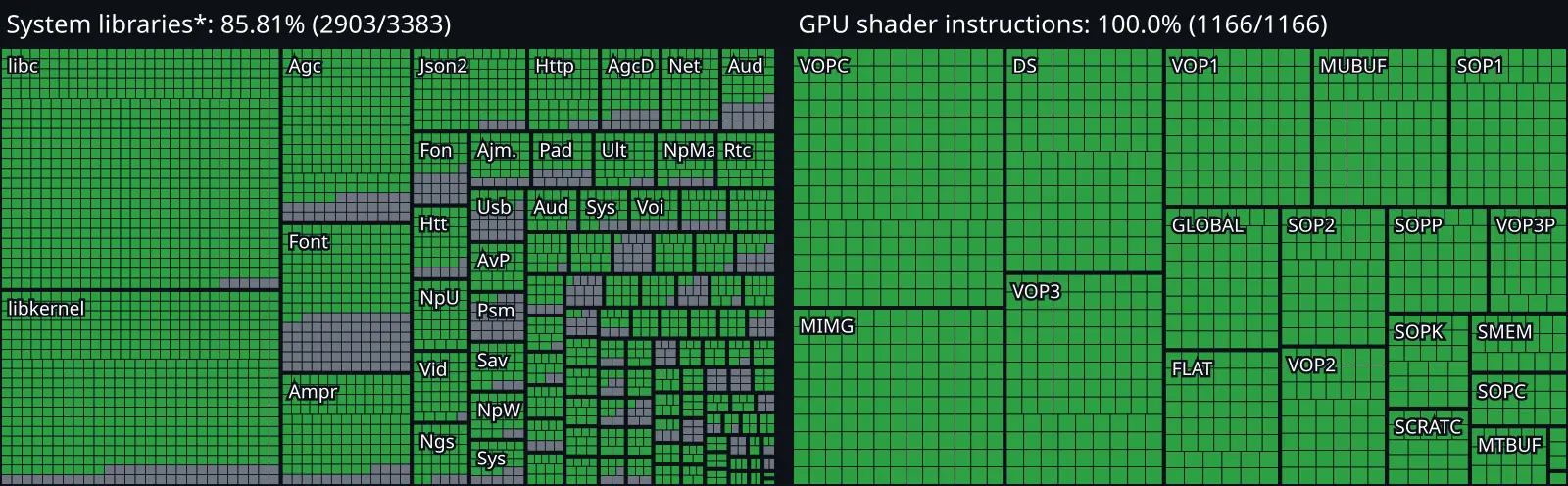
AnyPS5’s live project dashboard now shows its decoder recognizing all 1,166 instructions in the tracked AMD RDNA 1 and RDNA 2 set. That completes an instruction-recognition milestone; it does not mean the PS5 GPU is fully supported or that PS5 games are broadly playable on Windows or Linux.
The distinction matters because the project counts an instruction once the decoder recognizes it. Correctly translating shaders and handling graphics state, memory, synchronization, audio and system services are separate challenges. The 100% figure is meaningful progress on one part of the work, not a compatibility score.
The same dashboard reports 2,903 of 3,383 declared system-library functions at 85.81%. The project’s progress notes explain that this denominator covers functions declared in its codebase, not every API in PS5 firmware. It should not be read as 85.81% of the console’s operating system being implemented.
The current compatibility list marks Dreaming Sarah as playable on Windows, with the project reporting 60 FPS on a GTX 1050 Ti and Core i5-7500. It lists the DOOM Shareware homebrew port only as “In game,” with different limits on Windows and Linux. Each title still needs its own validation; a completed decoder milestone does not establish that commercial games work.
Dashboard graphic: AnyPS5 project, checked October 11, 2026. See the [live progress dashboard](https://boykopovar.github.io/AnyPS5/), [project compatibility list](https://github.com/boykopovar/AnyPS5/blob/main/docs/user/COMPATIBILITY.md), [progress methodology](https://github.com/boykopovar/AnyPS5/blob/main/docs/dev/PROGRESS.md) and [Tom’s Hardware’s explanation of the GPU milestone](https://www.tomshardware.com/video-games/playstation/anyps5-reaches-critical-gpu-milestone-with-100-percent-shader-instruction-coverage-ps5-games-running-natively-on-pc-still-far-off).
~PS5Scene
BlackBox has moved beyond its early preview: the project now has a public repository, and its latest tagged release, v1.0.8, was published on October 9. The release page does not label it as a beta; versions 1.0.6 and 1.0.7 were marked beta.
The update focuses on the app’s interface and download management. The developer lists a six-column discovery grid, a redesigned game page, a drawer that separates download sources and formats, and an option to choose a default storage drive. The selected game can also set the interface accent colour and DualSense light bar. Music, interface sounds and vibration can be configured separately.
The release notes also describe retries for stalled downloads, more tolerant timeouts for slow hosts, and another ShadowMount scan after a download. From version 1.0.8 onward, the app says it checks for updates when opened. These are the developer’s claims; the release notes are not independent compatibility or performance tests.
One important clarification: despite its storefront-style interface, BlackBox says it does not host game files. Its repository describes the catalog as metadata and says the project is not a game store or content distributor. It also says the app is not intended for unauthorized access or piracy. The README does not list supported PS5 firmware versions, so compatibility should not be assumed.
Sources: BlackBox v1.0.8 release notes · Project repository and README
https://github.com/D3ATHLY/blackbox
https://github.com/D3ATHLY/blackbox/releases/tag/v1.0.8
~Gaming
The latest public Relapse release still lists support only through PS5 firmware 13.60. That leaves consoles on 14.00 and later outside the project’s published range, including Sony’s October 1 update, 26.06-14.10.00. Relapse’s README does not claim support for either 14.x version.
Sony’s notes for 14.10 mention security fixes and improved performance and stability, but do not identify the vulnerabilities addressed. Some coverage has linked the timing to Relapse; Sony has not confirmed that this update specifically patches the exploit. The distinction matters: the public compatibility limit is clear, while the exact security changes are not.
Released on September 29, Relapse substantially widened the range of PS5 firmware covered by a public jailbreak. Its repository describes a browser-based WebKit stage followed by a kernel exploit, with an ELF loader for running further code. Ars Technica reported that the release reaches consoles up to 13.60 and also covers PS5 Pro systems on supported firmware. It is a chain of exploits, not a permanent unlock or a promise that every payload and app will work.
There are practical caveats. Relapse’s own notes say the browser stage may take several tries and that the kernel stage can hang or panic the console. The project lists firmware 7.00 through 13.60 as supported; that range is the best reference for checking a console’s eligibility. The broader homebrew scene continues to build around the release, but newer loaders or payload projects do not by themselves extend Relapse to 14.x.
For now, the firm update is about the boundary: 13.60 remains the newest firmware listed by the Relapse project, while 14.00 and 14.10 are outside its stated support. Sony’s 14.10 notes do not say whether every relevant exploit path is closed, and no public Relapse release for 14.x appears in the project’s current documentation.
Sources: [Relapse project and stability notes](https://github.com/ntfargo/Relapse-Exploit) · [Ars Technica’s report on the release](https://arstechnica.com/gaming/2026/09/ps5-jailbreaks-just-got-a-lot-more-useful/) · [Sony’s PS5 system software support page](https://www.playstation.com/en-us/support/hardware/ps5/system-software/)
~PS5Scene
## PS5 Jailbreak Guide — Living Thread
This guide is for people exploring homebrew on a PS5 they own or are authorized to modify. I’ll update it when the supported firmware list or recommended setup changes.
Last checked: October 11, 2026
## Before you start
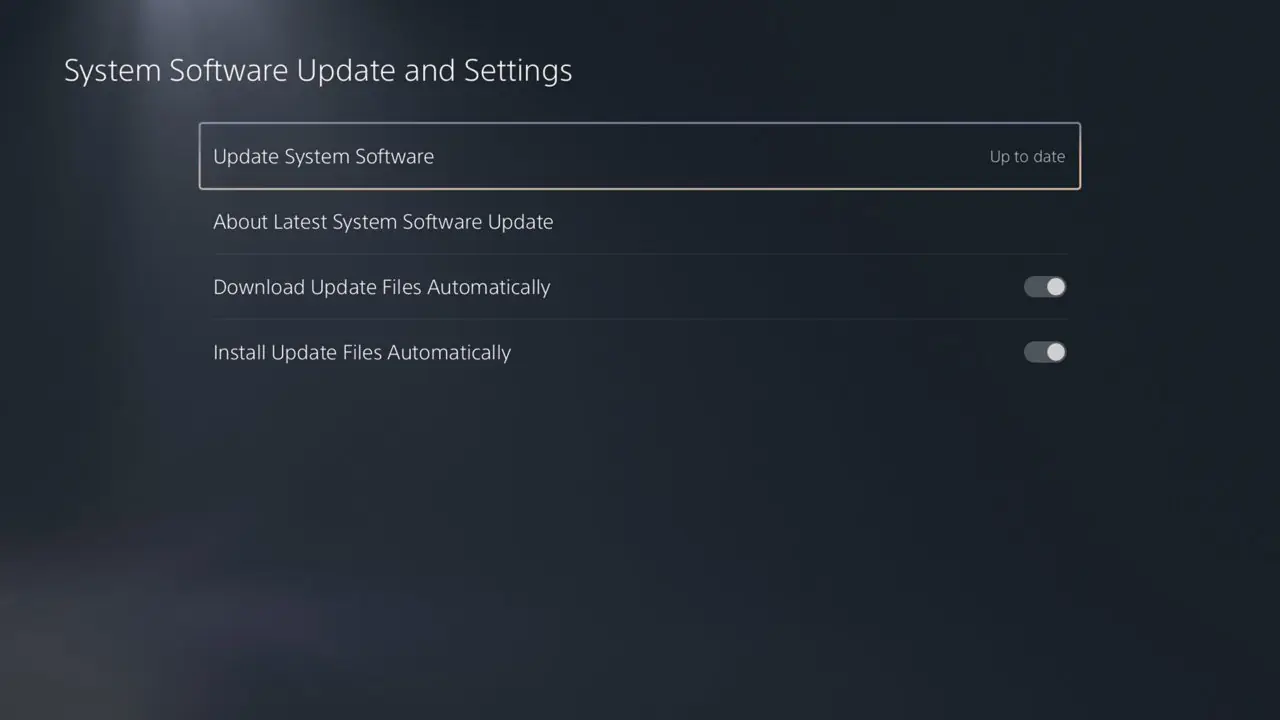
- Check the full system software version at Settings → System → System Software → Console Information. Match the complete version number below; “7.00–13.60” does not mean every build in that interval is supported.
- If keeping jailbreak compatibility matters to you, do not update the console until you have checked the current exploit and payload compatibility. A newer system update can close the entry point.
- These are unofficial, experimental tools. A failed run can freeze or crash the console. Back up important data first. The exploit must be run again after a full reboot; it does not replace Sony’s system software.
- Use this only for lawful homebrew on a console you own or are authorized to test. Do not use it for piracy or unauthorized access. Online use can risk account or console restrictions.
## Firmware compatibility
Relapse is publicly listed for PS5 firmware 7.00 through 13.60, but only the exact builds below are in its current support list:
- 7.xx: 7.00, 7.01, 7.20, 7.40, 7.60, 7.61
- 8.xx: 8.00, 8.20, 8.40, 8.60
- 9.xx: 9.00, 9.20, 9.40, 9.60
- 10.xx: 10.00, 10.01, 10.20, 10.40
- 11.xx: 11.00, 11.20, 11.60
- 12.xx: 12.00, 12.02, 12.20, 12.40, 12.60, 12.70
- 13.xx: 13.00, 13.20, 13.40, 13.42, 13.60
Not on that Relapse list: 9.05, 10.60 and 11.40. The current WebKit Autoloader release routes 9.05 and 11.40 to Poops instead of Relapse. Version 0.6.1, released October 8, adds missing offsets to fix Poops support on 9.05, 11.40 and 11.60; its notes explicitly say Relapse remains unsupported on 9.05 and 11.40. Firmware 11.60 is also on Relapse’s supported-build list, so check which options the current installer offers for your exact firmware rather than assuming one route is preferable. For 10.60, check the current release’s firmware detector and instructions before proceeding; do not try the Relapse route unless the project explicitly lists your build. Firmware below 7.00 uses a different route in the Autoloader project (umtx2 is listed for 1.00–5.50). Firmware 6.xx and firmware above 13.60 are outside the support described here.
The maintainers’ live compatibility list is the source of truth: [Relapse supported builds](https://github.com/soniciso1/relapse). The original exploit project is [ntfargo/Relapse-Exploit](https://github.com/ntfargo/Relapse-Exploit).
## Setup guide for a supported build
The steps below use the open-source WebKit Autoloader, which provides a repeatable setup and lets its firmware detection choose a documented route. Follow the project’s release notes if they differ from this summary.
1. Confirm your exact firmware using the menu path above. Check it against the exact Relapse build list and the Autoloader’s current release notes. Stop if your build is not listed or the detection result does not match it.
2. Download the current stable release, currently v0.6.1, from the [WebKit Autoloader releases page](https://github.com/itsPLK/ps5-webkit-autoloader/releases). Use the host program for your computer’s operating system. Avoid unofficial mirrors and repackaged payload bundles.
3. Run the host on a computer on the same local network as the PS5. Follow the release README. For the initial install, the README says to point the PS5’s DNS to that computer’s local IP address, then open the User’s Guide from Settings to run the installer.
4. When installation finishes, find WebKit Autoloader on the PS5 home screen and launch it. For Relapse on 12.02–13.60, the console needs an active Wi-Fi or Ethernet connection to the local network; internet access is not required. Keep the connection active while the exploit runs.
5. If the exploit succeeds, the loader opens Payload Manager unless a custom `autoload.txt` configuration is installed. Start only payloads that explicitly support your firmware, and use their maintainers’ instructions.
6. After a full reboot, launch the Autoloader again to re-run the temporary exploit. If the browser stalls or the console reports a kernel panic, follow the project’s recovery notes; do not keep forcing power cycles.
The [Autoloader README](https://github.com/itsPLK/ps5-webkit-autoloader) has the current setup instructions, network requirements and payload configuration details. See the [v0.6.1 release notes](https://github.com/itsPLK/ps5-webkit-autoloader/releases/tag/v0.6.1) for the Poops offsets and the Relapse limitations on 9.05 and 11.40.
## Known risks and limits
Relapse may need more than one attempt; its maintainers warn that it can hang or panic the console. Unofficial payloads can add their own compatibility and stability risks. The exploit is temporary, support changes as projects are updated, and there is no guarantee of PSN access. Stop if your exact firmware or the files you downloaded do not match the maintainers’ documentation.
## Update log
- October 11, 2026: Checked the v0.6.1 Autoloader release and clarified its Poops fixes for 9.05, 11.40 and 11.60, plus the continuing Relapse exclusions for 9.05 and 11.40.
- October 3, 2026: Added the exact Relapse firmware list through 13.60, current route notes for 9.05 and 11.40, and the WebKit Autoloader setup path.
Image: PlayStation system software settings screen, from [PlayStation Support](https://www.playstation.com/en-us/support/hardware/ps5/system-software/). Primary references: [Relapse build list](https://github.com/soniciso1/relapse) · [Relapse exploit project](https://github.com/ntfargo/Relapse-Exploit) · [WebKit Autoloader v0.6.1 release](https://github.com/itsPLK/ps5-webkit-autoloader/releases/tag/v0.6.1) · [Autoloader setup instructions](https://github.com/itsPLK/ps5-webkit-autoloader) · [PlayStation 5 system software support](https://www.playstation.com/en-us/support/hardware/ps5/system-software-info/)
~PS5Scene
# TheFlow Quits PS5 Linux Development, Putting PS5 Pro Support on Hold
**PlayStation security researcher Andy Nguyen, better known as TheFlow, has announced that he is stepping away from the PS5 scene and ending his work on PS5 Linux, including planned support for PS5 Pro.**
Nguyen [confirmed his departure](https://x.com/theflow0/status/2099987019954831744) after months of work on the project, saying he had originally planned to finish PS5 Pro compatibility and publish it in 2027.
That release is now unlikely to happen through Nguyen himself.
His decision does not appear to stem from a major technical obstacle. Instead, TheFlow has pointed to frustration with the direction of the PS5 hacking community, particularly the growing use of large language models to discover vulnerabilities and generate exploit code.
A dispute involving a PS5 hypervisor vulnerability also appears to have played a major role in his decision.
## TheFlow had been working on PS5 Pro Linux support
Nguyen says he spent several months developing the PS5 Linux project and had already started preparing support for Sony’s newer PS5 Pro hardware.
The plan was reportedly to finish the work and make it public in 2027.
That development has now stopped, leaving PS5 Pro without an official path to Linux support through TheFlow’s project.
The current public codebase still focuses on the original PS5 and PS5 Slim, while the PS5 Pro work appears to have remained private.
This distinction is important because other developers can continue working on the existing open-source project, but they cannot simply pick up Nguyen’s unfinished PS5 Pro implementation if the relevant code was never published.
## AI-assisted exploit development became a point of frustration
One of the main issues raised by Nguyen concerns the increasing use of AI tools in security research.
He argues that parts of the console hacking scene are becoming more dependent on large language models for finding bugs and producing exploit code.
According to his comments, this can result in developers creating working exploits without necessarily understanding all of the low-level mechanisms involved.
That criticism represents Nguyen’s own view of the current PS5 research community and should not be interpreted as applying to every developer involved in console modding.
Still, his comments reflect a broader change taking place across software security, where AI tools are increasingly being used for reverse engineering, source-code analysis and vulnerability discovery.
## A PS5 hypervisor vulnerability appears to have triggered the decision
The immediate trigger behind Nguyen’s departure appears to involve a previously unknown PS5 hypervisor vulnerability.
Nguyen says he had already discovered the flaw and intended to keep it private for future research.
Another researcher later reported the vulnerability to Sony after a third party apparently identified the same issue using AI-assisted tools.
For Nguyen, that effectively removed one of the remaining valuable vulnerabilities available for his research.
He claims that the bug was the final usable hypervisor vulnerability within the environment he had been working with.
## Why PS5 hypervisor exploits are so valuable
The hypervisor sits at a highly privileged level within the PlayStation 5 security architecture.
Breaking through that layer can potentially provide significantly more control over the system than exploits limited to the browser or even parts of the operating-system kernel.
That level of access is particularly valuable for projects such as Linux, hardware research and advanced homebrew development.
Nguyen had reportedly chosen not to disclose the vulnerability immediately because keeping it private would allow it to remain useful for future PS5 development.
He also says that he asked other researchers to delay reporting the flaw until after the release of **Grand Theft Auto VI**.
The idea was that users with vulnerable consoles could potentially purchase and play the game legally while still keeping firmware versions suitable for Linux and homebrew research.
According to Nguyen, the researchers initially agreed to wait, but the vulnerability was ultimately reported to Sony soon afterward.
## Vulnerable PS5 consoles may still remain exploitable
Sony being informed about the vulnerability does not automatically disable it on every PS5.
The company would generally need to patch the issue through a system software update.
Consoles that remain on older, vulnerable firmware versions could therefore potentially continue using the exploit if researchers eventually release working code for it.
This is already common within console hacking communities, where users interested in homebrew often avoid firmware updates in order to preserve known vulnerabilities.
## Linux already runs on PS5 and PS5 Slim
TheFlow’s departure does not affect the Linux code that has already been released.
The public **ps5-linux-loader** project remains available and supports selected versions of the original PS5 and PS5 Slim.
Depending on the console and exploit used, compatibility currently covers firmware versions ranging approximately from **3.00 to 7.61**.
Earlier work has already demonstrated that full Linux distributions can boot on compatible PS5 systems.
Ubuntu has also been [successfully demonstrated running on PS5 hardware](https://fanaticosdelhardware.com/ps5-ejecuta-ubuntu-26-04-con-kernel-linux-7-0-tras-publicarse-el-metodo-completo-de-jailbreak/).
The Linux environment can access a surprisingly large amount of PS5 hardware.
Existing implementations support features including HDMI output at up to 4K60, M.2 SSD storage, Ethernet, internal Bluetooth and Blu-ray hardware.
Developers have also made progress with AMD GPU support through Linux graphics drivers.
## PS5 Linux can access the console’s full CPU
One of the most significant achievements of the project is access to the PS5’s CPU configuration.
Linux can use all **8 cores and 16 threads** of the console’s Zen 2 processor.
Available tools also allow CPU frequencies of up to around 3.5 GHz, while the GPU can operate at frequencies close to 2.23 GHz under supported configurations.
The system still has limitations and cannot be treated exactly like a traditional PC.
Some hardware components remain partially supported or require workarounds, and the overall Linux experience depends heavily on the console firmware and exploit chain being used.
Even so, the project has progressed far enough for users to run applications such as **Steam and multiple emulators**.
That makes PS5 Linux one of the most technically significant developments in the PlayStation 5 homebrew scene so far.
## Open-source development can continue without TheFlow
The future of the project is not entirely dependent on Nguyen.
The **ps5-linux-loader** repository is distributed under the GPL-3.0 licence, allowing other developers to study, modify and fork the existing code.
That means support for the original PS5 and PS5 Slim can continue evolving even without TheFlow’s direct involvement.
PS5 Pro presents a much bigger challenge.
Nguyen’s unfinished PS5 Pro work does not currently appear in the public repository, meaning future developers may need to independently reproduce much of the research required to support the newer console.
The loss is therefore much more significant for PS5 Pro than for older models.
## PS5 Pro Linux now has an uncertain future
TheFlow’s exit does not prove that Linux will never run on PS5 Pro.
Other researchers could eventually develop their own implementation, and previously vulnerable firmware may continue to offer opportunities even after Sony patches newer system versions.
However, losing several months of unpublished work from one of the most experienced PlayStation security researchers creates a substantial setback.
For now, **PS5 Linux remains alive on original and Slim consoles, while PS5 Pro support has effectively been left without a roadmap**.
The existing open-source code can still be developed by the community, but replacing Nguyen’s private PS5 Pro research may require significant additional reverse engineering.
His departure also illustrates how rapidly AI tools are changing vulnerability research.
LLMs can make exploit development and code analysis more accessible, but TheFlow’s criticism highlights an ongoing debate over the difference between generating working exploit code and fully understanding the systems being attacked.
For the PS5 scene, however, the immediate consequence is much simpler: one of its most prominent researchers has stepped away, and PS5 Pro Linux development has lost its expected 2027 release path.