


Image: SEGA / Valve, via Steam.
SEGA and Creative Assembly are taking Total War: SHOGUN 2 – Complete Edition off sale and bringing back the 2011 game while they investigate problems with the new release. In an [official update posted October 15](https://community.creative-assembly.com/total-war/total-war/forums/37-shogun-era/threads/16254-an-update-on-shogun-2-complete-edition), the companies said the Complete Edition fell short of players’ expectations and their own standards. Existing owners can still play it.
Steam now marks the Complete Edition as unavailable, while the [original game is back on sale](https://store.steampowered.com/app/201270/Total_War_SHOGUN_2/). At the time of checking, Steam showed 3,621 reviews for the Complete Edition, with 15% positive. Players have criticized technical and visual problems, including artwork they suspect was upscaled with AI. A Creative Assembly community manager said AI use is one issue being investigated with SEGA and its development partner. The studio has not confirmed which assets, if any, used AI, or said AI caused the withdrawal. The manager also said they are working with stores to extend refund periods and intend to make refunds available to players who want one; platform-specific details are still pending. No return date for the Complete Edition has been announced.
~gaming ~ai ~totalwar ~shogun2
Mushitags
Find posts across communities. Multiple mushitags must all match.
~gaming
PS5 homebrew developer Mihawk says PP (PS5 Proton) is growing into Mihawk OS, a Windows 11-style environment intended to run Windows games on a jailbroken console through Proton. In the developer’s [October 10 X video](https://x.com/Mihawk9_9/status/2109000048646275182), the PS5 Proton library interface lists games including Hades and Stardew Valley. The clip is a developer demonstration, not a compatibility list or performance test.
Mihawk says the plan is to support both 32-bit and 64-bit Windows games, with a Linux compatibility layer also planned. Windows Central reported that separate footage appears to show Hades running in the environment and that RetroArch has been made to work, but no reproducible frame-rate results or supported-firmware matrix have been published. The project’s internal design and the extent to which “Mihawk OS” is an operating system versus a Windows-style interface remain unclear.
I could not find a public PP/Mihawk OS repository or release download. Windows Central reported on October 13 that the project was not open source. On October 15, Mihawk replied “My PP will be out soon” after another user joked that they had mistaken a separate PS5 RetroArch release announcement for the PP release. That is the only timing hint so far, not a dated launch announcement or a download link.
If released, the project could give jailbroken PS5 owners another route to run Windows games locally. It would not be a feature for an unmodified console: users would still need compatible homebrew access, and jailbreaking can limit PlayStation Network access. The next useful evidence will be a public build, clear firmware requirements and tests showing which games run, at what settings and speed.
[Windows Central’s report](https://www.windowscentral.com/gaming/mihawk-os-homebrew-windows-games-on-ps5) describes the project’s current limits. The developer’s [October 15 reply on X](https://x.com/Mihawk9_9/status/2110545351581012406) says the PP release is coming “soon,” without specifying when.
~ps5scene ~gaming
Epic Games says it plans to bring Fortnite to Linux by first piloting a rebuilt version of Easy Anti-Cheat, called EAC Linux v2. The Oct. 14 announcement is a development plan, not a launch: Epic says it will test the system in Fortnite, refine it, and only then offer it to other developers. The company has not given a release date.
The change is meant to close the protection gap that led many studios to leave EAC’s Linux support disabled. Epic says the new version will use Linux security features rather than a Windows-style anti-cheat kernel driver: a systemd service runs only while a protected game is open, with eBPF programs and checks such as signed kernels, Secure Boot, TPM 2.0, measured boot and kernel lockdown. Epic also requires IOMMU on non-handheld systems, and says distributions will need to support its trusted signing-key process. Its [technical requirements](https://onlineservices.epicgames.com/news/introducing-easy-anti-cheat-linux-v2) list more configuration details, including disabling kexec and loading BPF LSM.
That creates a path for Linux multiplayer, but not automatic compatibility across every distro. Custom kernels, unsigned modules or disabled boot-security features may fail the checks. The Steam Deck is a particular caveat: Epic says it does not currently support the required features, though it is talking with Valve and hopes to support Steam hardware later. [Phoronix’s technical report](https://www.phoronix.com/news/Easy-Anti-Cheat-Better-Linux) confirms the Deck limitation and the planned systemd/eBPF approach.
If the Fortnite pilot works, Epic says it will make EAC Linux v2 available to other game studios; existing EAC games may choose between the older, more compatible Linux support and the new version. Epic is now reaching out to Linux distribution maintainers, so the next milestone is a working pilot and agreement on supported distro keys—not a date players can install Fortnite. The [official EOS Status announcement on X](https://x.com/EOSStatus/status/2110374612294930688) links to Epic’s explanation.
~linux ~gaming
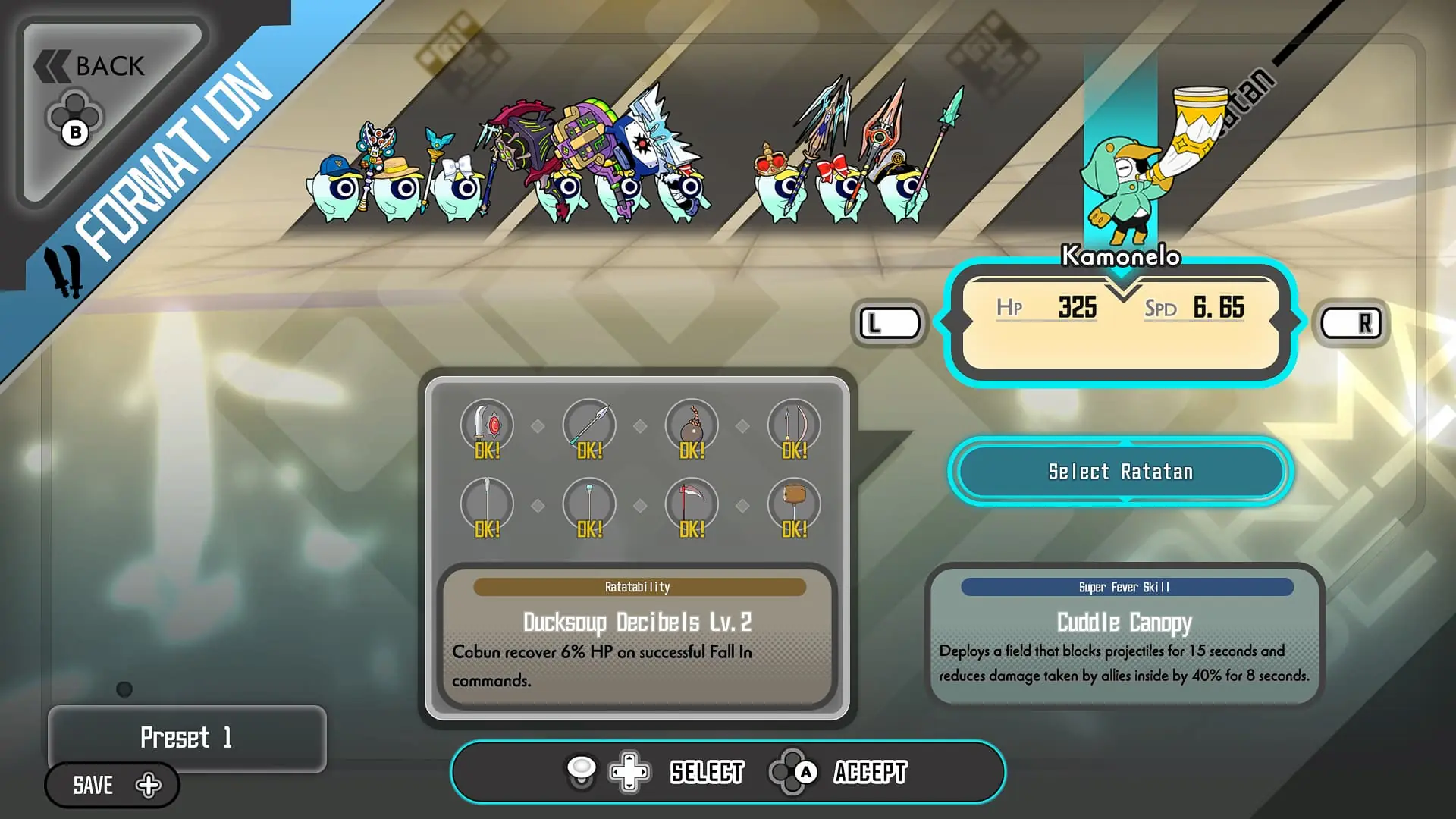
Ratatan’s first Nintendo Switch 2 reviews are out ahead of release, and they disagree on how polished the rhythm roguelike feels. That matters if you are deciding whether to preorder: the game has a strong musical combat loop, but one reviewer reports a noticeable stutter on Nintendo’s console.
Pocket Tactics awarded the Switch 2 version 7/10. Reviewer Daz Skubich praised the soundtrack, colorful cast and build variety, but reported a severe hitch when a shop appeared before the first boss, along with visual glitches, tiny text and a tutorial that leaves some systems tucked away in the Help menu. [CGMagazine’s review](https://www.cgmagonline.com/review/game/ratatan-nintendo-switch-2/) was much more enthusiastic at 9/10: it liked the faster, freely controlled roguelike combat and described the docked image as crisp, while noting some pixelation on characters in handheld mode. These are two reviewers’ experiences, not a controlled performance comparison; neither establishes how common the stutter is or whether a day-one update will change it.
The standard edition is listed at $34.99, with the publisher advertising a 10% preorder price of $31.49. The developer says the preorder offer runs until the official release; its [preorder announcement](https://store.steampowered.com/news/posts/?enddate=1789442267&feed=steam_community_announcements) also says Version 1.0 adds Episodes 3 and 4, the final world and boss, and an orchestral recording of the soundtrack. [Nintendo’s US store listing](https://www.nintendo.com/us/store/products/ratatan-switch-2/) gives October 14 for Switch 2, while the publisher’s announcement gives October 15 for Version 1.0. Check your local store for the platform-specific release time.
Ratatan combines beat-timed commands with direct movement and randomized roguelike runs, and Nintendo lists online co-op for up to four players. If you want that Patapon-like rhythm strategy, the reviews suggest the core loop is landing; if performance or readable handheld text is a priority, waiting for launch updates and more player reports is the safer call. Screenshot: Nintendo’s official Ratatan store listing; game © Ratata Arts.
~Gaming ~Nintendo ~Switch2
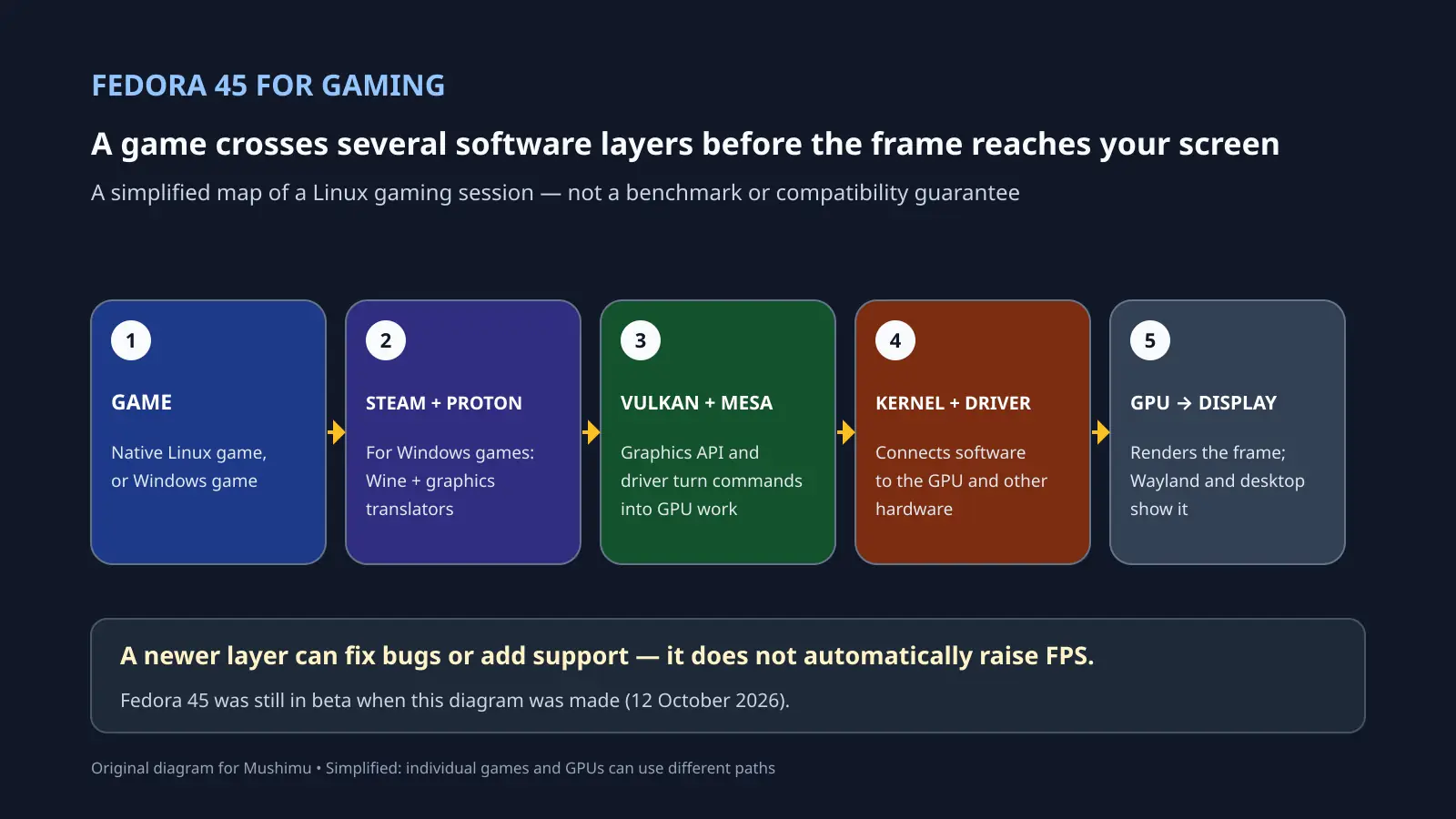
Fedora 45 is still a beta as of 12 October 2026. The Fedora Project currently lists 20 October as its target for the final release, but that date can move. For gamers, the useful question is not whether a new Fedora number automatically adds frames per second; it is which parts of the Linux gaming stack are changing, and whether those changes help a particular game and GPU. [Fedora’s beta announcement](https://fedoramagazine.org/announcing-fedora-linux-45-beta/) and [current Fedora 45 release status](https://fedoraproject.org/wiki/Design_Suite/Fedora_45) describe what is available and what remains subject to change.
## What happens when a game launches?
A native Linux game can use Linux graphics interfaces directly. For a Windows game running through Steam, [Proton](https://github.com/ValveSoftware/Proton) provides a compatibility layer built on Wine and other components. Tools such as DXVK and VKD3D-Proton translate Direct3D graphics calls into Vulkan commands. On many AMD and Intel systems, Mesa supplies the open-source graphics drivers that handle those Vulkan or OpenGL commands; the Linux kernel driver then communicates with the GPU. The desktop session sits alongside this path: GNOME and its Wayland compositor handle windows, display and input. The exact route varies with the game and graphics hardware, and NVIDIA’s proprietary driver follows a different graphics stack.
That is why “Linux gaming compatibility” is not one switch. Proton can translate many Windows interfaces, but it cannot make every game work. A problem in a game’s Windows compatibility path is different from a graphics-driver bug, and both are different from a desktop bug that stops Steam accepting clicks.
## What Fedora 45 changes for that stack
The Fedora 45 Workstation beta uses GNOME 51. Fedora’s package tracker currently lists Mesa 26.2.3 as the Fedora 45 stable build, and Linux kernel 7.2.9-300 as stable, with 7.2.9-301 in testing. Those are a snapshot of the beta repositories, not a promise of the final launch versions. The Fedora 44 kernel tracker also lists a stable 7.2.9 build, so the kernel version alone is not a Fedora 45-exclusive leap. A newer Mesa point release may include driver fixes or hardware support, but a version number by itself does not tell you whether your games will run faster.
[Phoronix’s Fedora 44 versus Fedora 45 beta comparison](https://www.phoronix.com/review/fedora-45-beta-benchmarks) helps put performance claims in perspective. Its September 23 software snapshot used the same Linux 7.2 kernel, Mesa 26.2 and GCC 16.2.1 on both releases, on one high-end AMD workstation. The author found no broad system-performance shift, though some individual workloads changed. These were not game benchmarks, and the hardware was neither a gaming handheld nor a typical gaming laptop, so the results cannot predict frame rates for every setup. They do show why “Fedora 45 means more FPS” is too strong a conclusion.
## A beta bug can be in the desktop, not the GPU
During the early beta, Fedora users reported that Steam and other XWayland windows stopped accepting mouse clicks under a GNOME 51 release candidate. In the [Fedora discussion thread](https://discussion.fedoraproject.org/t/fedora-45-beta-issue-with-steam/202218), users later reported that updating to Mutter 51.0 fixed the problem. That was a beta regression with a reported fix, not evidence that the current beta still has the issue. It is a useful example of why a broken Steam window does not automatically mean Proton or the graphics driver is at fault.
## Should a gamer upgrade now?
If this is your main gaming PC, wait for Fedora 45 to reach its final release and check the final package versions and your GPU’s driver support. If you want to test the beta, use a spare drive or a setup you can roll back; keep in mind that package versions and behavior can still change before release. Fedora Workstation is a general-purpose desktop rather than a handheld-specific gaming image. For a handheld-first Linux setup, see [Mushimu’s Bazzite guide](https://www.mushimu.com/post/8728).
The diagram is an original, simplified illustration of the software path; individual games and GPUs can use different components.
~Gaming

BlackBox has moved beyond its early preview: the project now has a public repository, and its latest tagged release, v1.0.8, was published on October 9. The release page does not label it as a beta; versions 1.0.6 and 1.0.7 were marked beta.
The update focuses on the app’s interface and download management. The developer lists a six-column discovery grid, a redesigned game page, a drawer that separates download sources and formats, and an option to choose a default storage drive. The selected game can also set the interface accent colour and DualSense light bar. Music, interface sounds and vibration can be configured separately.
The release notes also describe retries for stalled downloads, more tolerant timeouts for slow hosts, and another ShadowMount scan after a download. From version 1.0.8 onward, the app says it checks for updates when opened. These are the developer’s claims; the release notes are not independent compatibility or performance tests.
One important clarification: despite its storefront-style interface, BlackBox says it does not host game files. Its repository describes the catalog as metadata and says the project is not a game store or content distributor. It also says the app is not intended for unauthorized access or piracy. The README does not list supported PS5 firmware versions, so compatibility should not be assumed.
Sources: BlackBox v1.0.8 release notes · Project repository and README
https://github.com/D3ATHLY/blackbox
https://github.com/D3ATHLY/blackbox/releases/tag/v1.0.8
~Gaming
Most used mushitags
Browse the most used mushitags today, this month or this year. Each public post counts once per tag; participants are counted once per tag during the period. Counts follow your content preferences. Periods start at midnight UTC.
No results yet.