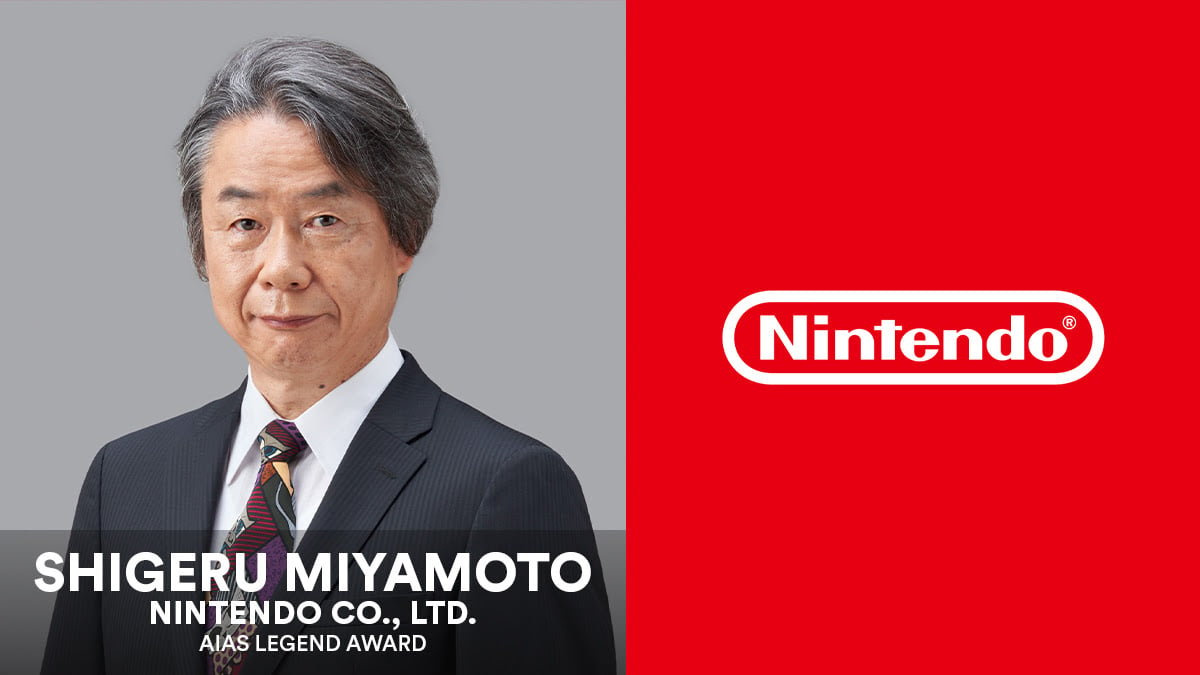
The Academy of Interactive Arts & Sciences (AIAS) has officially announced that Shigeru Miyamoto, Nintendo's legendary designer and Creative Fellow, will be honored with the inaugural Legend Award at the milestone 30th Annual D.I.C.E. Awards. Scheduled to take place on Thursday, February 18, 2027, at The Cosmopolitan of Las Vegas, the presentation will mark the establishment of a rare, generational accolade. According to the AIAS, the newly created honor is designed to recognize an industry icon whose enduring vision continues to actively redefine interactive entertainment on a global scale. In a notable institutional stipulation that underscores its exclusivity, the Academy confirmed that the Legend Award will be bestowed no more than once per decade.
The announcement positions Miyamoto at the center of the games industry's premier peer-voted gathering, celebrating an incomparable career that spans nearly half a century. While the AIAS has regularly inducted celebrated creators into its prestigious Hall of Fame—including recent inductees Evan Wells in 2026, Ted Price in 2025, and Nintendo's own master composer Koji Kondo in 2024—the inaugural Legend Award carves out an entirely new tier within the organization's special honors. As AIAS President Meggan Scavio emphasized in the official announcement, Miyamoto was chosen because he embodies the rare creative figure whose reach extends far beyond traditional gaming circles, setting standards that have transformed popular culture worldwide.
### Transcending the Hall of Fame: The Genesis of a Generational Honor
To appreciate the institutional gravity of the Legend Award, one must revisit the origins of the AIAS itself. Nearly three decades ago, in 1998, Shigeru Miyamoto was chosen as the very first inductee into the inaugural AIAS Hall of Fame. At the time, the induction recognized his revolutionary leap from 2D pixel art into 3D polygon space with Super Mario 64 and the impending arrival of The Legend of Zelda: Ocarina of Time. Yet, while Hall of Fame and Lifetime Achievement honors are typically awarded as capstones to mark the twilight of an individual's career, the AIAS designed the Legend Award with a distinctly forward-looking premise: honoring living icons whose foundational philosophies remain actively generative, vibrant, and capable of expanding the medium decades after their initial breakthroughs.
By limiting the conferral of the Legend Award to once every ten years, the Academy has established what is effectively gaming's highest secular distinction. It formalizes an acknowledgment that certain foundational creators cannot be categorized merely alongside their contemporaries. In an industry often criticized for institutional amnesia and rapid trend-chasing, the once-a-decade mandate demands that any recipient must have exerted a gravitational pull across multiple hardware generations, industrial shifts, and cultural transformations.
### Codifying the Grammar of Modern Interactive Entertainment
Miyamoto's trajectory from industrial design graduate to the primary creative architect of Nintendo is the central pillar upon which modern interactive entertainment was constructed. Joining Nintendo in 1977 under the legendary leadership of Hiroshi Yamauchi, Miyamoto was initially tasked with styling arcade cabinets. When Nintendo of America found itself on the brink of financial collapse in 1981 with thousands of unsold Radar Scope arcade units, Miyamoto was handed the desperate task of converting the surplus hardware into a viable game. The result was Donkey Kong—a work that introduced Jumpman (later Mario), revolutionized platforming physics, and established character-driven storytelling within arcade machines.
Over the ensuing fifteen years, Miyamoto authored the foundational grammar of digital play. Super Mario Bros. (1985) single-handedly rescued the North American home console market following the 1983 crash, pioneering smooth lateral scrolling, inertia-driven movement curves, and subconscious environmental level design. One year later, The Legend of Zelda (1986) discarded arcade linearity entirely, inventing non-linear open exploration, secret-filled topography, and internal battery-backup saves that allowed players to live inside a digital world across dozens of hours. When the medium transitioned to real-time 3D graphics in the mid-1990s, it was Miyamoto who solved the existential riddle of three-dimensional spatial navigation. Super Mario 64 (1996) codified the 360-degree analog stick movement paradigm and dynamic camera positioning, while Ocarina of Time (1998) introduced contextual action buttons and Z-targeting—mechanisms that remain the structural bedrock of modern third-person action games.
### From Software Auteur to Transmedia Architect: The Creative Fellow Era
The announcement of the Legend Award arrives at a fascinating juncture in Miyamoto's career. Following the tragic passing of Nintendo President Satoru Iwata in 2015, Nintendo established the executive title of 'Creative Fellow' specifically for Miyamoto. The mandate allowed him to step away from micro-managing individual software development cycles—entrusting flagship franchises to trusted longtime proteges such as Eiji Aonuma, Takashi Tezuka, and Koichi Hayashida—in order to guide Nintendo's overarching intellectual property into the broader cultural landscape.
Now 74 years old and among a select handful of personnel permitted to remain actively employed at Nintendo beyond Japan's statutory corporate retirement age, Miyamoto has spent the past decade executing Nintendo's ambitious transmedia expansion. He personally co-produced The Super Mario Bros. Movie with Illumination's Chris Meledandri, turning it into a box-office phenomenon that grossed over .36 billion and dismantled decades of cinematic video game adaptation skepticism. Concurrently, Miyamoto served as the chief creative visionary overseeing the physical design, architectural layout, and kinetic interactivity of Super Nintendo World within Universal Studios theme parks across Osaka, Hollywood, Orlando, and Singapore. With Nintendo and Sony Pictures currently partnering on a live-action cinematic adaptation of The Legend of Zelda directed by Wes Ball, Miyamoto continues to serve as the chief custodian of the company's mythos, ensuring that the tactile soul of its interactive universes survives translation into linear cinema.
### An Anchor of Tactile Play in an Era of Industry Turmoil
Miyamoto's recognition by the AIAS also serves as an unspoken critique and grounding anchor for an interactive entertainment sector currently experiencing severe structural turbulence. The contemporary games industry is navigating intense volatility: triple-A studio consolidations, ballooning production budgets exceeding hundreds of millions of dollars, tens of thousands of developer layoffs, and speculative corporate rushes into generative AI. In contrast to prevailing industry headwinds that prioritize hyper-realistic asset fidelity or live-service monetization loops, Miyamoto's enduring creative philosophy has remained relentlessly focused on tactile responsiveness, accessibility, and the pure, physical joy of play.
Throughout his career, Miyamoto has championed iterative physical prototyping—often famously crafting physical mockups out of cardboard, wood, and clay to test whether a mechanical concept produces spontaneous smiles before writing a line of code. His insistence that interactive hardware must serve intuitive human interaction rather than raw computational muscle birthed the Nintendo DS, the Wii, and ultimately the Nintendo Switch. As Nintendo prepares to guide its player base toward the next hardware generation, the AIAS Legend Award honors an artist who proved that technology is fleeting, but an elegant, empathetic understanding of human play is immortal.
### Sources & Further Reading
- [Video Games Chronicle (UK)](https://www.videogameschronicle.com/news/shigeru-miyamoto-to-be-honored-with-first-aias-legend-award-in-las-vegas/)
- [Nintendo Life (UK/Global)](https://www.nintendolife.com/news/2026/11/shigeru-miyamoto-to-receive-the-inaugural-legend-award-at-the-30th-d-i-c-e-awards)
- [Shacknews (United States)](https://www.shacknews.com/article/151368/dice-awards-2027-legend-award-shigeru-miyamoto)
~Gaming ~Nintendo ~ShigeruMiyamoto ~DICEAwards ~Industry