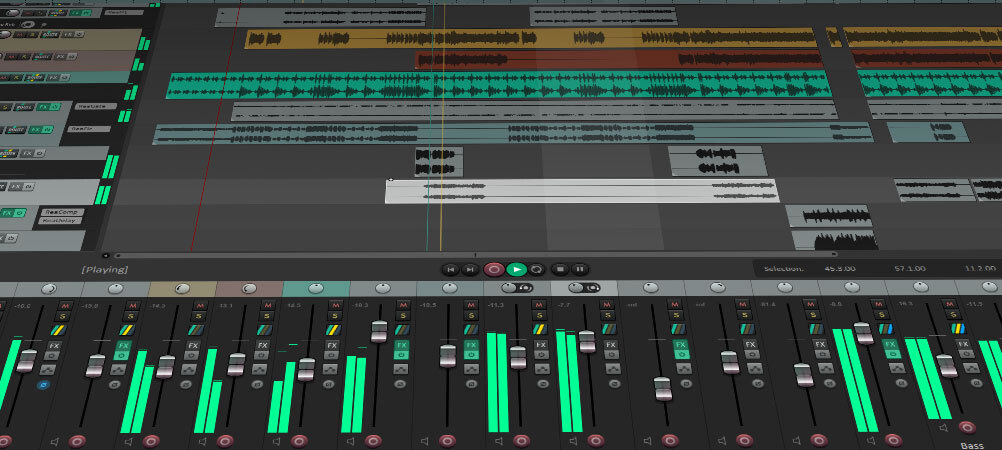
For years, professional audio production has been one of the last major holdouts keeping Linux users tethered to X11 sessions. Now, **REAPER**—Cockos’ widely adopted cross-platform digital audio workstation—has received a comprehensive native Wayland port submitted upstream by **Jason A. Donenfeld** (`zx2c4`, creator of WireGuard) alongside collaborator **Goran**.
Disclosed across [GitHub pull request #40](https://github.com/justinfrankel/WDL/pull/40) to Cockos’ open-source **WDL** (Woodpecker Development Library) repository on November 16 and highlighted on November 17 by [Phoronix](https://www.phoronix.com/news/REAPER-DAW-Wayland), the submission packs **52 commits** totaling **11,244 additions** across 22 files—also mirrored in Donenfeld’s [`WDL-wayland`](https://git.zx2c4.com/WDL-wayland/about/) tree. Rather than a quick compatibility shim, the patchset re-engineers how REAPER’s Linux GUI layer (`SWELL`) draws windows, scales across HiDPI displays, and hosts legacy plugins.
### Why Donenfeld Abandoned GTK and Built Directly on Wayland Protocols
Porting a mature DAW to Wayland is notoriously tricky because audio interfaces rely on dense real-time metering, custom drag-and-drop routing, and sub-frame responsiveness. Donenfeld explained in his submission letter to Cockos founder Justin Frankel that the team initially built a GTK-based Wayland backend—and even fixed numerous long-standing GDK and SWELL bugs along the way—before hitting a wall.
Because REAPER and Cockos’ `LICE` graphics engine already handle custom pixel rendering internally, synchronizing `LICE` surfaces against GTK’s complex frame scheduler introduced stubborn performance penalties. Once Goran demonstrated how to bypass GTK’s renderer for main surfaces, Donenfeld started fresh with `swell-generic-wayland` (+5,442 lines): a lean backend speaking native Wayland protocols directly. According to Donenfeld, testing across roughly a dozen Wayland compositors shows sharper HiDPI and multi-monitor behavior alongside faster frame delivery via hardware-accelerated zero-copy rendering and precise damage tracking.
### Solving Linux Audio’s Biggest Roadblock: X11 and `yabridge` Plugins
Even if a DAW itself speaks native Wayland, music producers cannot abandon thousands of third-party VST, VST3, LV2, and CLAP plugins—nor Windows plugins wrapped through `yabridge`—whose graphical editors still assume X11. Simply dropping X11 plugin windows would render a Wayland-native REAPER unusable in real studios.
Donenfeld’s answer is **`swell-xwayland-bridge`** (+4,223 lines), an internal bridge that spawns a small, private Xwayland instance dedicated solely to hosting X11 plugin editors. Rather than forcing the entire DAW onto Xwayland, the bridge composites plugin windows into REAPER’s native Wayland surfaces using **EGL zero-copy** (with `memfd` copying as fallback) while translating coordinate spaces, clipboard state, and pointer hooks behind the scenes. Donenfeld even coordinated directly with `yabridge` maintainer Robbert to squash interoperability edge cases, claiming plugin rendering under the Wayland bridge actually outperforms standard X11 sessions.
### Even X11 REAPER Users Benefit From an `XCB` Overhaul
Perhaps the quietest win inside PR #40 is what it fixes for Linux users who plan to stay on X11—including studios running older Nvidia drivers or legacy window managers. While untangling `swell-generic-gdk` to separate window backends from shared UI controls, Donenfeld replaced deprecated synchronous `Xlib` calls with asynchronous **`XCB`** requests.
Because `Xlib` relies on global lock state and blocking round-trips to the X server, dense DAW interfaces with dozens of floating meters and mixers can suffer unnecessary UI stalls. Migrating those paths to `XCB` cuts synchronous overhead across non-Wayland Linux builds too, complementing the ongoing Wayland stabilization seen across lightweight desktop stacks like [Xfce 4.22’s `xfwl4` effort](https://www.mushimu.com/post/9469).
### What Happens Before It Reaches Official REAPER Builds
For now, the native Wayland backend lives in upstream review on Cockos’ `WDL` repository rather than in the official **REAPER 7.86** release shipped on November 13 (documented in Cockos’ [release changelog](https://www.reaper.fm/whatsnew.txt)). Whether Justin Frankel merges PR #40 intact—and how quickly Cockos ships official Wayland-enabled Linux tarballs—will determine when everyday bedroom producers and commercial Linux studios can switch cleanly. Regardless of merge timelines, Donenfeld’s open-source `WDL-wayland` implementation proves that pro-audio latency and legacy plugin ecosystems no longer require keeping an entire desktop on X11.
### Sources & Further Reading
- [Phoronix](https://www.phoronix.com/news/REAPER-DAW-Wayland)
- [GitHub — Cockos WDL Pull Request #40](https://github.com/justinfrankel/WDL/pull/40)
- [zx2c4 Git — WDL-wayland Repository](https://git.zx2c4.com/WDL-wayland/about/)
- [REAPER Official Changelog](https://www.reaper.fm/whatsnew.txt)
~Linux ~Wayland ~REAPER ~AudioProduction ~OpenSource