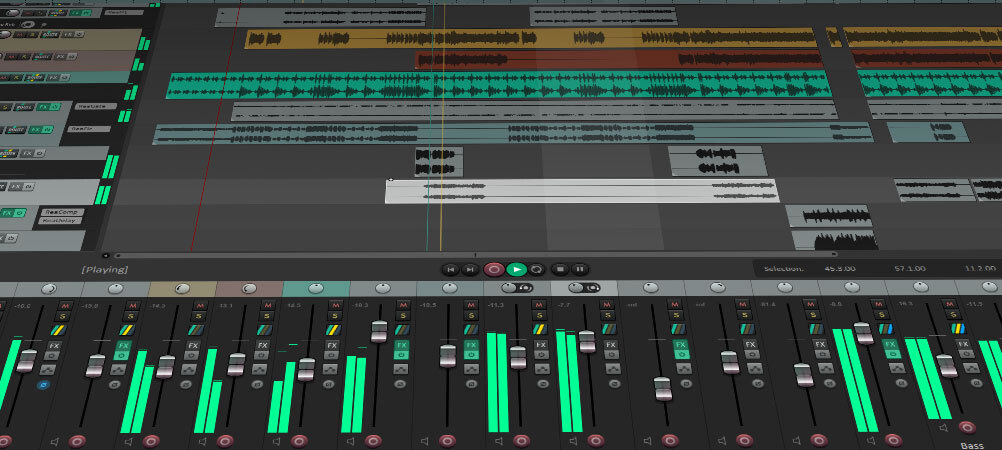
WireGuard Creator Jason Donenfeld Submits Native Wayland Port for REAPER With Seamless X11 Plugin Bridging
For years, professional audio production has been one of the last major holdouts keeping Linux users tethered to X11 sessions. Now, **REAPER**—Cockos’ widely adopted cross-platform digital audio workstation—has received a comprehensive native Wayland port submitted upstream by **Jason A. Donenfeld** (`zx2c4`, creator of WireGuard) alongside collaborator **Goran**. Disclosed across [GitHub pull request #40](https://github.com/justinfrankel/WDL/pull/40) to Cockos’ open-source **WDL** (Woodpecker Development Library) repository on November 16 and highlighted on November 17 by [Phoronix](https://www.phoronix.com/news/REAPER-DAW-Wayland), the submission packs **52 commits** totaling **11,244 additions** across 22 files—also mirrored in Donenfeld’s [`WDL-wayland`](https://git.zx2c4.com/WDL-wayland/about/) tree. Rather than a quick compatibility shim, the patchset re-engineers how REAPER’s Linux GUI layer (`SWELL`) draws windows, scales across HiDPI displays, and hosts legacy plugins. ### Why Donenfeld Abandoned GTK and Built Directly on Wayland Protocols Porting a mature DAW to Wayland is notoriously tricky because audio interfaces rely on dense real-time metering, custom drag-and-drop routing, and sub-frame responsiveness. Donenfeld explained in his submission letter to Cockos founder Justin Frankel that the team initially built a GTK-based Wayland backend—and even fixed numerous long-standing GDK and SWELL bugs along the way—before hitting a wall. Because REAPER and Cockos’ `LICE` graphics engine already handle custom pixel rendering internally, synchronizing `LICE` surfaces against GTK’s complex frame scheduler introduced stubborn performance penalties. Once Goran demonstrated how to bypass GTK’s renderer for main surfaces, Donenfeld started fresh with `swell-generic-wayland` (+5,442 lines): a lean backend speaking native Wayland protocols directly. According to Donenfeld, testing across roughly a dozen Wayland compositors shows sharper HiDPI and multi-monitor behavior alongside faster frame delivery via hardware-accelerated zero-copy rendering and precise damage tracking. ### Solving Linux Audio’s Biggest Roadblock: X11 and `yabridge` Plugins Even if a DAW itself speaks native Wayland, music producers cannot abandon thousands of third-party VST, VST3, LV2, and CLAP plugins—nor Windows plugins wrapped through `yabridge`—whose graphical editors still assume X11. Simply dropping X11 plugin windows would render a Wayland-native REAPER unusable in real studios. Donenfeld’s answer is **`swell-xwayland-bridge`** (+4,223 lines), an internal bridge that spawns a small, private Xwayland instance dedicated solely to hosting X11 plugin editors. Rather than forcing the entire DAW onto Xwayland, the bridge composites plugin windows into REAPER’s native Wayland surfaces using **EGL zero-copy** (with `memfd` copying as fallback) while translating coordinate spaces, clipboard state, and pointer hooks behind the scenes. Donenfeld even coordinated directly with `yabridge` maintainer Robbert to squash interoperability edge cases, claiming plugin rendering under the Wayland bridge actually outperforms standard X11 sessions. ### Even X11 REAPER Users Benefit From an `XCB` Overhaul Perhaps the quietest win inside PR #40 is what it fixes for Linux users who plan to stay on X11—including studios running older Nvidia drivers or legacy window managers. While untangling `swell-generic-gdk` to separate window backends from shared UI controls, Donenfeld replaced deprecated synchronous `Xlib` calls with asynchronous **`XCB`** requests. Because `Xlib` relies on global lock state and blocking round-trips to the X server, dense DAW interfaces with dozens of floating meters and mixers can suffer unnecessary UI stalls. Migrating those paths to `XCB` cuts synchronous overhead across non-Wayland Linux builds too, complementing the ongoing Wayland stabilization seen across lightweight desktop stacks like [Xfce 4.22’s `xfwl4` effort](https://www.mushimu.com/post/9469). ### What Happens Before It Reaches Official REAPER Builds For now, the native Wayland backend lives in upstream review on Cockos’ `WDL` repository rather than in the official **REAPER 7.86** release shipped on November 13 (documented in Cockos’ [release changelog](https://www.reaper.fm/whatsnew.txt)). Whether Justin Frankel merges PR #40 intact—and how quickly Cockos ships official Wayland-enabled Linux tarballs—will determine when everyday bedroom producers and commercial Linux studios can switch cleanly. Regardless of merge timelines, Donenfeld’s open-source `WDL-wayland` implementation proves that pro-audio latency and legacy plugin ecosystems no longer require keeping an entire desktop on X11. ### Sources & Further Reading - [Phoronix](https://www.phoronix.com/news/REAPER-DAW-Wayland) - [GitHub — Cockos WDL Pull Request #40](https://github.com/justinfrankel/WDL/pull/40) - [zx2c4 Git — WDL-wayland Repository](https://git.zx2c4.com/WDL-wayland/about/) - [REAPER Official Changelog](https://www.reaper.fm/whatsnew.txt) ~Linux ~Wayland ~REAPER ~AudioProduction ~OpenSource