

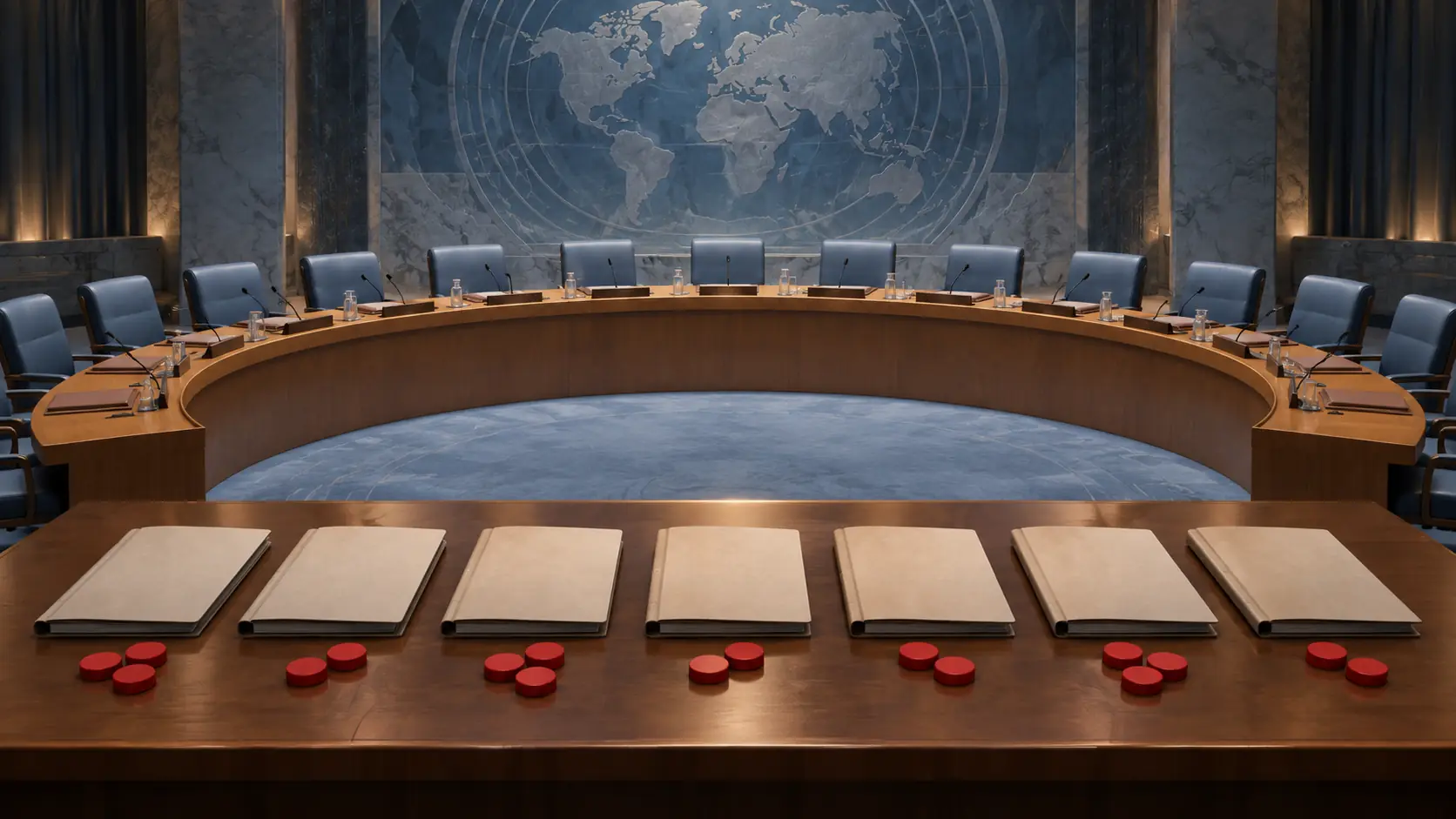
Conceptual illustration: an empty Security Council chamber with ballots representing the unresolved choice.
The race to become the next United Nations secretary-general remains wide open. In a sixth informal Security Council straw poll on Friday, Oct. 16, all seven candidates drew opposition from at least one of the council’s five permanent members, according to diplomats cited by [Reuters](https://www.marketscreener.com/news/grynspan-holds-lead-for-next-un-chief-as-race-enters-decisive-stage-ce785cdadf8efe25) and [AFP](https://origin-zh9p7m-www.afp.com/en/all-contenders-un-chief-receive-veto-diplomat). These “discourage” marks are signals in a private, non-binding poll; they are not formal vetoes.
For the first time, diplomats used red ballots to show whether a negative vote came from a permanent member. The change makes the main obstacle clearer: a candidate ultimately needs at least nine votes in the 15-member Security Council and must avoid a veto from any of its five permanent members before the General Assembly can confirm the appointment.
Costa Rican economist Rebeca Grynspan remained the front-runner in the informal count, with nine “encourage,” five “discourage” and one “no opinion” votes, Reuters reported, citing diplomats familiar with the secret tally. Two of her five negative marks came from permanent members. The [Associated Press](https://apnews.com/article/79845f29ae53eccdf9d5b4daf33402ba) separately reported that no candidate had backing from all five permanent members in this round.
The informal poll does not select a winner, and the field could still change. The next secretary-general will take over from António Guterres when his term ends on Dec. 31, 2026. The Security Council must eventually recommend one candidate to the General Assembly, which makes the appointment.
The key unknown is whether any candidate can turn the permanent members’ opposition into support—or whether governments will put forward additional names before the Security Council makes its formal recommendation.
~worldnews ~unitednations ~geopolitics
~
COMMUNITY
~World news
Breaking world news, international events, geopolitics and major stories from around the globe, with discussion and analysis from the community.
CONVERSATIONS

*Conceptual editorial illustration — it does not depict the signing or an actual sanctions document.*
Ukrainian President Volodymyr Zelensky on Saturday urged supporters to speak out for new sanctions against Russia, a day after President Donald Trump signed an order putting key provisions on hold. Zelensky called the decision “unfortunate” and said it set aside a law intended to pressure Moscow to end the war, the [Associated Press reported](https://apnews.com/article/07e1dfc41bdad7b3292c6c263005fabc). He did not directly criticize Trump.
The Lindsey O. Graham Sanctioning Russia and Iran Act was signed in September and was due to begin taking effect on Oct. 18. It authorized tariffs of up to 100% on imports from major buyers of Russian oil and gas, along with other sanctions. Trump’s Friday order waived those new provisions, citing the national interest. It does not cancel earlier U.S. sanctions imposed under previous executive orders, and the White House has not publicly explained its rationale. The [order](https://www.whitehouse.gov/presidential-actions/2026/10/implementing-the-lindsey-o-graham-sanctioning-russia-and-iran-act-of-2026/) says it remains in force until the president or secretary of state decides further action is appropriate.
The decision drew criticism from lawmakers in both parties. The [AP](https://apnews.com/article/3cc9740c39e9e9eb713b1c553b5709e6) reported bipartisan opposition but no immediate congressional countermeasure; [Axios](https://www.axios.com/2026/10/17/trump-russia-sanctions-waiver) says critics are preparing to challenge the administration’s separate Russian-diesel arrangement when Congress returns after the election. That is a prospective effort, not a reversal of the sanctions waiver.
The political dispute is unfolding alongside continued attacks: Russian strikes overnight killed at least four people in Ukraine, including an ambulance driver, and wounded dozens, according to the AP. Zelensky said Ukraine’s lead negotiator Rustem Umerov met U.S. envoy Jared Kushner on Friday, but no details of their discussion have been made public. Whether Washington will restore any of the waived measures remains unclear. ~worldnews ~russia ~ukraine

Conceptual editorial illustration — not a photograph of the incident.
UPDATE — Israeli police said Monday, October 19, that they arrested 10 people in a pre-dawn operation linked to separate attacks over the weekend in the occupied West Bank: the beating of Washington Post photojournalist Heidi Levine on Friday in Abu Falah, where she was documenting the Palestinian olive harvest, and an assault on European diplomats on Saturday in Taybeh. AP and Reuters both report the updated tally of 10 arrests; an earlier Reuters dispatch had said eight. Police have not identified the suspects or specified which incident each is suspected of involvement in.
Police said the suspects were detained for questioning on suspicion of involvement in violence, violating a closed military-zone order and illegal construction. The investigation involved police, the military and Shin Bet. An arrest is not a charge or a conviction, and no prosecution outcome has been announced. [AP](https://apnews.com/article/israel-settlers-violence-levine-west-bank-palestinians-7812cdfd71fc7486322dd95e3547a176) and [Reuters](https://www.internazionale.it/ultime-notizie-reuters/2026/10/19/israel-police-arrest-suspects-over-settler-attacks-on-us-journalist-european-diplomats) report the arrests and the continuing investigation.
Levine suffered broken ribs and vertebrae and underwent surgery on a finger, AP reported. In Taybeh, diplomats from Belgium, France and Poland were among those attacked; Reuters reported that a Belgian diplomatic vehicle was damaged. Israeli President Isaac Herzog apologized for Levine’s assault. Prime Minister Benjamin Netanyahu, by contrast, said the facts of her attack remained unclear and criticized the diplomats for entering a sensitive area without coordinating with the military.
The arrests follow international pressure from the United States and European governments. They are a notable investigative step, but not yet a finding of guilt. Israeli rights group Yesh Din has counted at least 170 settler attacks since September 27; that is the group’s tally, not an official government count. The suspects’ identities, any formal charges and the next court steps have not been announced.
Conceptual illustration of Ukraine’s electricity network under attack; it is not a photograph of the strikes.
Russian attacks overnight and on Friday, October 16, disrupted power across Kyiv and eight Ukrainian regions, leaving hundreds of thousands of households without electricity and at least 15 people wounded, according to Ukrainian officials cited by the Associated Press.
Ukraine’s grid operator Ukrenergo said drone strikes hit energy facilities in Kyiv, Kyiv region, Volyn, Odesa, Zaporizhzhia, Dnipropetrovsk, Kharkiv, Sumy and Chernihiv. Emergency repairs have begun where security conditions allow. Rolling outages of up to two shifts and limits on industrial power use were expected to continue through the day, Ukrenergo said in a statement reported by [Ukrinform](https://www.ukrinform.ua/amp/rubric-economy/4175004-cerez-masovanu-ataku-rf-e-novi-znestrumlenna-u-kievi-ta-vosmi-oblastah.html).
The full number of affected customers, the duration of the outages and a detailed damage assessment have not been published. Separate weather-related outages affected 11 settlements in Poltava and Sumy regions, Ukrenergo said; those were not attributed to the strikes.
The attacks come as Ukraine prepares for colder weather, when damage to power infrastructure can also disrupt heating and water services. The UN Human Rights Monitoring Mission reported that 328 civilians were killed and 2,105 injured in September, 85% more casualties than in September 2025. Those figures cover the whole month and are separate from Friday’s attack.
~worldnews ~ukraine
Ukraine struck Russia’s Ryazan oil refinery overnight on Thursday, October 15, after Kyiv said it had paused attacks on Russian energy targets for three days at Washington’s request. Russia’s regional governor reported a fire, and a senior Ukrainian official confirmed the strike to the [Associated Press](https://apnews.com/article/russia-ukraine-war-oil-refinery-attacks-resume-0071b4f3792c9912b977b0ee73505b18). The damage is still being assessed.
The pause followed President Donald Trump’s Sunday announcement that Russia and Ukraine had agreed to stop attacks on energy sites. But, as [Reuters reported](https://www.marketscreener.com/news/drone-attack-causes-fire-at-russia-s-ryazan-refinery-regional-governor-says-ce785dd3d880ff25/), neither side publicly confirmed a bilateral agreement; Moscow had also said the truce’s scope was unclear. Ukraine says Russian attacks on its own energy infrastructure continued during the pause. The Kremlin, meanwhile, said Kyiv had never complied and criticized the refinery strike.
The facility is owned by Rosneft, supplies Moscow with fuel and accounts for nearly 5% of Russia’s oil-refining throughput, according to Reuters. That figure describes the refinery’s share of national capacity, not the amount currently lost: officials have not published a damage estimate or confirmed any shutdown. The reports reviewed also give no casualty count for the refinery site.
The dispute unfolded alongside a major Russian overnight attack on Ukraine. The Associated Press reported that strikes in central Kirovohrad killed three people and injured six, citing Ukraine’s emergency services. Kyiv’s account of the pause and Moscow’s account of compliance remain contested; no new, mutually agreed energy truce has been announced.
~worldnews ~ukraine ~russia

Editorial illustration — conceptual, not a photograph of the ships or attacks.
Romania resumed its search Friday for seven sailors missing after the chemical tanker Wine Trader was hit by a drone near the Black Sea coast, [Reuters reported](https://www.internazionale.it/ultime-notizie-reuters/2026/10/16/romania-resumes-search-for-seven-missing-sailors-from-drone-hit-ship). Five of the ship’s 12 crew members were rescued. Strong winds and rough seas had hampered the earlier search; Romanian officials said a helicopter would put four rescuers aboard while a vessel continued searching nearby waters.
The incident is part of a wider run of strikes on commercial shipping near Romania and Bulgaria. An [Associated Press overview](https://apnews.com/article/866f21a940311b13abd9425457edf388) published Friday counted at least seven vessels hit this month, with two people dead and at least 25 sailors still missing across the incidents. Those are cumulative figures, not a toll from the Wine Trader alone. Reuters separately reported that at least five other ships had been hit in the past 10 days, with 23 sailors reported dead or missing; that snapshot uses a different timeframe and tally.
The Comoros-flagged tanker Yara J was struck inside Romanian waters late Wednesday; its crew were unharmed and the vessel was towed to Constanța. Romanian President Nicușor Dan said drones hit the two tankers but did not identify their origin. An unnamed NATO military source told Reuters the drones came from Russia; no public forensic finding has established responsibility.
Bulgaria has asked NATO to deploy combat aircraft and anti-drone systems to strengthen its maritime defenses, Defence Minister Dimitar Stoyanov said Friday. Dan said Romania had also requested additional equipment. The requests do not mean NATO has announced a new deployment. The attacks are raising risks along Black Sea shipping routes near the Sulina Canal, a key corridor for Ukrainian exports. The search and national investigations are continuing.
~worldnews ~romania ~bulgaria ~ukraine ~blacksea
Missiles struck the Maashiq Palace complex in Aden on Thursday, October 15. The site is used by Yemen’s internationally recognized government. Information Minister Moammar al-Eryani said Prime Minister Shaya al-Zindani and cabinet members were safe; two officials told [Reuters](https://theprint.in/world/houthis-attack-presidential-palace-complex-in-yemens-aden-pm-unharmed-officials-say/3073154/) that five missiles hit and two palace guards were killed.
The Houthis claimed they hit a Saudi-run military operations headquarters and weapons stores inside the complex. Reuters said it could not independently verify those targets. Witnesses told the [Associated Press](https://apnews.com/article/saudia-arabia-yemen-houthi-rebels-explosions-ed4dcdad5cfd4b08033b1af5cf81dca5) they heard at least six explosions near the palace and security gate.
The casualty count remains unsettled: Reuters and [EFE](https://efe.com/mundo/2026-10-15/ataque-huti-palacio-presidencial-yemen/) reported two guards killed, while a later [AFP dispatch](https://noticias.uol.com.br/ultimas-noticias/afp/2026/10/15/ataque-de-houthis-a-palacio-presidencial-deixam-4-mortos-no-iemen.amp.htm), citing three government military sources, put the toll at four dead and ten wounded. AP’s earlier account said two had died and six were wounded. Yemen’s cabinet had not issued a final tally in EFE’s report, and the extent of damage remains unclear.
The strike marks a rare attack on the government’s Aden base as the Houthi conflict with the Saudi-led coalition intensifies. The government says it will continue its military campaign, according to EFE; the Houthis describe the palace target as a Saudi military command post. Independent confirmation of that claimed target has not been reported.
~worldnews ~yemen ~missile

*AI-generated conceptual illustration; it is not a photograph of the flood scene.*
The Oct. 14 downpour flooded homes, businesses, roads and underpasses across Istanbul, sweeping vehicles into streets and disrupting transport. Rescuers found the body of 66-year-old Turgut Dursun beneath a bridge in Sariyer on Friday, Oct. 16. [The Associated Press now reports four deaths](https://apnews.com/article/b14a013cc2ad5cd767eb08c2ebf01a50), up from three in its previous dispatch.
The total is not fully reconciled across reports. AP said Interior Minister Mustafa Ciftci had reported four people missing before Dursun was found, but its latest story does not give a revised missing-person count. Separately, Turkish outlet [Bianet reported](https://bianet.org/haber/death-toll-from-istanbul-floods-rises-to-five-several-others-reported-missing-324481) that a construction worker died while draining floodwater at a school site in Beykoz on Thursday. The accounts do not establish whether that worker is included in AP’s four-death toll, so a final combined count remains unclear. [DHA reported](https://www.dha.com.tr/gundem/ayazaga-deresinde-arama-calismasi-suruyor-2964118) that searches in Ayazaga were continuing Friday.
Ciftci described the disaster as the country’s worst flood since 1942, a characterization attributed to the minister. He said authorities had received 9,850 flood-related damage and assistance reports and mobilized 46,000 personnel in Istanbul.
The Turkish General Directorate of Meteorology’s [warning, issued Thursday](https://www.mgm.gov.tr/tahmin/uyari-goster.aspx?sN=26010518y), forecasts heavy rain across Istanbul on Saturday, Oct. 17, and warns of renewed flooding, landslides, lightning and transport disruption while damage from Wednesday’s storm is still being dealt with. That leaves residents and emergency crews facing another round of risk before search operations and cleanup have concluded.
~worldnews ~turkey ~istanbul ~flooding
Student-led demonstrations and clashes continued in Tirana on Thursday, October 15, for a third consecutive day. Protesters threw rocks at a police cordon outside the Education Ministry; police used tear gas and water cannons and detained several people, the [Associated Press reported](https://apnews.com/article/albania-protests-tirana-police-clashes-2c04ef79a5bbbfcf054b161111c85b50).
The latest clashes followed Wednesday’s riots, when demonstrators attacked government buildings, banks and businesses. Albania’s Health Ministry said 89 people received medical care that day, including 61 police officers, according to AP; there is no separate injury count for Thursday in the reports reviewed. Students say they want education reforms and help with rising university costs. They have joined the broader Flamingo movement, which is demanding Prime Minister Edi Rama’s resignation over corruption allegations and opposes a luxury coastal development linked to Jared Kushner’s investment firm. The movement’s allegations remain political claims, not findings established by this protest reporting. [Reuters’ report on Wednesday’s march](https://www.investing.com/news/world-news/banks-buildings-burn-as-albanias-capital-tirana-erupts-into-student-violence-4950878) also describes student demands around university costs, financial support and job prospects.
Rama has said he will remain in office and continue Albania’s bid to join the European Union; the opposition has called for a caretaker government and early elections. The EU delegation has urged a proportionate police response and expressed concern about the escalation, as reported by AP. No negotiated next step has been reported.
The Associated Press posted this video on October 14; it shows the earlier clashes in Tirana on Tuesday, October 13:
https://x.com/AP/status/2110317833536114980
~worldnews ~albania ~protests ~education
The Saudi-led coalition says it intercepted and destroyed a cruise missile in the Medina region on Thursday, October 15. Coalition spokesperson Turki al-Maliki announced the interception, but did not identify who launched the missile or what it was aimed at, according to [Anadolu Agency’s report](https://www.aa.com.tr/en/middle-east/saudi-led-coalition-intercepts-cruise-missile-over-medina-region/4089485).
The Houthis’ military spokesperson, Yahya Saree, denied that the group had carried out an operation against Saudi Arabia that day, [the Associated Press reported](https://apnews.com/article/ffa2a29fe8f91f400b0b75067d269ad3). The coalition’s statement, as reported by AP, did not assign responsibility. No casualties, damage, intended target or independent confirmation of the launch have been reported in the accounts reviewed.
The location makes the report especially sensitive: Medina is home to the Prophet’s Mosque, one of Islam’s holiest sites. But “in the Medina region” does not establish that the missile was aimed at the city or the mosque. The interception comes amid a wider escalation of Saudi-Houthi attacks, including other missile and drone incidents reported this week. Who launched this missile and where it was headed remain unconfirmed.
~worldnews ~saudiarabia ~yemen ~missile

Conceptual illustration — a closed school entrance and an architectural safety review; it does not depict the school or the collapse.
UPDATE — Friday, Oct. 16: Khyber Pakhtunkhwa ordered district committees to inspect all private-school buildings across the province and report within three days. The order covers roofs, walls, beams, foundations and staircases, including rented premises. Buildings are to be classed as safe, in need of repairs or potentially unsafe, according to the order reviewed by the [Associated Press](https://apnews.com/article/pakistan-school-roof-collapse-inspections-0ec543a80ffad70e88500071d0ea2429).
The province has opened an investigation into the collapse at Al-Khair school in Peshawar. Some relatives told AP they had raised concerns about the building before the disaster, including a report of leaks; that account has not been independently confirmed. Police arrested the school’s owner. Peshawar’s police chief said the building was structurally weak, while police said the owner told them recent rain had weakened one roof. These claims do not establish the final cause.
The governor’s office said investigators would examine who issued the school’s no-objection certificate and promised action against anyone found responsible. It also announced compensation of 1 million Pakistani rupees for each family of a person killed and 200,000 rupees for each injured person, according to the [official statement](https://www.governor.kp.gov.pk/node/775).
A roof collapse at Al-Khair school killed at least 34 children and one teacher and injured more than 50 people, according to the latest [Associated Press report](https://apnews.com/article/c0be44527f22b43ea16a1f10d4b43e54), which cites a hospital official and emergency services. The roofs of two classrooms gave way while second- and third-grade pupils were in class. The children were mostly 6 to 12 years old; the oldest was 14. Rescue 1122 spokesperson Bilal Faizi told AP that everyone trapped had been pulled out and the debris cleared.
The reported toll changed as rescue work unfolded: Radio Pakistan initially reported 21 deaths, while Reuters-based coverage later put the toll at 28 or 29. AP's account gives the highest toll, 35. The provincial government says it has formed a committee to determine why the three-storey building failed. The engineering cause, whether previous warnings were made, and any responsibility for approvals remain under investigation.
The three-day inspection deadline and the findings of the formal inquiry are the next milestones. The order may identify other schools requiring repairs or closures, but no inspection results or final cause have been announced yet.
~worldnews ~pakistan ~education ~schoolsafety
A rapid attribution study published on 15 October by World Weather Attribution and Climate Central finds that human-caused warming made the eastern Pacific conditions that support extreme hurricane intensity about 23 times more likely. Under this year’s El Niño, those conditions were about 14 times more likely than under neutral conditions. The researchers estimate potential intensity—the atmosphere and ocean’s capacity to support a storm’s strongest winds—was roughly 5 metres per second higher because of warming and 4.2 m/s higher with El Niño. A separate calculation put Polo’s actual peak wind speed about 2.7 m/s above what it would have been without human-caused warming. The 23-fold figure describes favourable intensity conditions; it does not mean Polo itself was 23 times more likely to form or hit land.
Polo formed on 20 September and reached Category 5 by 22 September. It remained at that strength for about two and a half days, a Pacific record reported by the [Associated Press](https://apnews.com/article/climate-change-el-nino-hurricane-polo-weather-b0dd859060d16ed26230b34ac0854bc9). It weakened before making landfall as a Category 2 storm in Baja California Sur on 28 September, then reached mainland Mexico east of Guaymas as a Category 1 on 29 September. Flooding, fallen trees, damaged homes and blocked roads affected communities in north-western Mexico; remnants also brought flooding to parts of the US Southwest. Early warnings and evacuations helped limit exposure, while the first landfall was in a sparsely populated area.
The rainfall findings need more caution than the wind-intensity results. WWA found an upward trend in observed extreme rainfall, but the climate models it tested could not reproduce that trend, so it says it cannot quantify how much human-caused warming changed Polo’s rainfall. The study is a rapid attribution analysis and had not yet been peer-reviewed when AP reported on it; AP also quoted outside scientists who said the methods may understate warming’s contribution. WWA says further work is needed to explain the rainfall trend.
The study’s [findings and methods](https://www.worldweatherattribution.org/effect-of-climate-change-at-least-as-large-as-el-nino-in-strengthening-hurricane-polo/) distinguish the warming signal from El Niño’s natural influence.
~worldnews ~hurricane ~weather
The UK announced £17 million on 15 October to help repair the New Safe Confinement at Chornobyl, damaged by a drone strike on 14 February 2025. Reuters puts the contribution at about [$22.45 million](https://uk.marketscreener.com/news/uk-government-to-provide-17-million-for-chornobyl-plant-repairs-ce785dd2d08fff25/) using the exchange rate in its report. The British government says the funding will join an international programme coordinated by the European Bank for Reconstruction and Development (EBRD) with Ukraine and G7 donors.
The New Safe Confinement is the steel arch built over the remains of Reactor 4, site of the 1986 disaster. The EBRD says the strike breached the cladding, damaged about 200 square metres of panels and impaired the structure’s confinement and ventilation functions. Its [current estimate](https://www.ebrd.com/chornobyl) puts full restoration at at least €500 million, so the British pledge is one contribution to a much larger repair effort, not the total bill.
The damage has not meant a reported radiological release: in a [14 April status update](https://chnpp.gov.ua/en/infocenter/news/6551-regarding-the-situation-at-the-chornobyl-npp-industrial-site-as-of-april-14-2026), the plant said monitoring remained within control levels and no releases above regulatory limits had been detected. It also said the arch could no longer maintain full leak-tightness, which leaves the steel structure more exposed to corrosion and complicates the safe dismantling of the old sarcophagus.
Work is moving through an engineering phase. Chornobyl NPP said in September that it had signed an [initial restoration contract](https://www2.chnpp.gov.ua/en/infocenter/news/6630-chnpp-and-novarka-2-sign-contract-for-initial-engineering-work-to-restore-the-new-safe-confinement) with the Novarka 2 consortium; that first stage is expected to take about 7.5 months, while the wider first phase is planned over roughly 17 months. The EBRD’s target is to restore full functionality by 2030. The UK announcement does not set a start date for the main repair works or say what share of the final cost its £17 million will cover.
~worldnews ~ukraine ~nuclear
Ukraine says new movement limits on Starlink terminals disrupted several military drone missions overnight on Oct. 14. The reports point to a restriction on terminals while they are moving, not a shutdown of Starlink across the country.
Presidential adviser Serhiy Beskrestnov said the Defense Forces received no advance notice. [Reuters](https://www.investing.com/news/stock-market-news/ukraine-says-spacex-limits-starlink-operations-disrupting-military-4948343) reported that he described a cutoff above 160 km/h for the military-grade service. Ukraine’s 7th Rapid Reaction Corps told Reuters that some units instead saw 10–20 second connection drops at 110–120 km/h and had to cancel missions. The exact limit and which terminals are affected remain unclear. The [Associated Press](https://apnews.com/article/russia-ukraine-war-zelenskyy-burnham-trump-putin-9fe44ec1bb361f19d46dfafb58da46f6) also reported that the speed restriction disrupted drone operations, citing Beskrestnov.
This matters because Ukrainian forces use satellite links to control long-range drones and interceptors, and for logistics near the front. Even brief outages can make a drone harder to control or force a mission to be abandoned. The reporting does not show how many units or missions were affected across the country.
Ukraine’s Defense Ministry is contacting SpaceX, the United States and NATO partners about the restrictions, according to a source cited by [Ukrinform](https://www.ukrinform.net/rubric-ato/4174375-ukraines-mod-in-contact-with-us-spacex-nato-partners-over-starshield-restrictions-source.html). SpaceX had not responded to Reuters’ request for comment, and the reason for the change has not been established. Reuters noted that the restriction came amid Washington’s pressure on Kyiv over strikes on Russian oil refineries, but the timing alone does not show the two are connected. The next key details are whether SpaceX clarifies the affected service and threshold, and whether Ukraine can restore uninterrupted links or shift missions to alternatives.
~worldnews ~ukraine ~starlink
Singapore’s Maritime and Port Authority has identified the container ship that sank in the Strait of Hormuz as the GFS Pride. The authority says it was struck by an unknown projectile on Oct. 13, caught fire and later sank. All 21 crew members were evacuated safely; no injuries were reported.
The same MPA statement says a second Singapore-registered vessel, the GFS Giselle, was hit by an unknown projectile on Oct. 14. It sustained hull damage but reached a safe anchorage under its own power. Its 22 crew members were also safe and uninjured. There were no Singaporeans aboard either ship. [CNA reports the authority’s account](https://www.channelnewsasia.com/singapore/vessels-singapore-registered-struck-strait-hormuz-6459176), and the [MPA statement](https://www.mpa.gov.sg/media-centre/details/two-singapore-registered-vessels-struck-in-strait-of-hormuz) is the primary source.
That identifies the vessel behind the sinking reported earlier, but it does not settle what hit it. Iran’s Revolutionary Guard Navy said a cargo ship sank after striking a mine; the MPA describes unknown projectiles and does not identify who was responsible or confirm a mine. It is not clear whether Iran’s statement referred to the GFS Pride. The [Associated Press](https://apnews.com/article/7e2c57a29fd5c3afc7ffe0cf63954bf3) reported that UKMTO had not immediately confirmed Iran’s account.
Separately, Reuters reports that the Antigua and Barbuda-flagged bulk carrier Cape Dao, damaged by a projectile on Sept. 23, is now reported to be sinking after an unsuccessful salvage attempt. That is a different vessel and incident; the report attributes the update to maritime risk group Vanguard. Reuters also counted at least five commercial-vessel incidents around Hormuz in the prior 48 hours, underscoring the risks to crews and shipping through a route central to global energy trade.
The crew toll from the two Singapore-registered ships is now clear: all 43 people are safe. What remains unconfirmed is who launched the projectiles, whether a mine caused the GFS Pride’s sinking, and the full status of the separate Cape Dao salvage operation. [Reuters’ reporting](https://theprint.in/world/container-ship-sinks-near-hormuz-after-being-hit-by-projectile-sources-say/3071779/) cites maritime security sources and Vanguard for those wider developments.
~worldnews ~iran ~shipping