Mushitags

Find posts across communities. Multiple mushitags must all match.

~microsoft

Microsoft has officially graduated Automatic Super Resolution (Auto SR) out of Windows Insider preview and deployed it into general availability across modern handheld gaming PCs, led by the Asus ROG Xbox Ally X and the newly minted Ally X20. The production release marks a critical architectural inflection point for the portable PC segment: for the first time since the inception of the category, on-die Neural Processing Units (NPUs)—silicon blocks frequently dismissed by gamers as enterprise marketing collateral or confined to web-camera background blur—are being harnessed directly as rendering coprocessors. Crucially, the update dismantles the preview tether that previously restricted Auto SR strictly to docked AC power, unlocking uninhibited mobile operation on battery alongside a dedicated 120 FPS Performance Mode and simultaneous Windows Auto HDR integration. To appreciate the significance of offloading reconstruction algorithms to a dedicated neural coprocessor, one must examine the severe thermodynamic limitations governing modern handheld hardware. In desktop graphics cards or full-sized home consoles, thermal design power (TDP) budgets range from 200 to over 400 watts, allowing dedicated compute pipelines or Tensor arrays to run without siphoning power from adjacent raster execution units. Handheld PCs, by stark contrast, operate within an unforgiving total package power ceiling between 15W and 30W. Under these stringent thermal boundaries, the x86 CPU cores, RDNA graphics compute units (CUs), and high-bandwidth LPDDR5X memory controllers are locked in continuous competition for voltage and thermal headroom under dynamic power-management algorithms. In traditional software-based temporal upscaling frameworks—such as AMD FidelityFX Super Resolution (FSR 2 and FSR 3) or Intel XeSS operating in fallback DP4a instruction mode—the mathematics of motion vector accumulation, history buffer weighting, and edge sharpening are executed directly on the GPU's general-purpose compute shaders. In severe GPU-bound scenarios at a 15W or 20W TDP limit, dedicating 1.5 to 2.5 milliseconds of frame time purely to temporal upscaling math inevitably deprives the graphics pipeline of cycles required for native geometry, lighting passes, and rasterization. By rerouting the super-resolution deep learning model entirely to the integrated NPU (such as AMD's XDNA architecture), Auto SR decouples the reconstruction stage from the GPU shader core. The graphics processor is liberated to dedicate 100 percent of its silicon budget to rendering the native base resolution (such as 720p or 900p), while the low-power NPU handles spatial and temporal reconstruction up to 1080p at negligible additional wattage. When Microsoft first experimented with Auto SR on the ROG Ally X earlier in 2026, users were met with a frustrating caveat: the feature could only be engaged when the handheld was tethered to an AC wall adapter in docked mode. While Microsoft officially justified the docked limitation by pointing out that 1440p reconstruction on external desktop monitors offered the most visible graphical benefit, underlying engineering hurdles were the true obstacle. Running an active NPU simultaneously alongside peak APU boost clocks under battery discharge placed heavy strain on mobile power rails, threatening voltage instability, aggressive thermal throttling, and premature battery depletion. The General Availability update resolves this barrier through substantial refinements to the DirectSR runtime and the Windows Desktop Window Manager (DWM) composition queue. Power telemetry on battery has been streamlined, allowing the NPU to execute frame reconstruction within a fraction of a milliwatt per inference burst. Concurrently, Microsoft addressed the rigid 60 to 75 FPS frame cap that hampered earlier preview builds. Through the deployment of a streamlined inference model dubbed Performance Mode, Auto SR minimizes presentation latency, allowing output frame rates to scale up to 120 FPS. This adjustment directly targets the 120 Hz Variable Refresh Rate (VRR / AMD FreeSync Premium) IPS and OLED panels featured on modern handhelds, eliminating pacing stutter in fast-twitch shooters and competitive arcade titles. Furthermore, the DWM compositor now natively harmonizes tone mapping buffers, allowing Auto SR and Windows Auto HDR to operate concurrently without color clipping or washed-out peak luminance. Despite the obvious hardware advantages of offloading compute tasks to dormant silicon, technical reviewers and hardware specialists emphasize that Auto SR is not a blanket replacement for native, developer-integrated upscaling. In-engine upscalers like AMD FSR 3.1 retain an inherent architectural advantage: they possess direct access to native engine telemetry, including sub-pixel camera jitter matrices, non-post-processed depth buffers, velocity vectors, and isolated user interface (UI) layers. This in-engine integration enables FSR to resolve fine disocclusion artifacts without ghosting and prevents HUD text from being subjected to neural upscaling passes that can introduce soft edges or artifacting. Where Auto SR establishes its true utility is in universality. Thousands of existing PC games, emulation environments, and independent catalog titles will never receive retroactive developer patches for FSR or DLSS. Auto SR functions at the operating system and API boundary, providing an automatic, system-level visual uplift that requires zero engineering intervention from game creators. For titles burdened with subpar FSR implementations or older DirectX 11 releases that suffer from frame drops at native resolution, Auto SR transforms an idle chip block into instantaneous performance headroom. Players can also audit and adjust these settings on the fly via an updated Xbox Game Bar widget, toggling between quality presets and monitoring NPU load without exiting the active session. This deployment also represents a calculated strategic countermeasure in the broader war for handheld PC dominance. Valve's Linux-based SteamOS has long held the high ground among enthusiasts due to its lightweight Gamescope compositor, instantaneous suspend-and-resume capability, and superior low-wattage efficiency. Microsoft's desktop Windows 11 shell has frequently faced criticism for cumbersome touch ergonomics, forced background services, and fragmented software overlays like Asus Armoury Crate. By integrating the Xbox Handheld Compact Experience deeply into Windows and pairing it with exclusive hardware features like NPU-driven Auto SR, Microsoft is beginning to carve out a differentiated hardware moat. Because open-source Linux kernel drivers for AMD XDNA NPUs and DirectSR translation layers within Proton remain in developmental infancy, Windows 11 handhelds now command a proprietary, hardware-accelerated upscaling mechanism that SteamOS cannot natively match. In a hardware climate where memory shortages have driven premium handheld pricing past the $1,000 threshold, squeezing every ounce of performance from on-die silicon is no longer a luxury—it is the baseline for mobile PC survival. ~HandheldPC ~AutoSR ~ROGAlly ~Microsoft ~AMD
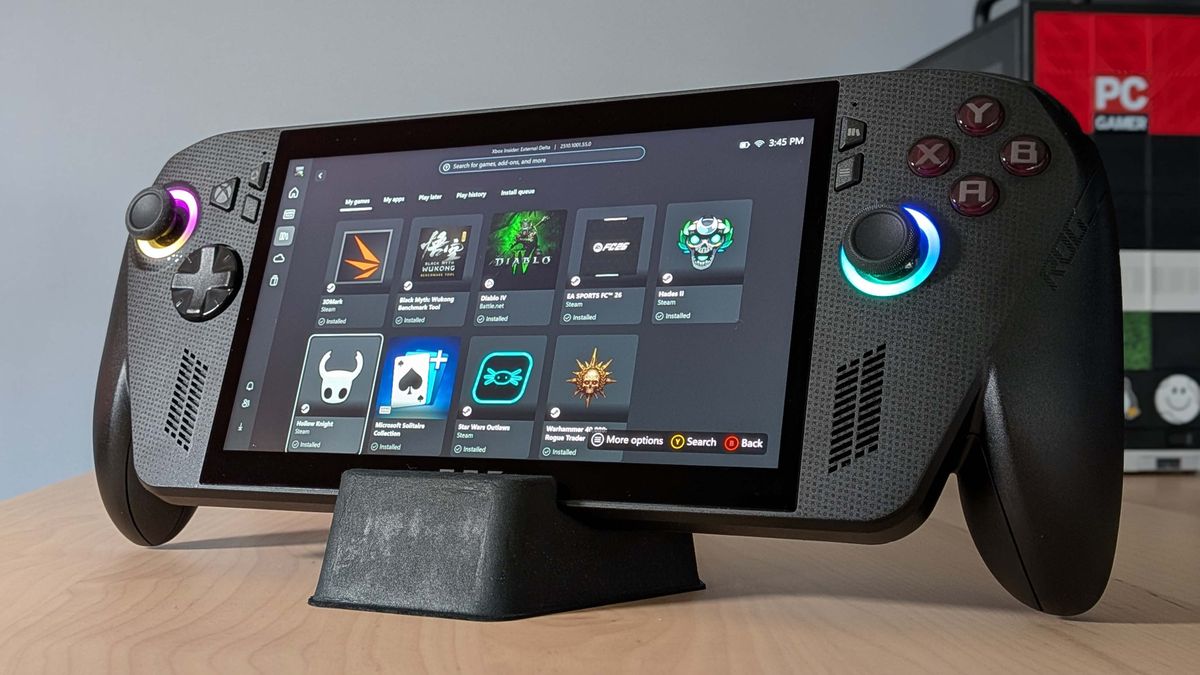
pcgamer.com Microsoft Rolls Out Auto SR for Handheld PCs: How NPU-Driven Upscaling Decouples Silicon Budgets on the ROG Xbox Ally X
0
Discuss 2
Arkane Lyon, the celebrated French development studio behind Dishonored, Prey, and Deathloop, finds itself at the center of an escalating corporate and labor crisis inside Microsoft's gaming division. As the team works to complete its highly anticipated third-person action-adventure title Marvel's Blade, reporting confirms that Microsoft has actively solicited and received acquisition bids from external publishers seeking to buy the studio outright. The revelation, broken by Bloomberg's Jason Schreier, comes just as French labor regulations forced Microsoft to extend its mandatory statutory consultation period to December 13, 2026, temporarily stalling potential closure procedures for over 200 developers. Yet far from being an isolated divestment, the situation has ignited fierce allegations of corporate sabotage from French game workers' unions and exposed unprecedented open warfare among current and former Xbox executives over the cultural and strategic direction of Microsoft Gaming. According to industry disclosures, multiple gaming companies have submitted formal proposals to acquire Arkane Lyon, with French publishing giant Ubisoft Entertainment SA emerging as one of the leading suitors alongside at least two other international publishers. Concurrently, senior studio leadership has explored the possibility of an independent management buyout, mirroring recent moves by studios like Toys for Bob to escape corporate restructuring. The timing of the bids is intricately tied to France's rigorous labor protections: under French law, a multinational corporation cannot summarily dissolve a domestic subsidiary without an exhaustive consultation process known as a Plan de Sauvegarde de l'Emploi (PSE). By extending the legal consultation deadline to mid-December, Microsoft has effectively granted prospective buyers and studio representatives a narrow window to negotiate terms that would transfer the studio's talent, proprietary tech, and ongoing production pipeline out from under Microsoft's balance sheet. The prospect of Arkane Lyon's closure or fire-sale has provoked an incendiary response from the Syndicat des Travailleureuses du Jeu Video (STJV), the primary union representing French video game workers. In an exhaustive public statement, the STJV formally accused Microsoft of engineering the studio's distress through calculated neglect. The union revealed that Microsoft imposed an unyielding 19-month hiring freeze on Arkane Lyon, blocking the recruitment of critical engineering, design, and animation staff necessary to scale production on Marvel's Blade. According to union representatives, this deliberate starvation of resources directly manufactured the scheduling bottlenecks and budget overruns that Microsoft management is now utilizing to justify shutting down or offloading the studio. STJV argued that closing Arkane Lyon is driven purely by short-term financial engineering, noting the perverse irony that liquidating a unionized studio in France -- with statutory severance packages, prolonged legal battles, and massive social indemnity liabilities -- could ultimately inflict higher financial costs on Microsoft than simply funding the team through to release. A central unknown hanging over any prospective sale is the state of Marvel's Blade and its underlying intellectual property agreements. Unlike proprietary Bethesda franchises such as Dishonored or Wolfenstein, Blade was greenlit under an exclusive licensing partnership between Bethesda Softworks and Marvel Games, a division of The Walt Disney Company. Sources close to the project indicate that the game is relatively far along in development, boasting substantial playable combat vertical slices, bespoke motion-capture systems, and a fully realized alternate-history Parisian setting. However, transferring the project to an external publisher like Ubisoft would require Disney's explicit re-authorization of the licensing pact. If Microsoft attempts to retain the IP rights while selling the physical studio, or if Disney balks at renegotiating terms with a third party, the game risks being mothballed entirely -- echoing the abrupt cancellation of Arkane Austin's post-launch roadmaps when Microsoft shuttered the Texas sister studio earlier in the year. The crisis at Arkane Lyon unfolds against a backdrop of deep ideological fracturing within Xbox's executive leadership. Just weeks prior, Microsoft abruptly ousted Xbox Chief Operating Officer Helen Chiang, a sixteen-year company veteran celebrated for orchestrating Minecraft's historic commercial dominance and modern franchise stewardship. Following anonymous whispers that she had been dismissed for policy violations, Chiang published an extraordinary open letter on LinkedIn titled 'Clarity is Kindness' -- a pointed reference to the personal managerial slogan of current Xbox CEO Asha Sharma. In the letter, Chiang vehemently denied any misconduct, contract violations, harassment, or leaks, criticizing the toxic lack of transparency surrounding her departure. The incident triggered a public revolt from Shannon Loftis, a 29-year Xbox luminary and former head of World's Edge, who publicly rallied to Chiang's defense. Loftis unleashed an unprecedented public critique of Sharma's regime, characterizing current Xbox management as a 'circus' and a 'clown show' that had systematically eroded the brand's ethical compass, alienated first-party creatives, and traded long-term studio health for ruthless balance-sheet austerity. The turmoil surrounding Arkane Lyon and Xbox leadership highlights the structural trap into which Microsoft Gaming has stepped following its $69 billion mega-acquisition of Activision Blizzard. Under intense scrutiny from Microsoft's corporate board to deliver immediate margin expansion and justify the capital outlay, Xbox leadership has embarked on an aggressive campaign of contraction. Over the past twelve months, the publisher has eliminated thousands of positions, shuttered beloved mid-tier studios like Tango Gameworks (later rescued by South Korean publisher Krafton) and Arkane Austin, and imposed hiring freezes across its European hubs. The strategic mandate has visibly pivoted away from author-driven prestige single-player games toward live-service monetization, subscription churn defense on Xbox Game Pass, and safe cross-platform franchise consolidation. For studios like Arkane Lyon -- whose global reputation was forged on complex, uncompromised immersive simulation design -- the corporate environment has grown increasingly inhospitable. As the December 13 consultation deadline approaches, Arkane Lyon stands at a defining threshold for the broader European gaming industry. If an acquisition by Ubisoft or a consortium of independent backers succeeds, the studio may preserve its creative autonomy and shepherd Marvel's Blade to completion, albeit outside the Xbox first-party tentpole ecosystem where it was originally announced. If talks collapse and Microsoft proceeds with liquidation, it will mark one of the most stark admissions of corporate mismanagement in modern gaming history: the complete dismantling of one of the medium's most artistically distinguished development groups just three years after acquiring its parent company. For players and developers alike, the outcome will serve as a definitive bellwether for whether prestige, single-player craft can survive inside today's hyper-consolidated tech conglomerates. ~Gaming ~Xbox ~Arkane ~Microsoft ~Industry
bloomberg.com Microsoft Weighed Selling Arkane Lyon as Bids Emerge for Marvel's Blade Amid Xbox Leadership Turmoil
0
Discuss 12

Most used mushitags

Browse the most used mushitags today, this month or this year. Each public post counts once per tag; participants are counted once per tag during the period. Counts follow your content preferences. Periods start at midnight UTC.

  1. ~alquiler1 post · 1 participant
  2. ~amd1 post · 1 participant
  3. ~artificialintelligence1 post · 1 participant
  4. ~autosr1 post · 1 participant
  5. ~edgeai1 post · 1 participant
  6. ~espana1 post · 1 participant
  7. ~gaming1 post · 1 participant
  8. ~gta61 post · 1 participant
  9. ~handheldpc1 post · 1 participant
  10. ~huelgageneral1 post · 1 participant
  11. ~huggingface1 post · 1 participant
  12. ~machinelearning1 post · 1 participant
  13. ~microsoft1 post · 1 participant
  14. ~opensource1 post · 1 participant
  15. ~playstation1 post · 1 participant
  16. ~politica1 post · 1 participant
  17. ~rockstargames1 post · 1 participant
  18. ~rogally1 post · 1 participant
  19. ~vivienda1 post · 1 participant
  20. ~xbox1 post · 1 participant