

AI can transform the economy while leaving some of the companies financing its infrastructure with losses. The commercial risk lies in committing capital today to computing capacity whose future earnings must cover equipment, electricity, financing and replacement costs.
For a heavily indebted operator, the timing is critical. Equipment purchases and interest payments can begin before a facility earns revenue. Once it opens, competition and newer hardware can erode the margins expected when the investment was approved. Long-term customer contracts offer protection, provided the operator delivers and the customer pays.
The consequences would depend on where losses accumulate. Shareholders and lenders can absorb unsuccessful investments without a financial crisis. A wider shock becomes possible when concentrated exposures, leverage or funding pressure force institutions to cut lending and investment elsewhere. Weakness in housing would make that adjustment harder to absorb.
## Why the housing slowdown matters
U.S. housing offers a measure of the pressure expensive credit is already exerting on the economy. The National Association of Realtors [reported on October 20, 2026](https://www.nar.realtor/newsroom/pending-home-sales-decreased-7-3-percent-in-september) that September pending home sales fell **7.3% from August and 11.3% from a year earlier**. The index tracks signed contracts ahead of completed sales. NAR attributed the decline to rising mortgage rates, while noting that distressed properties remained scarce.
[Realtor.com's September data](https://www.realtor.com/research/september-2026-data) showed active listings up 5.4% year over year and median asking prices down 1.4%. More homes were available, but high financing costs continued to weigh on transactions.
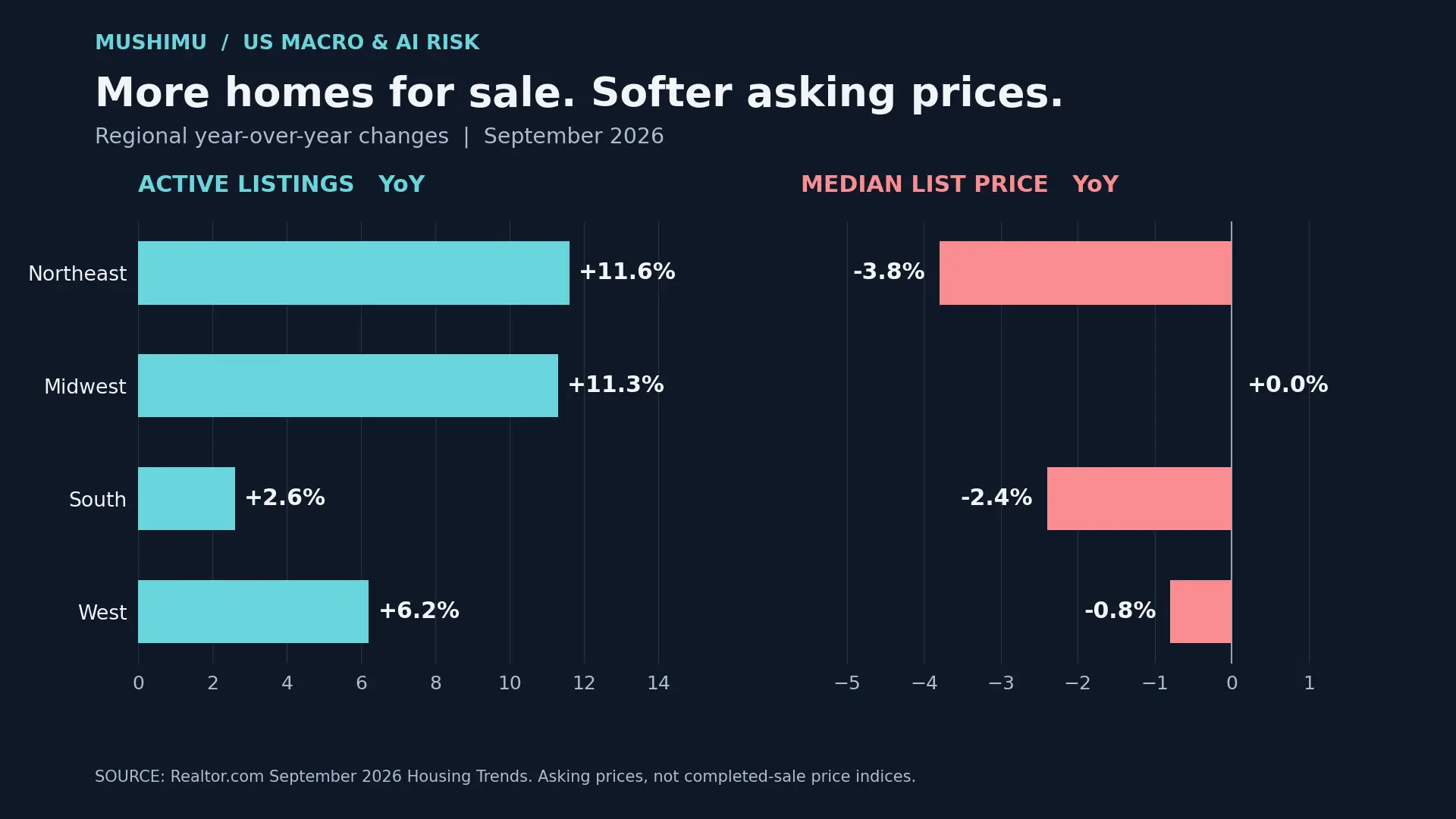
Housing and AI infrastructure share a sensitivity to the cost of capital. Higher rates reduce what households can afford and raise the return an infrastructure project must earn to justify its financing. Their demand cycles differ, but both become vulnerable when borrowing remains expensive.
The connection also runs through employment and spending. Fewer home transactions reduce demand for brokerage, moving and related services. An AI construction slowdown would affect contractors, equipment suppliers and local employment. Simultaneous weakness would remove support from two parts of the economy, making household income and credit availability more important to the outlook.
The scale of AI's contribution deserves care. The [Federal Reserve's July 16 analysis](https://www.federalreserve.gov/newsevents/speech/jefferson20260716a1.htm) groups software, data centers, high-tech equipment and power investment into a broad spending category. Some of that activity serves purposes beyond AI, and imported equipment adds less to domestic production than the headline spending suggests.
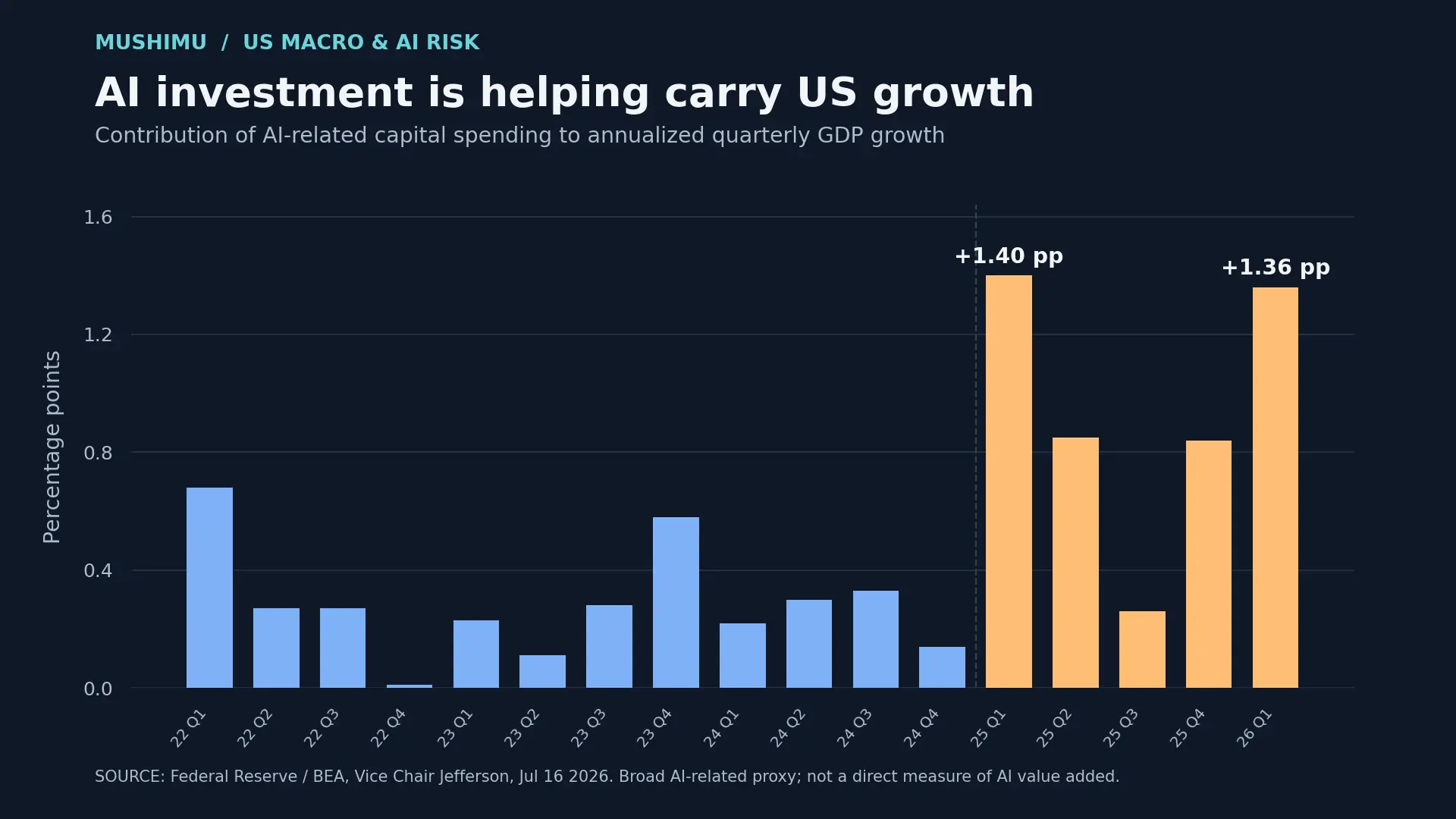
*The investment chart uses the Federal Reserve's broad AI-related spending category, published in July 2026. Contributions are percentage points of annualized quarterly GDP growth.*
Housing is therefore a potential amplifier of an investment shock. Job losses and tighter credit could weaken it further; lower inflation and mortgage rates could provide a cushion. The balance would turn on the effect on incomes and financing conditions.
## The gap between buying hardware and earning revenue
A data-center project depends on coordinated schedules for chip deliveries, construction, power connections and customer commitments. Delays in any of them can postpone the revenue needed to earn the expected return.
[Business Insider reported on October 20](https://www.businessinsider.com/amazon-nvidia-ai-gpu-data-centers-power-shortages-2026-10) that Amazon's Early Rack Receipt program planned to receive Nvidia servers before facilities were fully ready, with an initial $5 billion in GB300 racks. Amazon described early receipt as normal supply-chain planning. The figure concerns planned deliveries, rather than an independently verified stock of idle equipment.
For operators with less financial flexibility, a delay can be costly. Financing charges accrue while grid connections, transformers, cooling and substations are completed. If deployment slips far enough, newer hardware may reach the market before the original investment achieves full utilization.
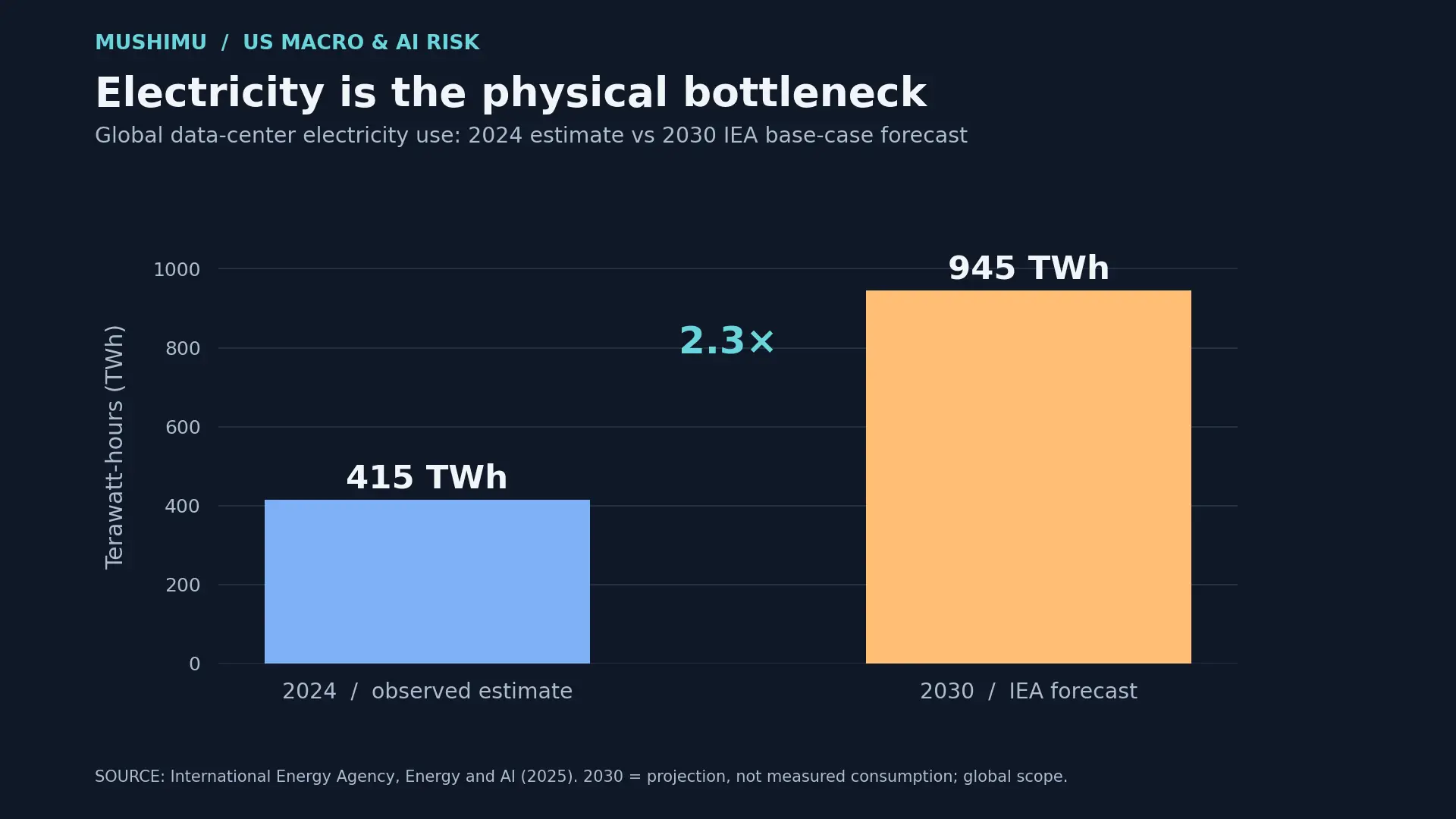
*Global data-center electricity demand, using the IEA's 2025 estimates and forecasts. The [2026 update](https://www.iea.org/reports/key-questions-on-energy-and-ai/executive-summary%C2%A0) projects about 950 TWh in 2030, close to the earlier 945 TWh forecast. These totals cover all data centers.*
The exposure varies across the industry. A diversified cloud company can finance delays from other businesses. A GPU rental specialist may depend more heavily on timely customer payments and access to new funding. A landlord leasing a powered building owns an asset that can outlast several chip generations. Treating all three as the same investment obscures who bears the deployment risk and how long the underlying assets can generate income.
## Useful chips can still be poor investments
Demand for AI computing can grow while returns on particular machines decline. Inference—the use of trained models—puts increasing weight on cost per token. Improvements in chips, software and model efficiency can make newer capacity more competitive, putting pressure on older equipment when rental contracts renew.
An operator earns money from the price received per billed GPU-hour and the share of available capacity customers use. Against that revenue sit electricity, cooling, staff, networking and facility costs. The resulting cash must also support interest, scheduled principal repayments and the equipment needed to sustain the business.
**Technical usefulness and investment value can diverge.** A machine may keep serving customers for years while earning too little to recover its original purchase price and financing cost. Accounting depreciation spreads that purchase cost over an estimated useful life; resale value reflects what another buyer will pay. Neither provides a universal timetable for GPU obsolescence.
Contract structure can absorb much of the volatility. Committed payments offer more protection than short-term rentals, although delivery conditions, service penalties and customer creditworthiness still matter. Renewal pricing becomes especially important as contracts expire.
There is also a substantial upside: cheaper computing can stimulate additional demand. If usage expands fast enough, efficiency gains can support utilization and cash generation. The challenge for investors is to identify which operators can capture that growth at returns sufficient to cover their capital costs.
## CoreWeave and the cost of expansion
CoreWeave shows the scale of the financing involved. Its [second-quarter results, released August 11](https://investors.coreweave.com/news/news-details/2026/CoreWeave-Reports-Strong-Second-Quarter-2026-Results/default.aspx), recorded $35.07 billion of debt at June 30, 2026, up from $21.37 billion at December 31, 2025. Operating lease liabilities added $16.32 billion of fixed obligations. Unused credit facilities provide potential funding, subject to their draw conditions.
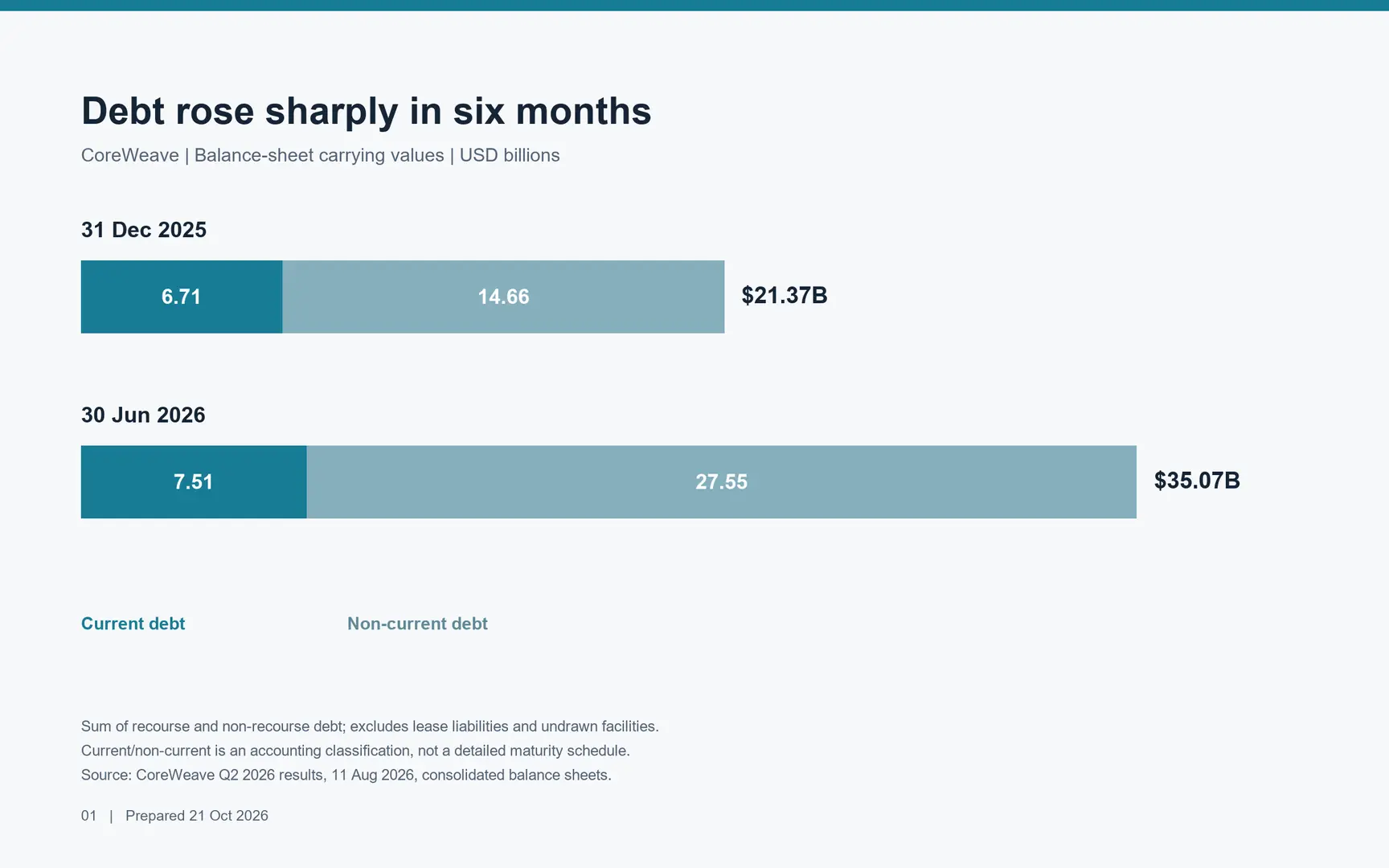
*Balance-sheet debt at the dates shown, excluding leases and undrawn facilities.*
Bond investors have become more demanding. [Reuters reported on October 20](https://www.investing.com/news/stock-market-news/coreweavedebt-selloff-poses-limited-risk-to-global-banks-jp-morgan-says-4959014) that CoreWeave's 2031 bond yield had approached 16% the previous week. That secondary-market price signals concern about risk and refinancing; the company's existing interest bill follows the terms of its individual loans and bonds.
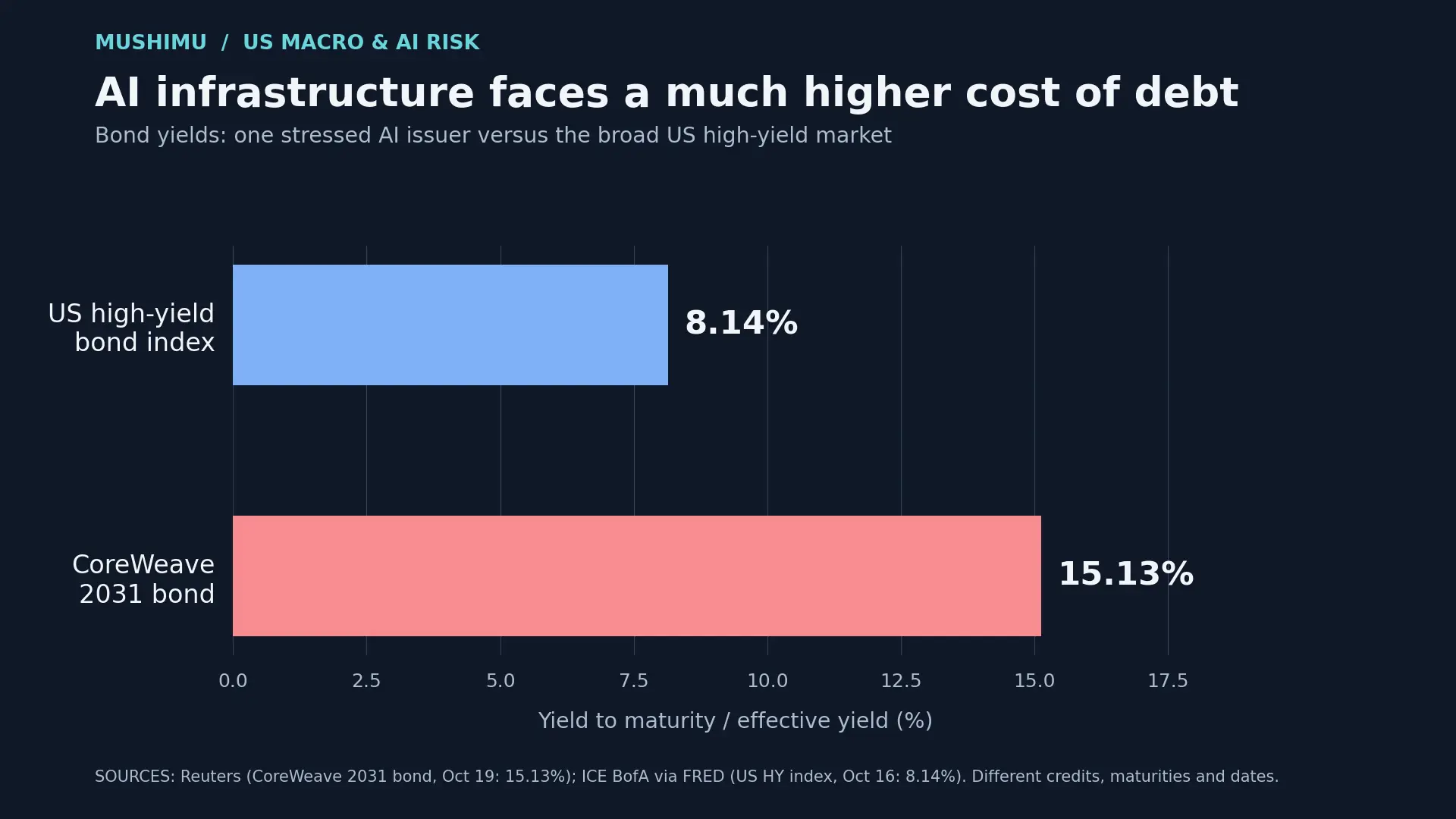
*Historical financing comparison across different dates and credit instruments. The yields are indicative market observations, rather than a matched credit-spread comparison or the rate paid on all CoreWeave debt. Benchmark series: [ICE BofA via FRED](https://fred.stlouisfed.org/series/BAMLH0A0HYM2EY).*
Expansion is consuming much more cash than operations currently generate. During the first half of 2026, operating cash flow was $3.66 billion, while cash purchases of property and equipment, including capitalized software, reached $14.12 billion. The roughly $10.5 billion gap reflects the intensity of the buildout. Customer advances and working-capital movements also affect reported operating cash flow.
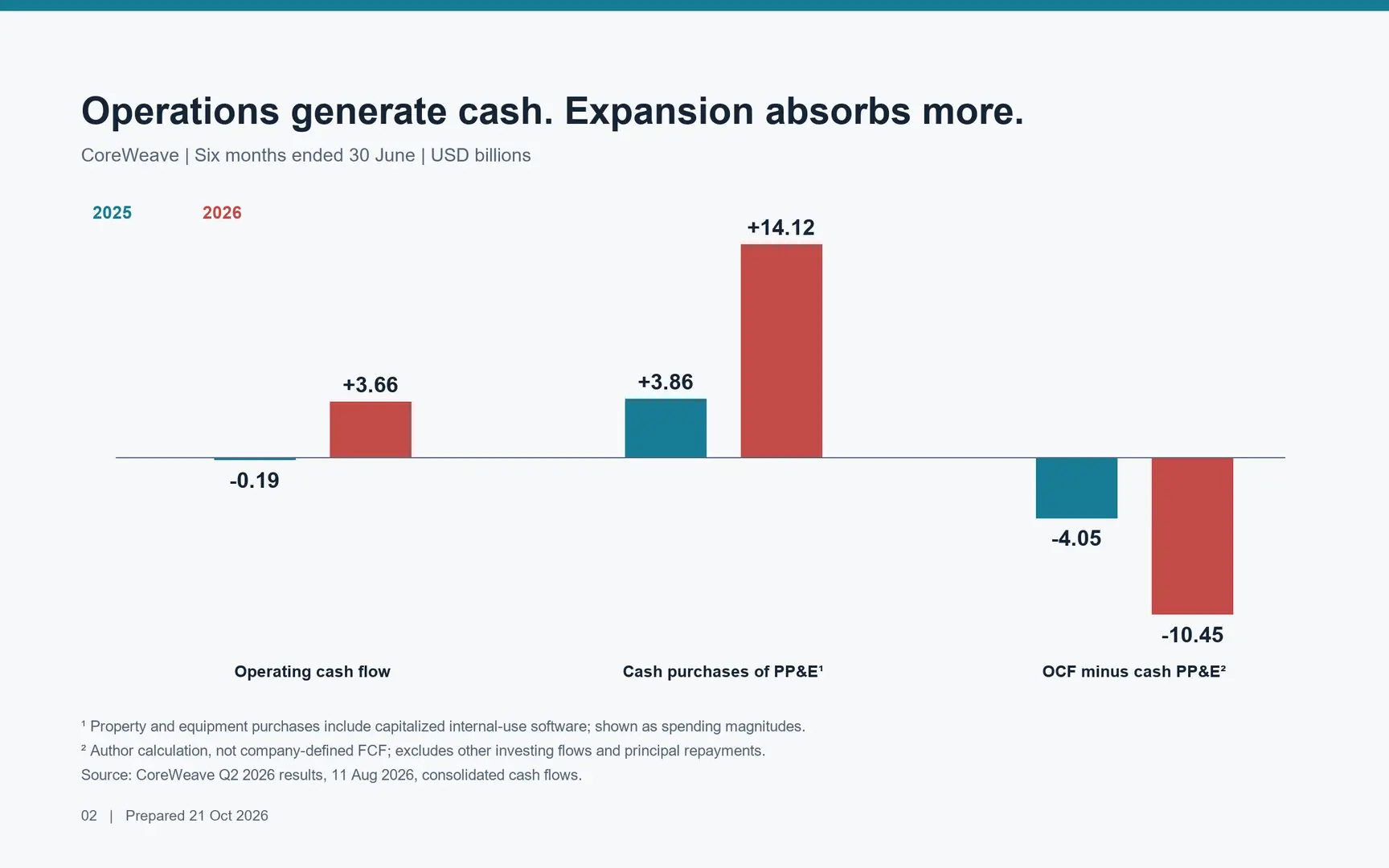
*Operating cash flow less cash purchases of property and equipment, including capitalized software. Calculation from company filings; it differs from company-defined free cash flow. Periods cover the first half of each year.*
The decisive commercial test is how much cash mature facilities can generate after the spending needed to maintain their revenue. Growth investment can be reduced if financing tightens; maintenance and replacement cannot be postponed indefinitely without affecting the service. Total expansion spending and adjusted EBITDA, taken separately, reveal only part of that picture.
Customer commitments provide a significant buffer. CoreWeave's [June Form 10-Q](https://www.sec.gov/Archives/edgar/data/1769628/000176962826000366/crwv-20260630.htm) said take-or-pay contracts generated 98% of quarterly revenue and reported $103.7 billion of remaining performance obligations. Converting those commitments into cash requires capacity to be delivered and customers to meet their obligations. Reuters also reported JPMorgan's forecast that free cash flow would remain negative until 2030, leaving continued funding access central to the expansion plan.
## When falling collateral meets a cash shortfall
Debt becomes harder to refinance when the assets securing it lose value. Consider an illustrative operator that purchases $10 billion of equipment using $7 billion of debt. If resale values fall 40% while principal remains unchanged, $6 billion of equipment backs $7 billion of borrowing.
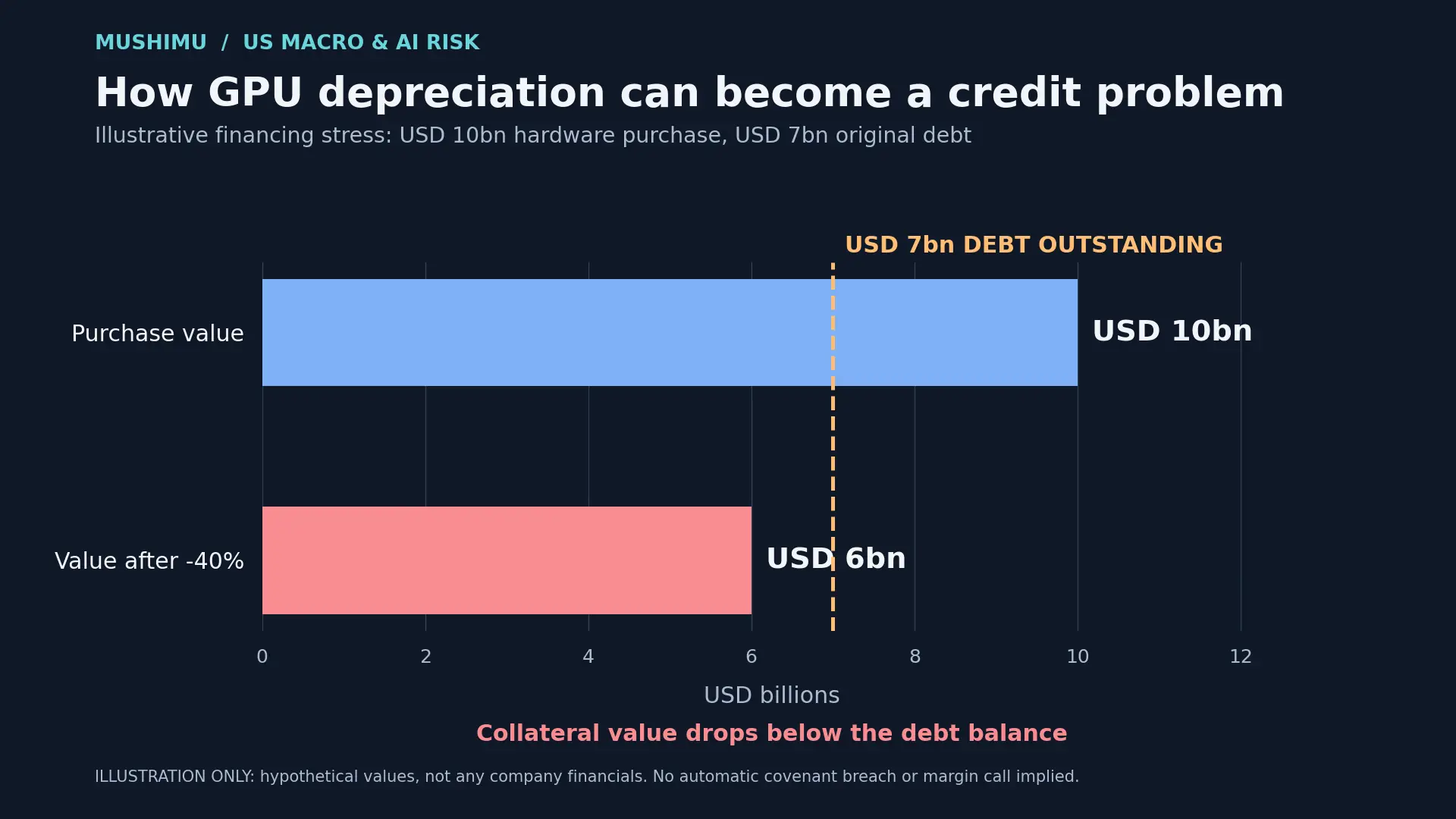
*Illustrative collateral scenario. The assumed decline is a stress-test input, rather than a measured GPU depreciation rate.*
Lender rights determine what happens next. A fall in collateral value may restrict further borrowing, trigger a contractual valuation test or reduce recoveries in a restructuring. An operator with reliable customer receipts can continue making payments despite weak liquidation coverage. Conversely, valuable equipment cannot solve an immediate cash shortage unless it can be sold or financed in time.
Accounting charges add a separate perspective on the cost of the installed fleet. CoreWeave's reported interest expense and depreciation illustrate the claims on revenue beyond day-to-day operating costs.
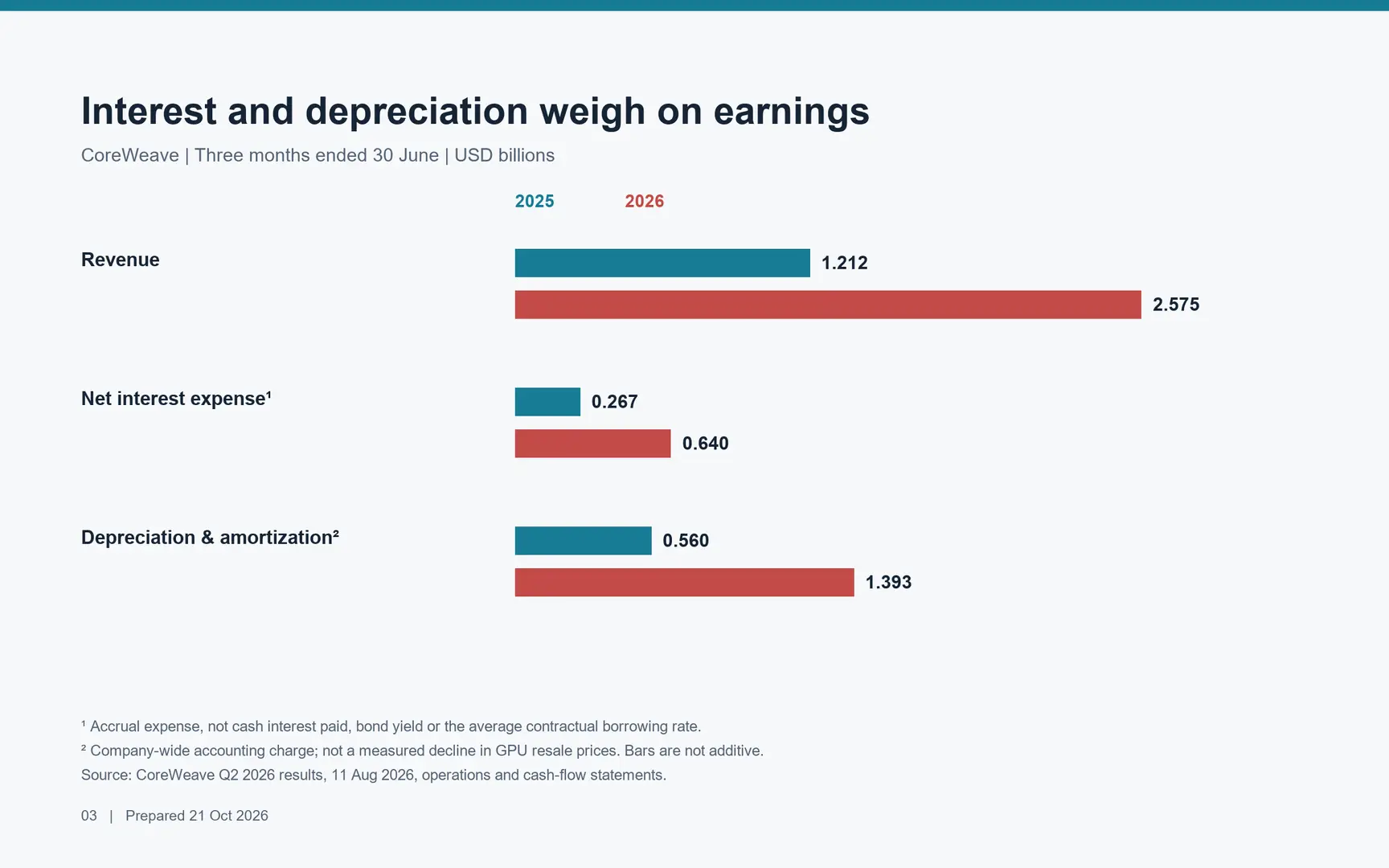
*CoreWeave's reported quarterly revenue, net interest expense, and depreciation and amortization. Depreciation is an accounting allocation of asset cost; it does not measure GPU resale losses.*
For the illustrative operator, suppose annual revenue is $3 billion, cash operating expenses are fixed at $1.2 billion and interest on the $7 billion debt is 10%, or $700 million. A 40% revenue decline leaves $1.8 billion of sales and $600 million after operating expenses: a $100 million shortfall against interest alone.
Under those assumptions, revenue of $1.9 billion covers operating expenses and interest. A decline of roughly 36.7% exhausts that cushion before taxes, working-capital needs, replacement spending or principal repayments. Variable costs and committed contracts would change the outcome. The revenue and collateral declines are separate assumptions; this merchant-rental example does not model CoreWeave's contracted business.
Rates can compound the pressure when debt reprices. A one-percentage-point increase on a fully exposed $7 billion balance adds $70 million in annual interest. Fixed-rate borrowing, hedges and amortization reduce or defer that exposure. The danger increases when several operators need refinancing at once and forced sales depress the collateral available to their lenders.
## How the debt reaches institutional portfolios
AI infrastructure is financed through a network of banks, bondholders, private-credit funds and long-term investors. A [March 2026 BIS analysis](https://www.bis.org/publications/qr-202603/financing-ai-infrastructure-boom-on-and-off-balance-sheet-borrowing) describes project vehicles supported by leases, capacity commitments and guarantees, with banks supplying funding lines. These structures spread the financing burden and create connections through which stress can travel.
Pension capital already participates in this market. On July 31, 2025, [CPP Investments committed C$225 million](https://www.newswire.ca/news-releases/cpp-investments-commits-to-225-million-in-construction-financing-for-ontario-data-centre-886540216.html) to construction financing for a 54 MW data-center expansion in Ontario. It provided half the loan alongside Deutsche Bank for a project pre-leased to a GPU-focused AI cloud provider. The pension investor was financing construction, with repayment supported by the project's commercial arrangements.
University endowments also invest in private credit, offering a possible indirect route into infrastructure loans. [Morgan Stanley's 2026 survey of endowments and foundations](https://www.morganstanley.com/cs/pdf/MS-2026-Endowments-Foundations-Survey.pdf) describes allocations and plans for the asset class, but provides no aggregate figure for their data-center debt holdings. The extent of that exposure remains opaque. [Mercer's 2026 pension outlook](https://www.mercer.com/en-gb/insights/pensions/defined-benefit-schemes/top-db-considerations/) similarly urges trustees to examine AI concentration across public and private credit portfolios.
Selling a loan, placing a bond and investing through a fund distribute risk in different ways. Institutional participation can match long-lived projects with patient capital. Problems arise when investors underestimate shared exposures, rely on similar collateral assumptions or finance illiquid assets with liabilities that can come due quickly.
### The threshold for a systemic crisis
Losses in pension and endowment portfolios can increase funding pressure or constrain spending. Their ability to absorb losses and hold assets through a downturn nevertheless differs from that of a leveraged lender facing immediate repayment demands. Closed-end funds, for example, generally face less withdrawal pressure than vehicles offering investors frequent redemptions.
There are also reasons to expect some losses to remain contained. JPMorgan's October 20 assessment, reported by Reuters, put most global banks' CoreWeave exposure at limited levels and described the bank financing as well secured. Its estimates relied on simplified assumptions because disclosure was incomplete, but they temper the argument for an immediate banking crisis.
The [IMF's October 2026 financial stability report](https://www.imf.org/en/Publications/GFSR/Issues/2026/10/13/global-financial-stability-report-october-2026) highlights the combination that could amplify stress: leverage, concentrated AI exposures and liquidity mismatches outside the banking system.
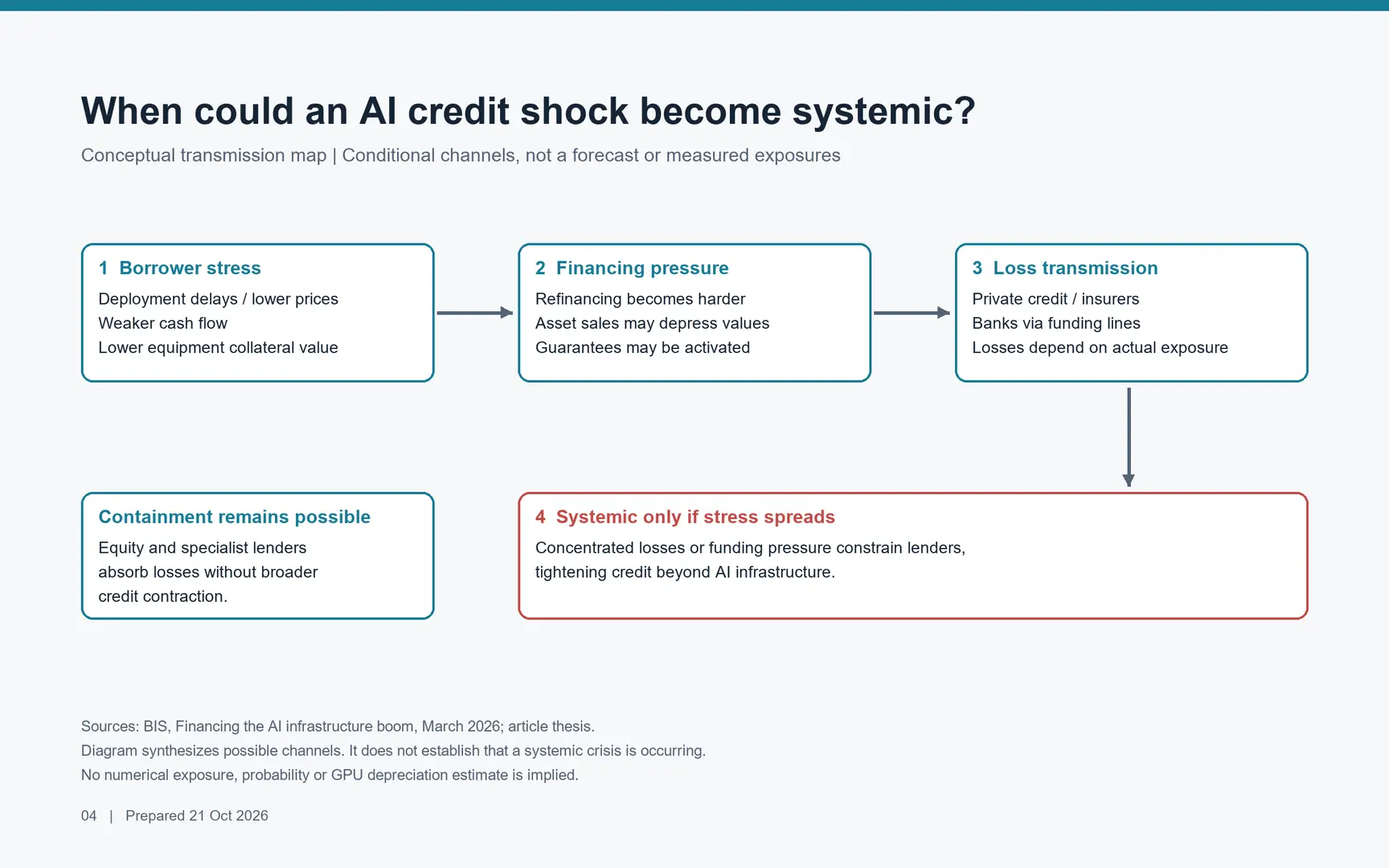
*Potential channels of contagion. The diagram describes mechanisms, rather than measured exposures or a forecast.*
An investment downturn could damage construction, equipment demand and employment even if the financial system remained functional. A systemic crisis would require losses or funding demands large enough to impair lending and market activity more broadly. Guarantees, overlapping investors and bank credit lines are the connections to watch.
Restructuring can also preserve economic value. Usable facilities and equipment may pass to new owners at a lower purchase price and continue serving customers. Whether the adjustment becomes destructive for the wider economy depends on the financing losses and the retrenchment they cause, as well as the condition of the assets themselves.
## Energy, Ukraine and the limits of monetary relief
Persistent inflation would complicate the response to an investment slowdown. In a [September 29 speech](https://www.federalreserve.gov/newsevents/speech/barr20260929a.htm), Federal Reserve Governor Michael Barr identified energy costs, tariffs and demand associated with the AI buildout as sources of price pressure. A central bank facing both weaker activity and stubborn inflation has less room to lower rates without risking renewed price increases.
Energy policy gives the recent diplomacy over Ukraine an economic dimension. [AP reported on October 10](https://apnews.com/article/228ccf74b2848c1ff0ac23f038b37512) that Trump called for Ukraine to have a new president and blamed Ukrainian attacks on Russian refineries for high U.S. diesel prices, after reaching a fuel agreement with Putin. Trump's portrayal of Zelensky as an obstacle to peace is contested; [Zelensky publicly welcomed renewed negotiations on September 7](https://www.president.gov.ua/en/news/vidnovlennya-peregovornogo-procesu-ye-vazhlivim-i-ukrayina-v-106273).
Could easing energy-price pressure, and creating more room for lower interest rates, be one economic incentive behind Trump's rapprochement with Putin and pressure on Kyiv? Prolonged expensive credit would increase the economic appeal of disinflation, particularly for sectors dependent on refinancing. The diplomatic developments leave open how much weight that consideration carries alongside strategic and political objectives.
A settlement could affect fuel supplies, sanctions and inflation expectations. Its impact on a particular data center's electricity bill would still depend on regional generation, grid constraints and power contracts. Cheaper oil and diesel would offer no automatic solution to local power shortages.
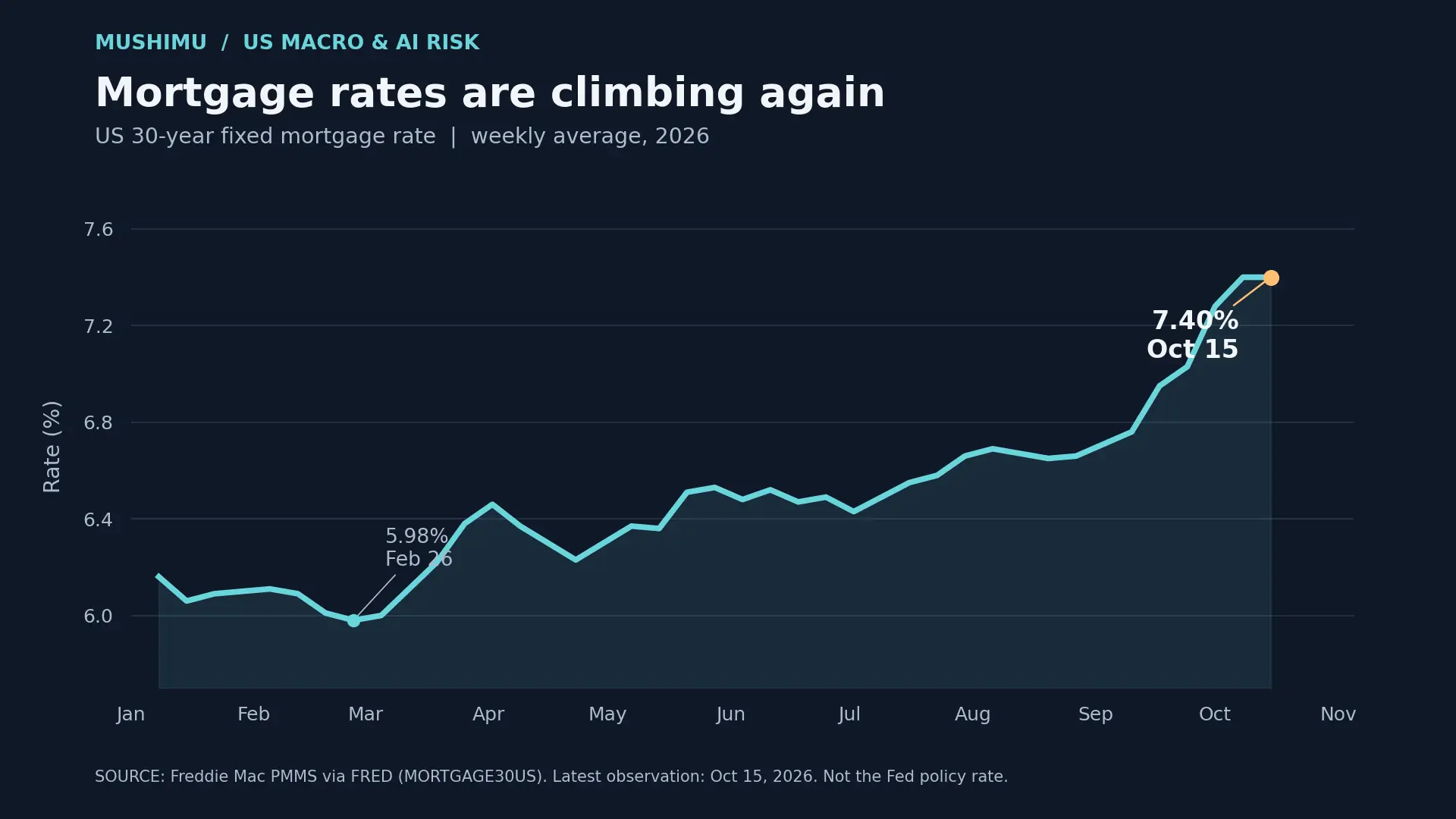
*Freddie Mac's weekly U.S. 30-year fixed mortgage average, via [FRED](https://fred.stlouisfed.org/series/MORTGAGE30US), through October 15, 2026. The series measures new mortgage financing.*
The same distinction applies to monetary policy. Long-term borrowing costs reflect Treasury yields, term premiums and borrower credit risk. A Fed cut can coincide with higher refinancing costs for a company whose credit spread is widening. Liquidity support can help markets function, while an unprofitable project may still require restructuring.
There is a possible cushion, too: weaker investment can reduce demand and inflation, allowing rates to fall. The outcome would depend on how quickly that relief reached borrowers relative to their cash needs and debt maturities.
## The signals that will matter in 2027
The next stage of the buildout will test whether installed capacity can generate the cash assumed in financing models. The most useful indicators connect operating performance with contractual obligations:
- **Returns on operating capacity:** realized rental prices, utilization, power costs and the replacement spending required to maintain revenue. Mature facilities should demonstrate cash returns sufficient to support their share of financing costs.
- **Conversion of contracts into collections:** delivery milestones, customer concentration, service penalties and renewal pricing. A large backlog has value when it produces profitable, collectible revenue.
- **Funding through the next 12–24 months:** unrestricted cash, available credit and expected receipts against construction commitments, interest and scheduled principal repayments.
- **Refinancing and recovery values:** maturity dates, rate hedges, covenant headroom and realistic collateral prices. Reduced lending or repeated asset sales could reveal pressure before reported defaults rise.
- **Stress beyond individual borrowers:** fund leverage, redemption demands, guarantees and tighter credit outside AI. These would show whether losses were spreading through the financing network.
Delays, weaker margins and refinancing pressure could reinforce one another, leading to restructurings and reduced investment. Strong utilization, timely deployment and improving cash generation would support a more orderly adjustment. The quality of those cash flows will matter more than the number of chips purchased or the size of announced commitments.
## AI's success and investors' returns
The infrastructure boom can deliver productive capacity even if some investors earn poor returns. The central risk is a mismatch between the price paid for that capacity, the cash it can generate and the obligations taken on to finance it.
Housing weakness would make a sharp investment slowdown harder to absorb. Institutional financing broadens the distribution of potential losses. Persistent inflation could delay relief from borrowing costs. Together, these factors justify close attention to the financing structure behind the buildout.
**AI adoption can keep growing while infrastructure owners and their lenders lose money.** The difference between a costly investment correction and a credit crisis will be determined by who bears those losses, how they are funded and whether the institutions involved can absorb them without withdrawing credit from the wider economy.
*Updated October 21, 2026.*
~AI ~Economics
Mushitags
Find posts across communities. Multiple mushitags must all match.
~economics
Most used mushitags
Browse the most used mushitags today, this month or this year. Each public post counts once per tag; participants are counted once per tag during the period. Counts follow your content preferences. Periods start at midnight UTC.
- ~ai1 post · 1 participant
- ~economics1 post · 1 participant