

What if AI succeeds, becomes cheaper and transforms the economy, while some of the companies financing its infrastructure fail to recover their investment?
That is the risk I want to examine. The problem would start with a mismatch between expensive equipment purchased upfront and cash flows that arrive later. Power delays, falling rental prices and costly refinancing could turn that mismatch into financial stress.
Housing belongs in this argument as a source of vulnerability and a possible transmission channel—not as evidence that an AI credit crisis has already begun. The question is what happens if an investment slowdown hits while another interest-sensitive part of the economy is struggling.
## 1. Housing weakness matters—but the connection needs explaining
The National Association of Realtors [reported on October 20, 2026](https://www.nar.realtor/newsroom/pending-home-sales-decreased-7-3-percent-in-september) that September pending home sales fell **7.3% month over month and 11.3% year over year**. These measure signed contracts, not completed sales or a fall in house prices. NAR attributed the weakness to rising mortgage rates and noted that distressed properties remained limited.
[Realtor.com's September report](https://www.realtor.com/research/september-2026-data) shows active listings up 5.4% year over year and median asking prices down 1.4%. Asking prices are different from completed-sale prices; neither measure establishes a nationwide crash.
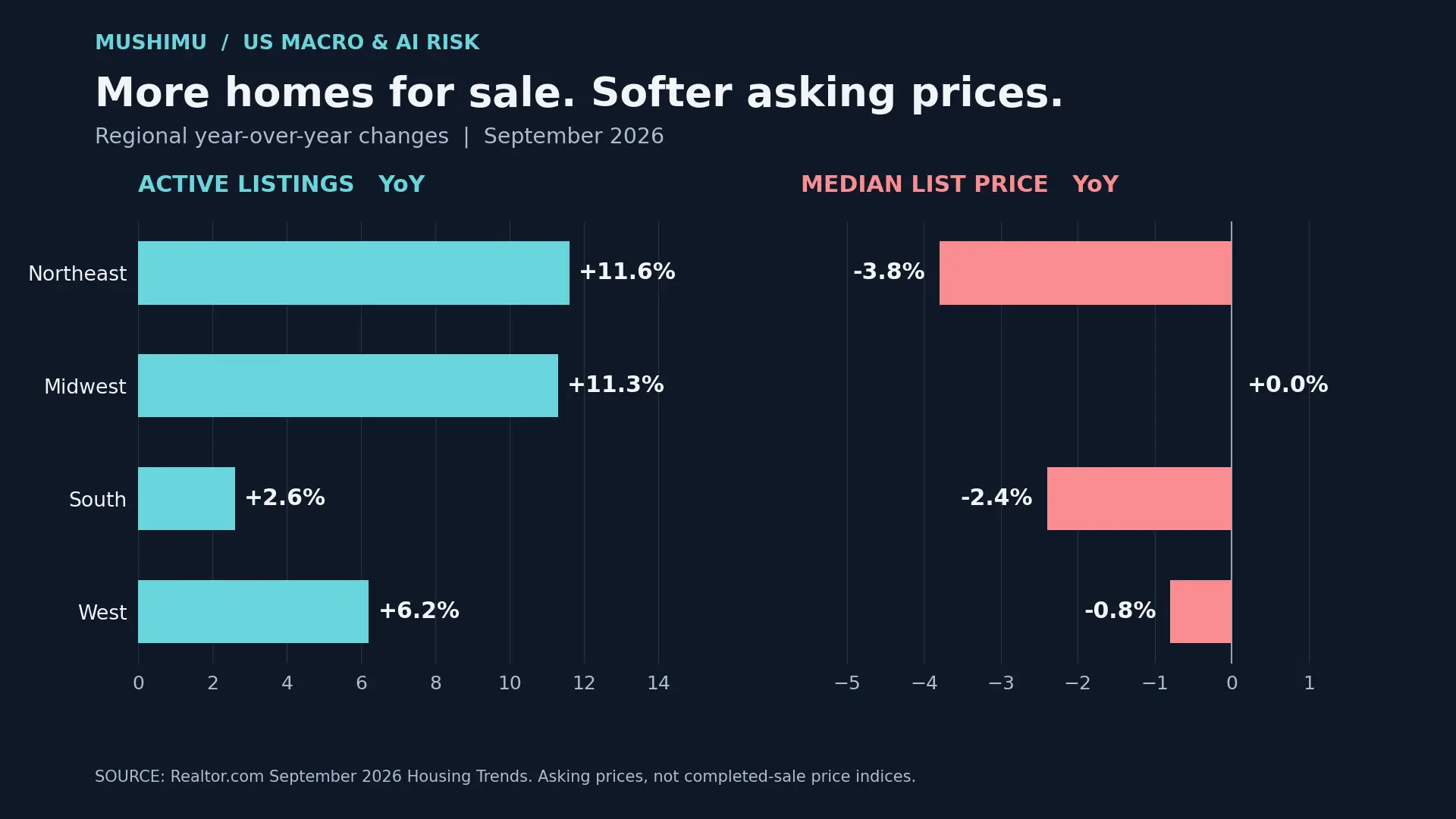
**The first link with AI is the cost of capital.** Expensive financing constrains homebuyers and makes debt-funded infrastructure harder to finance. The sectors have different borrowers and assets, but both are sensitive to borrowing costs.
The second link is economic activity. AI investment supports construction, equipment suppliers and related employment. The [BIS described its contribution to growth in January 2026](https://www.bis.org/publications/bulletin-120-financing-ai-boom-cash-flows-debt). If that spending slowed while housing remained weak, the two would provide less support to demand at the same time. This is a conditional argument, not a calculation that AI is the economy's only source of growth.
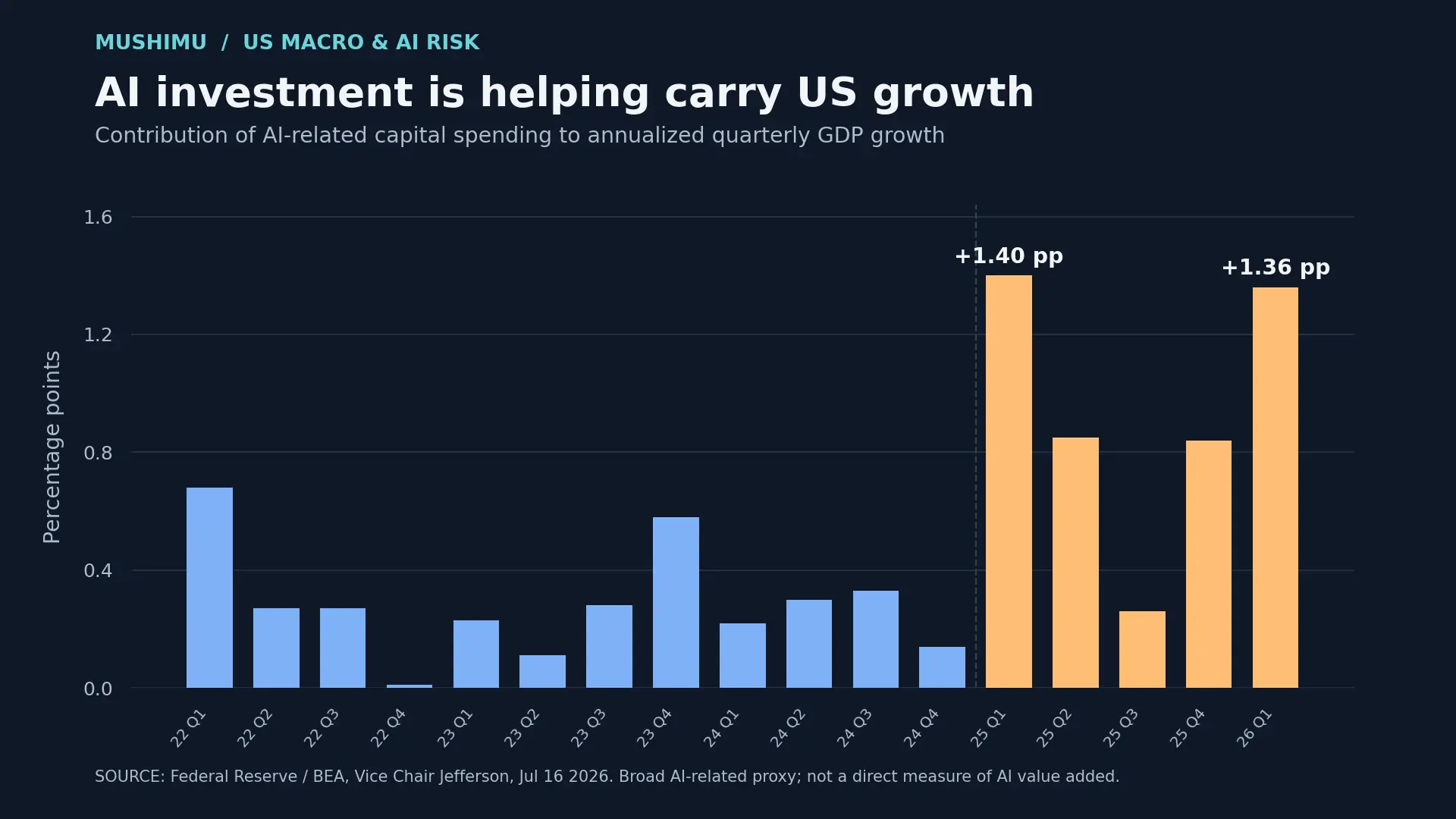
*Housing turnover and AI investment measure different things. Their relevance here is a potential overlap in financial pressure and economic weakness.*
The third link would arise after a shock: weaker employment and tighter credit could further reduce housing demand. Some households might need to sell, but forced selling would depend on income losses, savings and mortgage distress—not simply on one weak month of pending sales.
## 2. Hardware can arrive before the revenue
Business Insider reported on October 20 that Amazon's Early Rack Receipt program would receive Nvidia servers before facilities were fully ready. Internal plans described an initial $5 billion in GB300 racks. Amazon argues that early receipt is a normal supply-chain strategy; the planned deliveries should not be treated as a verified total of idle equipment.
The financing issue is straightforward: buying GPUs does not complete a data center. Grid connections, transformers, cooling and substations can take much longer to deliver than the servers themselves.
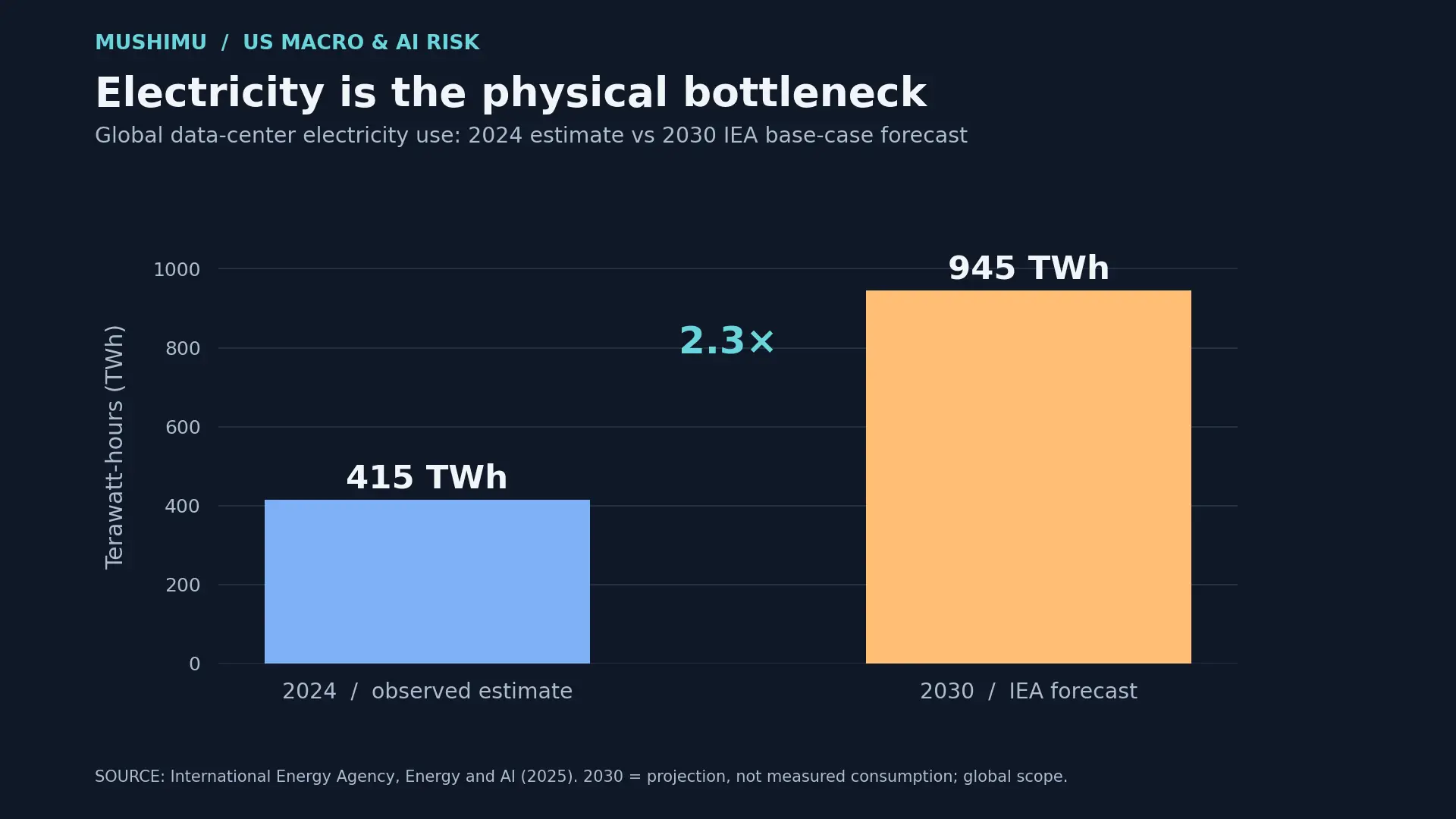
A smaller operator could borrow for hardware, encounter a power delay and incur financing costs before earning the expected revenue. Newer equipment may arrive before the project reaches full utilization. The damage depends on financing drawdowns, contract protections and the delay's duration.
Amazon has diversified businesses and substantial financial resources. A leveraged GPU rental company may have less room to absorb the same disruption.
## 3. Technical usefulness does not guarantee an adequate return
Inference—running trained models—makes cost per token increasingly important. HBM remains essential for many demanding workloads, but specialized accelerators, quantization and more efficient models can change which hardware offers the best economics.
A GPU can remain useful while its rental income falls. If newer capacity delivers better performance per dollar, customers may demand discounts on older equipment. Revenue and resale values could then decline faster than the operator expected, while debt principal and contractual payments remain due.
The effect will vary with workload, power costs, utilization and customer contracts. There is no single depreciation curve for every GPU, and accounting depreciation should not be mistaken for observed resale losses.
Cheaper inference could also stimulate enough additional demand to preserve returns. That is the strongest counterargument: efficiency gains can expand the market, although they do not guarantee equal returns for every operator.
## 4. CoreWeave: distinguish debt, commitments and cash flow
CoreWeave and other neoclouds illustrate the need to examine financing company by company. Their balance sheets and customer contracts differ.
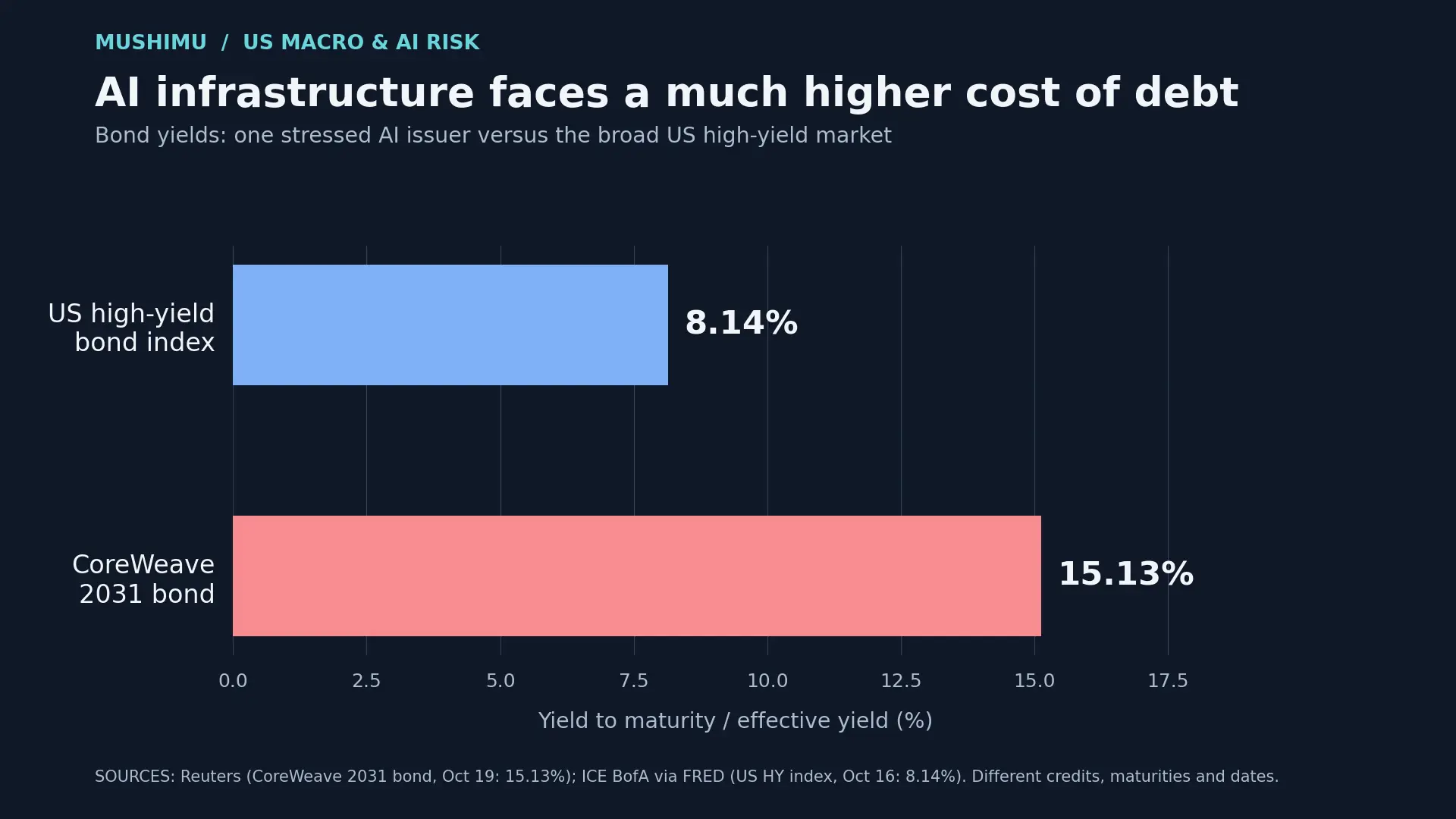
The Reuters coverage cited below described roughly $50 billion in debt and borrowing commitments in October. That broader measure should not be compared directly with debt already drawn. For a clearly dated balance-sheet measure, [CoreWeave's August 11 results](https://investors.coreweave.com/news/news-details/2026/CoreWeave-Reports-Strong-Second-Quarter-2026-Results/default.aspx) show $35.07 billion of debt at June 30, compared with $21.37 billion at December 31, 2025, summing current and non-current carrying values and excluding leases.
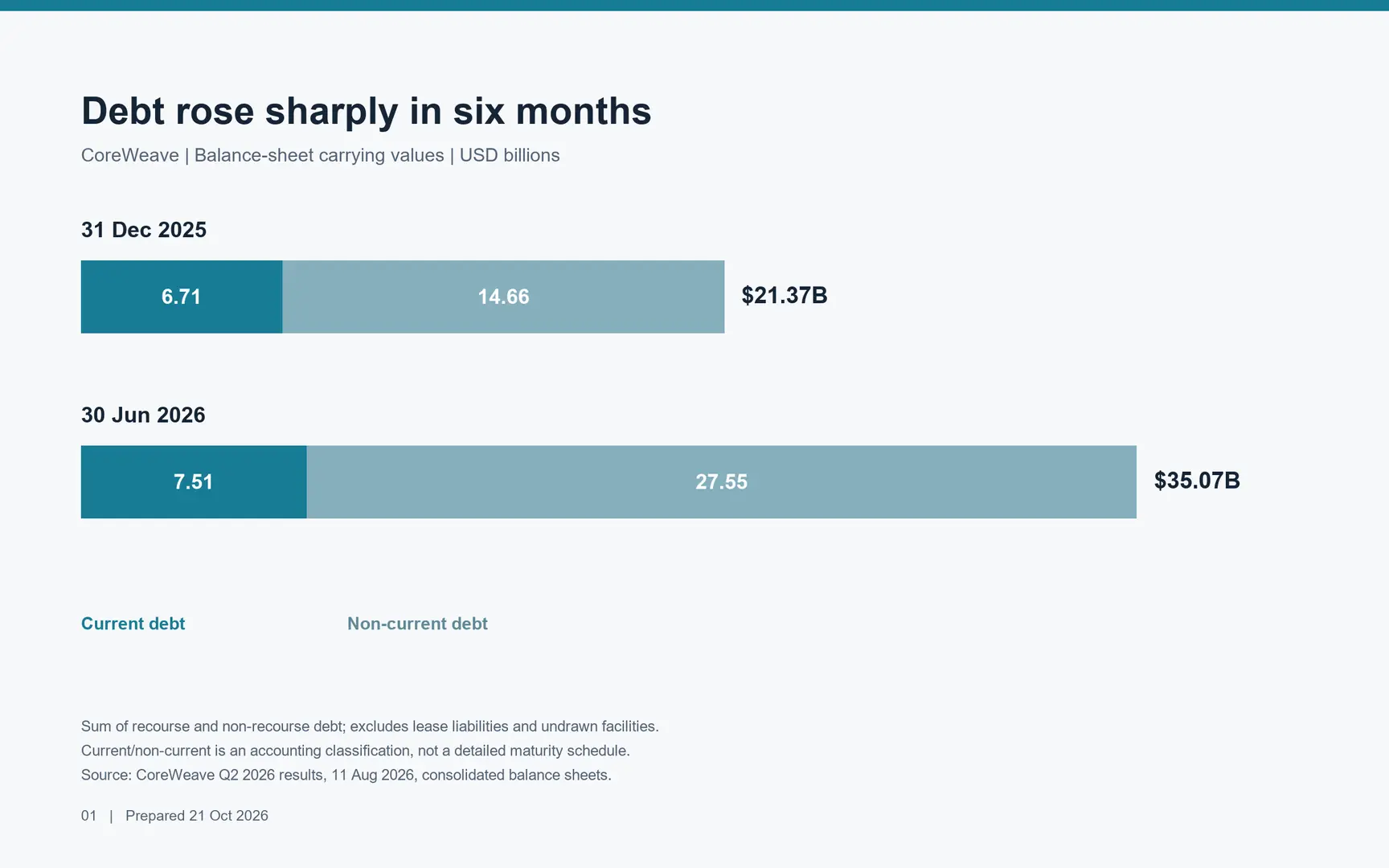
*Historical balance-sheet debt; excludes leases and undrawn commitments.*
The October coverage also described bond yields approaching 16% and a JPMorgan forecast of negative free cash flow until 2030. Those are market observations and an analyst forecast, respectively—not the contractual rate on all existing debt or an established future outcome. A secondary-market yield can signal refinancing pressure without changing a fixed coupon, and secured borrowing may carry different terms.
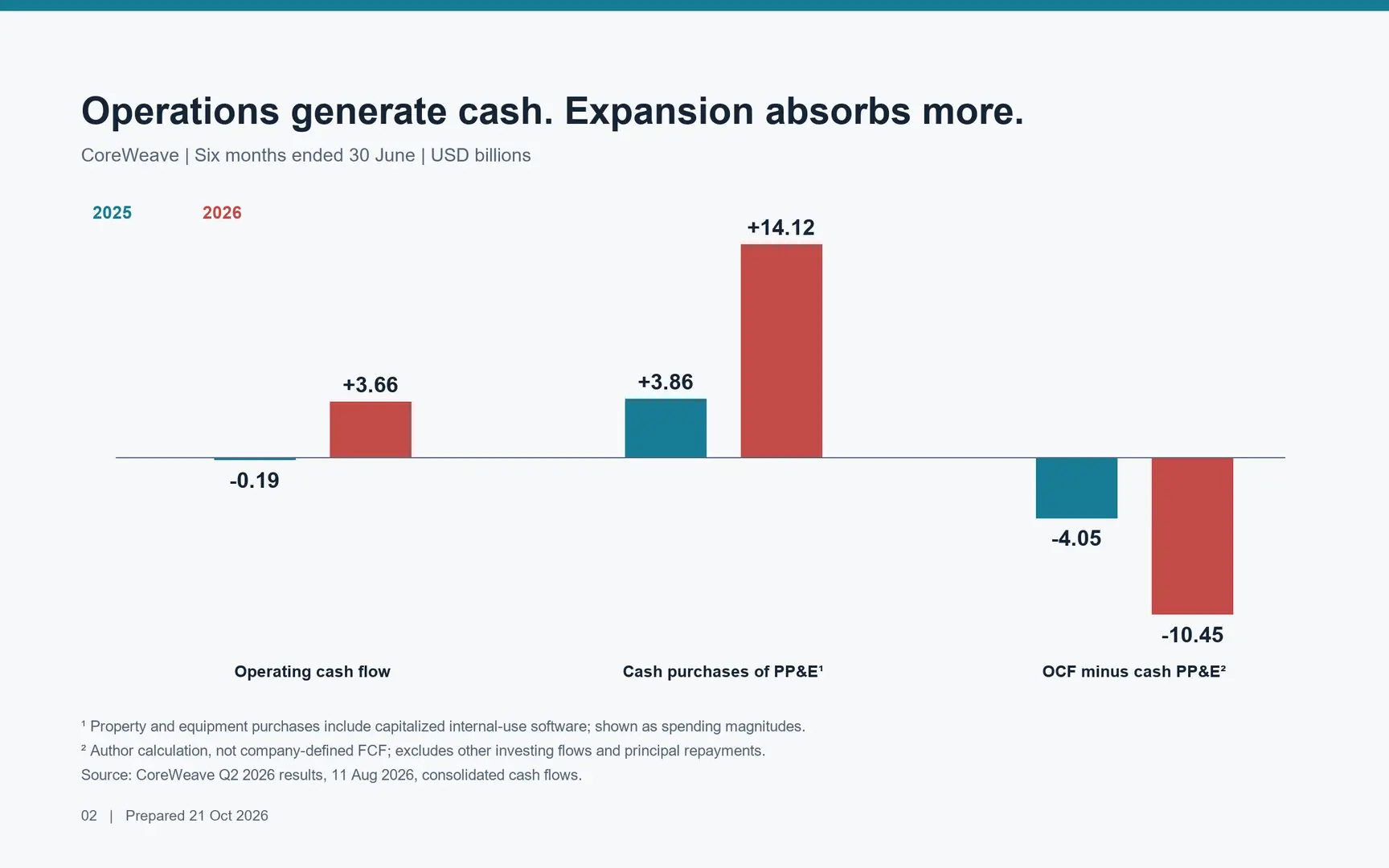
*The chart shows historical operating cash flow minus cash purchases of property and equipment, including capitalized software. This author calculation is not company-defined free cash flow and does not represent the JPMorgan forecast.*
Operating cash generation improved in the first half of 2026, but cash equipment spending was substantially larger. Expansion can consume cash before projects mature; that alone does not prove insolvency. The test is whether deployed capacity eventually earns enough to cover operations, equipment replacement and financing obligations.
## 5. How collateral and cash-flow problems can reinforce each other
Consider a hypothetical operator that buys $10 billion of equipment with $7 billion of debt. A 40% fall in resale values would leave $6 billion of equipment backing $7 billion of assumed outstanding principal.
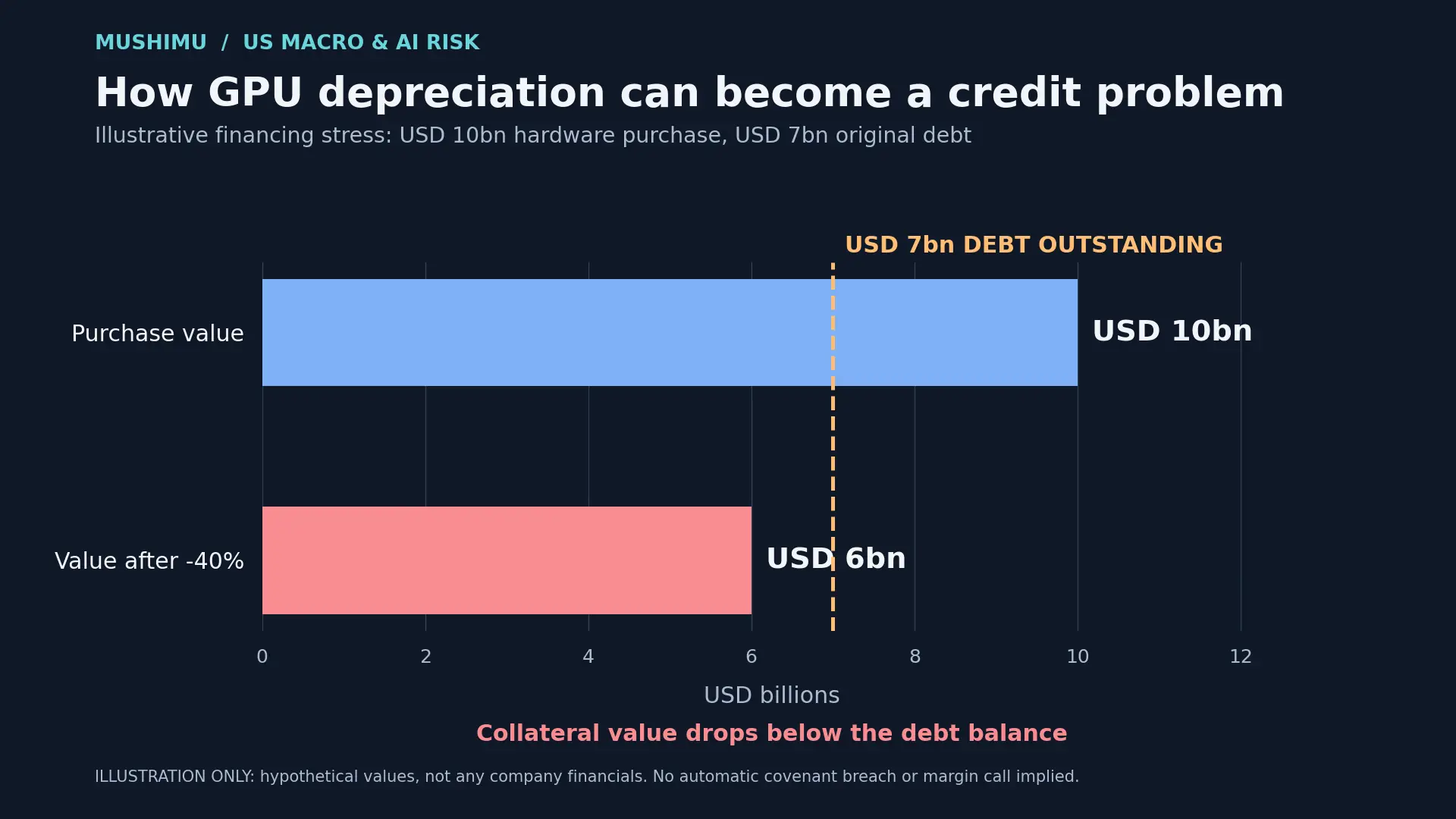
That would not automatically cause bankruptcy or a margin call: covenants, guarantees and repayment schedules matter. The more immediate threat could be an inability to service the debt from operations.
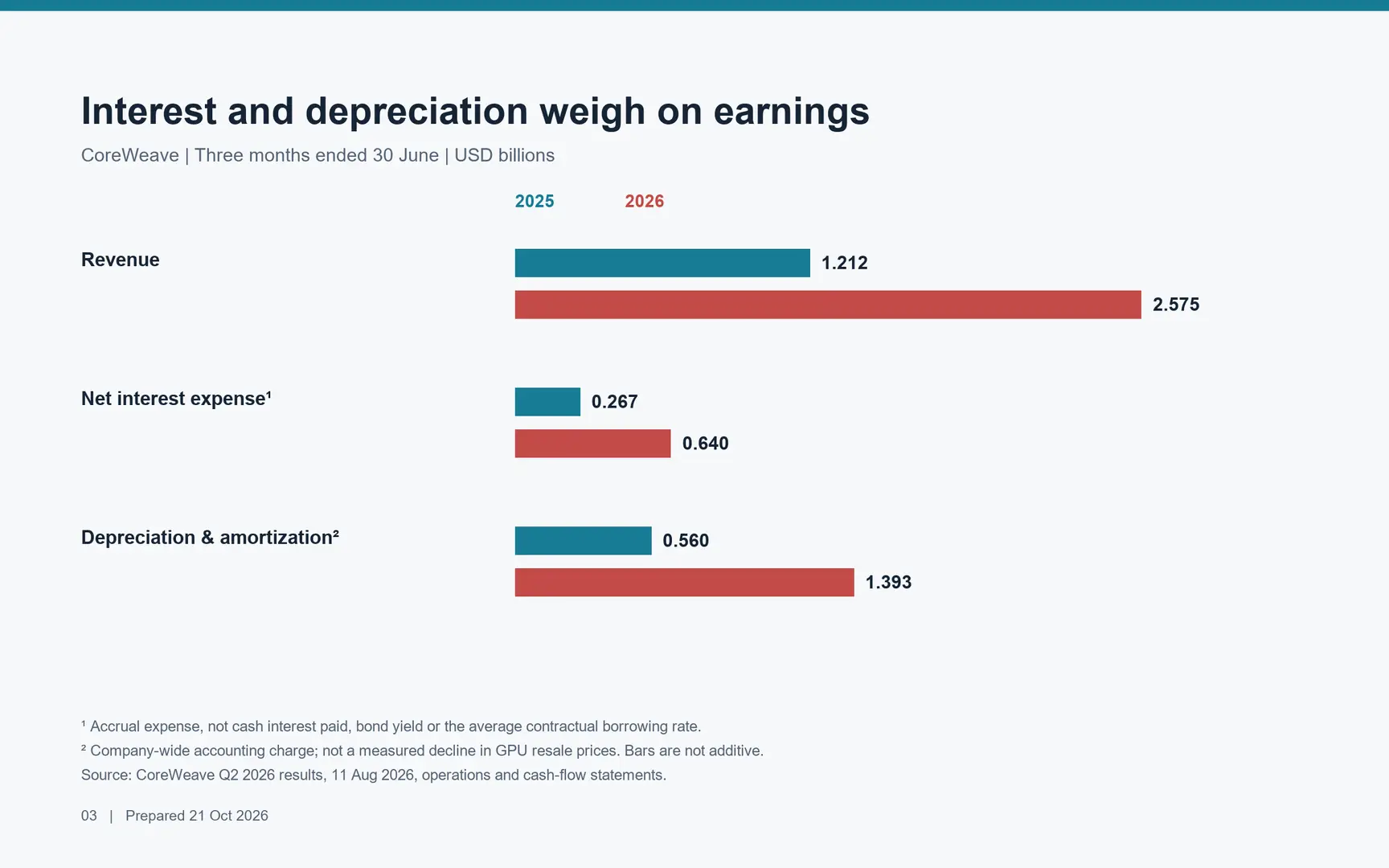
*The chart above contains CoreWeave's actual company-wide accounting data. It is separate from the hypothetical operator below; depreciation and amortization do not measure GPU resale losses.*
### A simplified annual stress test
- Revenue before the shock: **$3 billion**.
- Operating expenses: **$1.2 billion**.
- Interest on $7 billion of debt at 10%: **$700 million**.
- Revenue after an assumed 40% decline: **$1.8 billion**.
After operating expenses, only $600 million would remain—$100 million less than annual interest, before taxes, principal repayments and other obligations. The operator would face both weaker collateral coverage and insufficient cash generation.
These are illustrative assumptions, not CoreWeave's financial position or a prediction of GPU prices. If several borrowers experienced such pressure together, refinancing demands could force equipment sales that depressed collateral values for others. That feedback loop, rather than technological progress alone, is the financial danger.
## 6. Who ultimately owns the debt?
The financing extends beyond the operator and its bank. A [March 2026 BIS analysis](https://www.bis.org/publications/qr-202603/financing-ai-infrastructure-boom-on-and-off-balance-sheet-borrowing) describes vehicles funded through private credit and institutional capital, supported by leases, capacity commitments, guarantees and bank funding lines. Its conclusions are the authors' analysis, not a finding that a crisis is inevitable.
### Pension exposure is documented; university exposure needs qualification
There are concrete pension-backed lending deals. On July 31, 2025, [CPP Investments announced C$225 million of construction financing](https://www.newswire.ca/news-releases/cpp-investments-commits-to-225-million-in-construction-financing-for-ontario-data-centre-886540216.html) for a 54 MW data-center expansion in Ontario. It took half of a loan alongside Deutsche Bank; the project was pre-leased to a GPU-focused AI cloud provider. This establishes direct pension investment in data-center debt, not a distressed bank loan being dumped on pension savers.
[Mercer's 2026 pension outlook](https://www.mercer.com/en-gb/insights/pensions/defined-benefit-schemes/top-db-considerations/) also warns trustees to assess AI concentration in public and private credit, beyond their equity portfolios.
University endowments can have an indirect route through private-credit funds. A [2026 Morgan Stanley survey](https://www.morganstanley.com/cs/pdf/MS-2026-Endowments-Foundations-Survey.pdf) documents endowments' use or planned use of private credit, but does not identify how much they hold in data-center loans. It would therefore be premature to claim that universities as a group are buying large amounts of this particular debt.
**Loan origination, syndication, securitization and investment through a fund are different transactions.** They can distribute risk among investors, but selling debt does not prove it is bad debt. Nor does a pension's equity ownership of a data-center company establish that it owns that company's loans.
### When could losses become systemic?
Losses in these portfolios could affect pension funding or endowment spending without producing a banking crisis. Long-term capital can absorb losses; the systemic question is whether leverage, liquidity demands or concentrated exposures force institutions to sell assets or cut lending elsewhere.
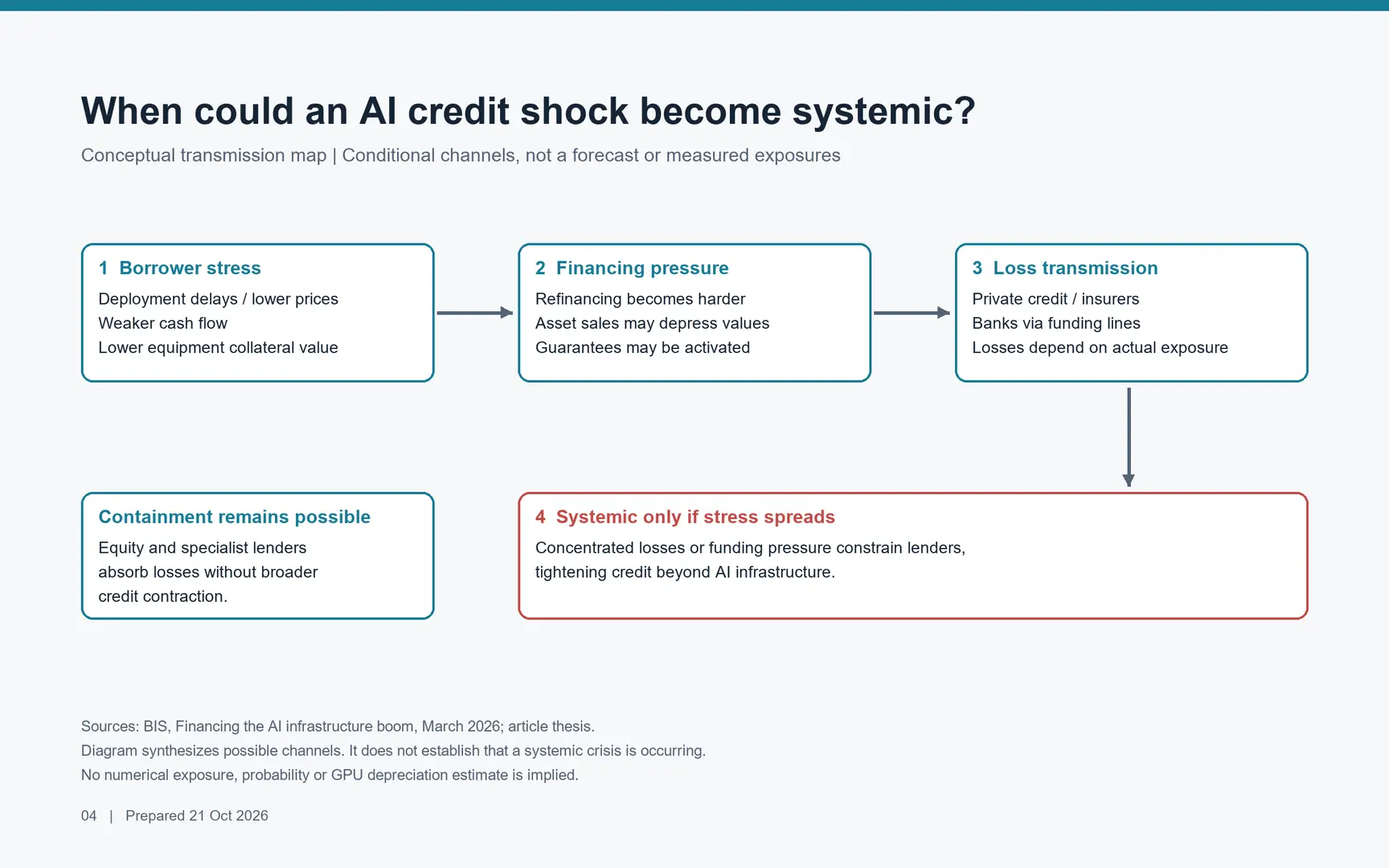
*Conditional transmission channels, not a forecast or measured financial exposures.*
A severe AI correction would become a broader threat if refinancing failed across several borrowers, collateral sales reinforced one another and exposed lenders tightened credit to unrelated sectors. Cancelled data-center projects could also reduce orders and employment in construction, equipment and electrical infrastructure.
That is the route back to housing: weaker household income and less available credit could aggravate an already slow market. Pending sales alone neither demonstrate that transmission nor establish an analogy with subprime mortgages in 2008.
## 7. Energy, Ukraine and the Fed's room to respond
If inflation stayed persistent during an AI credit shock, the Fed could face pressure to support activity without reigniting price increases. In a [September 29, 2026 speech](https://www.federalreserve.gov/newsevents/speech/barr20260929a.htm), Governor Michael Barr identified energy costs, tariffs and demand associated with the AI buildout as sources of price pressure.
The recent diplomacy gives this an immediate context. [AP reported on October 10](https://apnews.com/article/228ccf74b2848c1ff0ac23f038b37512) that Trump called for Ukraine to have a new president and blamed Ukrainian refinery attacks for high U.S. diesel prices, after reaching a fuel agreement with Putin. That brings energy costs explicitly into the political dispute. Trump's portrayal of Zelensky as an obstacle to peace is a contested position: [Zelensky publicly welcomed renewed negotiations on September 7](https://www.president.gov.ua/en/news/vidnovlennya-peregovornogo-procesu-ye-vazhlivim-i-ukrayina-v-106273).
**Could the wish to ease energy-price pressure—and create more room for lower interest rates—be one economic incentive behind Trump's rapprochement with Putin and pressure on Kyiv? And could prolonged expensive credit make that incentive more urgent?**
Those are questions raised by the overlap between diplomacy and economic pressures. A durable reduction in geopolitical energy risks could help inflation, depending on supplies, sanctions and market expectations. But Ukraine is not the only conflict affecting energy: Barr also emphasized the Middle East, while domestic demand and other policies matter for the inflation outlook. The connection to AI runs through those financial conditions; the diplomatic moves do not independently establish AI credit stress.
Lower energy prices would not automatically produce a Fed cut. Nor would a cut guarantee cheaper mortgages or refinancing for a risky borrower.
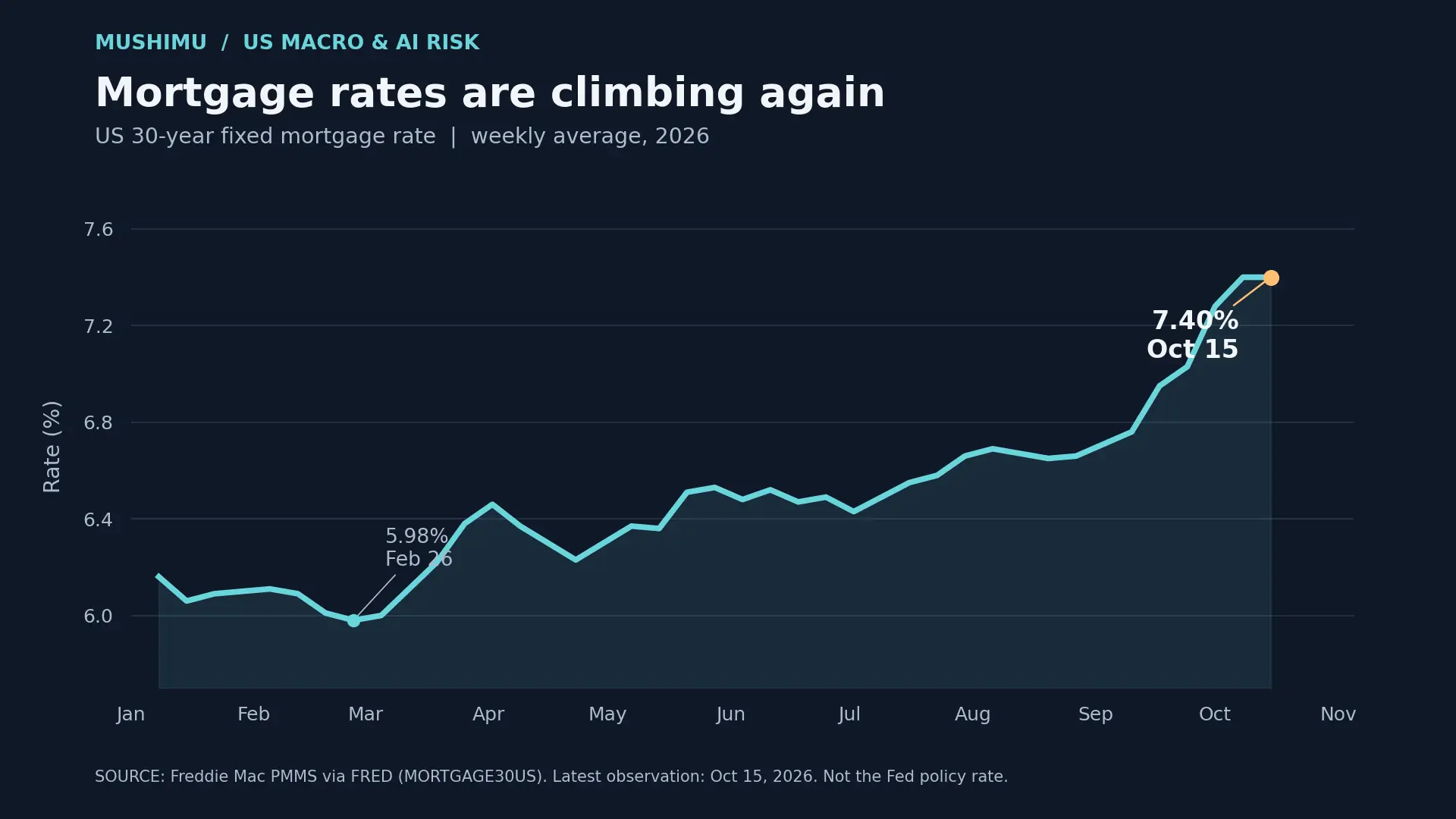
Long-term borrowing costs also reflect expected inflation, Treasury yields and credit spreads. Even if the Fed eased, lenders could demand more compensation for an AI operator whose contracts, collateral or cash flows had deteriorated. The relevant risk is prolonged expensive financing relative to project returns—not the absence of a rate cut in isolation.
## 8. The scenario to watch in 2027
The adverse sequence is conditional:
1. Deployment delays postpone revenue while financing costs accrue.
2. Competition or underutilization weakens returns on installed hardware.
3. Lenders demand stronger protection or decline to refinance.
4. Restructurings and asset sales depress collateral and curtail new investment.
5. Employment and credit effects spread beyond the original borrowers.
The alternative is that demand absorbs new capacity, energy bottlenecks ease and improving cash generation supports repayment. Some operators might fail while the technology and the wider economy continue growing.
## 9. What would confirm or weaken the thesis?
### Evidence that would strengthen it
- **Operating pressure:** comparable GPU rental prices fall faster than costs, utilization weakens or deployment delays persist.
- **Financing pressure:** cash generation disappoints, refinancing terms worsen, or multiple operators restructure and sell equipment.
- **Transmission beyond AI:** disclosed losses, funding calls or liquidity pressure lead exposed institutions to reduce lending or spending elsewhere.
### Evidence that would weaken it
- Demand growth preserves provider margins and utilization despite cheaper inference.
- Operating facilities generate enough cash to service debt and fund necessary replacement equipment.
- Refinancing remains available on sustainable terms, and losses stay contained among investors and creditors.
Total investment, Nvidia's share price and a single housing release cannot settle the argument. The useful indicators are project returns, financing terms and evidence about who bears losses and how they respond.
## My conclusion: adoption and investment returns can diverge
The internet survived the dot-com crash. AI could similarly transform the economy while some infrastructure owners discover that they paid too much or borrowed on assumptions their cash flows cannot support.
The housing slowdown strengthens the question about the economy's capacity to absorb another shock; it does not prove the AI thesis. Pension and institutional lending make it more important to trace the risk, but their participation alone does not make that risk systemic.
**The central concern is whether infrastructure can recover its capital before technological change, competition and financing costs erode the expected return.** If it can, the bearish case weakens. If it cannot, the consequences will depend on leverage, contractual protection and the resilience of the institutions holding the debt.
What evidence would persuade you that this is a manageable investment correction—or that stress is spreading into the wider credit market?
*Analysis revised October 21, 2026. Historical data, forecasts and hypothetical scenarios are identified separately.*
## Sources
- [National Association of Realtors — Pending Home Sales, September 2026](https://www.nar.realtor/newsroom/pending-home-sales-decreased-7-3-percent-in-september)
- [Realtor.com — September 2026 Housing Market Trends](https://www.realtor.com/research/september-2026-data)
- [Business Insider — Amazon's Nvidia hardware and data center power constraints](https://www.businessinsider.com/amazon-nvidia-ai-gpu-data-centers-power-shortages-2026-10)
- [Reuters — AI credit worries and rising default insurance costs](https://www.reuters.com/business/media-telecom/global-markets-cds-ai-urgent-2026-10-15/)
- [Reuters — CoreWeave debt and banking exposure](https://www.reuters.com/business/finance/coreweave-debt-selloff-poses-limited-risk-global-banks-jp-morgan-says-2026-10-20/)
- [Bank for International Settlements — Financing the AI Infrastructure Boom](https://www.bis.org/publications/qr-202603/financing-ai-infrastructure-boom-on-and-off-balance-sheet-borrowing)
- [Reuters — Federal Reserve rate expectations, October 2026](https://www.reuters.com/business/fed-skip-october-raise-rates-again-december-nearly-all-economists-say-2026-10-20/)
~AI ~Economics
Mushitags
Find posts across communities. Multiple mushitags must all match.
~economics
Most used mushitags
Browse the most used mushitags today, this month or this year. Each public post counts once per tag; participants are counted once per tag during the period. Counts follow your content preferences. Periods start at midnight UTC.
- ~ai1 post · 1 participant
- ~economics1 post · 1 participant