The real-time graphics ecosystem took a decisive step toward platform neutrality on November 12, 2026, with the public release of Apex Neural Rendering (ANR) FG version V.B14 by Apex Compute. Designed as an independent, cross-vendor deep learning alternative to NVIDIA DLSS 3 Frame Generation, ANR breaks down the proprietary hardware exclusivity that has defined neural frame synthesis since 2022. By reconstructing intermediate video frames through an adaptable neural pipeline rather than vendor-locked silicon, ANR delivers hardware-accelerated frame generation across NVIDIA GeForce RTX (20, 30, 40, and 50 series) and GTX 16 series GPUs, AMD Radeon RX (5000 through 9000 series, including the Valve Steam Deck), Intel Arc A and B series graphics, and even Apple Silicon (M2 Max) on macOS 26. Supported natively on Windows 10 and 11, and across Linux and SteamOS through Proton, ANR represents the most ambitious community-driven effort to date aimed at democratizing applied artificial intelligence in real-time computer graphics.
When NVIDIA introduced DLSS 3 Frame Generation during the Ada Lovelace generation, it anchored the feature strictly to the Optical Flow Accelerator (OFA) embedded within RTX 40 and subsequent RTX 50 series silicon. This hardware lock severed older architectures—such as the widely deployed RTX 3080 and RTX 2080—from AI-driven frame multiplication, relegating them to spatial upscaling while competing solutions like AMD FSR 3 relied heavily on analytical, non-neural optical flow algorithms. Apex Neural Rendering challenges this paradigm by restructuring neural inference around generalized compute shaders. Rather than depending on proprietary hardware fixed-function blocks, ANR executes inference through optimized tensor kernels capable of running on standard FP16 and INT8 shader arrays present on modern GPUs from any manufacturer.
At the core of the newly released ANR FG engine is a compact neural reconstruction architecture designated in internal benchmarks as model `r2-w4g05-s0-w96k`. The network is trained to synthesize fractional in-between frames (at temporal offsets t = 0.5 for standard 2x generation, or t = 1/3 and 2/3 for higher temporal multipliers) by digesting a synchronized cascade of engine inputs: camera depth buffers, two-dimensional screen-space motion vectors, sub-pixel jitter matrices, and historical color buffers. In real-time rendering, the primary challenge of frame interpolation has never been linear camera panning, but rather disocclusion—scenarios where foreground objects move rapidly to reveal previously hidden background geometry. While heuristic optical flow models often smudge disoccluded regions or introduce shimmering "halo" artifacts, ANR's neural network utilizes deep contextual priors to hallucinate coherent texture details, suppressing edge ghosting and maintaining structural stability around fine details such as foliage, alpha-tested hair, and particle effects.
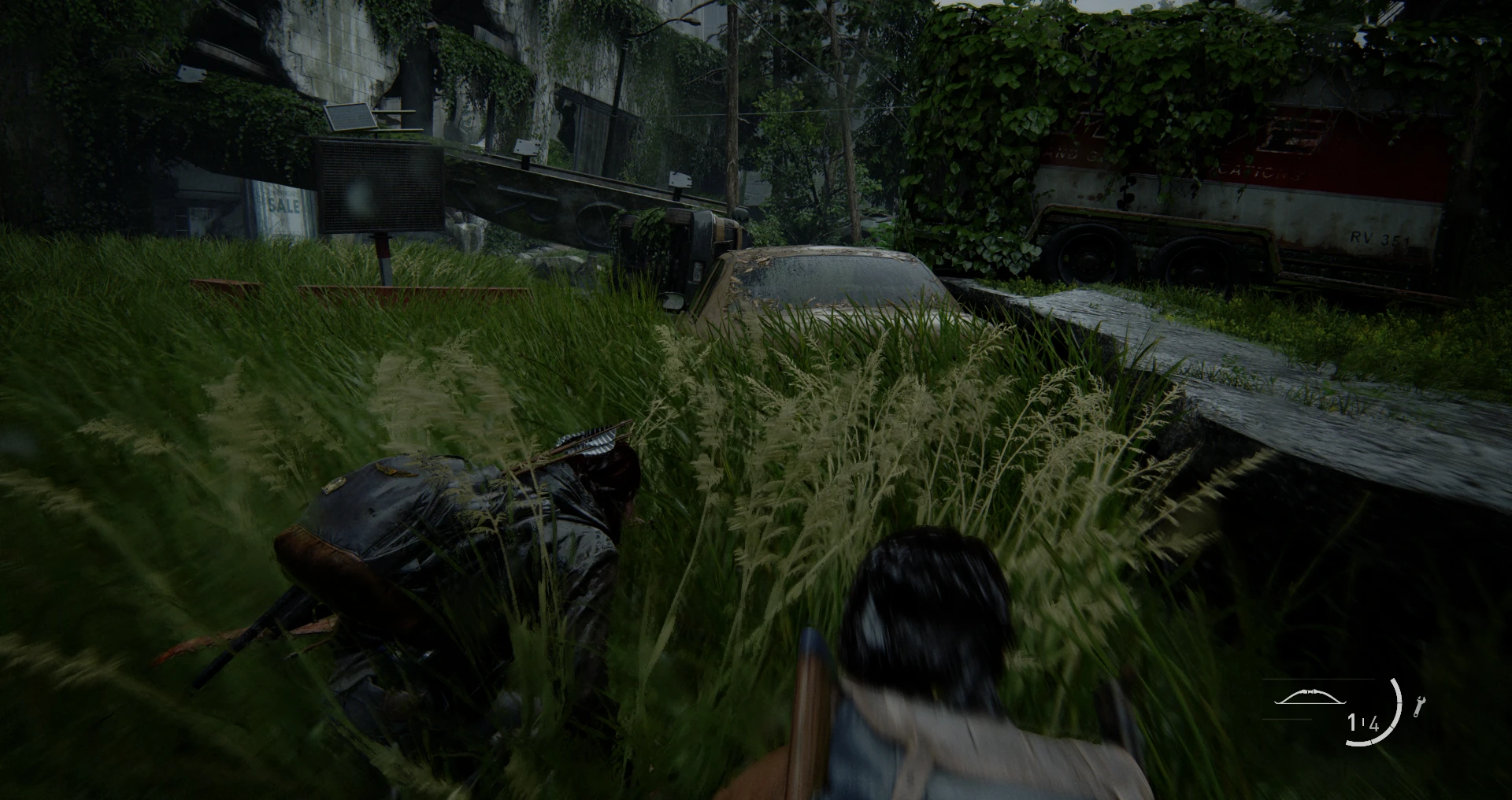
Integration into existing gaming ecosystems is accomplished via an ingenious wrapper architecture utilizing OptiScaler, an established open-source presentation hook. ANR ships in two packages: a standalone installer (`anr-fg-full`) that injects OptiScaler directly into a game's root directory, and an add-on package (`anr-fg-addon`) for setups with existing OptiScaler deployments. By intercepting Microsoft DirectX 12 (D3D12) and Vulkan swapchain presentations, ANR dynamically replaces calls to NVIDIA's proprietary runtime (`nvngx_dlssg.dll`). On Linux distributions and SteamOS, deployment requires no kernel modifications or custom display drivers; players simply execute an automated shell script (`sh install.sh`) and append the standard Wine dynamic library override (`WINEDLLOVERRIDES="dxgi=n,b" %command%`) to the game's launch parameters in Steam. This runtime abstraction enables titles featuring native DLSS Frame Generation menus—such as The Last of Us Part I and Part II Remastered—to transparently route frame generation through ANR on AMD and Intel hardware.
What sets Apex Compute's release apart from traditional vendor marketing is the simultaneous release of `nr-record`, a deterministic capture and telemetry suite. Utilizing the newly standardized `nr-record-4` binary container format, `nr-record` hooks into the graphics pipeline to record every raw texture buffer—including the composited backbuffer, hudless geometry passes, dedicated UI color and alpha masks, Z-depth, and motion vector fields—alongside precise floating-point projection matrices. These streams are compressed in real time using multi-threaded zstd blocks without dropping frames. Because the recording preserves the exact mathematical inputs provided by the game engine, testers can replay identical sequences offline through multiple frame generation runtimes, including ANR FG and NVIDIA's official `nvngx_dlssg.dll`, running on identical hardware.
This deterministic harness enables rigorous empirical comparison rather than subjective visual impressions. Apex Compute pairs the tool with an offline viewer and compare engine (`viewer/renderer`), allowing pixel-level split-screen zooming, dynamic error difference maps, and perceptual image quality metrics based on CGVQM-5 mean patchpoint scoring. Independent testing can thus isolate algorithmic differences under identical conditions, verifying whether neural models maintain text clarity on fast-moving heads-up displays (HUDs) or exhibit tearing along high-contrast specular edges.
Despite the breakthrough, practical deployment carries substantial technical tradeoffs that demand critical scrutiny. Chief among these is pipeline latency. Frame generation operates by holding the most recent real frame in a buffer while synthesizing an intermediate frame between it and the prior frame. This introduces intrinsic display latency, meaning synthesized frames do not reflect new user input. While NVIDIA combats this penalty through Reflex and AMD through driver-level anti-lag scheduling, ANR currently lacks a universal cross-vendor latency-reduction hook. Consequently, executing ANR FG from a low base framerate (below 40 FPS) can produce a perceptually smooth image paired with sluggish, unresponsive controller or mouse input. On power-constrained mobile architectures such as the Steam Deck's 15W Aerith/Sephiroth APU, running neural inference passes on the same RDNA 2 compute units responsible for 3D rendering inevitably consumes frame time, creating a delicate balance between higher visual fluidity and increased frame time variance.
Furthermore, software transparency remains an ongoing consideration. While the `nr-record` telemetry suite and OptiScaler harness are licensed under the GNU General Public License (GPL-3.0), the core ANR FG inference binaries are currently distributed as pre-compiled dynamic libraries, with Apex Compute promising the full source code in an upcoming release. Until the underlying model weights and training datasets undergo community verification, Linux and open-source advocates will treat performance claims—such as advertised speedups of "up to 2.4x over DLSS"—with measured skepticism.
Looking forward, Apex Compute has confirmed that ANR Frame Generation is merely the foundational module of a unified neural rendering stack. Companion models for Super Resolution (ANR SR) and Ray Reconstruction (ANR RR) are actively in training, targeting open cross-platform upscaling and neural path-tracing denoising to rival NVIDIA DLSS 3.5 and 3.7. As modern graphics pipelines increasingly transition from brute-force compute toward AI-assisted visual synthesis, the emergence of vendor-agnostic neural engines ensures that technological advancements remain accessible to the entire gaming community, preventing artificial hardware boundaries from dictating the future of interactive entertainment.
~ArtificialIntelligence ~NeuralRendering ~LinuxGaming ~ComputerVision ~MachineLearning