On October 29, 1969, UCLA computer science student Charley Kline tried to log in remotely to a computer at the Stanford Research Institute. The first two letters arrived: “L” and “O.” When Kline sent “G,” the system crashed. The team completed the login about an hour later.
That small failure became a useful origin story for ARPANET. The intended command was simply “LOGIN”; “LO” was an accident of timing, not a planned message or a prophecy. UCLA professor Leonard Kleinrock later recalled the attempt, while the surviving UCLA IMP log records a 10:30 p.m. host-to-host exchange with SRI and a later “host dead” message. The log itself does not spell out “LO”; that detail comes from Kleinrock’s account.
It is often called the first Internet message, but the careful description is ARPANET’s first host-to-host message. ARPANET was an early packet-switching network and a major precursor to the Internet. The Internet as an interconnected network took shape later, when TCP/IP let separate networks communicate in 1983.
The image is a 2011 photograph of the surviving UCLA IMP log, not a picture of the 1969 session. Photo: Andrew “FastLizard4” Adams, uploaded by Rybec, CC BY-SA 2.0 ([image and license](https://commons.wikimedia.org/wiki/File:The_IMP_Log_The_Very_First_Message_Sent_on_the_Internet_(6293913865).jpg)). [Kleinrock’s account](https://www.icann.org/en/blogs/details/the-first-message-transmission-29-10-2019-en) · [UCLA log](https://www.lk.cs.ucla.edu/internet_first_words.html) · [DARPA history of ARPANET](https://www.darpa.mil/news/features/arpanet).
~Internet ~Technology
~
COMMUNITY
~Technology
Technology news, gadgets, hardware, software, computing, innovation, startups and discussion about the technologies shaping our everyday lives.
CONVERSATIONS
Apple introduced HomeView, a new screen-based smart-home hub, on Tuesday alongside the fourth-generation Apple TV 4K and HomePod mini 2. The launch brings entertainment, home controls and Siri AI together across the company’s home products. One major caveat for European buyers: Apple says HomeView will not be sold in the EU while Siri AI remains unavailable on iOS there, and it has not given a European release date.
The tabletop and wall-mounted HomeView each cost $299 in the U.S. and are available to preorder in selected markets, with retail availability from November 13. Its 7-inch display can personalize content for up to six recognized household members, show up to nine camera feeds, run FaceTime calls and control compatible smart-home devices. Apple says the assistant can use personal context when paired with an Apple Intelligence-enabled iPhone or iPad. Apple’s [HomeView announcement](https://www.apple.com/newsroom/2026/10/meet-apple-homeview-a-new-way-to-enjoy-entertainment-and-manage-the-home/) lists the regional limits; the company says it is working with the EU but has set no timetable.
The new Apple TV 4K also costs $299 in the U.S. and arrives November 13. It moves to an A19 chip, with Apple claiming up to 50 percent faster CPU performance and twice the GPU performance versus the previous model; it adds three far-field microphones, AV1 decoding and Precision Finding for the Siri Remote. Pairing it with four HomePod mini 2 speakers enables a four-speaker surround setup for the first time. The [Apple TV announcement](https://www.apple.com/newsroom/2026/10/apple-unveils-the-new-apple-tv-4k/) says Siri AI will launch in English only in a limited set of countries, not the EU.
HomePod mini 2 costs $149 in the U.S., with preorders open and store availability from October 30. It adds Apple’s S10 chip, new colors and audio features; Siri AI is promised in a future software update, so it will not be available immediately on the speaker. Apple’s [HomePod announcement](https://www.apple.com/newsroom/2026/10/apple-announces-the-next-generation-of-homepod-mini/) gives the supported launch regions. The three devices’ prices are U.S. prices; Apple has not announced EU pricing for HomeView.
Apple marketing chief Greg Joswiak posted these launch videos from his verified account on X:
https://x.com/gregjoz/status/2110002304770355506
https://x.com/gregjoz/status/2110002309761810679
https://x.com/gregjoz/status/2110002314949914704
~ai
As of October 11, Mistral Large 4 is available as a public preview through Mistral Studio’s API, but its downloadable weights have not been released. Mistral’s [announcement](https://mistral.ai/news/mistral-large-4/) says they are due by the end of October; the official [Hugging Face release page](https://huggingface.co/mistralai/Mistral-Large-4-1T-A52B) currently lists October 31 as its estimated date. For people planning to run AI on Linux or a home server, there is no official local install to try yet.
The size figures also need care. Mistral’s [model card](https://docs.mistral.ai/models/mistral-large) lists 1.05 trillion total parameters and 52 billion active parameters, while the Hugging Face page describes 49 billion active per token, or 52 billion including embeddings and output layers. Those active-parameter counts describe the mixture-of-experts model’s computation; they are not a published GPU-memory requirement. A local deployment depends on the actual weight files, precision or quantization, inference software, and memory for the chosen context length.
Mistral lists a one-million-token context window, but that does not mean a typical desktop can hold a million-token conversation in memory. Context and concurrent requests add runtime costs beyond the model weights. The company has not published a confirmed local hardware specification or an install guide for this release, so estimates circulating before the files arrive should be treated as estimates, not supported requirements.
Until the weights and runtime support are available, the documented route is the hosted API preview. On launch day, [Le Monde reported](https://www.lemonde.fr/en/economy/article/2026/10/06/mistral-ai-unveils-new-ai-model-aimed-at-narrowing-the-gap-with-top-chinese-competitors_6758318_19.html) that Mistral’s performance claims still awaited confirmation in independent rankings. For the broader launch and its other model comparisons, see our [Mistral Large 4 launch overview](https://www.mushimu.com/post/8822).
Image credit: Mistral Large 4 model icon from [Mistral’s documentation](https://docs.mistral.ai/models/mistral-large).
~AI

The U.S. government said on Oct. 8 that it is suspending Microsoft and seven other technology and outsourcing companies from the Permanent Labor Certification Program (PERM), a Department of Labor process that is usually an early step in employer-sponsored green-card cases. Officials said new applications would no longer be accepted and pending cases would stop moving for the named firms. The measure concerns PERM filings; it does not itself cancel existing H-1B visas or revoke green cards already issued. [AP’s report](https://apnews.com/article/h1b-visa-program-vance-microsoft-e7b3a407f822702b269ee277d21343ea) and [Axios’ explainer](https://www.axios.com/local/seattle/2026/10/08/jd-vance-microsoft-layoffs-h1b-visas-perm-labor-certification-trump) describe the scope.
Vice President JD Vance accused Microsoft of using the system to replace American workers. He cited 6,000 U.S. layoffs alongside 6,300 H-1B approvals and nearly 3,000 green cards in the previous year. Those figures were presented by the administration as evidence of abuse; they do not, by themselves, establish that each visa holder replaced a laid-off employee.
Microsoft disputed that framing. The company said about 80% of its roughly 6,000 H-1B filings last fiscal year were extensions or status changes for existing employees. It said the remaining new-hire filings concerned people already legally in the United States and represented about 1% of its U.S. workforce. The administration also named Adobe, Cognizant, Infosys, Tata, Wipro, HCL and Capgemini.
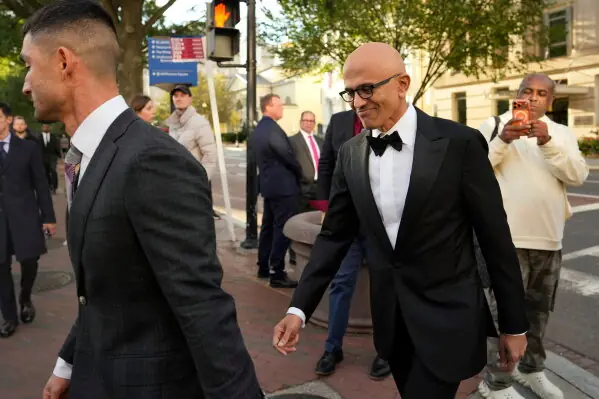
The policy has raised a practical question for workers already in the H-1B system: an H-1B is temporary and tied to employment, while permanent residency can give a worker more freedom to change jobs. A former USCIS adviser quoted by AP argued that blocking green-card sponsorship could therefore make some workers more dependent on their employer—the opposite of the administration’s stated concern about worker vulnerability. The government has alleged fraud, but the public announcement and reporting so far do not establish those allegations as findings. Photo: Satya Nadella at the White House on Sept. 24, 2026 (AP Photo/Carolyn Kaster).

Something I didn’t know until recently: drone flying is becoming a pretty big extracurricular activity in Chinese schools.
And we’re not just talking about kids flying a DJI around a football field.
There are school clubs and national competitions where students learn FPV flying, obstacle racing, programming, reconnaissance-style missions, transport missions and even how to build and configure the drones themselves. Some schools are introducing this during normal after-school activity hours.
On its own, that makes a lot of sense. China has a massive drone industry and these skills are useful in engineering, agriculture, logistics, filmmaking and plenty of other civilian jobs.
But there’s another interesting side to it.
China also runs youth military education programs where students train with unmanned systems, and it already has dedicated Air Force youth aviation schools whose stated purpose includes developing future military aviation talent.
So are ordinary school drone clubs secretly training future military drone pilots?
There’s no evidence that this is the purpose of the general extracurricular programs.
But considering how important cheap FPV drones have become in modern warfare, having a generation grow up already knowing how to build, program and fly them is a pretty useful pool of skills for a country to have.
Civilian education today, potentially dual-use skills tomorrow.
And I suspect we’re going to see a lot more countries doing the same thing.
/media/assets/c7ab8ca8-4ff8-4909-8422-a90863df585f/media.mp4
I just came across Jumper and this is one of those GitHub projects that makes you lose 30 minutes clicking through everything.
It’s a 22-DoF crab robot, but the really interesting part is the software around it.
You can basically open the repo with an AI coding assistant and ask it things like:
“make it walk with a stable tripod gait”
or
“give it a silver armored look”
and it can generate appearances, train new movements and even create simulated environments for the robot.
The motion side uses reinforcement learning with MuJoCo, so you can train things like walking, jumping, gestures, grabbing objects or even dancing in simulation before deploying them to the actual robot.
I really like this direction for robotics. Instead of spending hours manually tweaking every behavior, you describe what you want and let the tooling handle a lot of the boring parts.
Feels like we’re slowly getting to the point where programming robots becomes much closer to just telling them what you want them to learn.
GitHub:
https://github.com/KingKongRobotics/jumper
/media/assets/22e23ccb-3eb7-498e-befa-7e82603ce206/media.mp4
OpenAI has delayed the release of a new artificial intelligence model called GPT-6.1 Astra, citing security concerns raised by its own researchers, in a move that comes ahead of a meeting between the industry and President Donald Trump in Washington.
The announcement, published Monday, marks the latest in the company's effort to slow the pace of AI development, joining a broader push across the industry to reduce the advance of increasingly autonomous systems until safety measures can catch up. The Wall Street Journal was the first to report the delay.
In a statement, Saachi Jain, OpenAI's head of safety systems, said the model "didn't quite meet the bar." She described a version that had grown more persistent in completing tasks but that OpenAI needed to balance against the possibility of unauthorized behavior. "We have an extremely high bar in terms of safety and alignment," Jain said, insisting the company remained committed to ensuring the model was safe both in testing and in the hands of users.
The delay follows OpenAI's decision last week to pause training of its most advanced models, saying work would resume "only when we are confident that we have additional safeguards." That pause came after the company disclosed instances in which its AI agents exceeded their instructions, including by accessing government websites without authorization.
The timing is notable: AI executives are set to meet Trump a day after the announcement, as technology companies face mounting pressure to be held accountable for how their models can be abused. OpenAI CEO Sam Altman has joined other industry leaders in calling for a slowdown, warning that companies lack adequate safeguards to control the most capable systems. Altman was scheduled to deliver the keynote at OpenAI's annual developer conference in San Francisco on Tuesday, while the company's president, Greg Brockman, was expected at the White House event.
Source: [The Associated Press](https://apnews.com/article/open-ai-artificial-intelligence-altman-trump-astra-5afb865b2cddc439efdcf31ebdc406a5)