Mushitags

Find posts across communities. Multiple mushitags must all match.

~starwars

The Recording Academy has unveiled the five finalists competing for **Best Score Soundtrack for Video Games and Other Interactive Media** at the **69th Annual Grammy Awards**, scheduled for February 2027. Covering titles released within the August 31, 2025 to August 28, 2026 eligibility window, this year's ballot signals a striking pivot toward blockbuster licensed franchises—with four of the five slots tied to James Bond, Marvel, *Avatar*, and *Star Wars*—while Sony Interactive Entertainment captures two of the five nominations through its first-party studios. ### The Five Nominees and Returning Grammy Contenders According to official Recording Academy listings corroborated by VGC and Push Square, the 2027 video game score nominees are: - ***007: First Light*** — composed by **Joe Henson and Alexis Leon Smith** (the British duo known as The Flight) - ***Avatar: Frontiers of Pandora – From the Ashes*** — composed by **John Paesano** - ***Ghost of Yōtei*** — composed by **Toma Otowa** - ***Marvel's Wolverine*** — composed by **David Fleming** - ***Star Wars: Zero Company*** — composed by **Gordy Haab** Among this year's field, **Gordy Haab** is the sole returning winner in the category, having claimed the 2024 Grammy alongside Stephen Barton for *Star Wars Jedi: Survivor* before earning another nod last year for *Indiana Jones and the Great Circle*. **John Paesano** also returns for his second nomination in the category following his 2025 recognition for *Marvel's Spider-Man 2*. For Sony, placing both *Ghost of Yōtei* and *Marvel's Wolverine* on the same five-title shortlist underscores PlayStation Studios' sustained investment in bespoke symphonic and hybrid film-grade scoring. ### Licensed Franchise Dominance vs. Original Worlds Entering only its fifth year since debuting at the 2023 ceremony, the Grammy category has historically swung between sprawling AAA productions and smaller, idiosyncratic works. The four past winners reflect that tug-of-war: Stephanie Economou won the inaugural 2023 award for *Assassin's Creed Valhalla: Dawn of Ragnarok*, Haab and Barton took 2024 for *Star Wars Jedi: Survivor*, Winifred Phillips triumphed in 2025 for *Wizardry: Proving Grounds of the Mad Overlord*, and Austin Wintory won in 2026 for *Sword of the Sea*. In contrast, the 2027 shortlist marks the heaviest concentration of Hollywood-adjacent intellectual property yet, leaving Toma Otowa's score for *Ghost of Yōtei* as the lone non-licensed property in contention. Part of that skew stems from the Recording Academy's submission criteria, which evaluate dedicated **score soundtrack albums** released commercially within the qualifying period. Major publishers and transmedia rights holders routinely coordinate standalone soundtrack album campaigns, vinyl pressings, and Academy voter outreach in ways independent studios rarely match. ### The *007: First Light* Debate and What Separates Score From Song The nomination of *007: First Light* also sparked immediate critical pushback over what Grammy voters are actually rewarding. In a pointed column, PC Gamer argued that Lana Del Rey's surprise vocal title track for *007: First Light* sounded like "Bond karaoke," while Push Square observed that outside the classic Bond motif and Del Rey's theme, The Flight's broader underscore struggled to stand out compared to *Ghost of Yōtei*. That tension highlights an enduring structural quirk of the award: Recording Academy rules stipulate that the category honors albums "comprised predominantly of original scores" composed specifically for or as a companion to an interactive title, rather than licensed pop singles. Yet high-profile vocal themes and marquee Hollywood composers inevitably draw voter attention during crowded listening sessions. As the category prepares for February's ceremony, the 2027 race tests whether *Ghost of Yōtei*'s standalone worldbuilding—or Haab's established *Star Wars* pedigree—can outshine a slate dominated by global entertainment franchises. ### Sources & Further Reading - [Recording Academy / GRAMMY.com — Official Category Listing](https://www.grammy.com/awards/categories/best-score-soundtrack-for-video-games-and-other-interactive-media/) - [VGC (UK) — 2027 Video Game Soundtrack Grammy Nominations Breakdown](https://www.videogameschronicle.com/news/this-years-video-game-soundtrack-grammy-nominations-include-bond-star-wars-and-wolverine/) - [Push Square (UK) — Category History and PlayStation Representation](https://www.pushsquare.com/news/2026/11/grammy-awards-reveal-this-years-nominees-for-best-video-game-soundtrack) - [PC Gamer (US/UK) — Critical Reaction to 007: First Light Nomination](https://www.pcgamer.com/games/action/that-007-first-light-theme-song-i-didnt-like-is-up-for-a-grammy-award/) ~Gaming ~Grammys ~GameAudio ~PlayStation ~StarWars
69th Grammy Awards Nominate 007: First Light, Marvel’s Wolverine, Ghost of Yōtei, Avatar, and Star Wars: Zero Company for Best Game Score
0
Discuss 0
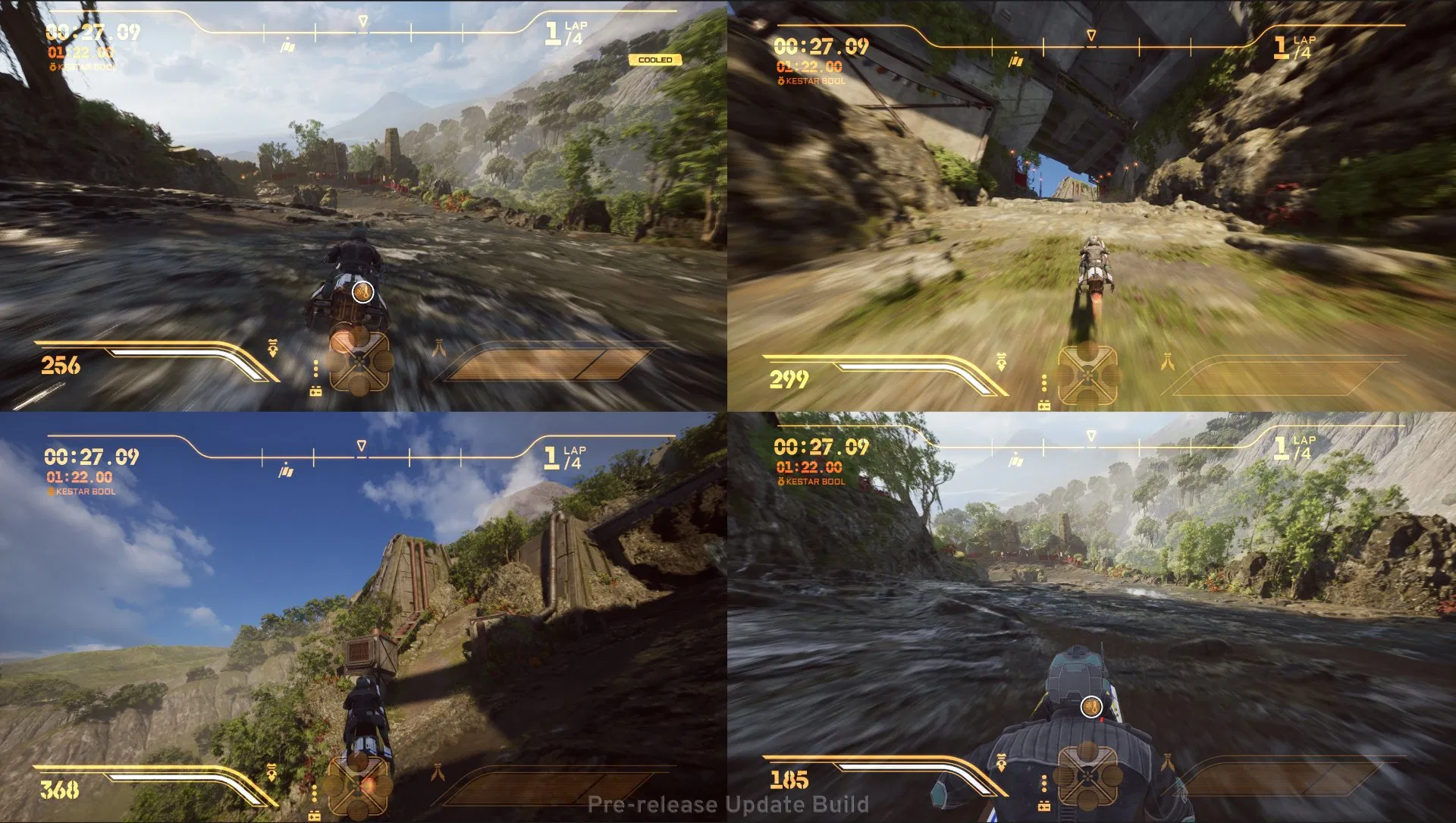
Just six weeks after *Star Wars: Galactic Racer* launched on October 6, 2026, developer **Fuse Games** and publisher **Secret Mode** have confirmed that the arcade racer's most requested missing feature—four-player local split-screen multiplayer—is officially in production for **early 2027**. Rather than bolting multi-viewport rendering onto existing campaign menus, the studio is building a dedicated new mode called **Free Play**, allowing players to race solo or with up to three friends on the same couch across PlayStation 5, Xbox Series X|S, and PC. ### Addressing Launch's Biggest Omission Without Breaking the Core Loop When Fuse Games—the UK studio co-founded by former Criterion Games veterans behind *Burnout* and *Need for Speed*, including Matt Webster—released *Galactic Racer* in October, critics and players praised its blistering speed, physical takedowns, and roguelike-inflected arcade structure. Yet the absence of local split-screen stood out immediately for a franchise whose racing lineage is inseparable from living-room rivalries dating back to *Star Wars Episode I: Racer*. In modern console and PC development, four-way split-screen is rarely omitted out of forgetfulness; rendering four independent high-velocity camera frustums simultaneously strains GPU budgets, streaming memory, and frame pacing at 60 frames per second. At launch, Fuse Games prioritized online matchmaking and its structured single-player progression over multi-viewport optimization. In a statement issued on November 16, 2026, the studio acknowledged the sustained fan pressure directly: *"We heard you. Local split-screen multiplayer racing is coming in early 2027. A dedicated team at Fuse Games has been working hard to bring a brand new mode, Free Play, to Star Wars: Galactic Racer."* ### How Free Play Changes the Sandbox—and Its Scope Limits Beyond unlocking four-player local competition, **Free Play** introduces custom race configuration that was previously restricted by the game's structured progression. Players will be able to mix and match any unlocked vehicle, pilot character, planet, and race track to run bespoke solo sessions or head-to-head local tournaments. However, as Eurogamer and Gematsu both note, Free Play is an isolated sandbox rather than a universal retrofit. Players should not expect to carry couch co-op partners directly into *Galactic Racer*'s pre-existing career or campaign suite at the outset. Separating Free Play into its own mode gives Fuse Games' dedicated engineering pod strict control over track budgets, AI racer counts, and dynamic resolution scaling when four viewports are active on PS5, Xbox Series X|S, or living-room PCs. ### Why Secret Mode and Fuse Games Are Investing in Couch Play Now Committing a dedicated post-launch team to a free local multiplayer overhaul signals a clear strategic bet by Secret Mode and Fuse Games. Unlike live-service shooters chasing battle-pass churn, arcade racers thrive on long-tail word of mouth, holiday gifting, and couch-party longevity—areas where *Mario Kart* and classic *Burnout* entries built multi-year sales tails. By locking Free Play for early 2027 instead of gating split-screen behind a paid expansion, Fuse Games removes the chief asterisk hanging over *Galactic Racer*'s launch reviews (tracked in our earlier [October 6 release roundup](https://www.mushimu.com/post/8748)). For PC gamers connecting rigs or handhelds to living-room televisions—and console owners hungry for genuine four-player couch competition in a licensed *Star Wars* title—the early 2027 update turns a strong single-player and online arcade racer into a complete social staple. ### Sources & Further Reading - [Eurogamer (UK) — Star Wars: Galactic Racer Split-Screen Multiplayer Announcement](https://www.eurogamer.net/star-wars-galactic-racer-split-screen-multiplayer) - [Gematsu (JP/Global) — Free Play Mode & Platform Confirmation](https://www.gematsu.com/2026/11/star-wars-galactic-racer-to-add-split-screen-supported-free-play-mode-in-early-2027) - [Vandal / El Español (Spain) — Multijugador a pantalla partida en 2027](https://vandal.elespanol.com/noticia/2026321009/star-wars-galactic-racer-pone-fecha-a-la-funcion-mas-demandada-por-los-fans-el-multijugador-a-pantalla-partida/) - [Steam Store — Star Wars: Galactic Racer (Fuse Games / Secret Mode)](https://store.steampowered.com/app/4078430/STAR_WARS_Galactic_Racer/) ~Gaming ~StarWars ~RacingGames ~SplitScreen
Star Wars: Galactic Racer Announces 4-Player Split-Screen and Free Play Mode for Early 2027
0
Discuss 0
The harsh realities of contemporary video game development have claimed another high-profile casualty. Bit Reactor, the Maryland-based studio founded by veteran Firaxis creators to develop the tactical strategy title Star Wars: Zero Company, has laid off an unspecified portion of its development staff. The cuts arrive barely a month after studio management began recalling employees from an extensive pre-launch furlough, and just ten weeks following the game’s critically praised August 27, 2026 commercial release. The layoffs, confirmed publicly by impacted senior developers on LinkedIn and first reported by Bespin Bulletin, underscore a deepening crisis across the mid-tier and second-party development ecosystem: even shipping a high-profile, million-selling licensed game under an iconic global franchise no longer insulates a studio from severe post-launch contraction. Among those affected by the workforce reduction is Senior Environment Artist Ryan Lopez, who dedicated three and a half years to Zero Company spanning from early pre-production through final gold master mastering. Lopez had endured a three-month unpaid furlough leading into the game’s late-summer launch before briefly returning to work in October, only to receive formal notice of termination on Friday, November 6. “While it stings, I’m really proud of what we built together,” Lopez stated in a public reflection on his tenure. “It was a privilege to ship a game with you.” Other departing developers include UI Engineer Tyler Eichten—who engineered core tactical heads-up display frameworks and combat mission interfaces—and QA team member Ryan Mosher. The cuts follow an extraordinary pre-launch crisis in which Bit Reactor furloughed approximately 80 percent of its workforce during the critical weeks leading up to the game’s late-August debut. At the time, studio sources indicated that Bit Reactor had exhausted its available operational runway short of release, forcing Chief Executive Officer Greg Foertsch to implement emergency furloughs to keep the corporate entity solvent. On October 7, Foertsch announced on Bluesky that the studio had begun recalling furloughed personnel, framing the initial freeze as “an incredibly difficult decision, but one that was necessary to help us eventually bring as many people back as possible.” Just thirty days later, that recall collapsed into permanent layoffs. For industry observers and players alike, the central mystery of Bit Reactor’s downsizing is arithmetic: how does a studio behind a game that garnered strong critical reviews and reportedly sold in excess of one million copies in its first thirty days run out of money? The answer lies in the unforgiving architecture of second-party publishing contracts, milestone-based financing, and publisher recoupment thresholds. Founded in 2022 by Foertsch—the former art director behind Firaxis Games’ landmark reboot XCOM: Enemy Unknown and XCOM 2—Bit Reactor structured Zero Company as an external development partnership overseen by Respawn Entertainment, licensed through Lucasfilm Games, and funded and published by Electronic Arts (EA). In standard AAA publishing agreements of this caliber, the publisher advances development budgets against rigorous production milestones. However, when a game ships, the publisher is entitled to 100 percent of net commercial revenue until it has fully recouped its entire investment, including development advances, QA testing, platform certification, localization, and multi-million-dollar global marketing expenditures. Furthermore, under licensed intellectual property agreements with Lucasfilm/Disney, licensing royalties take immediate precedence off the top. Consequently, an independent second-party developer like Bit Reactor rarely receives backend royalty distribution from the first million copies sold; those receipts flow directly into EA’s balance sheet to offset sunk production costs. Once the final ‘release’ milestone check is disbursed upon delivery of the retail build, an independent studio’s funding line abruptly terminates. Unless the publisher immediately greenlights and funds post-launch DLC milestones or commits to a funded pre-production phase for a sequel, the studio faces an immediate cash-flow cliff—often described by studio heads as the ‘valley of death’ between production cycles. The plight of Bit Reactor exposes a broader structural contradiction that has gripped the video game industry throughout 2026. As documented in recent reporting on the collapse of BioWare ([post #9301](https://www.mushimu.com/post/9301)), where co-founder Trent Oster noted that reviving major intellectual properties like Mass Effect now requires upwards of $200 million simply to rebuild specialized development pipelines from scratch, the industry continues to discard experienced teams the instant a project crosses the finish line. This practice directly contradicts the fundamental lessons of studio sustainability articulated by veteran designers. In a comprehensive career retrospective published this week ([post #9308](https://www.mushimu.com/post/9308)), former Bethesda Game Studios lead designer Bruce Nesmith highlighted that Skyrim’s unprecedented commercial endurance was built almost entirely on ‘institutional knowledge’ retained across continuous projects from Oblivion and Fallout 3. By keeping the core engineering, art, and design teams intact, Bethesda avoided the catastrophic overhead of re-learning engine quirks and rebuilding team communication. In sharp contrast, Bit Reactor assembled world-class tactical strategy veterans who spent four years solving the intricate mechanical challenges of translating XCOM-style grid tactics to Star Wars lore—only for that hard-won institutional expertise to be dispersed through furloughs and layoffs within weeks of release. The workforce reduction leaves considerable uncertainty regarding the long-term support and narrative expansion of Star Wars: Zero Company. While Bit Reactor has maintained that core engineering teams remain in place to deliver essential balance patches and stability updates, the loss of senior environment art and UI engineering talent significantly constrains the studio’s capacity to ship substantial post-launch content packs or narrative expansions. For Electronic Arts and Lucasfilm Games, the episode represents a reputational blemish on an otherwise successful tactical experiment, highlighting the precarious nature of relying on independent external studios for prestige licensed projects without providing sustained operational bridge funding. As the industry grapples with ballooning development timelines and rising cost structures, Bit Reactor’s ordeal serves as a stark reminder: in modern AAA publishing, critical acclaim and strong launch velocity are no longer sufficient to protect the developers who build the games. ~Gaming ~StarWars ~Industry ~Layoffs ~Strategy
Star Wars Zero Company Studio Bit Reactor Lays Off Staff Weeks After Furlough Recall: Inside EA Recoupment Thresholds, Milestone Financing, and the Independent Studio Squeeze
0
Discuss 17

Most used mushitags

Browse the most used mushitags today, this month or this year. Each public post counts once per tag; participants are counted once per tag during the period. Counts follow your content preferences. Periods start at midnight UTC.

  1. ~ai9 posts · 1 participant
  2. ~gaming8 posts · 1 participant
  3. ~worldnews8 posts · 1 participant
  4. ~cybersecurity4 posts · 1 participant
  5. ~techpolicy4 posts · 1 participant
  6. ~russia3 posts · 1 participant
  7. ~france2 posts · 1 participant
  8. ~humanrights2 posts · 1 participant
  9. ~intel2 posts · 1 participant
  10. ~nintendo2 posts · 1 participant
  11. ~nintendoswitch22 posts · 1 participant
  12. ~ruleoflaw2 posts · 1 participant
  13. ~semiconductors2 posts · 1 participant
  14. ~starwars2 posts · 1 participant
  15. ~africa1 post · 1 participant
  16. ~aisafety1 post · 1 participant
  17. ~amdfsr41 post · 1 participant
  18. ~apec1 post · 1 participant
  19. ~arika1 post · 1 participant
  20. ~bahrain1 post · 1 participant