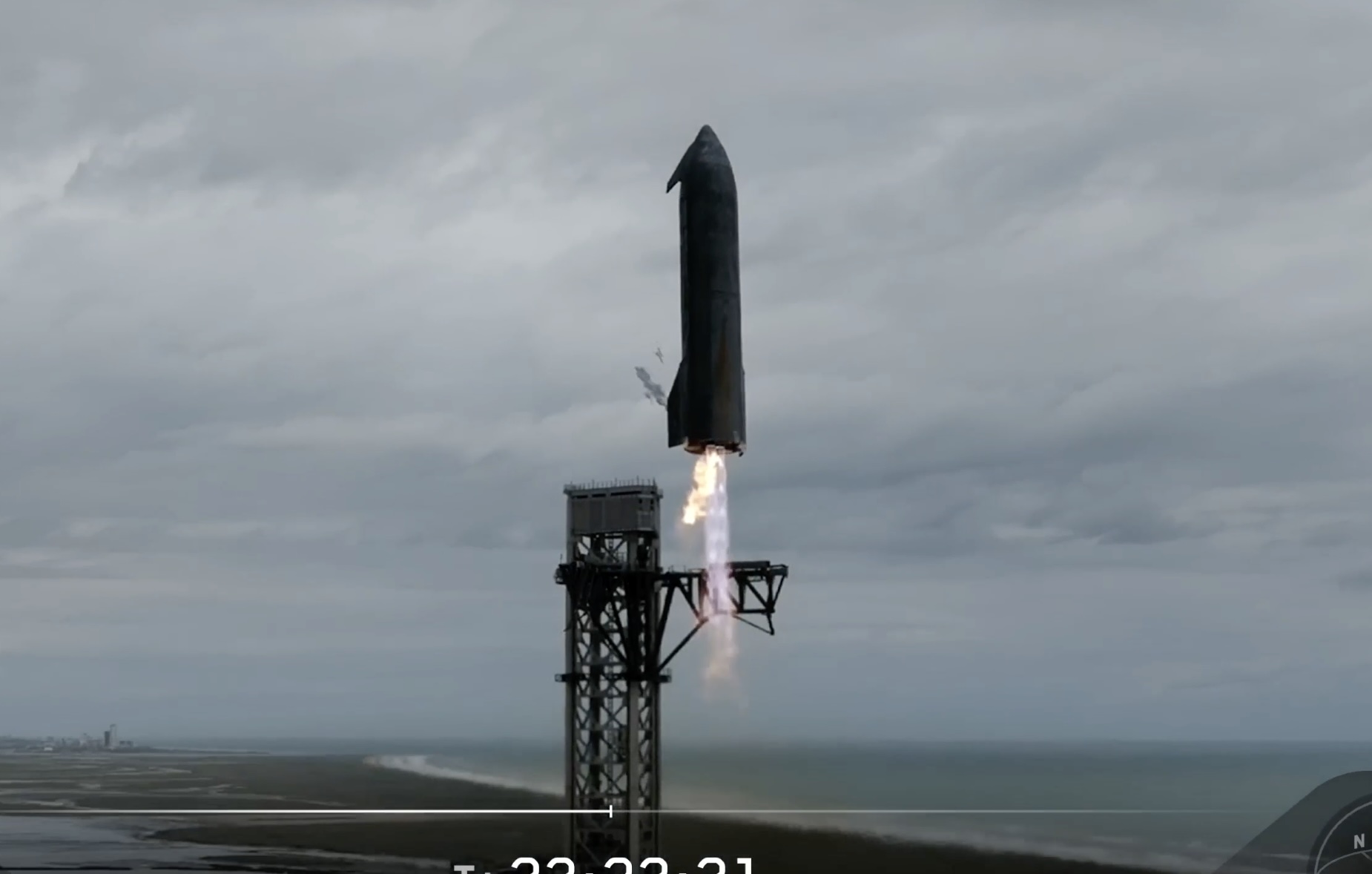
In what spaceflight historians and aerospace engineers are already characterizing as the single most consequential structural milestone in the history of rocketry, SpaceX has successfully returned an orbital-class spacecraft from space and caught it mid-air at its launch tower. On Saturday afternoon, November 14, 2026, the 50-meter-tall Starship upper stage—designated Ship 42 and famously emblazoned with Douglas Adams’s “Don’t Panic” adage—plunged back through Earth’s atmosphere, reignited its center Raptor engines, performed an aerodynamic pitch-up flip, and slipped smoothly into the mechanical chopstick arms of the Mechazilla launch gantry at Starbase in Boca Chica, Texas. The capture represents the first time in human history that a rocket upper stage has survived orbital velocities, reentered without shedding its primary structure, and returned intact to the exact launch mount from which it departed.
While SpaceX demonstrated catching the Super Heavy first-stage booster on earlier flight tests, capturing the upper stage solves the far more intractable half of orbital economics. First stages fly suborbital parabolic arcs, separating at roughly Mach 6 before coasting back with minimal thermal shielding. An upper stage, by contrast, must achieve full orbital velocity—accelerating to nearly 28,000 kilometers per hour (Mach 25)—and subsequently dissipate that staggering kinetic energy during atmospheric reentry. For decades, the global aerospace sector treated orbital upper stages as expendable hardware destined to vaporize in the upper atmosphere or crash into the South Pacific. By snaring Ship 42 directly out of the sky without requiring landing legs, SpaceX has validated the foundational thesis of its Starship architecture: fully and rapidly reusable heavy-lift space transportation.
### The Flight 15 Profile: 14 Orbits and Starlink V3 Operational Staging
Flight 15 lifted off from Orbital Launch Pad 2 at Starbase on Friday, November 13, 2026, powered by 33 Raptor 3 engines on Booster 22. Unlike earlier developmental suborbital hops or Pacific splashdowns, Flight 15 was an exhaustive 22.5-hour operational demonstration that completed 14 full orbits around the planet at an apogee of 275 kilometers. During its orbital transit, Ship 42 conducted critical propellant settling demonstrations, tested internal header-tank pressure stability in vacuum, and successfully deployed 26 next-generation Starlink V3 broadband satellites from its forward payload pez-dispenser door.
Notably, three of the deployed satellites carried specialized multispectral optical cameras tasked with surveying Ship 42’s underbelly in real time. The resulting high-resolution orbital telemetry provided ground controllers with unprecedented structural mapping of the spacecraft’s hexagonal ceramic heat shield tiles prior to the commit-to-deorbit burn, confirming zero critical tile loss across the forward nosecone and flap hinge seal interfaces.
### Aerothermal Reentry and the Dynamics of the Tower Catch
The transition from orbital freefall to mechanical capture required a complex convergence of hypersonic aerothermodynamics, autonomous software guidance, and heavy civil robotics. Reentering over the Gulf of Mexico, Ship 42 endured peak plasma temperatures exceeding 1,400 degrees Celsius, relying on upgraded ceramic tiles and active purge seals around its forward and aft aerodynamic control flaps. As the spacecraft dropped through the sound barrier, it pitched into a horizontal “belly flop” attitude, bleeding velocity through atmospheric drag before executing its final landing sequence.
At approximately 800 meters above the Texas coastline, three sea-level Raptor engines ignited to flip the 100-ton dry-mass vessel vertical. Autonomous terminal guidance systems interfaced with Starbase’s ground-based radar and laser rangefinders, maneuvering the vehicle between Mechazilla’s two hydraulically actuated steel arms. Rather than touching down on landing pads, Ship 42 hovered momentarily as the tower arms closed around hardened structural lift pins located just below the forward flaps. Shock-absorbing dampeners absorbed the remaining downward momentum, bringing the spacecraft to a dead stop suspended above Launch Pad 2.
### Fail-Safe Telemetry: Explaining the Booster 22 Divert
Despite the triumphant ship recovery, Flight 15 fell just short of achieving SpaceX’s coveted “double catch.” Roughly seven minutes after Friday’s liftoff, flight controllers issued an automated wave-off command to the descending Super Heavy booster (Booster 22). Ground telemetry indicated a low-fuel mass alarm and transient pressure oscillations within the central Raptor engine manifold during the boostback burn.
Under SpaceX’s launch commit criteria, a tower catch requires unanimous health verification across thousands of sensor channels; if a single critical threshold deviates by fractions of a second, the guidance software automatically aborts the return-to-launch-site trajectory. Diverted away from the multi-billion-dollar ground infrastructure at Starbase, Booster 22 performed an offshore deceleration before exploding upon contact with the Gulf of Mexico. The deliberate abort underscores the conservative safety margins governing launch-pad captures: sacrificing an individual first stage is entirely acceptable to safeguard the launch tower, fuel tank farms, and ground support equipment that underpin the entire test campaign.
### Geopolitical Consequences: Artemis III and the Commercial Cost Chasm
The successful recovery of Ship 42 reverberates far beyond Texas, fundamentally reshaping international space geopolitics and commercial satellite economics. NASA’s Artemis III mission, contracted to return American astronauts to the lunar surface, relies directly on Starship Human Landing System (HLS). A major technical bottleneck facing Artemis has been the requirement for rapid orbital propellant transfer, necessitating dozens of tanker launches in quick succession. Proving that Starship upper stages can be recovered, inspected, and recycled without fabricating new hulls drastically derisks the lunar architecture and accelerates NASA’s timeline.
Globally, the milestone widens the already vast asymmetric chasm between the United States commercial space industry and competing state-backed space agencies. With traditional expendable heavy-lift rockets like Europe’s Ariane 6, the United Launch Alliance Vulcan Centaur, and China’s Long March variants operating at launch costs between $100 million and $300 million per mission, an operational Starship operating with dual-stage recovery threatens to drop marginal launch costs below $10 million. While significant engineering hurdles remain—chiefly validating rapid heat-shield turnaround without manual tile refurbishment—Flight 15 has definitively shifted mechanical rocket capture from speculative science fiction into demonstrated operational reality.
### Sources & Further Reading
- [Teslarati (US / Aerospace)](https://www.teslarati.com/spacex-catches-starship-first/)
- [The Hindu (India / International)](https://www.thehindu.com/news/international/spacexs-starship-returns-from-orbit-and-is-captured-by-launch-pad-arms-in-a-dramatic-first/article71703046.ece)
- [Al Jazeera (Qatar / Middle East)](https://www.aljazeera.com/news/2026/11/15/spacexs-starship-captured-by-launchpad-arms-in-dramatic-first)
- [France 24 (France / Europe)](https://www.france24.com/en/spacex-starship-set-for-return-to-earth-after-failed-booster-catch)
~SpaceX ~Starship ~Aerospace ~SpaceFlight ~Technology