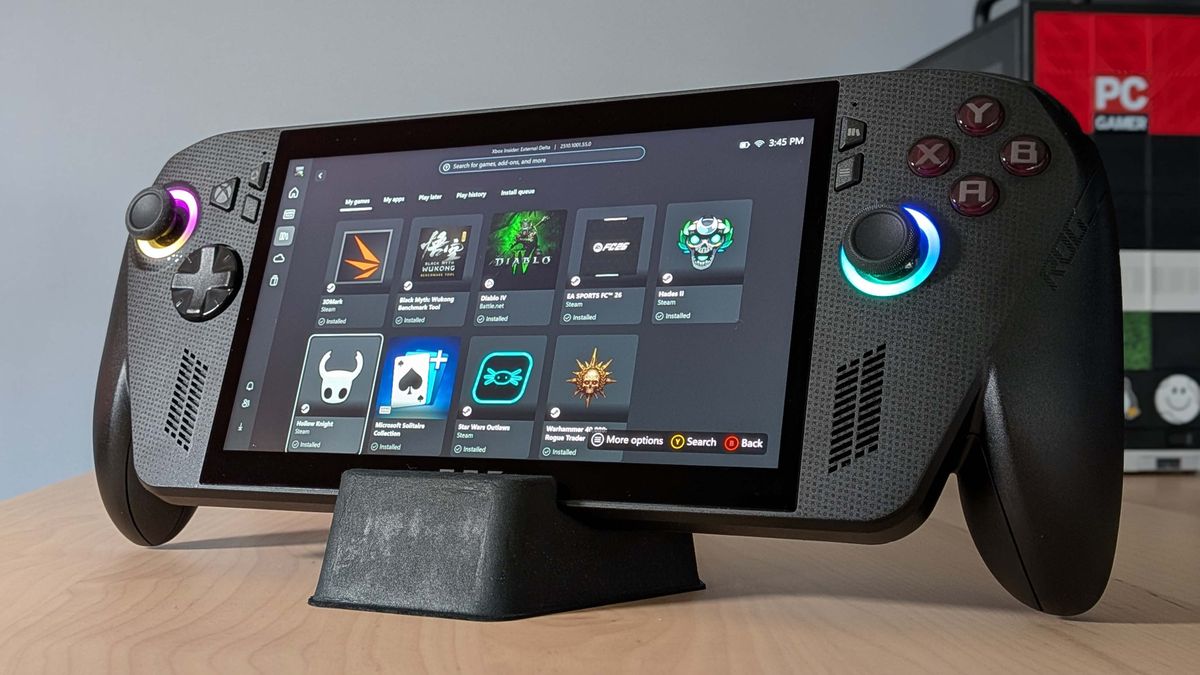
Microsoft has officially graduated Automatic Super Resolution (Auto SR) out of Windows Insider preview and deployed it into general availability across modern handheld gaming PCs, led by the Asus ROG Xbox Ally X and the newly minted Ally X20. The production release marks a critical architectural inflection point for the portable PC segment: for the first time since the inception of the category, on-die Neural Processing Units (NPUs)—silicon blocks frequently dismissed by gamers as enterprise marketing collateral or confined to web-camera background blur—are being harnessed directly as rendering coprocessors. Crucially, the update dismantles the preview tether that previously restricted Auto SR strictly to docked AC power, unlocking uninhibited mobile operation on battery alongside a dedicated 120 FPS Performance Mode and simultaneous Windows Auto HDR integration.
To appreciate the significance of offloading reconstruction algorithms to a dedicated neural coprocessor, one must examine the severe thermodynamic limitations governing modern handheld hardware. In desktop graphics cards or full-sized home consoles, thermal design power (TDP) budgets range from 200 to over 400 watts, allowing dedicated compute pipelines or Tensor arrays to run without siphoning power from adjacent raster execution units. Handheld PCs, by stark contrast, operate within an unforgiving total package power ceiling between 15W and 30W. Under these stringent thermal boundaries, the x86 CPU cores, RDNA graphics compute units (CUs), and high-bandwidth LPDDR5X memory controllers are locked in continuous competition for voltage and thermal headroom under dynamic power-management algorithms.
In traditional software-based temporal upscaling frameworks—such as AMD FidelityFX Super Resolution (FSR 2 and FSR 3) or Intel XeSS operating in fallback DP4a instruction mode—the mathematics of motion vector accumulation, history buffer weighting, and edge sharpening are executed directly on the GPU's general-purpose compute shaders. In severe GPU-bound scenarios at a 15W or 20W TDP limit, dedicating 1.5 to 2.5 milliseconds of frame time purely to temporal upscaling math inevitably deprives the graphics pipeline of cycles required for native geometry, lighting passes, and rasterization. By rerouting the super-resolution deep learning model entirely to the integrated NPU (such as AMD's XDNA architecture), Auto SR decouples the reconstruction stage from the GPU shader core. The graphics processor is liberated to dedicate 100 percent of its silicon budget to rendering the native base resolution (such as 720p or 900p), while the low-power NPU handles spatial and temporal reconstruction up to 1080p at negligible additional wattage.
When Microsoft first experimented with Auto SR on the ROG Ally X earlier in 2026, users were met with a frustrating caveat: the feature could only be engaged when the handheld was tethered to an AC wall adapter in docked mode. While Microsoft officially justified the docked limitation by pointing out that 1440p reconstruction on external desktop monitors offered the most visible graphical benefit, underlying engineering hurdles were the true obstacle. Running an active NPU simultaneously alongside peak APU boost clocks under battery discharge placed heavy strain on mobile power rails, threatening voltage instability, aggressive thermal throttling, and premature battery depletion.
The General Availability update resolves this barrier through substantial refinements to the DirectSR runtime and the Windows Desktop Window Manager (DWM) composition queue. Power telemetry on battery has been streamlined, allowing the NPU to execute frame reconstruction within a fraction of a milliwatt per inference burst. Concurrently, Microsoft addressed the rigid 60 to 75 FPS frame cap that hampered earlier preview builds. Through the deployment of a streamlined inference model dubbed Performance Mode, Auto SR minimizes presentation latency, allowing output frame rates to scale up to 120 FPS. This adjustment directly targets the 120 Hz Variable Refresh Rate (VRR / AMD FreeSync Premium) IPS and OLED panels featured on modern handhelds, eliminating pacing stutter in fast-twitch shooters and competitive arcade titles. Furthermore, the DWM compositor now natively harmonizes tone mapping buffers, allowing Auto SR and Windows Auto HDR to operate concurrently without color clipping or washed-out peak luminance.
Despite the obvious hardware advantages of offloading compute tasks to dormant silicon, technical reviewers and hardware specialists emphasize that Auto SR is not a blanket replacement for native, developer-integrated upscaling. In-engine upscalers like AMD FSR 3.1 retain an inherent architectural advantage: they possess direct access to native engine telemetry, including sub-pixel camera jitter matrices, non-post-processed depth buffers, velocity vectors, and isolated user interface (UI) layers. This in-engine integration enables FSR to resolve fine disocclusion artifacts without ghosting and prevents HUD text from being subjected to neural upscaling passes that can introduce soft edges or artifacting.
Where Auto SR establishes its true utility is in universality. Thousands of existing PC games, emulation environments, and independent catalog titles will never receive retroactive developer patches for FSR or DLSS. Auto SR functions at the operating system and API boundary, providing an automatic, system-level visual uplift that requires zero engineering intervention from game creators. For titles burdened with subpar FSR implementations or older DirectX 11 releases that suffer from frame drops at native resolution, Auto SR transforms an idle chip block into instantaneous performance headroom. Players can also audit and adjust these settings on the fly via an updated Xbox Game Bar widget, toggling between quality presets and monitoring NPU load without exiting the active session.
This deployment also represents a calculated strategic countermeasure in the broader war for handheld PC dominance. Valve's Linux-based SteamOS has long held the high ground among enthusiasts due to its lightweight Gamescope compositor, instantaneous suspend-and-resume capability, and superior low-wattage efficiency. Microsoft's desktop Windows 11 shell has frequently faced criticism for cumbersome touch ergonomics, forced background services, and fragmented software overlays like Asus Armoury Crate.
By integrating the Xbox Handheld Compact Experience deeply into Windows and pairing it with exclusive hardware features like NPU-driven Auto SR, Microsoft is beginning to carve out a differentiated hardware moat. Because open-source Linux kernel drivers for AMD XDNA NPUs and DirectSR translation layers within Proton remain in developmental infancy, Windows 11 handhelds now command a proprietary, hardware-accelerated upscaling mechanism that SteamOS cannot natively match. In a hardware climate where memory shortages have driven premium handheld pricing past the $1,000 threshold, squeezing every ounce of performance from on-die silicon is no longer a luxury—it is the baseline for mobile PC survival.
~HandheldPC ~AutoSR ~ROGAlly ~Microsoft ~AMD