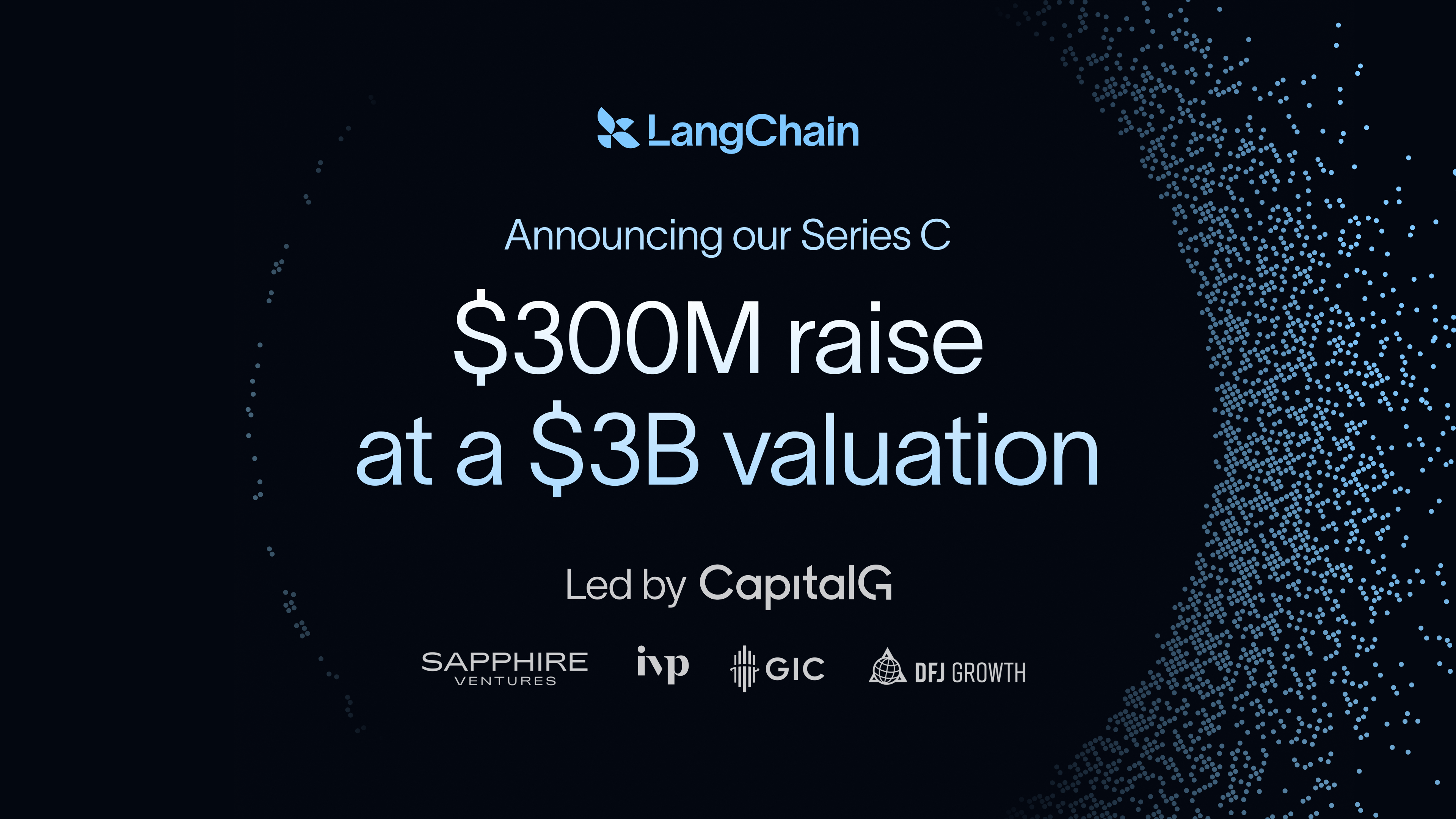
Artificial intelligence infrastructure firm LangChain has closed a $300 million Series C financing round at a $3 billion valuation, more than doubling its capitalization from late 2025. The round was led by CapitalG, Alphabet’s independent growth fund, with substantial participation from Singapore’s sovereign wealth fund GIC and DFJ Growth, alongside returning backers IVP, Sapphire Ventures, Salesforce Ventures, MongoDB Ventures, QuantumLight, Sequoia Capital, Amplify Partners, and Benchmark. The deal brings LangChain’s aggregate capital raised to approximately $460 million, cementing its position as the premier independent operating layer for autonomous enterprise agents.
The valuation surge underscores a decisive structural pivot across enterprise technology. While 2023 and 2024 were dominated by foundational model training runs and raw context-window expansions, 2026 has witnessed enterprise budgets migrating toward the operational middleware required to govern, debug, and coordinate multi-agent systems in production environments. Rather than betting exclusively on individual frontier model weights, institutional investors are backing the neutral orchestration layer that insulates corporate systems from single-vendor lock-in.
### The Evolution from Prompt Chaining to Stateful Graph Execution
LangChain originated in late 2022 as a lightweight open-source library designed to solve the immediate limitations of early large language models: connecting static transformers to search APIs, SQL databases, and file systems. However, as frontier lab models evolved native tool calling and expanded context windows, basic string-based prompt chaining encountered an existential bottleneck. Rigid, single-pass pipeline abstractions broke down when confronted with non-deterministic agent workflows, multi-step error correction, and long-horizon planning.
In response, the engineering team engineered a fundamental architectural transition toward stateful, graph-based runtimes. The development of LangGraph and Deep Agents introduced cyclical reasoning graphs where memory checkpoints, human-in-the-loop interruption states, and parallel branching are treated as first-class primitives. This architecture allows developers to structure autonomous software processes where subagents fork execution paths, validate intermediate results against external schemas, and autonomously backtrack upon encountering exceptions.
### The Three Pillars of LangSmith: Runtime, Improvement, and Governance
The core commercial vehicle powering LangChain’s enterprise valuation is LangSmith, which has expanded into an end-to-end agent engineering platform. According to disclosure data released by founder and chief executive Harrison Chase, the platform now serves over 7,000 corporate customers, spanning hyper-growth tech companies such as Harvey, Rippling, and Listen Labs alongside industrial conglomerates including NVIDIA, Toyota, Workday, and Salesforce.
LangSmith’s architecture is anchored across three functional tiers:
1. **Agent Runtime:** Provides scalable hosting, containerized sandboxes, and orchestration servers. Through Managed Agents and Fleet infrastructure, enterprises can deploy long-running agent workflows in isolated compute sandboxes, executing untrusted code or complex data transformations without exposing host systems to container breakouts.
2. **Agent Improvement:** Tackles the persistent challenge of agent evaluation. Rather than relying on static prompt engineering, LangSmith captures detailed execution traces, scoring intermediate tool calls against expected outcomes. Its autonomous in-platform agent, LangSmith Engine, scans production trace streams to detect latency regressions, diagnose tool invocation failures, and propose targeted prompt or routing patches. Crucially, these traces can be compiled directly into curated synthetic datasets for fine-tuning specialized domain models.
3. **Agent Governance:** Serves as the security and compliance control plane. Enterprise IT administrators implement LLM and Tool Gateways that enforce granular rate limits, cost allocations, model fallback hierarchies, and automated personally identifiable information (PII) masking. These gateways prevent tool hallucination and prompt injection from escalating into unauthorized system access or catastrophic financial runaway loops.
The business impact of this middleware is evident in production metrics. Enterprise software provider Workday reported reducing the internal deployment timeline for new corporate agents from five months down to under 24 hours by leveraging LangSmith’s pre-certified governance templates. Similarly, go-to-market automation firm Clay utilizes the platform to trace and audit hundreds of millions of autonomous agent invocations each month.
### Strategic Capital Allocation and the Defense of Framework Neutrality
The prominent role of Alphabet’s CapitalG in leading this Series C round highlights an intriguing dynamic within the broader hyperscaler landscape. While Google Cloud offers its own proprietary agent tools through Vertex AI Agent Builder, and competitors Microsoft and AWS promote Copilot Studio and Bedrock Agents, enterprise buyers have demonstrated fierce resistance to proprietary lock-in.
By maintaining strict framework and cloud neutrality, LangSmith functions as an architectural insurance policy. If an enterprise encounters severe API latency, unexpected model degradation, or pricing adjustments from one frontier provider, the orchestration layer permits routing traffic to alternative frontier models or private open-weights deployments—such as Llama or DeepSeek—without rewriting core application logic. CapitalG’s capital injection reflects a recognition that open, multi-model infrastructure will capture substantial value regardless of which specific frontier foundation model leads benchmark rankings in any given quarter.
### Industry Headwinds and the Battle for Agent Mindshare
Despite its formidable valuation, LangChain faces intensifying competition from multiple angles of the AI stack. Frontier labs are increasingly building out native runtime harnesses, while alternative open frameworks such as CrewAI, AutoGen, and emerging agent identity startups like Mintive are vying for enterprise developer mindshare. Furthermore, many engineering teams report framework fatigue, preferring minimalist custom Python wrappers over comprehensive third-party abstractions.
LangChain plans to deploy its fresh capital to accelerate product development ahead of its virtual “Future of Agents” technical showcase scheduled for November 20, 2026. As corporate IT spending shifts from proof-of-concept experimentation to audited business automation, the battle over who controls the operating system of autonomous software labor is becoming the defining infrastructure contest of late 2026.
### Sources & Further Reading
- [LangChain Official Announcement (Harrison Chase)](https://www.langchain.com/blog/series-c)
- [TechCrunch (United States)](https://techcrunch.com/2026/11/13/ai-agent-startup-langchain-hits-3b-valuation/)
- [Trending Topics (European Union)](https://www.trendingtopics.eu/langchain-series-c-300-million-dollars/)
- [CryptoBriefing (International)](https://cryptobriefing.com/langchain-raises-300-million-3-billion-valuation/)
~ArtificialIntelligence ~LangChain ~AIAgents ~SoftwareEngineering ~TechIndustry