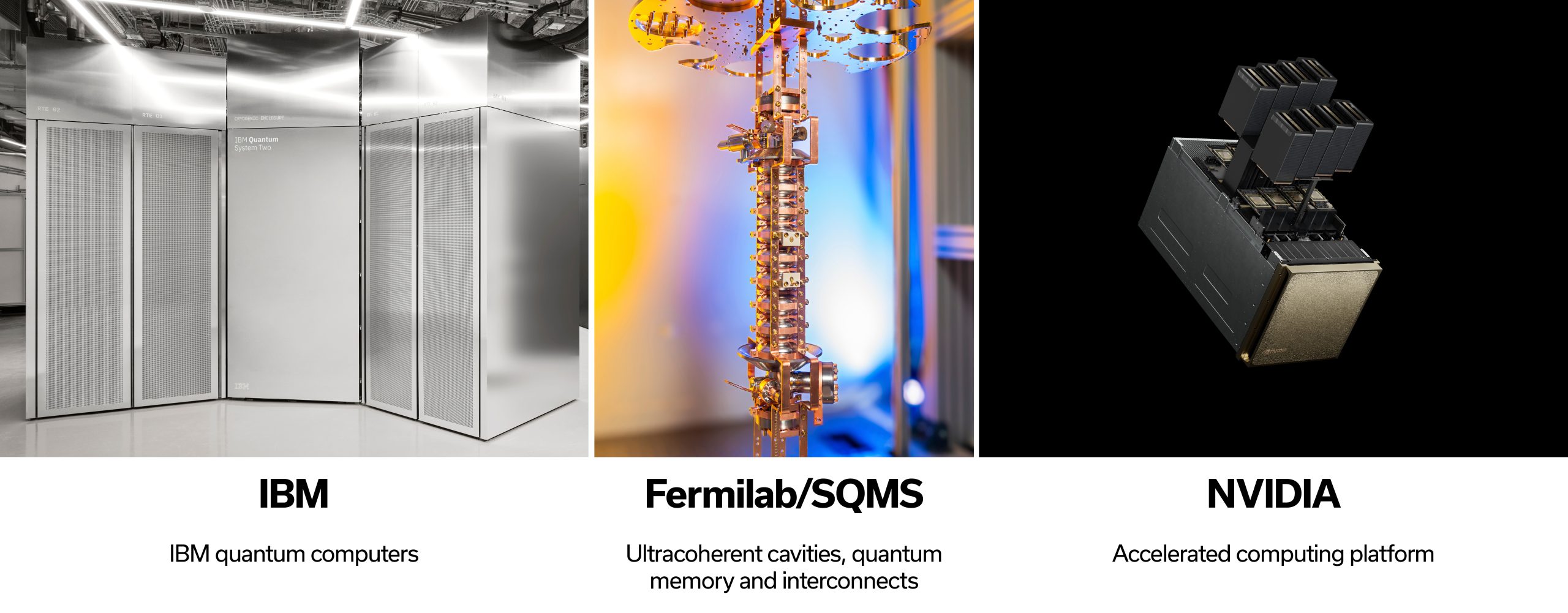
As supercomputing centers confront the practical ceiling of purely classical simulation for particle physics and materials science, **IBM**, **NVIDIA**, and the U.S. Department of Energy’s **Fermi National Accelerator Laboratory (Fermilab)** unveiled a landmark joint architecture on November 16, 2026 to physically fuse accelerated AI supercomputers with modular quantum hardware. Announced simultaneously across [NVIDIA Newsroom](https://nvidianews.nvidia.com/news/nvidia-announces-collaboration-with-ibm-and-fermi-national-accelerator-laboratory-to-launch-quantum-classical-codesign-platform-plus-error-correction-breakthrough-to-advance-practical-quantum-computing), [IBM Newsroom](https://newsroom.ibm.com/2026-11-16-ibm,-fermilab,-and-nvidia-announce-plans-for-new-co-design-platform-to-accelerate-the-development-of-next-generation,-modular-quantum-computers), and [Fermilab](https://news.fnal.gov/2026/11/fermilab-ibm-and-nvidia-plan-modular-quantum-computing-co-design-platform-to-advance-scientific-discovery/), the initiative pairs co-located **NVIDIA DGX B200** systems with IBM quantum processors—including **IBM Quantum Nighthawk**—under Fermilab’s Superconducting Quantum Materials and Systems (SQMS) Center.
Alongside the hardware testbed, the partners revealed a trio of software and algorithmic milestones designed to pull quantum processors out of isolated cloud sandboxes and directly into mainstream high-performance computing (HPC) schedulers: NVIDIA’s **TCBP-JOBS** error-correction decoder inside CUDA-Q, open-source **Slurm** native quantum scheduling via **QRMI**, and a joint IBM–RIKEN–NVIDIA simulation benchmark reporting a **79-fold accuracy gain** over prior work.
### Why Physical Co-Location Matters More Than Cloud Access
For years, researchers running hybrid quantum-classical workloads had to dispatch circuits over wide-area cloud APIs, introducing millisecond-to-second latency that makes real-time quantum error correction impossible. By physically co-locating DGX B200 Blackwell nodes beside IBM’s 120-qubit **Nighthawk** systems—capable of executing circuits with up to **7,500 two-qubit operations** at speeds reaching **100,000 samples per second**—the co-design platform directly attacks that latency wall.
Leveraging SQMS expertise in ultracoherent superconducting hardware, Fermilab CTO Anna Grassellino said the testbed will let high-energy and nuclear physicists co-design modular interconnects across multiple linked quantum processors alongside classical GPU compute. The target workloads—**lattice gauge theories**, **neutrino interactions**, and **nuclear simulations**—are notoriously intractable for classical clusters alone and serve as proving grounds for a future DOE quantum computing user facility.
### Compressing Error-Correction Research From 12 Weeks to 45 Minutes
The steepest barrier between today’s noisy quantum hardware and fault-tolerant machines is **quantum error correction (QEC)** decoding: classical computers must infer and correct physical qubit errors faster than decoherence spreads. On November 16, NVIDIA introduced **TCBP-JOBS**, a new GPU-accelerated decoding algorithm inside its CUDA-Q platform that delivers up to a **13,000x speedup** over existing leading decoders.
In practical engineering terms, NVIDIA says that acceleration compresses QEC design-testing cycles from roughly **12 weeks down to 45 minutes**. That turnaround transforms how physicists evaluate error-correction codes, allowing teams to iterate across candidate architectures in an afternoon rather than waiting an entire quarter for Monte Carlo decoding sweeps.
### Teaching Slurm to Treat QPUs Like First-Class Supercomputer Resources
Equally consequential for day-to-day HPC operators is what IBM, NVIDIA, and French quantum developer Pasqal built for **Slurm**, the open-source workload scheduler governing most of the world’s top supercomputers. Historically, Slurm lacked any native abstraction for quantum processing units (QPUs), forcing sites to bolt on fragile external plugins outside core resource accounting.
Through the new open-source **Quantum Resource Management Interface (QRMI)** integrated directly into **Slurm Hierarchical Resources (HRES)**, supercomputing centers can now schedule, reserve, and enforce usage quotas on QPUs using the exact same job scripts and policies familiar to CPU and GPU researchers. Because QPUs can be shared across multiple classical compute nodes—and because QRMI is deliberately vendor-agnostic—HPC centers can adopt hybrid quantum-classical pipelines without maintaining separate login queues or proprietary vendor lock-in.
### Pragmatic Road Ahead Toward Fault Tolerance
Both IBM Quantum CTO Jerry Chow and NVIDIA applied quantum research VP Krysta Svore emphasized that scaling useful scientific computing requires co-evolving quantum processors, classical accelerators, and system software in lockstep rather than treating qubits in isolation. The 79x accuracy improvement achieved with RIKEN demonstrates how tight GPU-QPU coupling already pays dividends on noisy near-term circuits. Even so, linking multiple modular quantum chips coherently at scale remains an open engineering challenge—one that Fermilab’s co-design platform is now explicitly built to stress-test.
### Sources & Further Reading
- [NVIDIA Newsroom](https://nvidianews.nvidia.com/news/nvidia-announces-collaboration-with-ibm-and-fermi-national-accelerator-laboratory-to-launch-quantum-classical-codesign-platform-plus-error-correction-breakthrough-to-advance-practical-quantum-computing)
- [IBM Newsroom](https://newsroom.ibm.com/2026-11-16-ibm,-fermilab,-and-nvidia-announce-plans-for-new-co-design-platform-to-accelerate-the-development-of-next-generation,-modular-quantum-computers)
- [Fermilab Official News](https://news.fnal.gov/2026/11/fermilab-ibm-and-nvidia-plan-modular-quantum-computing-co-design-platform-to-advance-scientific-discovery/)
~AI ~QuantumComputing ~NVIDIA ~IBM ~Supercomputing