

Conceptual illustration generated for this report; it does not show King Fahd Airport or the attack.
One person was killed and eight others injured in an attack on King Fahd International Airport in Dammam late Wednesday, October 21, Saudi Arabia's General Authority of Civil Aviation said, according to [the Associated Press](https://apnews.com/article/01c03af3191263452376510a670e8bf7). AP reported material damage at the airport; [Reuters, citing the authority](https://whbl.com/2026/10/21/saudi-civil-aviation-says-one-killed-eight-injured-in-attack-on-king-fahd-airport/), said damage assessments were underway.
The attack disrupted air traffic: Flightradar24 said flights were diverted away from the airport, AP reported. The latest accounts do not give a timeline for a full return to normal operations.
Saudi officials have not publicly identified the weapon or who carried out this particular attack. AP said Yemen's Houthi movement had not commented on it. The Saudi-led coalition separately reported intercepting four drone attacks in the Eastern Region, but that statement does not establish that one of those drones hit the airport. Neither AP nor Reuters attributes this strike to a group.
The incident adds to a wider run of attacks on Saudi aviation and energy sites. King Fahd Airport was also targeted earlier this month, according to the [Saudi Press Agency](https://www.spa.gov.sa/en/w2698805). On Wednesday, Washington ordered non-essential staff at its Riyadh embassy and consulates, and their families, to leave Saudi Arabia; [AP reported](https://apnews.com/article/fa9a4806bff404a23a16a8c209afbd2b) that the State Department cited a series of deadly attacks and the risk of further escalation. That order reflects the broader security situation, not a public finding about who struck Dammam.
Authorities are assessing the damage but have not given a detailed account of what was hit or announced when flight operations will fully normalize. The weapon used and the attacker remain unconfirmed.
~worldnews ~saudiarabia ~yemen ~aviation
~
COMMUNITY
~World news
Breaking world news, international events, geopolitics and major stories from around the globe, with discussion and analysis from the community.
CONVERSATIONS

Conceptual illustration — not satellite imagery or a photograph of the storm.
Update — 5 p.m. Philippine time, October 21: Super Typhoon Rosal (international name: Champi) has slightly weakened while remaining over the Philippine Sea east of Northern Luzon, according to PAGASA’s Bulletin No. 6. At 3 p.m., its centre was estimated 725 kilometres east of Aparri, moving west-northwest at 25 km/h with maximum sustained winds of 205 km/h and gusts up to 250 km/h. That is a modest drop from PAGASA’s 11 a.m. estimate of 215 km/h sustained winds, and the storm remains a super typhoon. [PAGASA’s 5 p.m. bulletin](https://bagong.pagasa.dost.gov.ph/tropical-cyclone/severe-weather-bulletin/6) gives the latest position and forecast.
The greatest immediate danger is at sea. PAGASA forecasts very rough waters with waves up to 10 metres along the northern and eastern coasts of Batanes, and up to 9 metres along the rest of Batanes and the eastern Babuyan Islands. It warns that sea travel is risky for vessels of any size and advises mariners to remain in port or seek safe shelter. Batanes remains under Tropical Cyclone Wind Signal No. 2; parts of Cagayan, Isabela, Ilocos Norte, Apayao and northeastern Catanduanes are under Signal No. 1.
The disruption already extends beyond the northern islands. The Coast Guard suspended sea travel in five Bicol provinces: all vessels in Catanduanes, and vessels of 250 gross tons or less along the eastern coasts of Albay, Sorsogon, Camarines Sur and Camarines Norte, [Daily Tribune reported](https://tribune.net.ph/2026/10/21/sea-travel-suspended-in-5-bicol-provinces-due-to-gale-warning).
PAGASA expects Rosal to pass closest to extreme northern Luzon between Thursday afternoon and Friday morning. Its forecast places the storm about 370 km east of Basco on Thursday afternoon and about 290 km east-northeast of Itbayat early Friday. The projected centre stays offshore, but PAGASA cautions that the track can still shift and severe rain or winds can affect places outside the forecast cone. The agency expects the system to weaken into a typhoon by Friday and leave the Philippine Area of Responsibility Friday night or early Saturday.

Editorial illustration — conceptual, not a photograph of the ships or attacks.
Romania resumed its search Friday for seven sailors missing after the chemical tanker Wine Trader was hit by a drone near the Black Sea coast, [Reuters reported](https://www.internazionale.it/ultime-notizie-reuters/2026/10/16/romania-resumes-search-for-seven-missing-sailors-from-drone-hit-ship). Five of the ship’s 12 crew members were rescued. Strong winds and rough seas had hampered the earlier search; Romanian officials said a helicopter would put four rescuers aboard while a vessel continued searching nearby waters.
The incident is part of a wider run of strikes on commercial shipping near Romania and Bulgaria. An [Associated Press overview](https://apnews.com/article/866f21a940311b13abd9425457edf388) published Friday counted at least seven vessels hit this month, with two people dead and at least 25 sailors still missing across the incidents. Those are cumulative figures, not a toll from the Wine Trader alone. Reuters separately reported that at least five other ships had been hit in the past 10 days, with 23 sailors reported dead or missing; that snapshot uses a different timeframe and tally.
The Comoros-flagged tanker Yara J was struck inside Romanian waters late Wednesday; its crew were unharmed and the vessel was towed to Constanța. Romanian President Nicușor Dan said drones hit the two tankers but did not identify their origin. An unnamed NATO military source told Reuters the drones came from Russia; no public forensic finding has established responsibility.
Bulgaria has asked NATO to deploy combat aircraft and anti-drone systems to strengthen its maritime defenses, Defence Minister Dimitar Stoyanov said Friday. Dan said Romania had also requested additional equipment. The requests do not mean NATO has announced a new deployment. The attacks are raising risks along Black Sea shipping routes near the Sulina Canal, a key corridor for Ukrainian exports. The search and national investigations are continuing.
~worldnews ~romania ~bulgaria ~ukraine ~blacksea
The White House says Russia and Ukraine have agreed to a localized halt to military operations in Oleshky, a Russian-occupied town in Ukraine’s Kherson region, beginning October 29. The stated purpose is to let humanitarian aid enter and help residents evacuate through a designated safe passageway. Reuters and Al Jazeera independently reported the announcement; the agreement itself has not yet been independently documented by either side. [White House statement](https://www.whitehouse.gov/briefings-statements/2026/10/first-lady-melania-trump-secures-ceasefire-between-russia-and-ukraine-localized-to-oleshky/) · [Reuters](https://www.reuters.com/world/europe/melania-trump-secures-oleshky-ceasefire-between-russia-ukraine-white-house-says-2026-10-23/) · [Al Jazeera](https://www.aljazeera.com/news/2026/10/23/white-house-says-melania-trump-secured-a-ceasefire-in-ukraines-oleshky)
The White House attributes the deal to talks led by First Lady Melania Trump and says civilian teams from both countries will assess residents’ needs. It estimates that 1,700–2,000 people remain in Oleshky, including about 50 children; no formal population count has been made since 2022. Residents who want to leave are supposed to receive transport to a destination of their choice, in Ukraine or Russia. The statement says an unnamed U.S. media organization will accompany the teams, but gives no evacuation route, truce duration or monitoring arrangements.
The humanitarian stakes are severe. The UN Human Rights Monitoring Mission in Ukraine reported that no food deliveries had reached Oleshky since May 26. On October 19, Ukraine’s human-rights ombudsman Dmytro Lubinets said negotiations were nearing agreement on evacuations from Oleshky and six nearby settlements; Reuters later quoted a Ukrainian official saying a ceasefire would be established soon. Russia had not publicly commented on the White House announcement by the time of reporting. [UN Human Rights Monitoring Mission](https://ukraine.ohchr.org/en/Desperate-situation-for-civilians-trapped-in-frontline-areas-says-UN-Human-Rights-Ukraine) · [Ukrinform on Lubinets’ October 23 remarks](https://www.ukrinform.net/rubric-society/4177148-lubinets-on-evacuation-from-oleshky-were-in-home-stretch.html) · [UNITED24 on the earlier evacuation negotiations](https://united24media.com/war-in-ukraine/ukraine-and-russia-near-local-ceasefire-to-evacuate-some-6000-civilians-from-occupied-oleshky-area-23602)
The key test is whether the halt actually begins on October 29 and whether aid and civilians can move safely. The White House announcement does not say how long the truce will last, how violations would be handled or when evacuations could finish. Those details—and independent confirmation from both governments—remain outstanding.
~worldnews ~ukraine ~russia

South Korea renewed its offer on Friday, October 23, for military talks with North Korea to verify the land Military Demarcation Line, restore military communication links and reduce the risk of accidental clashes. Deputy Defense Minister Kim Hong-cheol said Seoul would also consider three-way talks involving the U.S.-led United Nations Command, according to [Yonhap](https://en.yna.co.kr/view/AEN20261023005751315?section=national%2Fdefense) and the [Associated Press](https://apnews.com/article/9498c415c93ae9bc3767caf83e15b8b3).
The renewed proposal follows a September 21 landmine blast in the Demilitarized Zone that injured three South Korean soldiers. Seoul says its investigation found North Korean mines south of the demarcation line; Pyongyang denies responsibility. The two governments also dispute where the line sits in some areas as North Korean troops reinforce the border. Seoul says its military recorded 50 crossings this year during that work; North Korea says its troops stayed on their side. These claims remain contested.
The boundary was set under the 1953 armistice, but some old markers have disappeared, AP reports. The United Nations Command hotline is currently the only remaining communication channel between the Koreas, Yonhap says.
This is an offer, not an agreed meeting. Seoul made a similar proposal last November and received no public response. Pyongyang has not yet accepted the latest one, and no date or agenda has been set. The immediate question is whether the two sides will use talks to clarify the line and reduce the chance that routine work or patrols trigger another armed incident.
*Conceptual illustration of a divided border and communication line; it does not depict the actual DMZ.*

Minnesota investigators say federal authorities stopped sharing evidence after a brief resumption this summer, leaving key material unavailable to the state investigations into the January killings of Renee Good and Alex Pretti by federal officers.
A July 13 handover included body-camera footage and hard drives, according to [Hennepin County’s announcement](https://www.hennepinattorney.org/news/news/2026/July/evidence-sharing). In later court filings, Minnesota Bureau of Criminal Apprehension Superintendent Drew Evans said cooperation stalled soon afterward. County Attorney Mary Moriarty says the U.S. attorney told her on September 10 that evidence sharing was paused indefinitely because of “challenges with D.C.” The [Associated Press](https://apnews.com/article/d18378b40675bb107f9c2d519c2b9853) and [CBS Minnesota](https://www.cbsnews.com/minnesota/news/minnesota-feds-stop-sharing-evidence-good-pretti-shootings-lawsuit/) have reviewed the filings.
The state says it still seeks Good’s clothing, the phone of the officer who shot her and interview recordings. In Pretti’s case, the requested material includes officers’ phones and firearms, the gun taken from Pretti before he was shot, projectiles and casings, and an officer’s recorded statement. Minnesota says it needs those items to complete independent investigations. No criminal charges have been filed in either death.
The Justice Department disputes the state’s legal position. In a Tuesday court filing, DOJ lawyers argued that federal agencies may decline these records requests under the department’s Touhy rules and asked the court to dismiss or transfer the case. Minnesota has asked the judge to order the evidence turned over. Those are the parties’ arguments; the latest filings do not establish wrongdoing or resolve what happened in either shooting.
The dispute matters because the missing material could inform whether state prosecutors pursue charges. The judge has not yet ruled on the latest requests, and the filings do not give a date for when evidence sharing might resume.
*Conceptual illustration; it does not show the actual courthouse or case evidence.*

*Conceptual illustration; it does not depict a specific city or measured temperatures.*
Researchers estimate that summer heat contributed to **50,391 deaths across 854 European cities in June–August 2026**. Their model attributes **32,619** of those deaths—about 65%—to additional warming caused by human activity, chiefly fossil-fuel emissions. The estimate is sharply higher than the same researchers’ modeled totals for 2022 (29,480) and 2003 (about 28,462), according to the [Associated Press report](https://apnews.com/article/d57dac06335203107caba8ae6ef67185).
The researchers, from Imperial College London and the London School of Hygiene & Tropical Medicine, combined temperature records and climate-model comparisons with established links between heat and mortality. They estimated what deaths might have occurred in the observed climate, then compared it with a counterfactual climate without human-caused warming. This is a statistical estimate, not a count of death certificates listing heat as the cause.
The geographic limits matter: the 854 cities span 30 countries—the EU, UK, Norway and Switzerland—and represent about 40% of their population. The analysis does not provide a measured total for all of Europe, and the summer estimate does not include the May heat episode. [RTÉ’s review](https://www.rte.ie/news/environment/2026/1023/1596522-heat-related-deaths-europe/) reports that about one-third of the estimated deaths fell during the intense June 17–July 1 heatwave. Italy had the largest modeled toll (13,303), followed by France (7,268), Spain (6,824), Germany (6,340) and the UK (4,354). People aged 85 and older accounted for an estimated 22,502 deaths.
An independent expert quoted by Spain’s [Science Media Centre](https://sciencemediacentre.es/en/summer-2026-resulted-more-50000-heat-related-deaths-europe-two-thirds-which-were-attributable) cautions that these figures rely on temperature and epidemiological models rather than observed 2026 mortality data, so they should not be treated as a fixed final tally. This estimate still points to a clear public-health challenge: heat plans need to reach older and medically vulnerable people, while cities improve shade and cooling and services prepare before the next heat season.
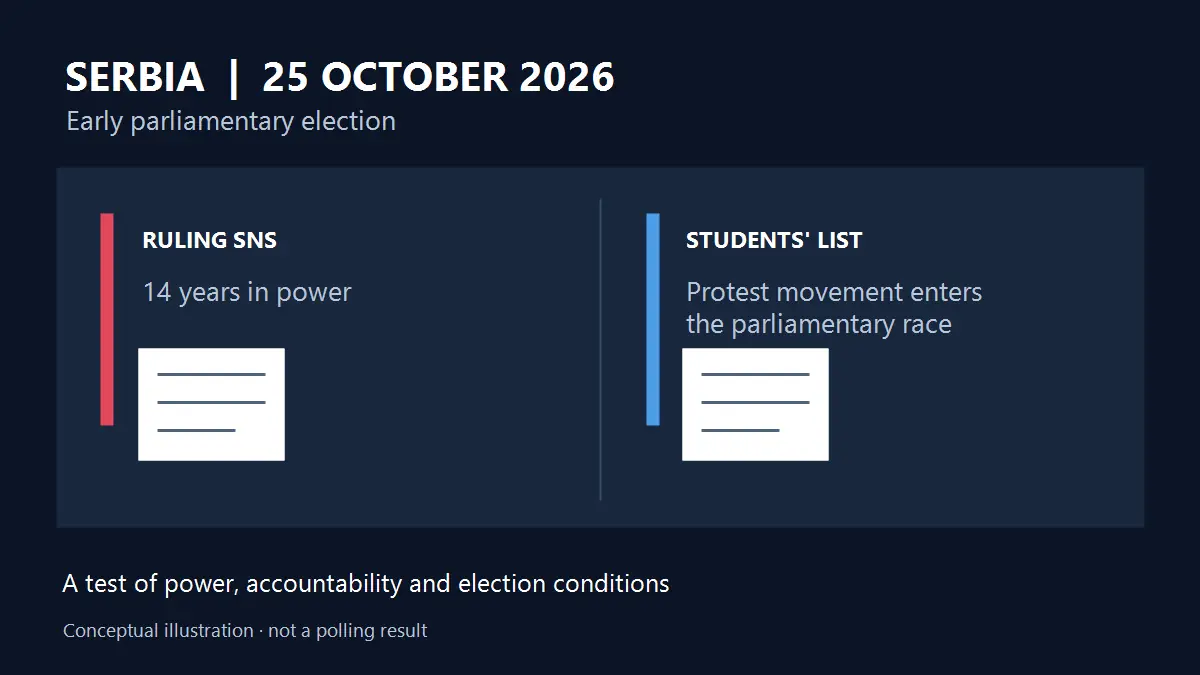
Conceptual illustration; it is not a photograph or a projection of the result.
Serbia votes on Sunday, October 25, in an early parliamentary election that has become the biggest test in years for the ruling Serbian Progressive Party (SNS). Its main challenger is a student-backed list born from nearly two years of protests. The [Associated Press describes the contest](https://apnews.com/article/serbia-parliament-election-vucic-students-6b407f309dc92fccde3c3b0016ba301c) as a referendum-like choice between Aleksandar Vučić’s party and the Students’ List, while noting that voters can choose among multiple lists.
Vučić dissolved parliament and called the early vote on September 9, according to the [Serbian presidency’s announcement](https://www.srbija.gov.rs/vest/en/287130/president-of-republic-calls-parliamentary-elections-for-25-october.php). Polling stations are scheduled to open at 7 a.m. and close at 8 p.m. local time, the [Republic Electoral Commission says](https://biraci.parlament.gov.rs/tekst/1279/kada-gde-i-kako-glasam.php). AP reports that about 6.4 million voters are eligible to choose the 250-member National Assembly.
The student protests began after a concrete canopy at Novi Sad’s railway station collapsed on November 1, 2024, killing 16 people. Students demanded accountability and the rule of law, and their movement grew into a national challenge to the SNS, which has dominated Serbian politics since 2012, [AP and Reuters report](https://www.marketscreener.com/news/as-serbia-votes-students-emerge-as-greatest-threat-to-vucic-s-long-rule-ce785cd9d989f02d). Vučić, who called the vote as president in September, is seeking to return as prime minister if his political bloc forms the next government, AP reports. This is a parliamentary election: it determines the Assembly and the government it supports, not the presidency directly.
The vote also matters because Serbia is an EU candidate country, and the campaign has prompted scrutiny of whether the contest is fair. International observers and the EU have raised concerns about polarization, media coverage, voter-list accuracy, journalists’ safety and the treatment of opposition voters, [AP reports](https://www.washingtonpost.com/world/2026/10/15/serbia-election-eu-tensions-vucic/bcce9c42-c898-11f1-aefb-abe4112d087e_story.html). The [Council of Europe’s pre-election delegation](https://pace.coe.int/en/news/10465/a-pace-pre-electoral-delegation-highlights-a-highly-polarised-campaign-ahead-of-serbia-s-early-parliamentary-elections) separately called attention to a highly polarized campaign. Claims of intimidation, surveillance and violence are reported concerns, not findings about how Sunday’s ballot will be counted. Observers also reported irregularities after the 2023 election.
The [OSCE’s election mission](https://odihr.osce.org/node/666908) includes 14 experts and 30 long-term observers; it has requested 300 short-term observers for polling day. Delegations from the OSCE Parliamentary Assembly, the European Parliament and the Council of Europe will join the observation effort. The OSCE says preliminary findings are due on Monday, October 26, with a fuller report later. The result, whether a government can be formed quickly and whether all sides accept the count remain unknown. Analysts quoted by [AP](https://apnews.com/article/serbia-election-students-rally-vucic-65df3d9c2842a670c56d253ca8fcfdd3) warn that a close result could raise the risk of post-election instability, which makes the observers’ assessment and the official count the next key steps.
~worldnews
Bulgarians vote on Sunday, Oct. 25, in a presidential election shaped by Russia’s war on Ukraine, debate over Sofia’s support for Kyiv and drone attacks on commercial shipping in the Black Sea. The attacks have pushed maritime security and foreign policy into the campaign, according to [The Associated Press](https://apnews.com/article/bulgaria-president-election-yotova-gyurov-678d47c9378fa70c426a15411690ae02) and [Deutsche Welle](https://amp.dw.com/en/bulgaria-concerns-about-security-in-the-black-sea-dominate-presidential-election-campaign/a-79729094).
The two front-runners are incumbent Iliana Yotova, backed by the governing Progressive Bulgaria party, and former caretaker prime minister Andrey Gyurov, supported by pro-Western opposition groups. A Market Links poll of 1,006 people, fielded Oct. 13–19, put Yotova at 47.3% and Gyurov at 30.6%, with a 3-point margin of error, AP reported. It is a snapshot, not an election result.
Bulgaria’s president has limited executive authority but commands the armed forces, can veto laws and represents the country abroad. The vote is therefore a test of the new governing bloc and a signal about voters’ views on Ukraine and Russia, though the president cannot reset national policy alone. Analysts expect a runoff on Nov. 1: a first-round winner needs a majority of votes and turnout above half of the 6.6 million registered voters. Actual turnout, the winner and any resulting policy shift remain unknown.

Conceptual illustration, not a documentary image.
On Oct. 22, the UN’s Fund for Responding to Loss and Damage provisionally set aside $20 million for Nepal’s recovery from the Aug. 26 Bhotekoshi–Trishuli floods. It is the fund’s first disaster-specific allocation, but not an immediate payment: Nepal must submit a detailed project proposal, and AFP reports that the fund has set no firm approval or disbursement timeline. The board is due to consider the proposal at its next meeting in December, according to [The Kathmandu Post](https://kathmandupost.com/national/2026/10/22/loss-and-damage-fund-allocates-20-million-to-nepal). [AFP](https://www.afp.com/en/un-climate-disaster-fund-moves-provide-20-mn-aid-nepal) and [Reuters](https://theprint.in/world/nepal-to-get-20-million-from-climate-fund-after-deadly-august-flood/3079271/) both report the board’s Oct. 22 decision.
Nepal estimates recovery and reconstruction will cost about $4.78 billion, making the allocation less than 0.5% of the need. The government’s assessment puts direct damage and economic losses at roughly $2.69 billion. Around 60,000 people in 15,000 households were affected; as of Oct. 5, Nepal’s disaster authority counted 1,455 confirmed deaths and 5,285 people missing, according to a [UK Parliament briefing](https://commonslibrary.parliament.uk/research-briefings/cbp-12232/).
The decision is a test of whether the fund can respond quickly to a specific disaster. Developed-country board members described the Nepal response as exceptional rather than a precedent, while developing-country representatives argued that it should inform faster disbursement procedures, AFP reported. The payment date and eventual spending plan remain unknown.
The Aug. 26 disaster began with an ice-and-rock avalanche that triggered flooding along the Bhote Koshi and Trishuli rivers. A September analysis by World Weather Attribution, covered by [AP](https://apnews.com/article/nepal-floods-climate-change-65ee7e50dfe7914dff37d893a5e6b810), found human-caused warming helped destabilise the mountainside by thinning glacier ice and thawing permafrost.
~worldnews ~climatechange ~nepal ~flooding
A magnitude-7 earthquake struck northern Tibet at about 10:33 p.m. local time on Thursday, Oct. 22, with its epicentre east-northeast of Nagqu. The U.S. Geological Survey’s reviewed event record puts it 191 km from Nagqu at 18 km depth; China’s earthquake network initially reported a shallower 10 km depth, a difference between agencies’ estimates. [USGS event record](https://earthquake.usgs.gov/earthquakes/eventpage/us6000u43g)
By Friday, local authorities reported 16 people dead and 65 injured, including 11 seriously hurt. More than 300 homes collapsed; state media reported that over 12,000 residents had been moved to safety. The injury figures differ across dispatches: Reuters cited a local-government post reporting 65, while a later AP report cited Chinese state media for 54. Both report 16 deaths, but neither account reconciles the injury totals, so the final number remains unclear. [Reuters](https://theprint.in/world/injuries-in-chinas-tibet-rise-to-65-after-earthquake-death-toll-remains-at-16/3079282/) · [AP’s Friday update](https://apnews.com/article/0358c57cfcbc0de48d2486df15ded4ef)
The epicentre is in a sparsely populated, high-altitude area, and authorities have recorded hundreds of aftershocks. AP reports that rescue and relief operations are continuing, with communications disrupted in some areas and snow forecast over the coming days. China’s state broadcaster described it as the region’s strongest quake in five years; it is not being reported as the strongest ever recorded there. [Associated Press](https://apnews.com/article/be27a2db79ada1c6309914d173b983a8)
The next key updates are whether search teams find further casualties, how many homes are unsafe, and whether transport and communications can be restored.
~worldnews ~earthquake ~tibet
Nigeria confirmed its first imported case of Bundibugyo Ebola virus disease on October 20, becoming the fifth country to detect the virus since the outbreak was declared in the Democratic Republic of Congo in May, the [World Health Organization says](https://www.afro.who.int/countries/nigeria/news/nigeria-confirms-imported-case-ebola-bundibugyo-virus-disease). The patient, a woman with recent travel to Uganda, is in isolation and receiving care in Abuja.
Her symptoms began on October 7, four days after she arrived in Nigeria. She sought treatment at a private clinic on October 11, and laboratory testing confirmed the infection on October 20. Nigerian officials had identified 44 contacts for monitoring in the WHO’s update. The source of her infection has not been established.
A separate question is whether the first patients detected in Nigeria and Kenya crossed paths at Entebbe airport in Uganda. Africa CDC told the [Associated Press](https://apnews.com/article/ebola-congo-uganda-nigeria-kenya-aad964dbbbca2f39e00739108ef7fc0a) that both were there on October 3 and that investigators were checking whether they interacted. That is a line of inquiry, not evidence that one infected the other or that Uganda was the Nigerian patient’s source. AP also reported that officials have given differing accounts of her earlier travel.
The scale remains concentrated in Congo: the U.S. CDC’s [October 20 tally](https://www.cdc.gov/ebola/situation-summary/index.html) lists 9,668 confirmed cases and 4,649 deaths across countries linked to the outbreak, including 9,637 cases and 4,646 deaths in Congo. The counts may change as investigations continue. The next key evidence will be contact-tracing results and a clearer reconstruction of the Nigerian patient’s movements; neither is public yet.
~WorldNews ~Ebola
South African police say a foreign national was beaten to death by a crowd of about 50 people during a march in central Durban on Thursday, Oct. 22. [Reuters reports](https://www.marketscreener.com/news/south-african-police-investigate-killing-of-foreign-national-by-crowd-ce785cded98af12c) that police said he died at the scene; [the Associated Press says](https://apnews.com/article/b34160c6e58b65b6da05e888af054ce8) he was standing beside the road when the group approached. Officers estimate he was in his late 30s or early 40s.
Investigators have not named the victim, disclosed his nationality, identified suspects or explained the march’s purpose. The killing comes amid months of anti-immigrant tension and protests, but police have not established a motive or said the attack was organized as part of that movement. They are trying to identify those involved.
The distinction matters: the killing is confirmed, while its motive remains unknown.
A Russian missile-and-drone attack hit Kyiv overnight into Thursday, October 22, killing one person and injuring 22, including four children, according to Ukraine's State Emergency Service as cited by [RBC-Ukraine](https://www.rbc.ua/rus/news/ataka-rf-kiyiv-e-zhertva-ta-22-postrazhdalih-1792646940.html) and the [Associated Press](https://apnews.com/article/5eef1c7dc4cc401dd8de85f718574877). The emergency service reported damage to homes, transport infrastructure and other civilian sites across several districts. These are early figures and may change as assessments continue.
The attack came hours after Kremlin foreign affairs adviser Yuri Ushakov said Vladimir Putin had agreed “in principle” to resume three-way talks involving Russia, Ukraine and the United States after November 10, the AP reported. Ukraine's President Volodymyr Zelenskyy backed further talks but was cautious. No meeting date or venue has been announced, and the Kremlin statement did not announce a ceasefire. The overnight strikes show that the diplomatic signal has not yet changed the immediate risks faced by Kyiv residents.
The next questions are whether the proposed talks are formally scheduled and whether Kyiv's casualty and damage toll changes as emergency crews finish their work.

Conceptual illustration; it does not depict the actual courthouse or hearing.
Georgia’s Constitutional Court opened hearings in Batumi on October 21 on a lawsuit seeking to outlaw five opposition parties. The case, filed by 88 MPs from the ruling Georgian Dream party, names the United National Movement, Coalition for Change, Strong Georgia–Lelo, the Federalists and Gakharia for Georgia. The court has scheduled hearings through October 23. [Georgia’s Public Broadcaster, citing the court](https://1tv.ge/lang/en/news/constitutional-court-opens-hearings-on-lawsuit-to-ban-five-opposition-parties/) and [AP](https://apnews.com/article/georgia-opposition-crackdown-dissent-georgian-dream-adf95f567c9025a8b3e657474d97960d) report the case details.
On the first day, the court rejected requests by opposition parties to remove judges from the panel and to hear one party’s case separately, according to [Civil Georgia](https://civil.ge/archives/755399). The ruling party alleges the groups seek to overthrow the constitutional order; the parties reject that claim and say the lawsuit is designed to eliminate political rivals before the 2028 election. Those are competing claims, not findings by the court.
The case could reshape political representation: four of the five parties together won about 38% of the vote in the 2024 parliamentary election. Three later gave up their seats, saying the election was rigged; Gakharia for Georgia remains in parliament with 11 of 150 seats, AP reports. [Reuters](https://www.reuters.com/business/georgian-court-begins-hearing-lawsuit-seeking-ban-major-opposition-parties-2026-10-21/) says the court must issue a final, non-appealable decision by June 2027. The hearings are still under way, so no ban has been ordered.