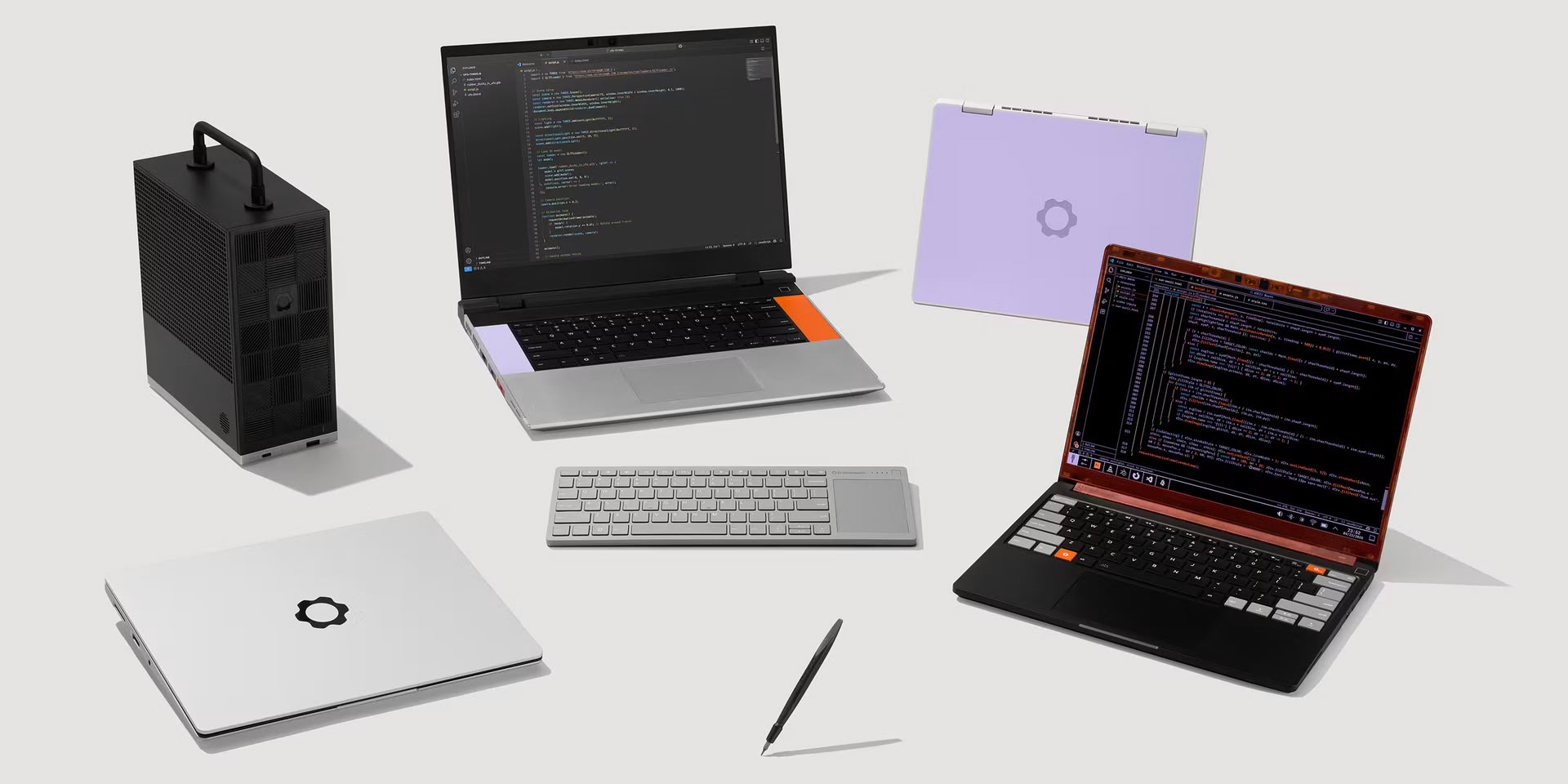
Framework’s $99 Wireless Touchpad Keyboard Brings Open ZMK Firmware and Repairable Design to Couch PC Setups
Framework has opened pre-orders for the Framework Wireless Touchpad Keyboard, a $99 slim 75% chiclet board with an integrated multi-touch trackpad engineered specifically for docked laptops, living-room mini PCs, home servers, and couch gaming setups. Backed by a refundable $50 deposit and slated to begin shipping in Q1 2027, the accessory has already sold through its first two pre-order batches according to [TechPowerUp](https://www.techpowerup.com/354946/framework-launches-customizable-slim-wireless-touchpad-keyboard-with-open-source-cad-files), signaling strong pent-up demand for a living-room keyboard that does not feel disposable. For more than a decade, anyone docking a Steam Deck, Bazzite mini PC, or HTPC to a television faced an awkward compromise: tolerate cheap, flex-prone budget boards such as the $35 Logitech K400 Plus, or balance a full mechanical keyboard and separate mouse on the sofa. Framework’s pitch—explicitly framed on its [product specification page](https://frame.work/products/framework-wireless-touchpad-keyboard?tab=specs) as "a couch keyboard that you want to use"—attempts to bridge laptop-grade ergonomics with open-source firmware and modular repairability. ### Laptop-Grade Mechanics and Living-Room Ergonomics Physically, the Wireless Touchpad Keyboard borrows its core input stack from Framework’s own notebooks rather than off-the-shelf living-room peripherals. The 75% keydeck uses scissor switches with 1.5 mm of key travel and full 19 mm key spacing—matching standard desktop layouts—anchored over a 0.8 mm internal steel plate for rigidity inside an opaque ABS top housing and smoky translucent bottom shell. At 118.65 × 357 × 16.9 mm and 484.9 grams, the chassis stays slim enough to slip into a backpack alongside a handheld PC or travel monitor. To the right of the keys sits a clickable, portrait-oriented 85.6 × 68.79 mm multi-touch trackpad without physical mouse buttons, supporting Windows Precision gestures alongside standard Linux libinput multi-touch navigation. Connectivity spans four wireless slots—one pre-paired 2.4 GHz USB-A dongle stored in the rear plus three Bluetooth Low Energy channels—alongside a wired USB-C mode for charging and zero-latency desktop use. Framework also plans to release a matching USB-A Adapter Expansion Card so the wireless receiver can sit flush inside its laptop chassis. ### Why ZMK Firmware and the nRF54LM20A Matter for Linux and Handhelds The most consequential engineering choice sits inside the translucent bottom shell. Rather than relying on a closed microcontroller paired with Windows-only configuration software, Framework built the keyboard around Nordic Semiconductor’s ultra-low-power nRF54LM20A wireless SoC running open-source ZMK Firmware on Zephyr RTOS, as detailed in the company’s [official hardware documentation on GitHub](https://github.com/FrameworkComputer/Framework-Wireless-Touchpad-Keyboard). For SteamOS, Bazzite, and CachyOS users running docked handhelds or living-room boxes—a category rapidly gaining developer attention ahead of [next-generation living-room PCs](https://www.mushimu.com/post/9413)—ZMK solves two long-standing pain points. First, keymaps, layers, and media/Desktop-mode macros live directly on the keyboard and can be compiled or updated across platforms without proprietary Windows bloatware. Second, ZMK’s aggressive power management lets the 1,200 mAh battery run for roughly a month of active use per charge and over a year in idle standby. Just as notably, Framework published the battery’s physical and electrical specification down to the 3-pin 1.25 mm Molex PicoBlade (`JBAT`) pinout (`VBAT`, `VBAT_NTC` thermistor, and `GND`), alongside an explicit instruction on how to tie the thermistor line to ground with a 10 kΩ resistor if builders want to power the board without a battery. Replacement 1,200 mAh packs will be sold directly on the Framework Marketplace, avoiding the sealed-cell obsolescence common to slim wireless keyboards. ### A Standalone Platform for DIY Keyboard Makers Framework is treating the product not only as a finished peripheral, but as a modular reference platform. Under a CC BY 4.0 license on GitHub, the company has already released STEP CAD models for the enclosure, battery, and Control Board alongside full schematic PDFs (`PowerManagementUSBInput.pdf`) and Zephyr board support. Even more unusually, Framework plans to sell the nRF54LM20A Control Board separately with breakout pinouts—and already has an early developer program underway—so hardware hackers can design custom split boards, cyberdecks, or handheld mounts around its wireless stack. At $99, the Wireless Touchpad Keyboard costs nearly three times as much as mass-market HTPC boards, and Framework itself notes in its repository that touchpad and key-matrix PCB pinouts are still pending publication while final pre-production hardware matures. Yet for Linux handheld owners, Framework Desktop buyers, and tinkerers tired of throwing away sealed living-room keyboards every few years, paying laptop-accessory money for open firmware, full schematics, and a replaceable battery marks a rare structural upgrade in an otherwise stagnant category. ### Sources & Further Reading - [TechPowerUp (Global)](https://www.techpowerup.com/354946/framework-launches-customizable-slim-wireless-touchpad-keyboard-with-open-source-cad-files) - [Framework Official Product Page (US)](https://frame.work/products/framework-wireless-touchpad-keyboard?tab=specs) - [Framework Wireless Touchpad Keyboard GitHub Repository (Primary Docs & CAD)](https://github.com/FrameworkComputer/Framework-Wireless-Touchpad-Keyboard) ~HandheldPC ~Framework ~LinuxGaming ~OpenSource ~Hardware