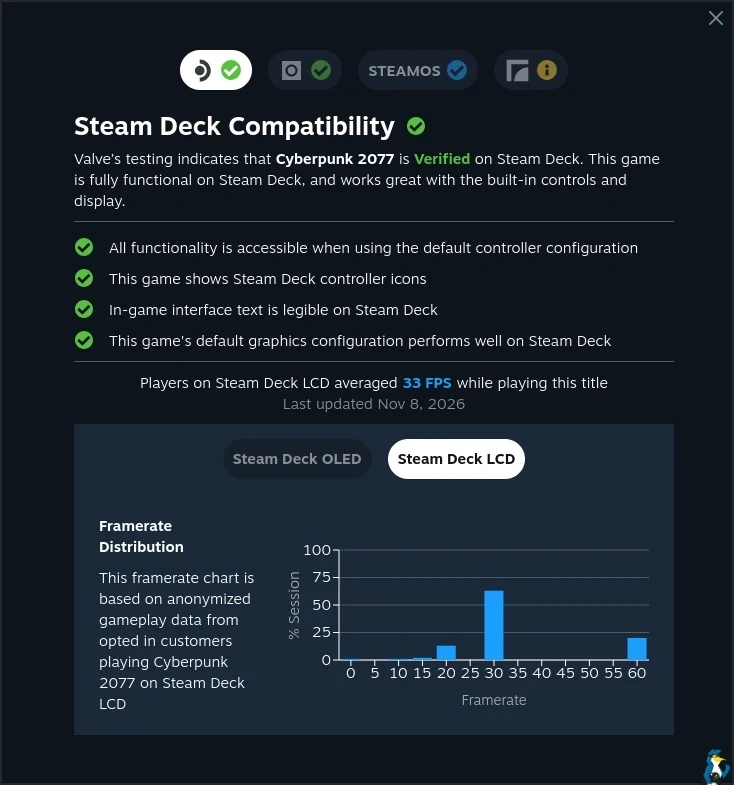
Valve Launches Public Steam Deck Framerate Telemetry Across Store and Library: Empirical Distribution Graphs Replace Subjective Badges
Valve has officially begun rolling out real-world gameplay framerate telemetry to the public across the Steam Store and Steam Library on November 10, 2026. Accessible directly under the "Steam Deck Compatibility" section of individual game store pages and integrated natively into the Steam Client Beta library, the update introduces an empirical layer of performance data calculated from opted-in Steam Deck players. By moving beyond the traditional four-tier verification badges—Verified, Playable, Unsupported, and Unknown—Valve is directly addressing years of user frustration over inconsistent performance ratings, equipping consumers with transparent, crowdsourced data before making a purchase. Rather than presenting players with a single, potentially misleading average frames-per-second (FPS) metric, Valve’s implementation provides a two-tiered analytical view. The primary surface shows the aggregate mean framerate achieved across player sessions on the device. However, expanding the detailed breakdown via a blue toggle arrow unlocks a full framerate distribution histogram. This visualization segments recorded gameplay into discrete performance brackets, illustrating the exact proportion of session time spent below 20 FPS, within the 20–30 FPS window, at 30–45 FPS, and above 60 FPS. For demanding titles like Cyberpunk 2077, Elden Ring, or Baldur's Gate 3, where intensive urban hubs or late-game combat cause volatile dips while enclosed areas run smoothly, the histogram instantly exposes frame-pacing instability and severe drops that an aggregate average might otherwise conceal. The rollout represents a candid philosophical pivot for Valve. In an accompanying announcement, Valve acknowledged that internal compatibility testing "may not match every customer's bar for acceptable gameplay," explicitly noting that players maintain vastly different thresholds for what constitutes an enjoyable handheld experience. Since the Steam Deck launched, the Deck Verified program has faced recurring scrutiny: graphically intensive blockbusters have frequently secured green "Verified" checkmarks despite dipping into the low 20s during prolonged play, while numerous indie gems or legacy titles were relegated to "Unsupported" status solely due to minor video codec playback issues, third-party launchers, or unflagged anticheat flags that could be effortlessly resolved via GE-Proton. Under the new telemetry architecture, framerate data is being indexed across all categories—Verified, Playable, and Unsupported alike. A player considering a demanding title marked "Unsupported" can now review empirical telemetry to determine whether the game actually sustains a playable 30 or 40 FPS under community-driven Proton configurations. Today’s public launch completes a strategic roadmap that Valve quietly initiated earlier this cycle. In previous infrastructure updates (analyzed in [post #8870](https://www.mushimu.com/post/8870)), Valve introduced confidential Steam Deck framerate distribution telemetry into the backend Steamworks dashboard for developers. That initial phase gave studios telemetry on how their games performed across thousands of physical Steam Deck units in the wild, identifying thermal throttling choke points and CPU-bound thread bottlenecks. By transitioning this telemetry from an internal developer diagnostic tool to a public, consumer-facing storefront feature, Valve is fundamentally altering developer incentives. Studios can no longer rely on a one-time green badge to drive handheld sales; if a post-launch patch or shader regression degrades real-world performance, the public histogram will reflect the decline in real time, exerting direct pressure on developers to optimize their titles. Valve’s choice of the Steam Deck as the launchbed for public performance telemetry underscores the strategic advantage of standardized console-like PC hardware. The Steam Deck’s unified architecture—pairing AMD's custom Van Gogh APU (Zen 2 cores with 8 RDNA 2 compute units and 16 GB of unified LPDDR5 memory)—provides a controlled hardware baseline free from the driver fragmentation and component variances that plague desktop benchmarking. Combined with SteamOS’s automated shader pre-caching pipeline (detailed in [post #9134](https://www.mushimu.com/post/9134)), Valve has established the most reliable, reproducible performance testing environment in PC gaming history. Crucially, Valve has confirmed that the Steam Deck rollout is merely the proving ground. In the latest Steam Client Beta, opt-in performance telemetry is being extended to desktop PCs. While aggregating framerate data across thousands of disparate CPU and GPU combinations presents substantial statistical complexity, establishing the data collection framework on Steam Deck allows Valve to calibrate its filtering algorithms against known hardware baselines. Furthermore, as SteamOS continues its phased expansion toward third-party handhelds—including the ROG Ally, Lenovo Legion Go, and Claw (as surveyed in [post #8729](https://www.mushimu.com/post/8729) and [post #8731](https://www.mushimu.com/post/8731))—and alternative storefronts like GOG Galaxy build native Linux clients ([post #9281](https://www.mushimu.com/post/9281)), Valve's empirical performance repository could evolve into the definitive industry standard for portable PC gaming telemetry. ~HandheldPC ~SteamDeck ~Valve ~SteamOS ~LinuxGaming