

Oxygen Collisions Give Physicists a Smaller Quark-Gluon Plasma Test
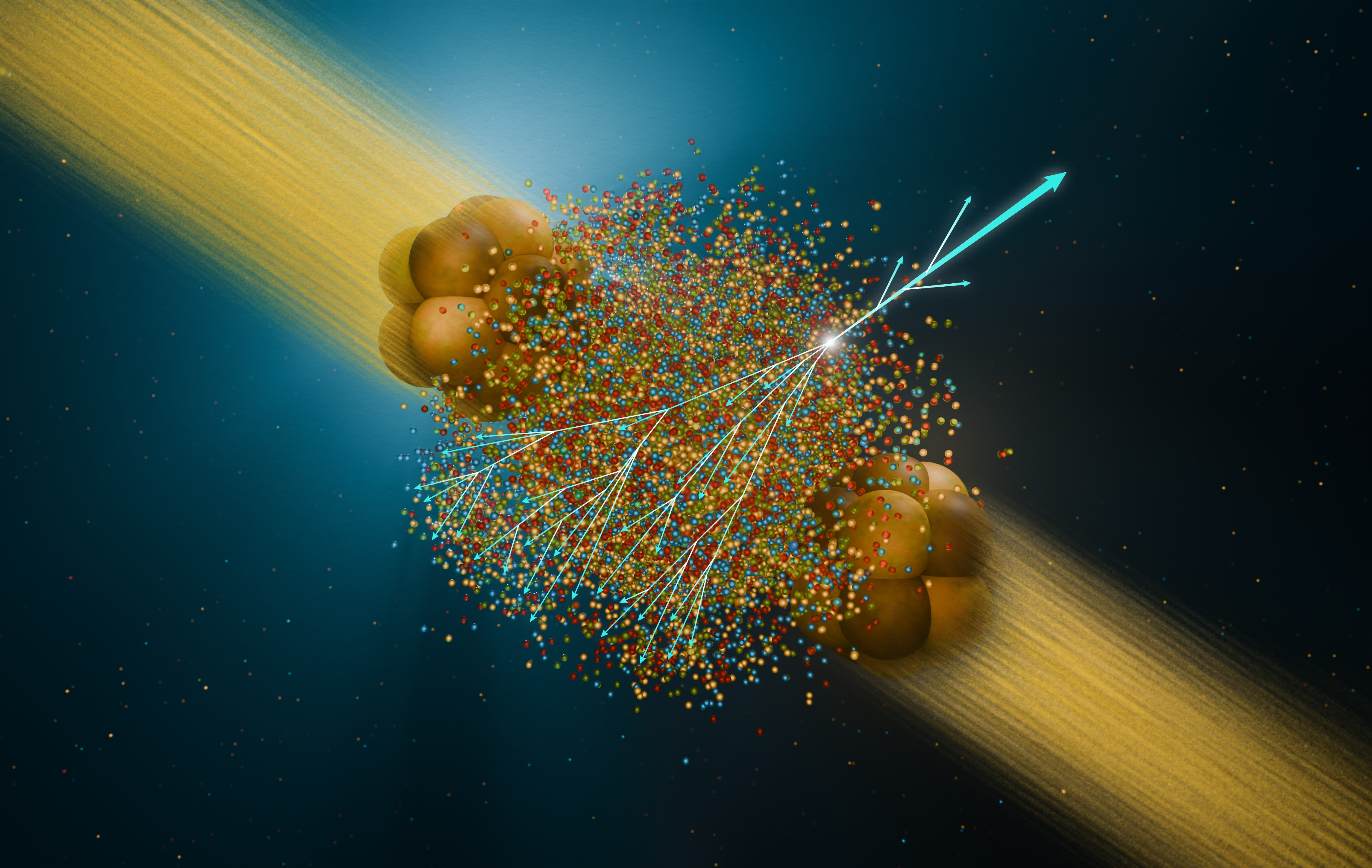 Image: Valerie A. Lentz / Brookhaven National Laboratory, illustrating jet quenching in oxygen collisions. A tiny, short-lived droplet of quark–gluon plasma may leave a measurable clue: one of a pair of energetic particle jets comes out weaker than the other. New STAR measurements at Brookhaven’s RHIC found that clue in oxygen–oxygen collisions, a much smaller system than the gold nuclei often used to study this primordial state of matter. The team analyzed collisions recorded in 2021 at 200 billion electron volts per pair of nucleons. In high-activity events, the yields of recoiling charged particles and jets were suppressed by about 20% compared with low-activity events. The collaboration interprets this as jet quenching: particles lose energy while crossing the hot, dense medium. The result was published in *Physical Review Letters* on October 20. The useful question is not whether oxygen collisions can make this kind of matter at all—similar signs have also been measured at CERN’s LHC. It is how small and cool a collision system can be while still producing the medium. RHIC’s result extends the evidence to a lower collision energy for oxygen and helps researchers narrow that boundary. This is indirect evidence. The plasma exists for an extraordinarily brief instant and cannot be observed directly; scientists infer it from the particles that escape. More oxygen data recorded during RHIC’s final run may help test how the signal changes as the system size and collision conditions shift. Read the [STAR paper](https://doi.org/10.1103/9w2y-bz9n) and [Brookhaven’s research explainer](https://www.bnl.gov/newsroom/news.php?a=223196). ~science