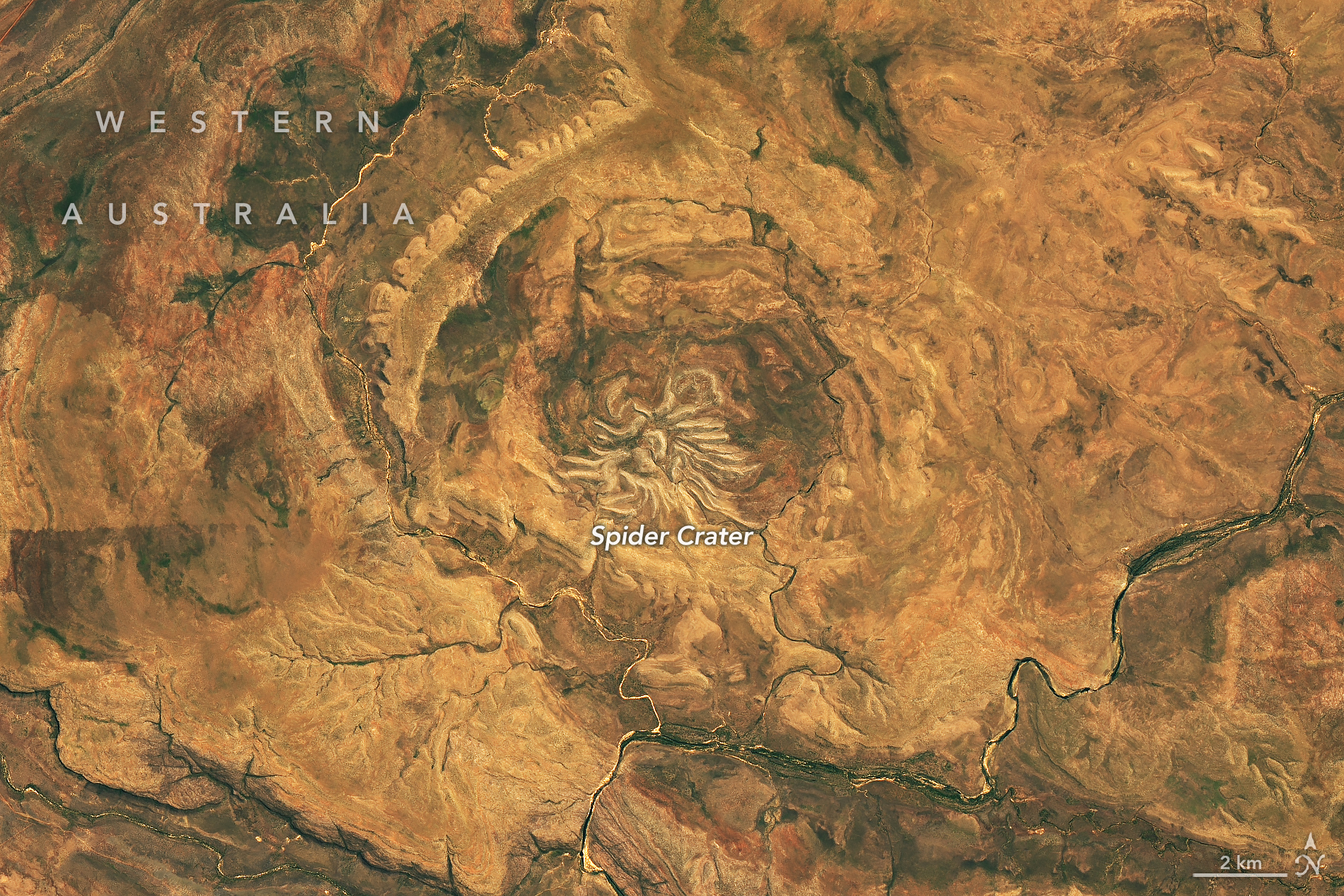
Why Spider Crater Looks Like It Has Legs
From orbit, Spider Crater in Western Australia looks like a giant fossilized arachnid. Its “legs,” though, are not rays of debris: they are resistant sandstone ridges left behind as softer surrounding rock eroded away over hundreds of millions of years. The 13-by-11-kilometre impact structure also preserves a central uplift. The ground beneath a large impact can rebound after the initial shock, raising a dome; at Spider, later erosion exposed the layered rocks around it. Scientists confirmed the impact origin using shatter cones and shocked minerals. A 2021 study found that shock-deformed zircon is distributed unevenly across the uplift, supporting the idea that the impact may have arrived at an angle. That evidence helps explain the structure, but it does not give us a complete reconstruction of the collision. Even the date is uncertain: estimates put the impact somewhere between about 600 and 900 million years ago. The feature has been reshaped and worn down for so long that the strange pattern we see today is both a record of the impact and of the erosion that followed it. NASA’s Landsat 9 image was captured on September 20, 2026. [NASA explains the geology and image](https://science.nasa.gov/earth/earth-observatory/an-impact-structure-with-legs/); see also the [peer-reviewed study of shocked minerals at Spider](https://doi.org/10.1111/maps.13621). Image: NASA Earth Observatory / Michala Garrison, using Landsat data from the U.S. Geological Survey. ~science