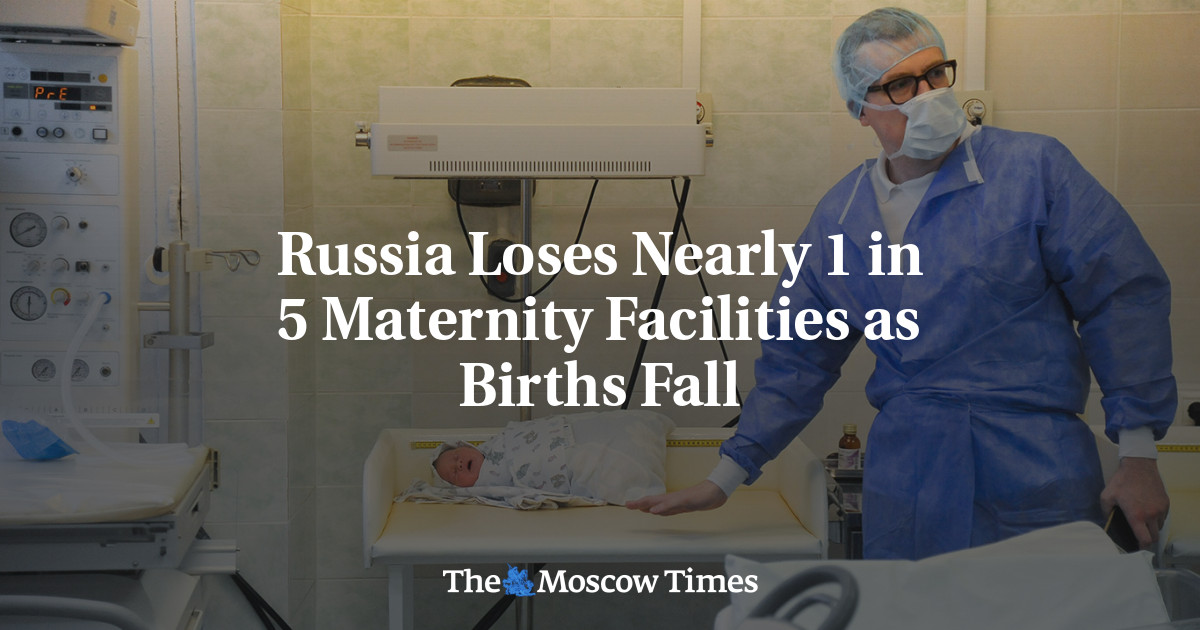
Russia Has Closed Nearly One in Five Maternity Facilities in Six Years Amid Falling Births and Budget Cuts
Russia has closed or halted routine childbirth deliveries at roughly 18 percent of its maternity facilities since late 2020, shrinking the network across Russia and occupied Crimea from 1,334 hospitals and wards to 1,090, according to an investigation by BBC Russia published on November 18, 2026. Drawn from Russia's Federal Register of Medical Organizations (FRMO) and corroborated by Meduza, The Moscow Times, and Novaya Gazeta Europe, the findings expose a stark contradiction inside state policy: even as the Kremlin campaigns aggressively for higher birth rates, regional budget pressures and hospital "routing" reforms are stripping local delivery care from small towns, rural districts, and even major regional cities. ### The Clinical Case for Centralization—and Its Blind Spots Russia's obstetric network is structured into three tiers: maternity wards in district hospitals, inter-district maternity hospitals, and high-tech perinatal centers in regional capitals. Health authorities are systematically dismantling the first two tiers, citing aging Soviet-era wards with too few deliveries to keep staff proficient, alongside what officials describe as declining maternal health that leaves fewer women eligible for low-risk local births. From a purely clinical standpoint, some physicians argue that concentrating births in better-equipped perinatal hubs saves lives. Kirill Danishevsky, editor-in-chief of the medical journal *Meditsina*, noted to BBC Russia that national infant mortality has dropped from 11 to 4 deaths per 1,000 live births since 2005, while maternal deaths have become rare. Yet the geographic reality of centralization undercuts that safety rationale whenever regions lack the top-tier infrastructure meant to absorb the closures. At least 15 Russian regions now have no full primary-tier district maternity wards remaining, while four—Kostroma, Magadan, the Jewish Autonomous Region, and the Nenets Autonomous District—have no perinatal centers at all. In the Jewish Autonomous Region, infant mortality stood at 7.7 per 1,000 live births in 2024, nearly double the national average. ### Passing the Financial and Logistical Burden Onto Mothers When a district maternity ward closes—sometimes replaced only by an emergency stabilization room—expectant mothers absorb the travel costs and clinical risks. In half of the affected areas, the nearest functioning maternity hospital lies 50 kilometers (31 miles) or farther away. Because regional maternal health budgets rarely reimburse prenatal travel or specify where patients should lodge before labor begins, families improvise at steep expense: women in remote parts of Yakutia can pay up to 210,000 rubles for three checkup trips to regional centers, while expectant mothers in the Lipetsk region routinely rent apartments in the regional capital starting at week 38 of pregnancy. Even medical institutions are clashing over the fallout, with hospitals suing one another over the cost of transferring complicated deliveries across regional borders. Nor is the squeeze confined to sparsely populated villages. As regional governments wrestle with budget shortfalls and public-sector cuts, closures have reached major urban centers such as Krasnoyarsk in Siberia, where two of the city's five maternity hospitals are shutting down despite direct appeals from medical staff to President Vladimir Putin. Over the past five years, BBC Russia documented at least 19 local protests or public campaigns against ward closures, occasionally forcing temporary delays or the retention of emergency delivery rooms. ### Pronatalist Rhetoric Collides With Demographic Secrecy The contraction of obstetric infrastructure collides directly with the Kremlin's flagship demographic drive. While officials urge women to have more children, seek to curb abortion access, and prepare a draft decree reported by *Izvestia* to step up Rosstat fertility-intent surveys from every five years to every three starting in 2027, the underlying birth trajectory continues to slide. Russia recorded 1.22 million births in 2024—the lowest annual total since 1999—before Rosstat halted publication of detailed monthly birth, death, and population totals in spring 2025. Even the surviving fertility metric tells a bleak story, slipping to 1.305 children per woman in 2025, the lowest rate since 2006. Independent demographer Alexei Raksha estimates that births fell roughly 4 percent further to 1.18 million in 2025 and dropped by another 17,000 year-on-year to 272,000 in the first quarter of 2026. Rather than reversing that slide, shuttering local maternity care risks deepening the very financial and future-security anxieties that Russian respondents cited in Rosstat's 2022 survey as primary barriers to having children. ### Sources & Further Reading - [Meduza (Independent Russian newsroom summary of FRMO data and regional costs)](https://meduza.io/en/feature/2026/11/18/russia-has-closed-one-in-six-maternity-hospitals-in-six-years-bbc-russia-finds-officials-blame-falling-birth-rates-and-declining-women-s-health) - [The Moscow Times (Demographic statistics, Krasnoyarsk closures, and Rosstat context)](https://www.themoscowtimes.com/2026/11/18/russia-loses-nearly-1-in-5-maternity-facilities-as-births-fall-a94300) - [Novaya Gazeta Europe (Russian-language investigative coverage of primary-tier closures)](https://novayagazeta.eu/articles/2026/11/18/s-2020-goda-v-rossii-zakrylos-kak-minimum-kazhdoe-shestoe-rodilnoe-otdelenie-news) ~Russia ~Healthcare ~Demographics ~WorldNews