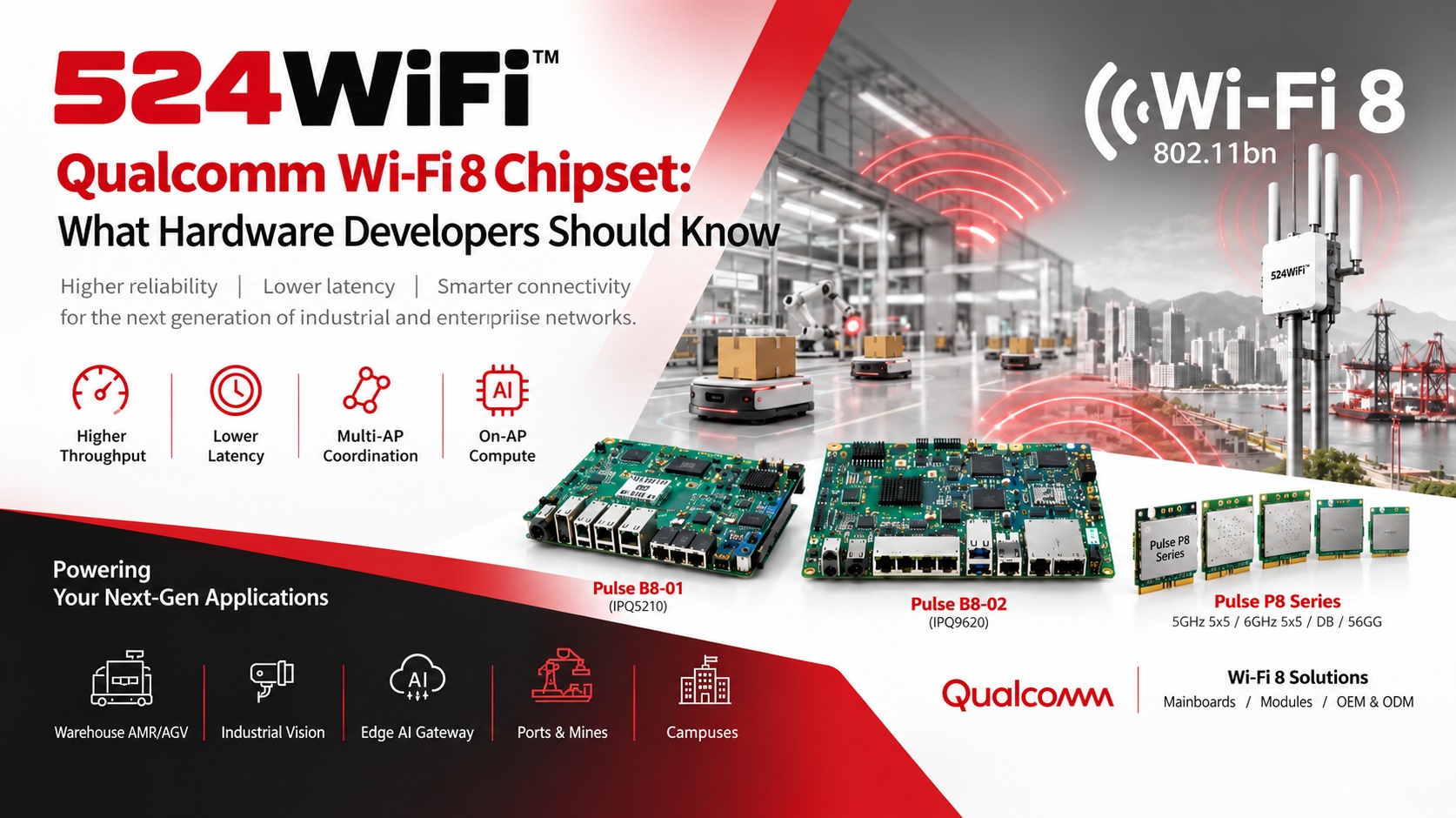
Qualcomm Posts v2 of ath12k Linux Driver Bring-Up for Wi-Fi 8 (802.11bn) QCN9575 Silicon
Even though IEEE 802.11bn—better known as **Wi-Fi 8**—is not expected to reach full standard ratification until 2027, open-source wireless enablement in the Linux kernel is already moving into active code review. On November 18, 2026, Qualcomm engineer Madhavan Ganesan posted **v2 of a 15-patch `ath12k` series** (`[PATCH ath-next v2 00/15]`) to the Linux Kernel Mailing List (LKML), establishing the core driver scaffolding for Qualcomm’s upcoming **QCN9575** Wi-Fi 8 PCIe chipset. For Linux laptop, router, and future handheld PC buyers, the upstream timing is notable: hardware vendors are increasingly landing foundational kernel plumbing a full year ahead of commercial client silicon, while simultaneously using automated AI code-review pipelines—such as [Google-backed Sashiko](https://www.mushimu.com/post/9561), whose findings directly prompted today’s v2 revision—to harden driver submissions before maintainers merge them. ### Inside the 15-Patch `ATH12K_DEVICE_FAMILY_WIFI8` Architecture According to Ganesan’s LKML cover letter, **QCN9575** represents a distinct hardware generation from Qualcomm’s current Wi-Fi 7 `ath12k` targets (`QCN9274` and `IPQ5424`), supporting **2.4 GHz, 5 GHz, and 6 GHz bands across up to two radios**. Rather than shoe-horning next-generation hardware assumptions into shared Wi-Fi 7 code paths, Qualcomm’s bring-up series isolates the new family cleanly inside a dedicated `wifi8/` subdirectory and a new `ATH12K_DEVICE_FAMILY_WIFI8` family identifier. Specifically, the 15 patches reorganize `ath12k` across four architectural layers: - **Per-device PCI window layouts:** Patch 1 moves PCI window register constants out of `pci.c` into per-device structures so Wi-Fi 7 and Wi-Fi 8 chips can define independent memory maps. - **Extended QMI and firmware loading:** Patches 2 and 3 expand the shared QMI layer with a larger WLAN configuration message—required to describe QCN9575’s copy-engine (CE) and service pipe counts—and support for larger unified firmware binaries. - **Dedicated `wifi8/` HAL and transport plumbing:** Patches 4 through 13 lay down `hw_params`, HAL register tables, descriptors, MHI channel/event configs, CE/service pipe maps, WMI resource allocation, and hardware operations. - **`mac80211` and PCI scaffolding:** The final two patches wire up a `mac80211` ops skeleton and PCI driver registration. Crucially, Qualcomm intentionally **omits QCN9575’s PCI device ID** from the driver’s active ID table in this first bring-up drop. That allows upstream trees to compile, link, and validate the structural refactor without probing incomplete hardware paths prematurely. ### Why Wi-Fi 8 Prioritizes Reliability Over Raw Peak Speeds Unlike Wi-Fi 7’s headline focus on wider 320 MHz channels and multi-gigabit bursts, **IEEE 802.11bn (Ultra High Reliability, or UHR)** aims as much at predictability in crowded spectrum as raw ceiling speed. While Wi-Fi 8 targets theoretical peak rates around **46 Gbps**, technical analyses from wireless hardware specialists emphasize that its defining upgrades target **lower latency, fewer packet drops in noisy RF environments, seamless roaming, and Multi-AP Coordination (MAPC)**—qualities critical for dense enterprise access points, edge AI gateways, low-latency cloud streaming, and wireless VR or handheld gaming. Early QCN9575 support sits alongside ongoing `cfg80211` and `mac80211` UHR groundwork in mainline Linux, ensuring that once enterprise routers and client adapters ship with Wi-Fi 8 silicon, open-source Linux drivers will not lag years behind proprietary Windows blobs. ### What Still Must Land Before Real Hardware Works For end users, today’s `v2` posting is strictly step one. No protocol-level 802.11bn features are switched on yet, and actual device bring-up awaits follow-up patch series adding the QCN9575 PCI ID, firmware blobs in `linux-firmware`, and UHR protocol handlers. Still, getting `ATH12K_DEVICE_FAMILY_WIFI8` reviewed and iterated on LKML in November 2026 signals that mainline Linux intends to meet Wi-Fi 8 silicon at launch rather than playing catch-up afterward. ### Sources & Further Reading - [Phoronix (US): Qualcomm Ath12k Linux Driver Preparing For New WiFi 8 Hardware](https://www.phoronix.com/news/Qualcomm-Ath12k-Linux-WiFi-8) - [LKML (Primary Kernel Patch Series): [PATCH ath-next v2 00/15] wifi: ath12k: add initial Wi-Fi 8 support for QCN9575](https://lore.kernel.org/lkml/20261118-wifi8_qcn9575_bringup-v2-0-d81a3046290e@oss.qualcomm.com/) - [524WiFi (Technical Reference): Qualcomm Wi-Fi 8 Chipset — What Hardware Developers Should Know](https://524wifi.net/qualcomm-wi-fi-8-chipset-what-hardware-developers-should-know/) ~LinuxKernel ~WiFi8 ~Qualcomm ~Networking ~HandheldPC