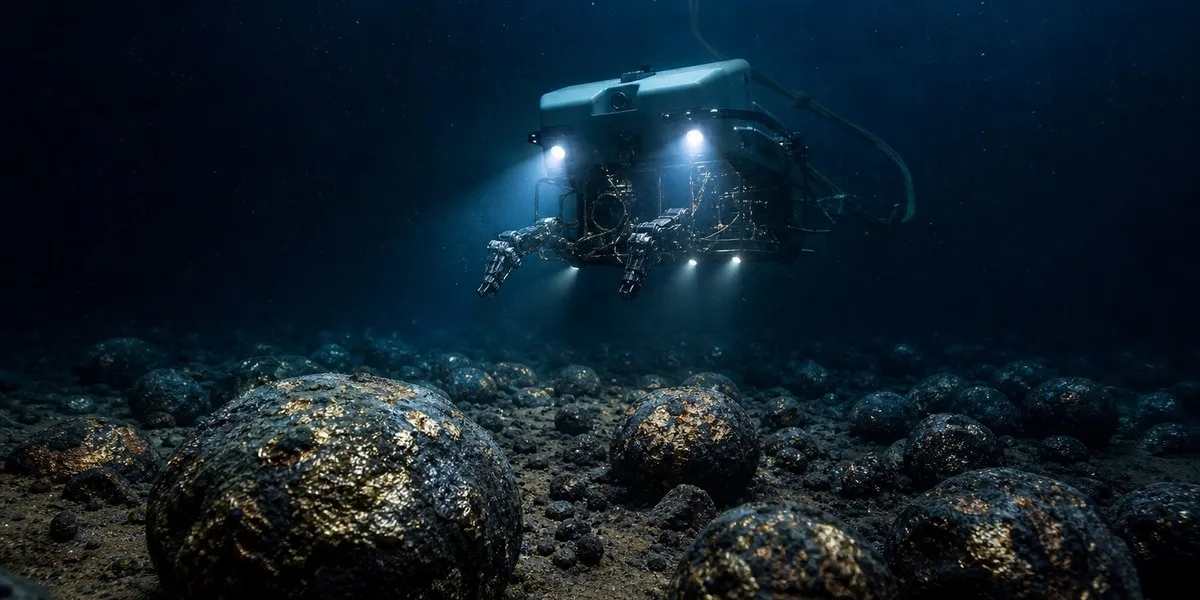
China Completes First Large-Scale Pacific Seabed Mining Trial at 5,330 Meters Amid Global Governance Deadlock
China has completed its first large-scale deep-sea ore mining trial in international waters of the eastern Pacific Ocean, deploying a robotic collector and an ultra-deep fiber-reinforced winch system down to **5,330 meters** to harvest polymetallic nodules rich in nickel, cobalt, manganese, and copper. Reported on November 17, 2026 by Chinese state outlets and the *South China Morning Post* (SCMP), the milestone signals that Beijing's state-backed seabed engineering is moving decisively from laboratory prototypes to sustained industrial testing inside the mineral-rich Clarion-Clipperton Zone between Hawaii and Mexico. No country has yet begun commercial deep-sea mineral extraction, and the United Nations-backed International Seabed Authority (ISA) has still not finalized its global commercial "Mining Code." Yet by putting full-scale collection and haulage hardware through nearly 200 hours of abyssal operation, state-owned **China Minmetals Corporation** and its university partners have underscored how rapidly engineering readiness is outpacing international governance. ### Inside the Kunpeng Collector and 5,330-Meter Winch Trial At the heart of the Pacific deployment were two domestic hardware pillars: the **Kunpeng** robotic mining vehicle built by China Minmetals and the **Haiwei GD11000** deep-sea winch system led by Dalian Maritime University professor Li Wenhua. As *UA.News* noted in its summary of the *SCMP* disclosure, the 13-kilometer Haiwei tether relies on synthetic fiber reinforcement rather than heavy steel cable, sharply cutting payload weight at extreme depths and enabling the winch—previously used solely for oceanographic science—to support continuous mining operations. During the expedition, the Haiwei winch executed six deep deployments to 5,330 meters, logging nearly 200 total underwater hours including a single continuous **48-hour descent**. Operating across freezing, high-pressure abyssal saltwater, the Kunpeng collector—named after the mythical giant creature in Chinese folklore—gathered potato-sized polymetallic nodules using an acoustic navigation suite developed by researchers at Harbin Engineering University, achieving **one-meter positioning accuracy** on the dark ocean floor. ### Navigating the ISA Contract Framework Amid US–China Mineral Rivalry China Minmetals conducted the trial inside its **72,745-square-kilometer** exploration contract block in the Clarion-Clipperton Zone, governed by a 15-year exploration agreement signed with the Jamaica-based ISA in 2017. While exploration contracts permit environmental baseline surveys and equipment testing under ISA environmental impact oversight, commercial extraction remains legally suspended while member states argue over exploitation regulations, liability rules, and revenue-sharing formulas. That regulatory vacuum is increasingly entangled with great-power competition over battery and defense supply chains. Nickel, cobalt, manganese, and copper found in Pacific nodules are critical inputs for electric-vehicle cathodes, grid storage, electronics, and military hardware—sectors where Washington and Beijing are racing to reduce strategic vulnerabilities. As Australia's **Lowy Institute** documented in an August 2026 policy assessment, the governance stalemate has been deepened by the United States—which is not a member of the ISA—pursuing alternative domestic licensing pathways outside the UN framework. By demonstrating working deep-ocean collection tech *inside* the ISA system, Beijing strengthens both its technological lead and its diplomatic claim to play by multilateral rules while Washington maneuvers outside them. ### Split Pacific Nations and Unanswered Ecological Warnings While engineers celebrated the trial's mechanical reliability, marine biologists and Pacific governments remain sharply divided over the cost of industrializing the abyss. Polymetallic nodules accumulate over millions of years and anchor delicate deep-sea habitats that scientists have barely cataloged. Researchers warn that collector tracks, sediment plumes, and mid-water waste discharge could inflict irreversible damage across abyssal ecosystems and disrupt oceanic food webs. Across the Blue Pacific, economic pressures further complicate any unified moratorium. As the Lowy Institute noted, some Pacific Island states view seabed licensing as a rare avenue for sovereign revenue, while a growing coalition of coastal nations and environmental groups warns against gambling ocean fisheries and cultural heritage on unproven promises before binding liability standards exist. With commercial extraction bids potentially accelerating as early as 2027, China's Kunpeng trial confirms that the hardware to strip-mine the Pacific floor is nearly ready—even though the rules to police it are not. ### Sources & Further Reading - [China taps Pacific metals trove in first large-scale seabed ore mining trial (South China Morning Post)](https://www.scmp.com/news/china/science/article/3374701/china-taps-pacific-metals-trove-first-large-scale-seabed-ore-mining-trial) - [China conducts first large-scale seabed mining trial — SCMP (UA.News)](https://ua.news/en/dovkolo-svitu/kitai-proviv-pershe-masshtabne-viprobuvannia-vidobutku-z-morskogo-dna-south-china-morning-post) - [China Minmetals Corporation Exploration Contract Profile (International Seabed Authority)](https://isa.org.jm/contractor/china-minmetals-corporation/) - [Fault lines beneath the Blue Pacific: Deep-sea mining and the future of Pacific unity (Lowy Institute)](https://www.lowyinstitute.org/publications/fault-lines-beneath-the-blue-pacific-deep-sea-mining-and-the-future-of-pacific-unity) ~WorldNews ~China ~DeepSeaMining ~Pacific ~CriticalMinerals