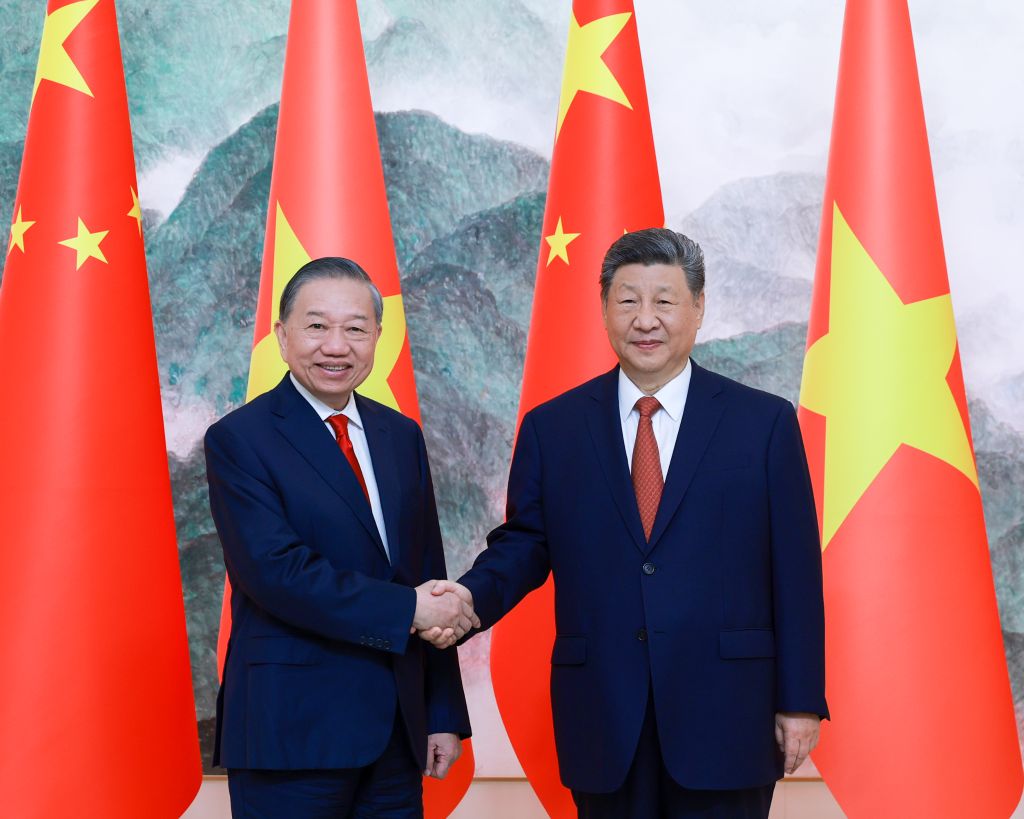
Xi Jinping Urges Vietnam’s To Lam to “Weather the Storm Together” in Pre-APEC Shenzhen Talks
On the eve of the 33rd Asia-Pacific Economic Cooperation (APEC) Economic Leaders’ Meeting in Shenzhen, Chinese President **Xi Jinping** met on Tuesday, November 17, 2026, with **To Lam**, who serves concurrently as General Secretary of the Communist Party of Vietnam and President of Vietnam. Against a backdrop of intensifying U.S. tariff pressure, regional security realignments, and back-to-back summit diplomacy—including [Donald Trump’s arrival in Manila for Quad talks](https://www.mushimu.com/post/9459) before heading toward China—Xi framed Beijing–Hanoi ties in pointedly protective terms, telling Lam that *"as comrades and brothers, China and Vietnam must stand together and weather the storms."* While both capitals projected continuity around building a higher-level China–Vietnam community with a shared future, a side-by-side reading of Chinese and Vietnamese official dispatches reveals subtle differences in emphasis. Beijing’s readout prioritized ideological alignment, party governance, and geopolitical solidarity, whereas Hanoi’s priorities centered on tangible economic rebalancing and cross-border physical infrastructure. ### Beijing’s Party-to-Party Solidarity Versus Hanoi’s Rail-and-Trade Push According to [Xinhua](https://english.news.cn/20261117/24ebafbb1d464b21872f4b0e54a21f68/c.html) and the [South China Morning Post](https://www.scmp.com/news/china/diplomacy/article/3374763/china-and-vietnam-should-weather-storm-together-xi-tells-lam-shenzhen), Xi used the Shenzhen bilateral to emphasize mutual support between the two ruling Communist parties—calling for deeper exchanges on *"self-supervision and self-governance of the parties"* alongside coordinated diplomatic positions within the United Nations, China–ASEAN, and Lancang–Mekong frameworks. Vietnamese reporting via [VnExpress and the Vietnam News Agency (VNA)](https://e.vnexpress.net/news/news/politics/vietnam-s-top-leader-to-lam-holds-talks-with-xi-jinping-in-shenzhen-5145738.html), however, foregrounded Lam’s concrete economic demands. While describing China as Vietnam’s most important strategic support, Lam pressed Beijing to steer bilateral trade toward *"greater balance, sustainability, and integration"*—an unmistakable nod to Vietnam’s widening bilateral trade deficit in components and raw materials as its export-oriented factories surpass the $1 trillion trade milestone. To anchor that integration, Lam urged *"decisive implementation"* of cross-border standard-gauge railway links connecting northern Vietnam into southern China’s industrial corridor, alongside cross-border power-grid connectivity, smart ports, digital transformation, and AI cooperation. ### Managing Maritime Friction Ahead of the 2026–2027 APEC Handoff Beneath the cordial rhetoric of *"comrades and brothers"* lies an unresolved strategic friction: competing claims and maritime enforcement across the South China Sea. Both readouts acknowledged the issue carefully. Xi called for both governments to *"properly manage maritime differences and steadily advance maritime cooperation,"* while Lam pledged to work with China to *"safeguard maritime stability."* Keeping South China Sea incidents compartmentalized allows Hanoi to sustain its "bamboo diplomacy"—preserving supply-chain ties with China without foreclosing defense and trade partnerships with Washington, Tokyo, and Manila. The Shenzhen meeting also carried practical institutional weight for Asia-Pacific multilateralism. China is hosting the 2026 APEC summit on November 18–19—alongside high-stakes [China–Canada tariff-relief diplomacy](https://www.mushimu.com/post/9457) and anticipated [trilateral talks involving Trump, Xi, and Putin](https://www.mushimu.com/post/9358)—before handing the APEC chairmanship directly to Vietnam for **2027**. Coordinating now gives Beijing and Hanoi an incentive to keep regional trade rules and supply-chain connectivity on the APEC agenda despite rising tariff barriers elsewhere. ### Why Shenzhen Matters Symbolically for Both Capitals Holding the bilateral in Shenzhen—China’s showcase of reform, hardware manufacturing, and cross-border logistics—reinforced the economic core of Lam’s November 17–20 visit. Whether Xi’s appeal to *"weather the storms"* translates into faster financing and customs integration for cross-border rail links, or narrower trade imbalances for Vietnamese exporters, will shape how deftly Hanoi navigates the growing U.S.–China economic divide ahead of taking over the APEC gavel next year. ### Sources & Further Reading - [Xinhua (China)](https://english.news.cn/20261117/24ebafbb1d464b21872f4b0e54a21f68/c.html) - [VnExpress / VNA (Vietnam)](https://e.vnexpress.net/news/news/politics/vietnam-s-top-leader-to-lam-holds-talks-with-xi-jinping-in-shenzhen-5145738.html) - [South China Morning Post (Hong Kong)](https://www.scmp.com/news/china/diplomacy/article/3374763/china-and-vietnam-should-weather-storm-together-xi-tells-lam-shenzhen) ~WorldNews ~China ~Vietnam ~APEC ~Geopolitics