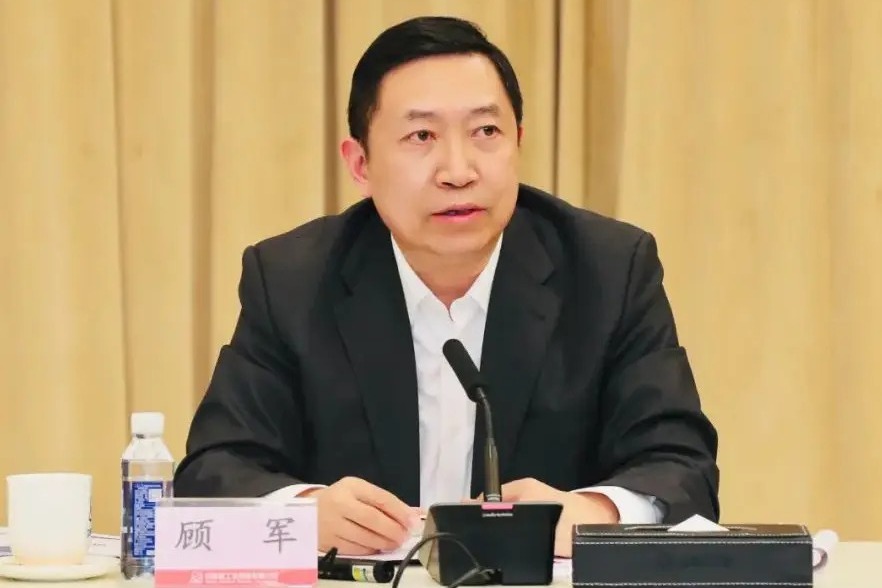
China Indicts Former Nuclear Chief Gu Jun on Massive Bribery Charges After Year-Long Anti-Graft Purge
Chinese prosecutors have formally indicted Gu Jun, the former general manager of state-owned China National Nuclear Corporation (CNNC), on bribery charges, advancing a high-profile anti-corruption prosecution inside one of the country's most strategic civilian and military-adjacent industrial conglomerates. In an announcement issued Tuesday, November 17, 2026, the Supreme People's Procuratorate confirmed it had ordered Gu's arrest and assigned his prosecution to the procuratorate in Hubei province's Enshi Tujia and Miao Autonomous Prefecture. Prosecutors in Enshi subsequently filed formal criminal charges against the 63-year-old veteran executive at the Enshi Intermediate People's Court following an investigation by China's National Commission of Supervision, according to [China Daily](https://global.chinadaily.com.cn/a/202611/17/WS6afbf500e4b03ebf8519ce01.html) and the [South China Morning Post](https://www.scmp.com/news/china/politics/article/3374749/china-charges-veteran-nuclear-expert-gu-jun-taking-huge-bribes). ### Four Decades Inside China's Nuclear Core Gu's downfall cuts near the institutional heart of China's atomic infrastructure. Born in Jiangsu province, Gu spent more than forty years rising through Beijing's state nuclear apparatus. Early in his career, he served as one of the first reactor operators involved in constructing the Qinshan Nuclear Power Plant—China's first domestically designed nuclear power facility. From there, Gu rotated through key command posts across the sector: serving as general manager and Communist Party chief of Sanmen Nuclear Power Co., leading the State Nuclear Power Technology Corporation from 2011 to 2015, and taking a senior management post at China Nuclear Engineering and Construction Group Corporation before assuming the general manager's seat at CNNC in 2018, a post he held until stepping down in 2024. Prosecutors allege he leveraged that uninterrupted chain of authority across plant construction, reactor engineering, and procurement to steer lucrative project contracts, equipment supply deals, and fund disbursements to third parties in return for "an exceptionally large amount" of money and valuables. ### From Party Expulsion to Criminal Trial: The 2026 Timeline Tuesday's indictment represents the judicial culmination of a ten-month disciplinary purge that first surfaced publicly in January 2026 when the Communist Party's Central Commission for Discipline Inspection (CCDI) and the National Commission of Supervision placed Gu under formal investigation. Six months later, in July 2026, anti-graft watchdogs stripped Gu of his Party membership and referred his file for criminal prosecution. According to the CCDI's July disciplinary findings documented by the [Global Times](https://www.globaltimes.cn/page/202607/1366761.shtml), investigators concluded that Gu not only rigged equipment procurement and personnel recruitment for financial kickbacks, accepted illicit cash gifts, banquets, and travel, and traded power for improper personal favors, but also obstructed organizational inquiries and engaged in "superstitious activities"—a recurring charge in CCDI dossiers targeting senior cadres accused of seeking fortune-telling or political protection. Under Chinese prosecutorial procedure, the Supreme People's Procuratorate routinely shifts cases involving senior state-enterprise executives across provincial jurisdictions—here routing a Beijing-based nuclear chief to Hubei's Enshi court—to sever local patronage networks ahead of trial. ### Anti-Graft Governance Meets Strategic Security Scrutiny Gu's indictment arrives against a sensitive backdrop for Beijing's energy and defense apparatus. Because CNNC oversees both commercial reactor expansion and sensitive defense-related nuclear engineering, Gu's initial January detention drew heightened international scrutiny. As [The Times of India](https://timesofindia.indiatimes.com/world/us/chinas-top-general-accused-of-leaking-nuclear-secrets-to-us-in-exchange-for-official-promotions-report/articleshow/127493568.cms) noted in covering parallel reporting on senior military purges earlier this year, foreign analysts pointed to overlapping scrutiny between nuclear procurement probes and wider leadership shake-ups inside China's defense establishment—though Tuesday's formal indictment in Enshi centers squarely on economic bribery rather than espionage. Chinese officials, meanwhile, have consistently framed the sweep as proof of "full-coverage, zero-tolerance" anti-corruption enforcement across capital-intensive state monopolies. With Beijing relying heavily on CNNC to anchor domestic baseload nuclear buildouts and overseas reactor diplomacy, prosecuting a four-decade insider sends an unmistakable warning to state-enterprise directors—while underscoring the persistent governance vulnerabilities embedded in closed, trillion-yuan infrastructure supply chains. ### Sources & Further Reading - [China Daily (China — Official Indictment & Career Timeline)](https://global.chinadaily.com.cn/a/202611/17/WS6afbf500e4b03ebf8519ce01.html) - [South China Morning Post (Hong Kong — Bribery Charges & CNNC Context)](https://www.scmp.com/news/china/politics/article/3374749/china-charges-veteran-nuclear-expert-gu-jun-taking-huge-bribes) - [Global Times (China — July 2026 CCDI Expulsion Findings)](https://www.globaltimes.cn/page/202607/1366761.shtml) - [The Times of India (India — Strategic & Defense Sector Context)](https://timesofindia.indiatimes.com/world/us/chinas-top-general-accused-of-leaking-nuclear-secrets-to-us-in-exchange-for-official-promotions-report/articleshow/127493568.cms) ~WorldNews ~China ~NuclearEnergy ~AntiCorruption