

Elon Musk says the math doesn’t add up in Brazil’s election. But does it actually?
https://x.com/elonmusk/status/2114717848518144177?s=46 Musk questioned Lula's win over Flávio Bolsonaro after seeing the jump in votes between Brazil's two presidential rounds. I was curious too, so I dug into the official election totals, municipality-level comparisons, turnout figures, and the final polls. There are some genuinely unusual patterns. But the viral calculation itself is missing a couple of rather important numbers. First, where did those extra votes come from? In round one, Bolsonaro got 56.10 million votes and Lula got 53.88 million. Three weeks later, Lula finished with 64.26 million and Bolsonaro with 59.83 million. That's about 10.38 million extra votes for Lula, versus 3.72 million for Bolsonaro. Combined, the two gained 14.10 million, even though eliminated candidates had received just 9.32 million in round one. That's the apparent discrepancy Musk was pointing to. But the accounting works out exactly: • 9,316,747 votes went to candidates who were eliminated. • 2,960,239 more voters showed up in the runoff, on a net basis. • 1,821,246 fewer ballots were blank or invalid. Total: 14,098,232. Exactly the increase in votes for the two finalists. No phantom votes required to reconcile those totals. 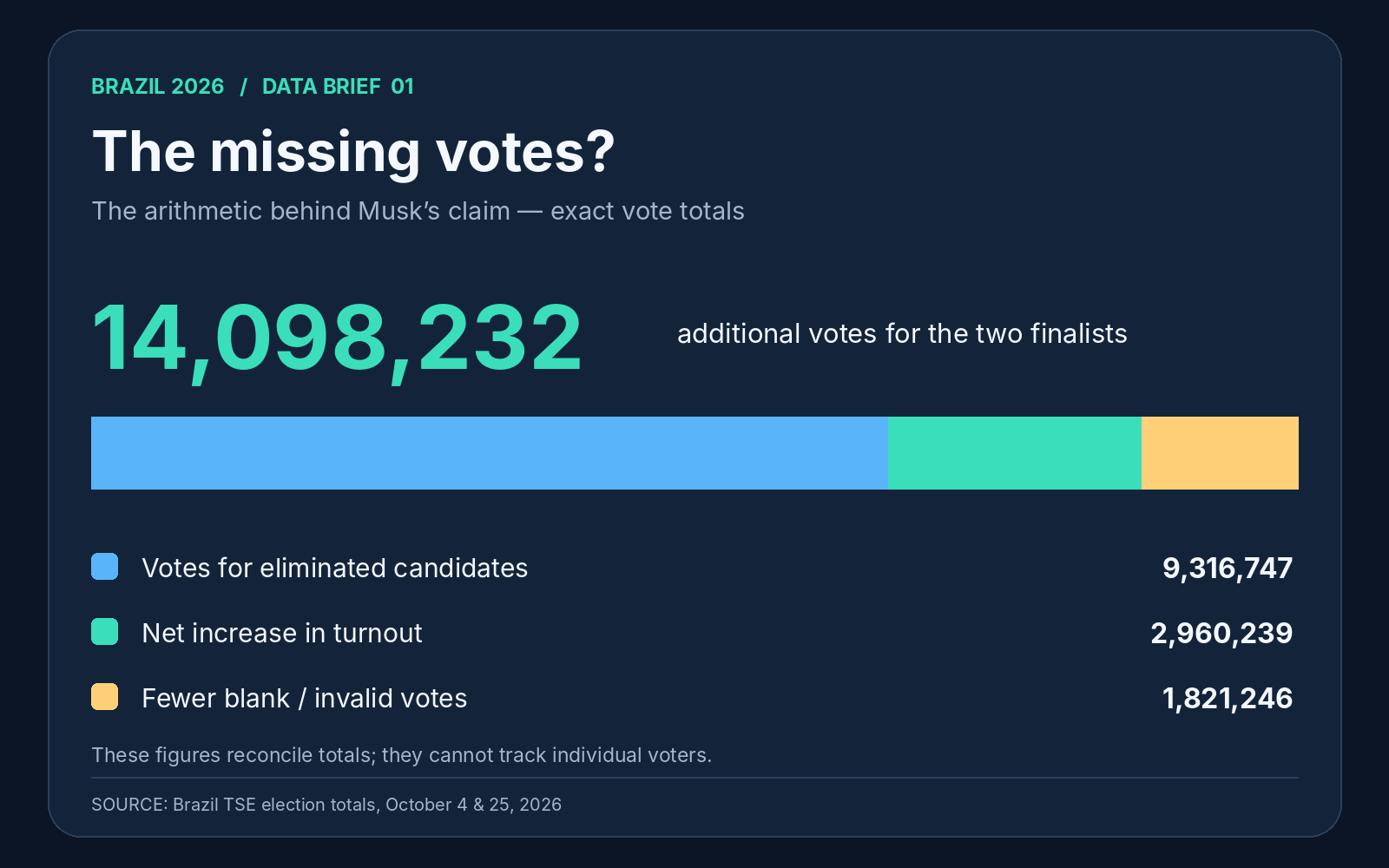 The vote arithmetic: where the 14.1 million additional votes came from That doesn't prove every single vote was legitimate. It just means the specific “math doesn't add up” claim doesn't hold up. The unusual part is the turnout Turnout rose from 78.92% to 80.78%. That's nearly 3 million additional voters on a net basis in three weeks, and an unusually large drop in abstention for a Brazilian presidential runoff. 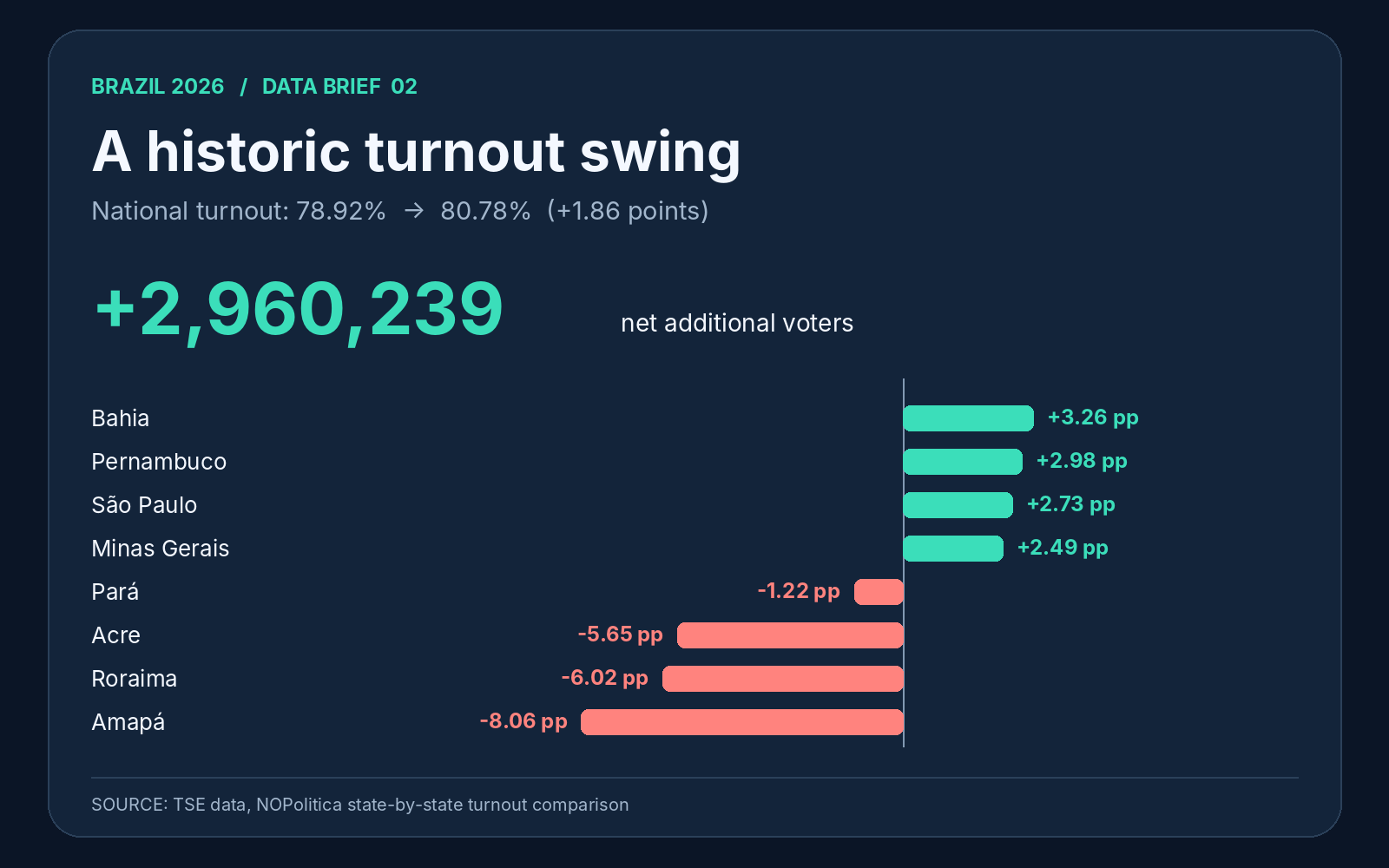 The geographic breakdown is even more interesting. Turnout rose by 3.26 percentage points in Bahia, 2.98 in Pernambuco, and 2.73 in São Paulo. Meanwhile, it fell by 8.06 points in Amapá, 6.02 in Roraima, and 5.65 in Acre. Turnout change by state Some smaller municipalities had genuinely dramatic changes. In Itaubal (Amapá), abstention went from 17.19% to 41.01%. In Cutias, from 17.60% to 40.36%. And in Porto Walter (Acre), from 18.82% to 40.26%. 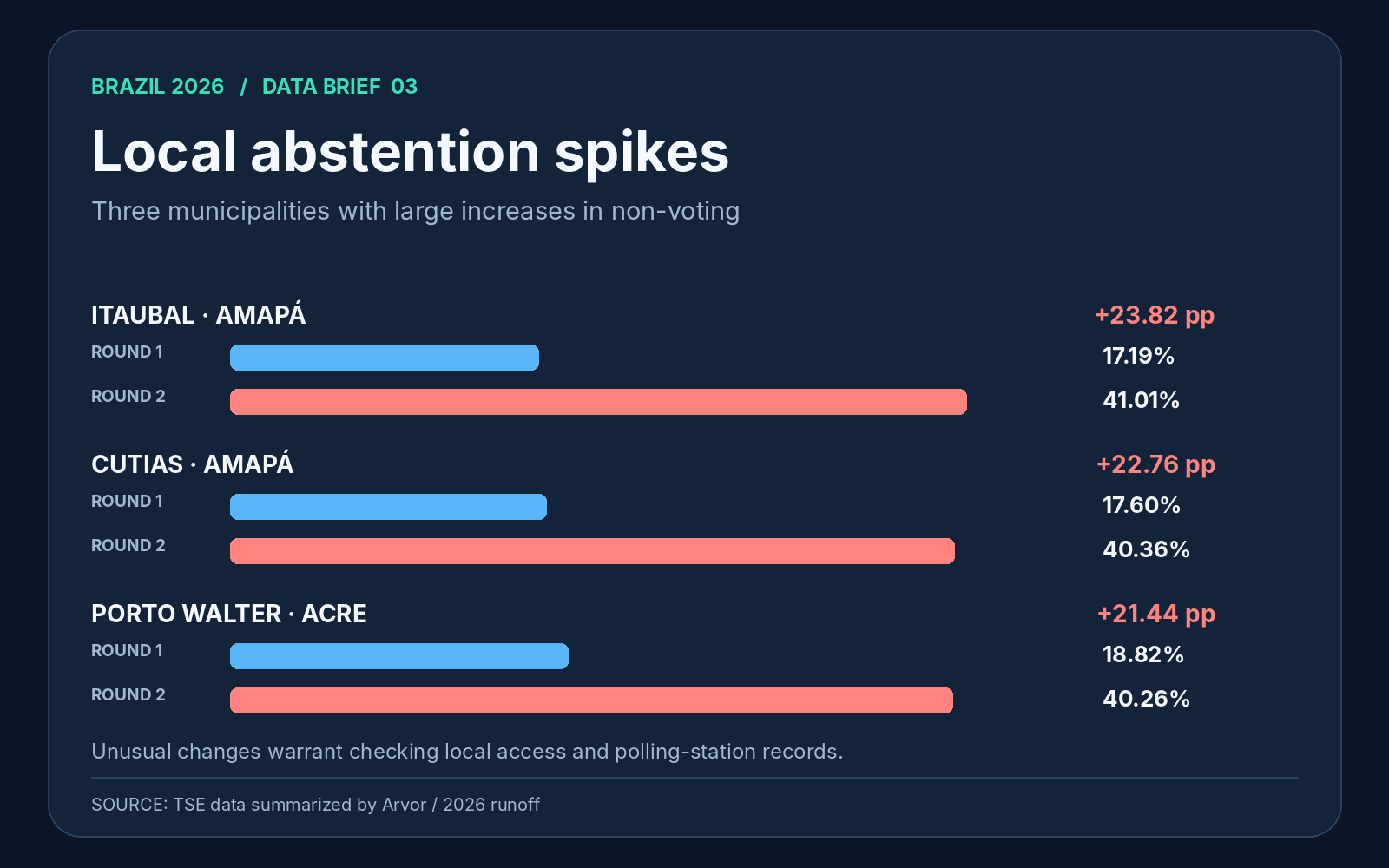 Large local increases in abstention I'd want to know what happened in those places. Road access, river transport, weather, polling station changes, and local incident reports should all be checked before anyone jumps to conclusions. Almost the whole country shifted in the same direction Here's another striking statistic: according to an analysis of electoral-court data by Nexo Jornal, 5,389 of Brazil's 5,571 municipalities (96.7%) saw the margin between the finalists move in Lula's direction compared with round one. That does not mean Lula won 96.7% of municipalities. It means his relative margin improved in those places, even in many areas Bolsonaro still won. 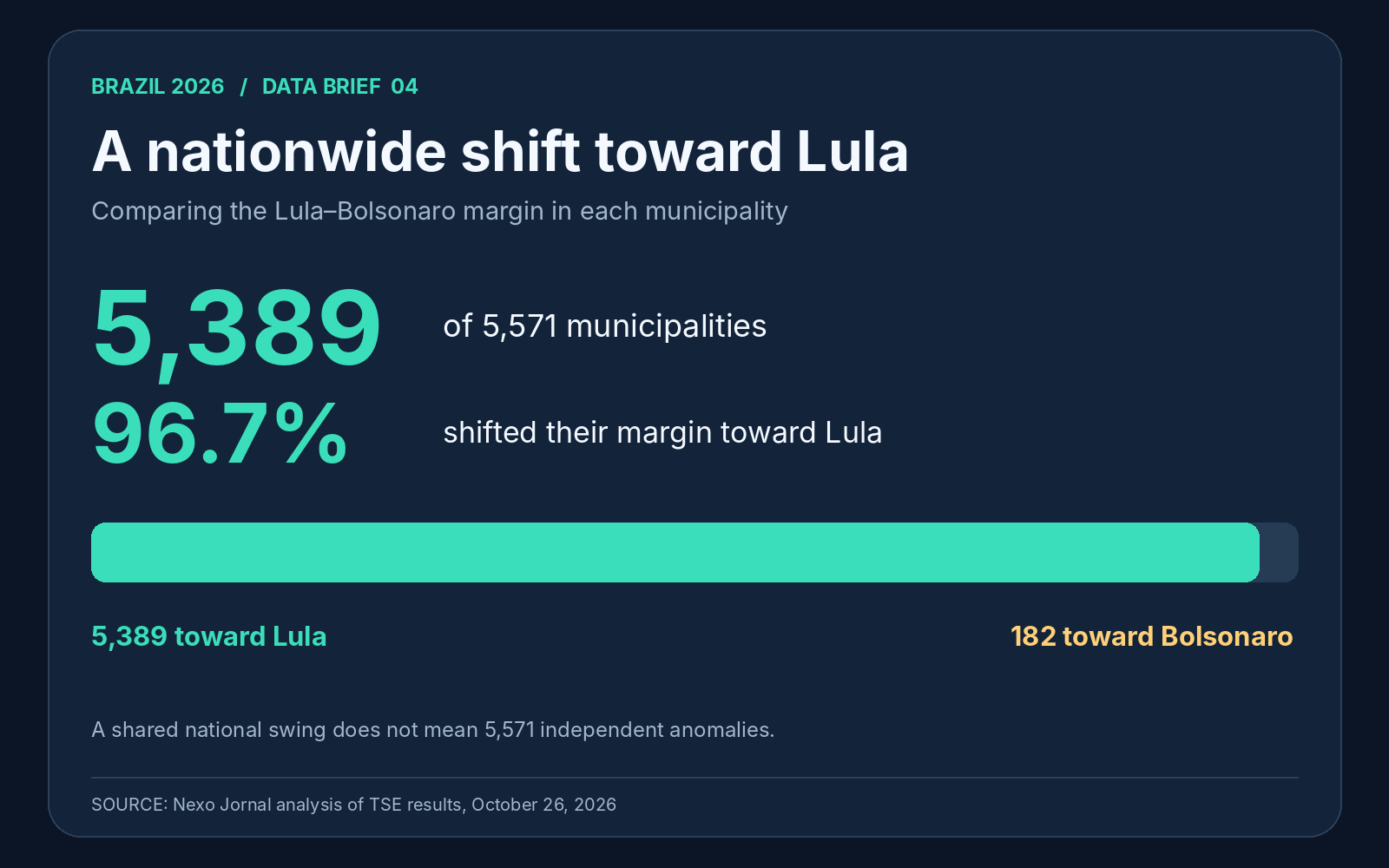 5,389 municipalities shifted their margin toward Lula That's a very broad national swing. But runoff elections aren't 5,571 independent coin flips. Once minor candidates disappear, a shared national political shift can show up almost everywhere. The question is whether the size and geographical pattern are consistent with plausible voter transfers and turnout changes. The final polls missed in the same direction The October 24 polls were extremely close but generally showed a narrow numerical Bolsonaro lead: 51–49 in Datafolha and Quaest, 50.5–49.5 in BTG/Nexus, and 50.8–49.2 in AtlasIntel. The actual result was 51.79% for Lula and 48.21% for Bolsonaro. 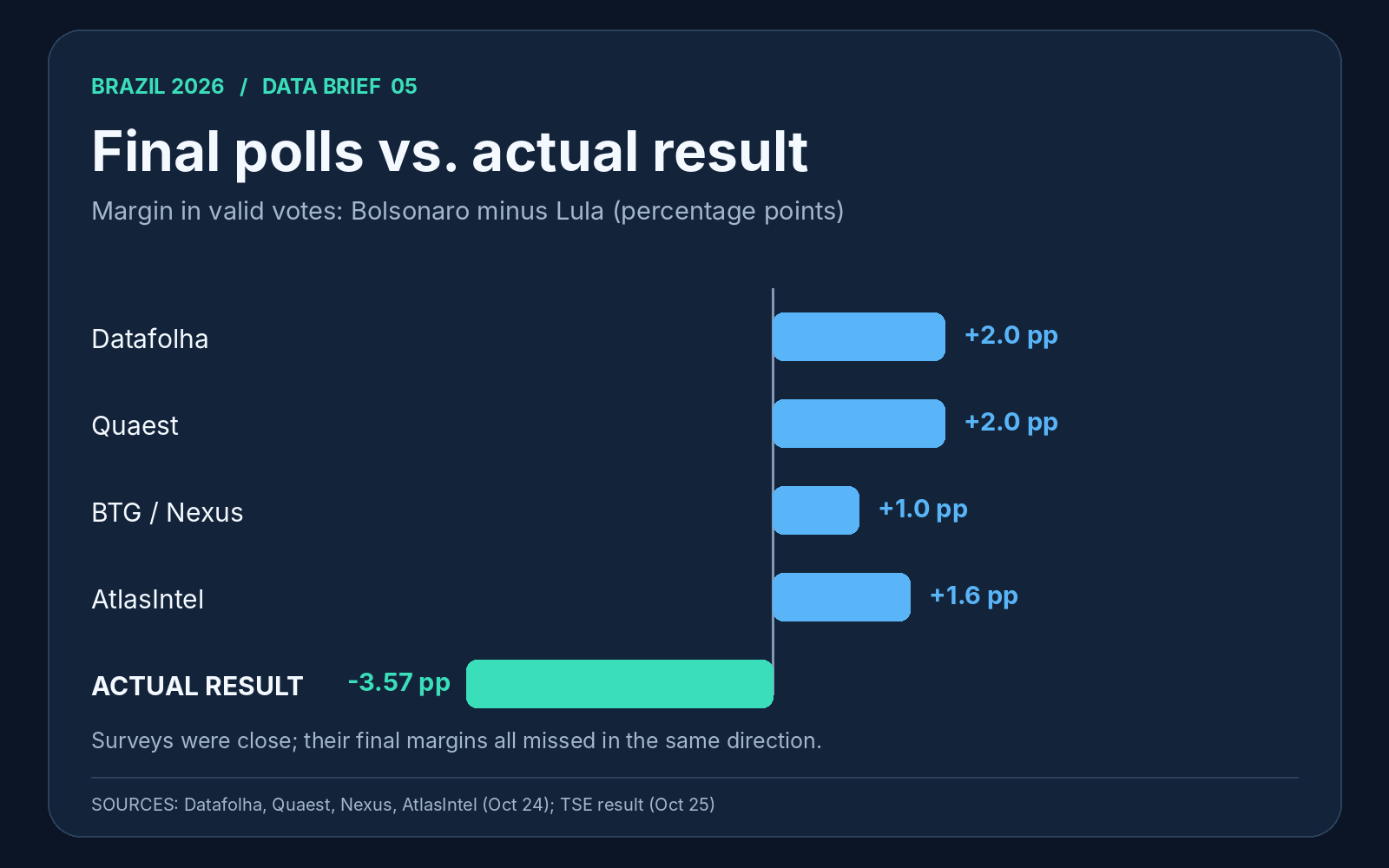 Final opinion polls compared with the result Multiple polling methods were off in the same direction. That could reflect a common turnout-model problem, nonresponse bias, late movement, or some combination. It isn't evidence of ballot manipulation on its own, but it's absolutely worth a serious polling postmortem. There's another complication. A Datafolha survey of voters who had backed eliminated candidates found 47% intended to vote Bolsonaro, 26% Lula, 21% blank/invalid, and 6% undecided. 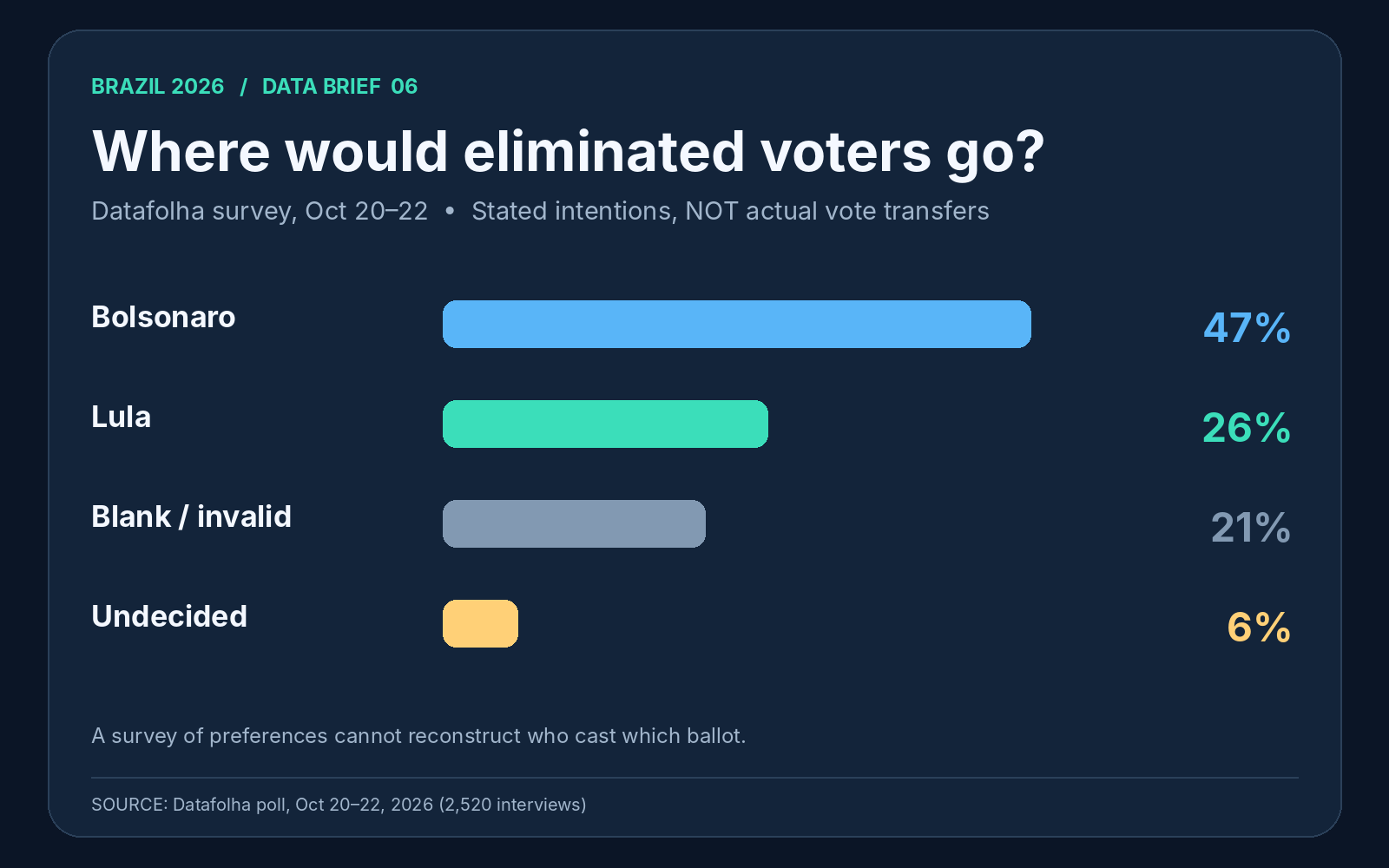 But those were reported intentions, not a record of where the actual votes went. Aggregate results can't identify individual voters switching sides. Surveyed preferences of voters whose first-round candidate was eliminated And what about the last-minute voting extension? This is a separate controversy worth discussing. A Supreme Court justice ordered voting extended to 7 p.m. after complaints about transport problems, but the decision arrived around the scheduled 5 p.m. closing time. Some polling stations were already shut, and the late instructions caused real confusion. However, an analysis of public electronic-voting logs found 34,330 votes registered after 5 p.m. (including voters who may already have been in line). Lula's winning margin was 4,430,191 votes. Even if every single one of those late votes had gone to Lula, the final result would still be nowhere near reversed. Late votes compared with the final victory margin So where does that leave us? I don't think the right question is “how did Lula magically invent 10 million votes?” The totals explain the increase. The more interesting questions are why turnout rose so much, why parts of the North moved in the opposite direction, why Lula's margin improved almost everywhere, and why several final polls missed the result in the same direction. Those are legitimate questions for a transparent, polling-station-level analysis. None of the figures above, by themselves, establishes electoral fraud. I'd be interested to see an independent, reproducible audit of the polling-station returns, machine logs, and local incident records rather than another viral screenshot comparing two incomplete totals. Extra: https://x.com/bfitzgab/status/2114519762831126903?s=46